Affective Capital and Interracial Marriage/Family Relations:
Ever since the Dobbs decision overturned Roe v. Wade in June of this year, Obergefell v. Hodges and Loving v. Virginia, which protect same-sex marriage and interracial marriage, respectively, seem to have grown more vulnerable to the same fate as Roe v. Wade, especially after comments from Justice Clarence Thomas. I want to focus on how the social construction of love infiltrates the private through affective capital in interracial relationships. Elizabeth Hordge-Freeman authors “The Color of Love: Racial Features, Stigma & Socialization in Black Brazilian Families,” which follows families of different racial identities through their navigation of affective capital, focusing on mixed race families. She explores how affective capital elucidates the various experiences of love and affection that can both perpetuate and reflect the social relations that comprise a racialized system. In Hordge-Freeman’s words, it is the “emotional and psychological resources that a person gains from being positively evaluated and supported, and from receiving frequent and meaningful displays of affection” (Hordge-Freeman 5). Within racist systems such as Brazil and The United States, affective capital is disproportionately distributed more to members of the dominant race, or those who present as White. This unequal distribution of emotional resources has significant impacts on individuals’ mental health and sometimes their legal standing, as in the case of Mildred and Richard Loving.
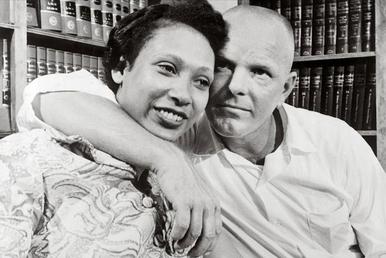
Mildred and Richard Loving grew up together in Caroline County, Virginia, and married in 1958. Because of Virginia’s Racial Integrity Act of 1924, an anti-miscegenation law, the couple traveled to Washington, DC, to legally wed (“How Dismantling Roe Puts Interracial Marriage at Risk”). However, when Mildred was pregnant and living back in Virginia, the Lovings’ house was raided, and the two were taken to jail. Interracial opposition referenced racist justifications of “racial integrity” and preventing the “corruption of blood,” with the trial judge asserting that “the fact that [God] separated the races shows that he did not intend for the races to mix” (54 Years After Loving: Is Interracial Marriage a SCOTUS Issue Again?). The case made its way to the U.S. Supreme Court in 1967, where Virginia continued to defend its law (How Dismantling Roe Puts Interracial Marriage at Risk) but ultimately lost in the famous Loving v. Virginia decision that legalized interracial marriage. This decision was not an absolute abolition of these views against interracial marriage, though, as we see in Justice Thomas’ statements and recent accounts of racist family treatment. Elizabeth Hordge-Freeman introduces the “family gaze,” to encapsulate the “way that families determine the well-being of family members by evaluating their appearance” (Hordge-Freeman 35). She argues that the family gaze can perpetuate a racist gaze when racist features are assessed and traded for emotional resources as well as social opportunities.
In 2021 Victoria Anderson, whose mother is White and father is Black, reported how her family gaze has reinforced a racist gaze. Relatives would deny her play time with her White cousins, and even nicknamed her “jungle bunny” (Karimi 2021). Anderson’s account of the justifications for this treatment almost perfectly reflect those of the trial judge in Loving v. Virginia: “I heard from a relative in my house that she (my mother) never should have had me because you’re supposed to stick with your own kind,”’ (Karimi 2021). In addition to the discrimination that Victoria must have faced from others, this lack of affective capital she received from her own family, those that are meant to love her unconditionally, must have had a lasting influence.
Sources:
Karimi, Faith. “When Your Own Family Is Racist toward You.” CNN, 13 Mar. 2021, https://www.cnn.com/2021/03/13/us/multiracial-discrimination-families-trnd/index.html.
“54 Years After Loving: Is Interracial Marriage a SCOTUS Issue Again?” https://news.bloomberglaw.com/us-law-week/54-years-after-loving-is-interracial-marriage-a-scotus-issue-again. Accessed 2 Dec. 2022.
“How Dismantling Roe Puts Interracial Marriage at Risk.” American Civil Liberties Union, https://www.aclu.org/podcast/how-dismantling-roe-puts-interracial-marriage-at-risk. Accessed 2 Dec. 2022.
Hordge-Freeman, Elizabeth. The Color of Love: Racial Features, Stigma, and Socialization in Black Brazilian Families. First edition, University of Texas Press, 2015.