
In August of 2020, Apple TV+ released the first episode of what became an award-winning and beloved show: Ted Lasso. In addition to garnering a strong fan base with its heart-warming story of struggle and personal growth, the first season of Ted Lasso was also awarded seven Emmys in 2021. The show follows Ted Lasso, played by Jason Sudeikis, who becomes the new soccer coach of AFC Richmond. As he begins his new job in England, he manages his own emotions around leaving his family in America, the emotions of his soccer team as they learn to work together, and the emotions of the fans watching their games. The show’s success is largely because it is not afraid to tackle themes of emotional hardship, grief, support, and therapy. Its characters get second chances and grow as they unpack their emotions, often with the help of Ted Lasso who is always willing to help. Ted Lasso coaches his team outside of the soccer pitch by performing emotional labor. The first episode of season two exemplifies Ted Lasso’s performance of emotional labor as AFC Richmond’s coach, as well as the players’ performance of body labor.
Season two opens to AFC Richmond stuck in a series of tied games. Dani Rojas, played by Cristo Fernández, is getting ready to take a penalty kick that has the potential to win them the game and break the streak of ties (Picture 1). As he does this, he exemplifies the body labor he performs in his role as a soccer player. Body labor adds another layer to emotional labor. Arlie Russell Hochschild writes about emotional labor in her book The Managed Heart: Commercialization of Human Feeling. Emotional labor occurs when one manages their own emotions, as well as the emotions of others, as a part of their job. Malian Kang builds off Hochschild’s work and introduces the idea of body labor in her article, “The Managed Hand: The Commercialization of Bodies and Emotions in Korean Immigrant-Owned Nail Salons.” Kang defines body labor as emotional labor with an embodied element. Body labor is tactile, physical, as well as emotional. As professional soccer players, they perform a glorified and prestigious form of body labor. As Dani Rojas prepares himself for his penalty kick, he performs deep acting by calming himself down, controlling his breathing, and saying a prayer (Picture 1). Simultaneously, he manages the fan’s emotions. His failure to correctly perform the embodied experience of a penalty kick would result in the continued streak of ties, thus disappointing the fans. Throughout the show, fans are shown in the stadiums as well as the bar, having intense reactions of anger and happiness depending on how well the players perform their body labor (Picture 1).

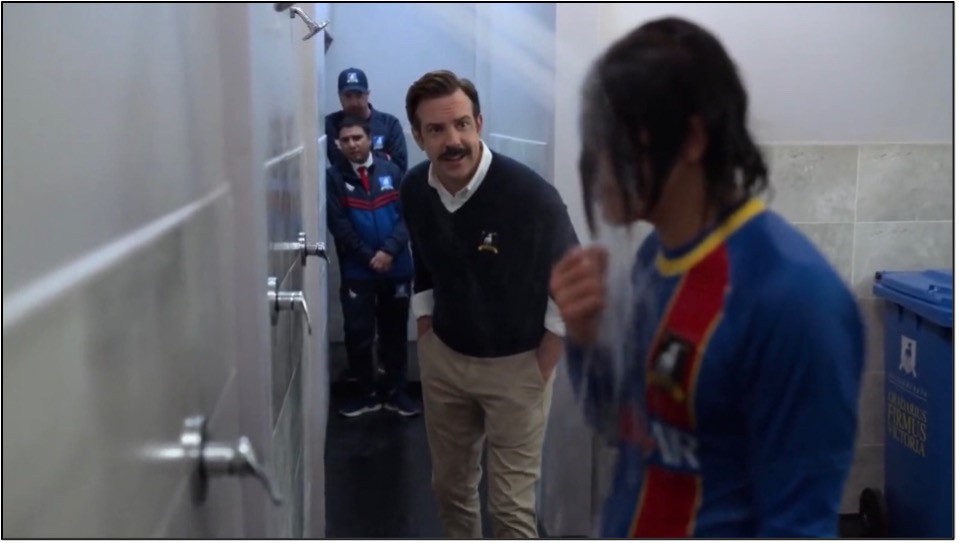
Rojas misses the penalty kick, causing another game to end in a tie and invertedly killing Earl the greyhound, RFC Richmond’s mascot. This leads to Ted Lasso stepping into his role as coach and performing emotional labor (Picture 2). Following the game, Dani Rojas goes to “wash the death” off himself. Ted Lasso attempts to cheer up Rojas by asking him to remember his catchphrase, saying, “don’t forget football is life.” This attempt doesn’t work as Rojas has been left with the trauma of killing Earl, leading to him having the yips and not being able to play football anymore. He is shell-shocked and begins grieving. Closure: The Rush to End Grief and What it Costs Us by Nancy Berns discusses grief and closure. She defines closure as “the satisfying feeling that something bad or shocking has finally ended” and “the ability to tell a story with evidence of coherent resolution.” As his coach, Ted Lasso attempts to help Dani Rojas find closure (Picture 2).
Ted Lasso often performs emotional labor and helps his players through emotional difficulty and undergo self-improvement; however, he is unable to tackle the intensity of grief. Thus, the team decides to hire a sports psychologist, played by Sarah Niles (Picture 3). In her introductory scene, her identity as a woman of color in a room of white men is emphasized. Emotional labor and body labor are both gendered and racialized. Women disproportionately perform emotional labor as teachers, caretakers, and therapists. They also disproportionately perform body labor as nail salon workers, masseuses, physical therapists, sex workers, and nurses. Additionally, minority groups and women of color tend to occupy emotional labor and body labor roles as well. In Ted Lasso, the RFC Richmond players and coaches break this mold. Dr. Fieldstone’s introduction to the team also brings themes of identity.

While he is on board, Ted Lasso says that he has a “general apprehension and a modest midwestern skepticism” towards therapy. He specifically doesn’t “trust therapists.” He expresses this distrust in a conversation with Dr. Fieldstone saying, “you aren’t listening because you care about me, you’re only listening because you’re paid to listen to me.” She responds by reminding him that he is also paid to care for his team. When Ted Lasso does his job, he sees it as emotional work. He needed a reminder that it is emotional labor as he receives a salary for managing his team’s emotions. Another criticism of therapy is discussed in an article titled “The Silent Mental Health Crisis Among South Asian Immigrants in US, UK is Crying to be Addressed” by Amanat Khullar. Dani Rojas is not American or English, he is from Mexico and speaks Spanish primarily. Khullar discusses that most traditional therapy models are tailored toward white middle-class western people and are often unadjusted. Ted Lasso leaves Dr. Fieldstone’s office disappointed that he could not help. As the door closes, Dr. Fieldstone begins speaking Spanish to Dani Rojas, who is surprised and instantly comfortable (Picture 4). Dr. Fieldstone was able to connect with Rojas through his language and can relate to him through her own othered and oppressed identities.

Ted Lasso leaves, disappointed he cannot help, and she closes the door. Most traditional therapy models are tailored toward white middle-class western people and are often unadjusted. Ted Lasso leaves Dr. Fieldstone’s office disappointed that he could not help. As the door closes, Dr. Fieldstone begins speaking Spanish to Dani Rojas, who is surprised and instantly comfortable.