
1. “Culture Affects How Hispanic Americans Experience Pain”

-
- The article, “Culture Affects How Hispanic Americans Experience Pain” describes the conclusions of a review article which compared how Hispanic-Americans and white Americans feel and recall pain. The study measured Hispanic-Americans and White Americans sensitivity to physical pain. It found that Hispanic-Americans were more sensitive to react to pain caused by touching a hot or cold object. However, when individuals responded to surveys that prompted them to recall their experiences with pain, Hispanic American respondents were less likely to report experiencing pain. It was concluded that Hispanic-Americans can be more sensitive to pain yet avoid reporting the pain. Researchers drew upon culture to explain these findings. It was stated that Hispanic-Americans, especially first generation immigrants, place large cultural emphasis on maintaining a strong front in the face of adversity (Hollingshead and Hirsh 2016, 518 ). A further claim was made that Hispanic American culture values stoicism. These cultural values may deter individuals from publicly expressing their pain despite their discomfort. One may extend such findings to emotional feelings of pain, sadness, or disappointment. The concept of feeling rules, in The Managed Hand by Arlie Hochschild draws upon Erving Goffman’s Dramaturgical approach. Through the idea of actors’ front stage and backstage, Hochchild explains how the public display of emotions is controlled through societal expectations. For such a reason, only certain emotions are deemed acceptable for a given situation. The outline for acceptable and unacceptable emotions are known as feeling rules. Feeling rules allow individuals to manage their emotions and decide if they are appropriate. Through self- monitoring, they can decide if they should display or conceal an emotion. However, feeling rules are not inclusive and can vary depending on an individual’s intersectional identities. Some emotions may be privileged towards a dominant group and exclude marginalized individuals. Therefore, racial minorities may need to overcompensate by increasing their emotion management. They may need to employ emotion management tactics to conceal emotions and remain in accordance with societal expectations. The findings of the study can be applied to these sociological concepts. Hispanic-Americans possess intersectional identities that govern their feeling rules. Therefore, despite feeling pain, they may feel conflicted with stating it. They must consider their cultural values, positions as immigrants, race, and economic status.
2. “Pain in Children is Often Ignored. For Children of Color, It’s Even Worse.”
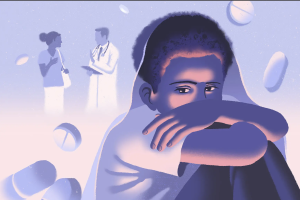
photo from Mikyung Lee
- https://www.nytimes.com/2022/08/16/well/pain-management-children-race.html
- The pain of black patients is often put into question due to the erroneous belief that black people feel less pain than white people . These beliefs can shape black patients’ feeling rules and the sympathy margin that they receive from others. In “Pain in Children is Often Ignored. For Children of Color, It’s Even Worse”, Rachel Peachman begins with the personal account of a social worker and her daughter. The social worker’s 15 year old daughter suffers from sickle cell disease. Due to evolutionary traits and genetics, sickle cell disease affects African-American communities at disproportionate rates. Sickle cell disease is often characterized by extreme pain, which is often overlooked when patients seek medical attention. Black patients are often undertreated for pain, as doctors tend to question the validity of the patients’ claims. A study from the University of Virginia found that medical students widely believed that there was a biological link between race and the experience of pain. These students reported that African Americans felt less pain due to thicker skin and different nerve endings. These beliefs are unfounded and a product of implicit bias (University of Virginia: Frank Batten School of Leadership and Public Policy 2020). In the New York Times article, the social worker found it very difficult for her daughter to receive opioids or other pain medications that would alleviate her discomfort. Doctors would respond with hostility, assuming that she was seeking drugs or exaggerating her pain. In other studies it has been found that white patients are more likely to be given the appropriate pain medications and dosage, despite reporting similar pain as black, Asian, or Hispanic patients.
- These findings and experiences have parallels with emotion management, feeling rules, and sympathy margin. In the article, “Are Some Emotions Marked White Only”, Adia Wingfield details how feeling rules are often racialized in the workplace. The emotions and attitudes that are considered appropriate for white employees, are deemed unprofessional and inappropriate for black employees. According to Wingfield the two types of racialized feeling rules are, “ those that are generally applied to all workers but are particularly difficult for them to follow, and those that differ from the rules available to white counterparts” (Wingfield 2010, 265). These feeling rules can be extrapolated from a workplace environment into a medical setting. Black patients may have racialized feeling rules, which can determine how they express feelings of distress. A white patient can feel comfortable outwardly stating their pain and being affirmative, because they know doctors will be receptive to their pain. However, a black patient cannot be vocal and describe their feelings, as they may be viewed as dramatic or aggressive. Therefore, black patients must find other methods to convey the severity of their pain without being labeled as disrespectful. In the chapter “The Socioemotional Economy, Social Value, and Sympathy Margin” of Cadance Clark’s Misery and Company, sympathy margin defines sympathy as an economy. The sympathy that an individual is entitled to is measured and limited. The amount of sympathy that an individual can receive is a result of how much sympathy is needed, how often they ask for sympathy, their social value, and their social status (Clark 1997, 150). A white patient may be considered as an individual with a large sympathy margin width. White patients demonstrate a high need for sympathy because of their high social value and social status. Doctors may acknowledge white patients’ sympathy margins and thus act responsive to their pain. However, a black patient’s low social value and social status could slim their sympathy margin. When a black patient is in need of sympathy, doctors may refuse to acknowledge them and fail to offer them proper care.
3. “Why Race Matters If You Have Major Depressive Disorder”

photo from istock; canva
- https://www.everydayhealth.com/depression/why-race-matters-if-you-have-depression/
- The article “Why Depression Matters if You Have Major Depressive Disorder” by Julie Lynn Marks, delves into the various barriers that marginalized groups face when experiencing mental health issues. It also explains possible societal factors that may exacerbate their distress. Due to a lack of reporting of depression in marginalized racial and ethnic groups, studies have encountered contradicting results on who has higher rates of depression. However, researchers have found that compared to white people, marginalized groups tend to exhibit serious long-term symptoms of depression. Additionally, people of color (POC) often do not find proper medical care for mental health issues. Therefore, POC’s inability to address their depression can create significant barriers to their well being, role in society, and adherence to cultural expectations. Marks identifies that an underlying factor of these issues is the a shortage of mental health professionals of color. The disproportion between the lack of mental health professionals of color and high cases of depression in individuals of color, prompts an inability for culturally sensitive medical care. It has been found that patients receive higher quality care when medical professionals share similar cultural or ethnic backgrounds. A patient may feel better understood when their therapist is knowledgeable of their struggles and values. By acknowledging cultural stigmas of mental health and the difficulty of addressing mental health in a particular culture, the professional can create a welcoming environment for the patient. Moreover, patients may feel most comfortable when they can speak in a language they can dominate. When facing a language barrier, it may be difficult to find translations for feelings that do not exist in the English language. The article “The silent mental health crisis among South Asian immigrants in the US, UK is crying to be addressed ” by Amanat Khullar, also emphasizes the importance of culturally sound therapy. Khullar includes how South Asian culture discourage individuals from expressing their mental health issues (Scroll.in 2020). As a result of these societal expectations, it can be difficult for one to seek help and find a professional that understands cultural dynamics. A culturally sound therapist could provide the patient with an understanding that would not be possible with a Westernized therapist. In order for marginalized groups to overcome culture-specific feeling rules, address mental health issues, and receive appropriate help, culturally sensitive therapy may be needed for change.