Many people contend that gay people have achieved acceptance in mainstream society. This begs the question, then, is there even a need for queer community anymore? Didn’t gay people mostly stick together to resist homophobia and create a ‘safe space’ for themselves? There must not be a need for that anymore, right?
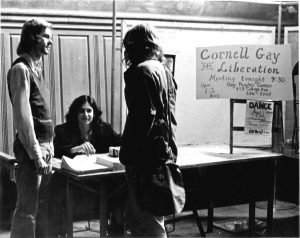
Recent scholarship refutes this claim. In his book A Queer New York, queer geologist Jen Jack Gieseking terms this line of thinking, ‘the myth of neighborhood liberation.’ Gay people, and more specifically, lesbian, bisexual, and queer (LBQ) women and trans- and gender non-conforming people (tgncp) have historically ascribed to the theory that claiming space within a city through the ownership of property (and creation of ‘gayborhoods’) is the ultimate step towards liberation from heterosexual society. Gieseking contends this narrative has failed LBQ women and tgncp time and time again, because they are not able to maintain these spaces over space and time as a result of economic and racial barriers (i.e. gentrification, displacement, socioeconomic status, etc). The ‘myth of neighborhood liberation,’ then, is a heteropatriarchal colonialist construction of the ownership of property as the ultimate step towards liberation and legitimization of the gay community. Scholars’ attention to this specific type of placemaking has marginalized the resilient communities of LBQ women and tgncp within sociological scholarship. My interview data shed light on the ways in which LBQ women and tgncp creatively, instinctively, actively, and resiliently take part in, create, and maintain their own sustaining nonresidential communities.
My interviewees, queer women and non-binary people, shed light on the vital role queer community plays in their lives; my interviewees show the gayborhood may be obsolete, but queer community sure isn’t. Even though queer women and non-binary people still conceptualize their queer community as necessary for their well-being, it is not always easy to come by. Despite my participants’ articulated desire and need for queer community, macrosocial forces of racism, cisnormativity, and classism are reproduced within my participants’ queer communities.
Depending on one’s social location, factors of one’s identity such as class, race, and gender, accessing queer community can be a struggle. My research data suggest that even though many queer groups embrace an ideology of inclusion, societal norms of whiteness and cis-ness still persist. Jess, a 21 year-old Chinese-American cisgender woman, articulated her struggles fitting in in queer spaces as a woman of color.
“I would say in general it’s been tricky finding one because I think being a person of color makes it hard, like, even when I go to a queer space, like I’m still sort of, an odd one out because I don’t look like other people there. And I don’t have the same like, experiences. Um and at my school, there are a lot of identity groups, so there is an identity group for like LGBTQ folx, and I’ve tried like going to meetings and like making it a sort of like, regular habit to be involved, but, it’s never really clicked for me and I don’t necessarily know why. I think partially because, I think it’s not as bad as maybe like in some other places, but like there are still a lot of white people involved and it makes it difficult.”
Jess is describing what sociologist Elijah Anderson calls “white spaces,” places where whiteness is the norm that governs the space. Some classic examples of “white spaces” are places where people of color have historically been excluded, such as colleges and universities and country clubs. White spaces can be found anywhere, however, and the concept allows us the opportunity to understand more deeply what Jess’ critique really means: queer communities, even though they are conceptualized by their members as being an ‘inclusive’ and ‘safe space,’ are still governed by norms of whiteness that alienate queers of color.
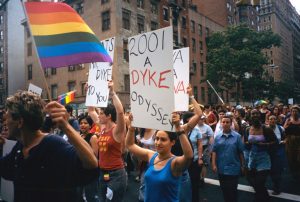
Furthermore, LBQ spaces and communities, even though they have embraced an ideology of inclusion, are also governed by gender norms that challenge tgncp membership. Alix, a non-binary white (add age) self-identified Dyke, spoke in their interview about the difficulty some tgncp have obtaining acceptance in communities of LBQ women. Alix is the head of the Dyke March Maine Committee in 2021, and they were instrumental in constructing the Dyke March as a space open to all dykes:
“going into it I was really adamant that Dyke March would be um, would be affirming of trans women as women and that we would not get into any TERF-y (Trans-Exclusionary Radical Feminist) territory and it would not be accepted and anybody who tried to go that way would be shut down, and we did have some of those conversations when we put out calls for the virtual Dyke March because we had people who maybe, some people would look at and think don’t identify as Dykes, um submit videos, and I said like we’re not in the business of policing who is or is not a dyke, um if people submit a video and they wanna be a part of the Dyke March, so be it, we’re gonna welcome them and include them, but we did early on have a lot of discussions about who is welcome in the Dyke march, who is a dyke…”
Despite their effort to enforce an inclusive space, Alix’s own acceptance in the Dyke March was sometimes questioned:
“I think I caught one of my committee members off-guard because she was saying like well, dykes are lesbians. And I was like well I don’t identify as a lesbian because I don’t identify as a woman! And then we got into a whole, you know, thing, so I think that definitely, um, I mean that came up very quickly.”
Alix’s interview shows that queer spaces, no matter how ideologically committed to inclusion, still struggle to resist structural heteronormative structures of the gender binary. They even said about communities of queer women in general,
I have thought to myself before, when kind of like grappling with my own like gender identity and stuff, I’ve thought like I don’t really want to transition to be a man because I don’t want to lose my place within the community of queer women. And I, that just I guess goes to show that I thought that was certainly a possibility, you know, that once I, if I truly identified as a man, presented very masculine, that I would somehow become an outsider in that community and I didn’t want to lose that.
This data begs the question: why? If queer women embrace an ideology of inclusion, why is it then that trans- and gender non-conforming people are systemically excluded? Sociologists Japonica Brown-Saracino and Amin Ghaziani provide a possible explanation in their article about the 2003 Chicago Dyke March. Brown-Saracino and Ghaziani contend that “organizers embraced an explicit ideology of broad inclusion while implicitly using the March as a vehicle to celebrate their own, narrower dyke identity which they believe Pride organizers marginalized.” They theorize that these queer women’s ideology and identity conflicted with one another and prevented them from achieving a truly inclusive Dyke March.
I imagine this explanation could also apply to my interviewees’ critiques of their own queer communities. The desire of white queers to include queers of color and tgncp conflicted with their desire to celebrate their own, narrower identity as cisgender white queers. I think white queers have to face the music: their tactics in facilitating inclusive community may not be effective. If white queers do not actively resist creating white, cisgender spaces, the status quo will reproduce itself. It is up to us to define our own places, and if inclusion is truly a core value, I believe that should reflect in the power structure of queer communities and organizations. Center the voices and concerns of queers of color and tgncp, even (and especially) if white queers numerically dominate a space.
The identity of Dyke has transformed from something to be ashamed of into a badge of honor: Gieseking describes that dyke politics “underly lesbian-queer productions of space and place” and are “antiracist and anticapitalist politics that fuel queer feminist ideas of community” (A Queer New York 25). Let’s take what it means to be a dyke (an outcast, a revolutionary, an antiracist, anticapitalist, fuck-the-system dyke), and put it to use; queers of color and trans- and gender non-conforming people should no longer be excluded from dyke politics, or from lesbian-queer spaces.