La Spedizione Siciliana

Italian 3008 – Spring 2016 – Professors Barbara Weiden Boyd and Davida Gavioli

  • About
  • Authors
  • LoginPress
  • About
  • Authors
  • LoginPress

Post #7: Morgantina

March 27, 2016 By kvise

Hey everyone! Ok, so for this next post, I really wanted to talk about Morgantina. I know y’all didn’t go there, but this archaeological site was so neat and filled with cool finds, plus there was a really friendly dog there. One of the coolest things about Morgantina was the fact that one of my professors, Professor Leigh Liebermann, had worked on the site, so how could we not like this place? One of the things that she pointed out to us herself were the mounds of votive offerings here (not pictured), which was a little overwhelming to think about from an archaeologist’s perspective (so much sorting to do!) but also still super interesting.
12143111_905310812837531_6696530079848682967_n

12115749_905309942837618_631133510680695338_n

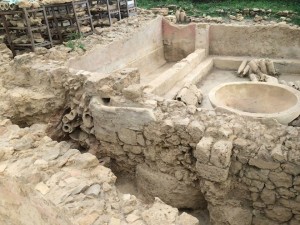
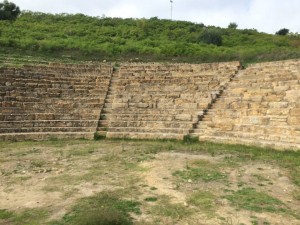
Although there has been a settlement in Morgantina ever since the Bronze Age, the Greek Morgantinian colony was thought to have been founded in the fifth to sixth century BC. Sometime around the third century BC,  The part most archaeologists are concerned with right now, however, is the third century BC material. The most notable parts of the archaeological site include the baths (top picture) and the agora (bottom picture). While the agora marks this community as one with clearly Greek roots, the bath-house is a little trickier to define. Being a recent excavation, it also is a little more ambiguous as the discovery of artifacts is ongoing. Greek bath houses traditionally have individual tubs, and the Morgantina bath complex does contain these. However, it also contains connected rooms, which is a trait generally only observed in Roman bath houses. In addition, “the communal immersion pool with hypocaust channels” is also absent from this newly discovered bath house (Lucore 6). Whether or not the baths can be characterized as fully Greek in style is still up for debate, and likely will become more clear as the excavations on the baths continue. Perhaps one day, I’ll even be back to see the Morgantina site and the baths excavated in their entirety for myself! :)


Works Cited:

Liebermann, Leigh.”Morgantina Site.” Sicily Centro Trip. Morgantina, Piazza Armerina. Oct. 2016.           Lecture.

Lucore, Sandra K., and Monidka Trumper. “American Excavations at Morgantina – South Baths Project 2013 Preliminary Report.” Morgantina. Web. <http://morgantina.org/>.


Filed Under: Sicily

Cyclops on Mount Etna

March 27, 2016 By kgilmore

On our last full day in Sicily, we visited the awe-inspiring Mount Etna, the largest active volcano in Europe. The contrast of black volcanic rock against pure white snow made it feel like we had stepped foot on an entirely new planet.

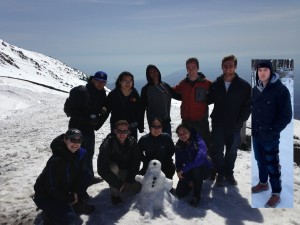
According to Greek mythology, the Cyclops made their home on Etna, where they were tasked by the gods to craft weapons under the forgeries of the volcano.  Seeing Mount Etna with my own eyes was particularly meaningful for me, as many ancient authors have discussed this site in their various works. In Book IV of the Georgics, for example, Vergil uses a metaphor to compare bees diligently making honey with the Cyclops obediently forging thunderbolts on Mount Etna. In Book VI of the Odyssey, Homer places the cave of Polyphemus, the Cyclops who imprisons Ulysses and his men, on the slopes of Etna as well. Seeing as the volcano has now been transformed into a bougie ski resort littered with folks donning bright, neon one-piece snowsuits and is completely different from the imaginations of Homer and Vergil, I was particularly delighted to find several snow-Cyclops dotting the top of the mountain. We approached one cautiously for a quick photo op…


IMG_8122
Classicists nervously pose with the terrifying, giant one-eyed Cyclops

Filed Under: Sicily

Greek Vase at Pirandello’s House

March 27, 2016 By kgilmore

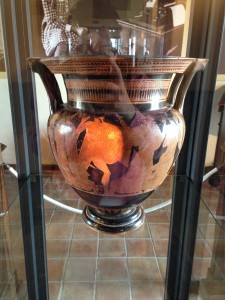
On the way to Porto Empedocle, we stopped at the House-Museum of Luigi Pirandello. Born in 1867, Pirandello was a famous Sicilian playwright, novelist, and (as we learned in the museum) a talented painter. On the second floor of the museum, I was shocked to see a Greek vase sitting in a glass case in the center of the room. Finally, a crossroads for the Italian and Latin class!

IMG_7921_2


The vase, as we learned from Professor Boyd, depicts the story of Tereus, Procne, and Philomela, a rendering of which is found in Ovid’s Metamorphoses Book VI. According to Ovid, Procne requested that her husband Tereus, the king of Thrace, fetch her sister, Philomela, from Athens. Tereus obeyed, but as he escorted the sister back to Thrace, he locked her in a cabin and raped her. When Philomela threatened to reveal Tereus’ crime, he cut out her tongue. The now mute Philomela wove a tapestry depicting the wicked act and tricked a servant into delivering it to Procne. As revenge, Procne murdered her own son, Itys, and served the child as a meal to Tereus. The story concludes with all three characters going mad from the traumatic events they had experienced, and the gods transform all three into various birds.


Interestingly, this vase once held the ashes of Luigi Pirandello. The ashes were later transferred to a different container, since the Italian bishops refused to bless the Greek vase as it wasn’t “Christian.” Probably a good thing, however, considering how incredibly gruesome the myth is…

Filed Under: Sicily

Day 1: Hit the Ground Running

March 27, 2016 By alamont

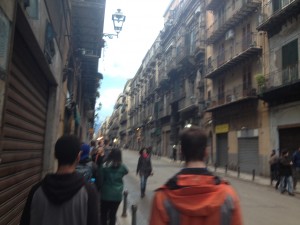
IMG_0483
Apologies for the blurry picture. Photography is not my strength.

The wonder of air travel is never lost on me, and in my dazed and jetlagged state on the first day, I began to experience Sicily. On our connecting flight from Rome to Palermo I slept the entire time, only arousing as our plane hit the tarmac. As I got off the plane I glimpsed the Mediterranean Sea on one side and rock faces climbing right out of the water on the other. I thought, “Oh, it’s starting to make sense why we would come all the way here. This place is pretty beautiful.”

One of the first things I had to do when we landed was get money from an ATM, a task that was surprisingly hard. Greg, Cam, and I went looking for one, but the streets of Palermo were not cooperating. We had to travel a good half mile to the center of Palermo and the main train station. Even then, an ATM was not readily apparent. We asked someone working at the station where we could find an ATM by using the universal signal for money. He started to walk away from us so we started to follow him but he put his arms out as if to say, ‘stay where you are.’ So we did, and then as he walked further he looked back and waved us over irritated that we weren’t following him. Do all Sicilians send such mixed signals? The Italian class has made much note about the contradictions of Sicily. This was my introduction to the land of contradictions.

Filed Under: Sicily Tagged With: Arrival, ATM, Cam, Contradiction, First Day, Greg, Palermo

Frutta Martorana con Maria Grammatico

March 27, 2016 By kgilmore

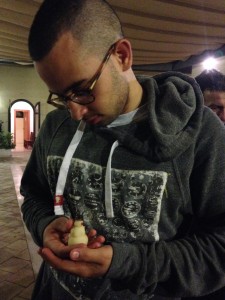
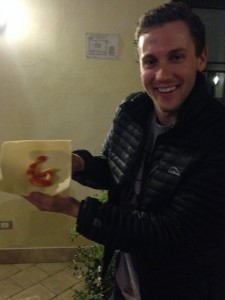
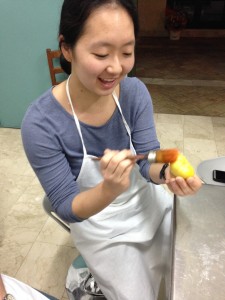
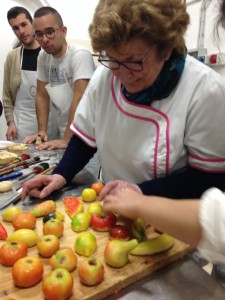
In Erice, Professors Boyd and Gavioli surprised us with a baking class taught by local hometown hero, Maria Grammatico. Maria and her assistants showed us how to make Frutta Martorana, or marzipan fruit. Throughout Sicily, one can find this pastry in various shapes and forms: as bananas, tomatoes, apples, pears, oranges, watermelon, etc. Maria’s recipe called for a kilo of blanched Sicilian almonds, a kilo of granulated sugar, some water, and a bit of vanilla and almond extract. Maria provided us with 50+ year old molds to shape the marzipan dough into fruits. David and Greg, however, took the road less traveled and got creative with their creations.

IMG_7839_2                 IMG_7838_2

Once the almond paste was molded, we painted the shapes with a yellow base, then added red, green, and orange as we saw fit.

IMG_7800_2

Maria admired our handiwork.

IMG_7804

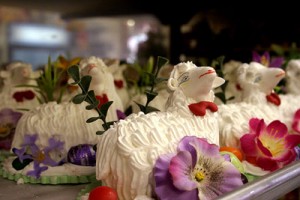
Since we were traveling days before Holy Week, we frequently saw little lamb-shaped pastries in bakery windows. I learned from Maria that these were also marzipan pastries, called pecorelle pasquali, a favorite in Sicily around Easter time.

lambs


Filed Under: Sicily

  • « Previous Page
  • 1
  • …
  • 8
  • 9
  • 10
  • 11
  • 12
  • …
  • 26
  • Next Page »

Authors

  • abradley
  • aglynn
  • agorman
  • alamont
  • bboyd
  • cdewet
  • dbanks
  • dgavioli
  • djohnso
  • dvargas
  • gmaslak
  • jglewis
  • jhartley
  • kgilmore
  • kvise
  • mcolbert
  • mkim
  • ssim
  • vwu
  • About
  • Authors
  • LoginPress

courses.bowdoin.edu