The Sociology of Emotions in Two Queer Relationships
Call Me By Your Name


“Messed you up:” Oliver worries that having started a relationship with Elio will have, in some way, “messed [him] up,” not wanting either of them to “pay for this.” Elio initially believes that he is referring to the potential for external scrutiny and promises not to tell anyone, but Oliver clarifies that this is not what he means. For Oliver, accepting an attraction to men comes with guilt, likely due to his family’s perspective on queerness (he later tells Elio, “my father would have carted me off to a correctional facility [had he known I liked men]”). This is the case for many from cultures or families that view queerness as unacceptable, and these feelings of guilt create narratives that same-sex attraction is something to deny for fear of inability to fulfill familial duties to marry and have children, as highlighted in Mishra’s “Queering Emotion in South Asia.” Elio, not feeling the same fear of guilt, is less afraid to pursue Oliver. In these images, the two demonstrate their emotional proximity, touching hands, but have to maintain distance from each other in public, walking away to have a conversation about their relationship and remaining physically apart.


“Don’t kill it:” After Oliver leaves, Elio’s father acknowledges his son’s human desire to avoid deep emotional hurt. He tells his son, “don’t kill it,” referring to the pain he feels. Hochschild notes how deep acting can be employed to dampen this, when there is “an inner desire to avoid pain” (40). In particular, she describes how one man who lost his wife could use these techniques to “actively conduct himself out of love through deep acting” (41). Elio is feeling immense sadness, but instead of trying to ignore it, his father counsels against deep acting, which could result in a loss of joy, as well. Elio’s father, unlike many parents, is supportive of his son’s emotions and accepting of his queerness, which is highlighted by their physical proximity by the end of the conversation. At the start, Elio sits stoically and tries to hide his hurt, but allows himself to feel upon hearing his father’s words, lying down on the couch; the images are also dark and somber in color, contrasting with many of the bright colors visible during Oliver and Elio’s relationship throughout the movie and highlighting Elio’s mood.
Brokeback Mountain
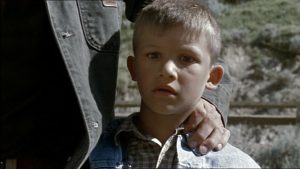

“A little ranch together:” Jack suggests that he and Ennis leave their respective wives and live together, despite society’s refusal to accept gay relationships. Ennis recounts how, as a child, his father showed him and his brother the body of a man who had similarly tried to live on a ranch with another man. The man had been brutally murdered for not following society’s expectations of a heterosexual union, and the unacceptability of this was drilled into Ennis’ head from a young age. Mishra writes that, “Gay men in India internalise the inevitability of mixed-orientation marriage. Choosing to abandon this institution is termed as “calling for trouble” because heteronormativity and patriarchy conjointly discriminate people failing to conform to heterosexual marital unions” (362). Similarly, this scarring image nine-year-old Ennis is being subjected to highlights the cruciality of heteronormativity to American society at the time, and the rules gay people are forced to follow to avoid horrible fates.

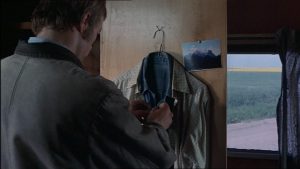
“Memorial of his own:” Brokeback Mountain ends with Jack Twist, who has had a relationship with Ennis Del Mar for the past twenty years, dying. Jack requests that his ashes be spread on the mountain where the two met, but this does not come to pass, as his wife has buried her portion of his ashes and his father insists that he will go into the family plot. Ennis, unable to give Jack the rites he would have liked, settles for hanging their shirts from the summer they spent together alongside a postcard of the mountain, in a memorial of his own making. This search for closure, and inability to fulfill the rituals of grief that reflected their relationship, highlight norms of grief and the difficulties faced by queer people in societies that do not recognize their relationships. Nancy Berns emphasizes how the death care industry markets products to families who have lost loved ones, convincing them of the necessity of rituals such as funerals and proper burial rites to find “closure” (60). Jack’s wife held a funeral for her husband, and Jack’s parents got half of his ashes, both being afforded the expected rituals to provide them with some sort of finality. Ennis, with no concrete connection to Jack and his life, is left without a way to mourn the man he loved, denied from even spreading his ashes where he had requested, but creates his own memorial, trying to find closure in a way that society would expect Jack’s loved ones to.