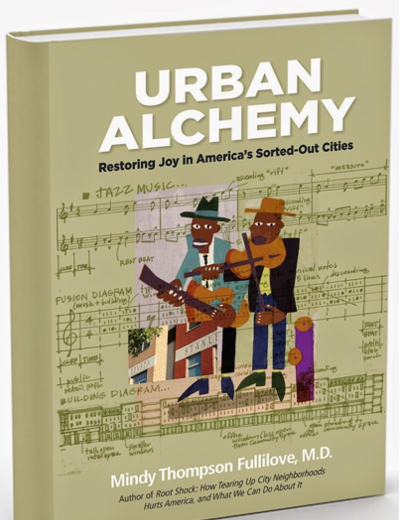
As a psychologist studying the AIDS epidemic in black and Hispanic communities in the 1990s, Mindy Thompson Fullilove developed her interest in fixing American cities, discovering that the cause of individual diseases resulted from neglected neighborhoods. In Urban Alchemy, anecdotes from years of community organizing come to life, as Fullilove and her collaborators work with residents and public officials to restore dignity and joy in the places we live. Accompanied by French urbanist Michel Cantal-Dupart, Fullilove brings readers along on their efforts in placemaking that range from urban beautification to community hikes to neighborhood barbecues. While Urban Alchemy offers inspiration for anyone interested in the well-being of the city, many of its case studies are made possible by the support of influential community actors, ultimately raising questions about the individual’s impact on placemaking.
Fullilove’s medical training informs her approach to cities, offering a refreshing perspective to urban planning issues of segregation and displacement. Under this framework, neighborhoods typically considered slums, are seen as symptoms of a larger disorder, rather than the disorder themselves (19). These neighborhoods have been “detached” from municipal efforts of economic development, transportation, and public education, and it is these fractures that must be repaired.
In this way, Urban Alchemy effectively presents the horrors of past urban planning policy while recommending guiding principles for anyone interested in correcting these past offenses. In the South Bronx and Harlem, New York City officials in the 1970’s closed fire stations and let poor neighborhoods burn in the name of “planned shrinkage” (16). In Pittsburgh, redlining resulted in unequal investment in public education throughout the mid-20th century. The departure of industrial manufacturing in the 1980s affected the city as a whole, especially minority neighborhoods where low-income wage laborers concentrated. Pittsburgh’s ongoing economic renewal (dubbed by Forbes Magazine as “comeback city” in 2012) has primarily attracted white-collar jobs, again leaving inner-city residents economically stranded (47). Reversing the damage done by these past offenses is the primary focus of Urban Alchemy that yields mixed results. To lay the framework, Fullilove offers nine guiding elements that make up the chapters of her book:
- Keep the whole city in mind
- Find what you’re FOR
- Make a mark
- Unpuzzle the fractured space
- Unslum all neighborhoods
- Create meaningful places
- Strengthen the region
- Show solidarity with life
- Celebrate your accomplishments
Reviewing these elements might cause you to wonder how a book filled with examples of community organizing will aim at “unslumming” entire neighborhoods or strengthening a region. That is a valid question, but one that Fullilove is confident to take on with her influential companions Cantal or American design firm RDCollab by her side. For the rest of us interested in playing our part in the city, possibly having been involved in a DIY urbanism project or two, that is a tall order.
From a sociological perspective, one of Urban Alchemy’s biggest strengths is connecting trends of social disintegration in our cities with what we experience personally. The ‘sorted-out city’ is one in which real or perceived borders fragment our movement through the city, “mark[ing] the edges of that which is our space from that which is not” (78). Think of an example in your city, where a street might mark the boundary between where you frequent and an area where your friends or family say you shouldn’t. These divisions may be more subtle but, in their essence, create a checkerboard of places we visit and those we don’t.
For residents of neglected neighborhoods, these boundaries have very real effects. Drawing from a psychology study on childhood behavior by Eva-Maria Simms, Fullilove connects how disruptions to the Hill District neighborhood in Pittsburgh manifest themselves in the personal. Simms identified three distinct eras from interviewing long-time residents on their childhood memories that differed remarkably by their descriptions: 1930 to 1960, 1960 to 1980, and 1980 to 2004. The first historical period from 1930 to 1960 (which Fullilove calls Simms I) characterized a neighborhood with strong relationships and sense of community. By the 1960s, interviewees recalled neighbors moving in-and-out to the point that they had little impact on their upbringing. This period, known as Simms II (1960 to 1980), coincided with the construction of a major highway through the Hill and the loss of manufacturing jobs mentioned before. Chronic unemployment and increased policing of the neighborhood by 1980 brought upon the final era, known as Simms III. During this period, children were unlikely to be allowed to play outside, and uncertainty characterized the feeling of being on the streets. So how would one go about unslumming this neighborhood?
According to Fullilove, repairing the city requires reversing the downward spiral of destabilization that span the block, neighborhood, city, and regional levels. The book’s cover art features a great example of a placemaking intervention at these various scales. The Legacy of Jazz project represented a community attempt at asserting the Hill District neighborhood’s rich African American history through urban design. Taking a popular piece from Billy Eckstine, one of the city’s jazz greats, RDCollab mapped out the song’s notes and translated them onto building facades on the neighborhood’s main street. In tandem with city-wide interventions that strengthened the neighborhood’s access to the rivers, one resident stated it was “the first time in my life I feel respected by the place I live” (222). This project, along with countless others cited in the book, could hardly be considered grassroots as RDCollab and Fullilove worked under contract with developers and planning authorities to complete.
Despite the influence that Fullilove draws from collaborating with powerful community agents, Urban Alchemy forces us to reconsider notions of “top-down” and “bottom-up” development, making the strong case that community organizers work across these distinctions. At other points in the book, Fullilove promotes grassroots approaches to neighborhood beautification, claiming “when there are enough points of light, the whole neighborhood will be bright” (191). It is in this framework that Fullilove’s storytelling of personal anecdotes makes the most sense. Every community event, barbecue, or neighborhood party blurs the line between being an active community member and an urbanist dedicated to the city’s well-being.
The end goal of restoring the sorted-out city for Fullilove is one of humanity and unlocking social cooperation. In the final pages of Urban Alchemy, she writes, “We can’t think collectively if we can’t live together and we can’t live together in the sorted-out city… To get the economic, social, and physical connections needed for effective collective thinking, we must restore the urban ecosystem. Then we must use our collective thinking to answer the hard questions of our times” (300). These final lines address why Fullilove became interested in cities as a psychiatrist, and why we should all be invested in the repairing of our sorted-out cities.