• Skip to main content
  • Skip to primary sidebar
  • Home
  • Course Description
  • About the Author
  • All Posts

You and Urban Planning

Public Sociology - Professor Theo Greene

Posts

Transportation for Whom?

December 14, 2020 By Nick Suarez

In the Harlem Park neighborhood of Baltimore, a restaurant worker rises at daybreak to commute to work. Located just two miles northwest of Inner Harbor, where the tourism business employs many local residents, the commute on public transportation remains an unpredictable one. Buses that run every 10 to 15 minutes are on-schedule only 65% percent of the time and no-shows are all too common. For employees who rely on public transportation the only options are to hope that the bus makes it on time, face the consequences of being late to work, or spend an hour and a half’s wages for an Uber or Lyft.

On the other side of town in East Baltimore, a medical student at Johns Hopkins University is preparing a trip to Inner Harbor as well. The Charm City Circulator (CCC), a new bus service that began in 2010 to relieve downtown traffic congestion, conveniently offers free rides between the East Baltimore campus and Inner Harbor. CCC buses are not entirely reliable either, but more so than MTA buses and are entirely free of charge. After waiting impatiently at the stop for a few minutes, the student contemplates ditching the wait and walking a few blocks to the metro station at the center of campus. In 1995, Baltimore’s single metro line was extended 8,000 feet at the price of $321 million to connect Johns Hopkins with the rest of the system. There is little doubt that the university’s political clout helped secure federal funding for the project.

The scenarios above illustrate very different experiences with transportation that residents of Baltimore and other cities across the country face. When politicians and planners talk about improving transportation, we must ask, transportation for whom? By targeting downtown and tourist-heavy areas of the city, the Charm City Circulator offers free rides in neighborhoods with median household incomes around $100,000. Meanwhile, Maryland Transit Authority (MTA) buses charge riders throughout the rest of the city but are plagued by low ridership and underfunding. And what about widening highways to relieve traffic congestion? Wouldn’t that benefit everybody? In Baltimore, 30% of residents lack reliable car access and highway construction has historically bulldozed inner-city neighborhoods to provide faster access between the suburbs and downtown.

It is time our streets and transportation policies reflect the dynamic and marginalized ways people navigate around urban spaces. Freeways and car infrastructure have become organizational elements in the city. Yet, transit-dependent populations find no use for them except as catalysts for disruption and displacement (Lost in the Transit Desert, pg. 25). All the while, public transportation facilities are falling in disrepair and transit agencies face increasing odds of staying afloat post-COVID.
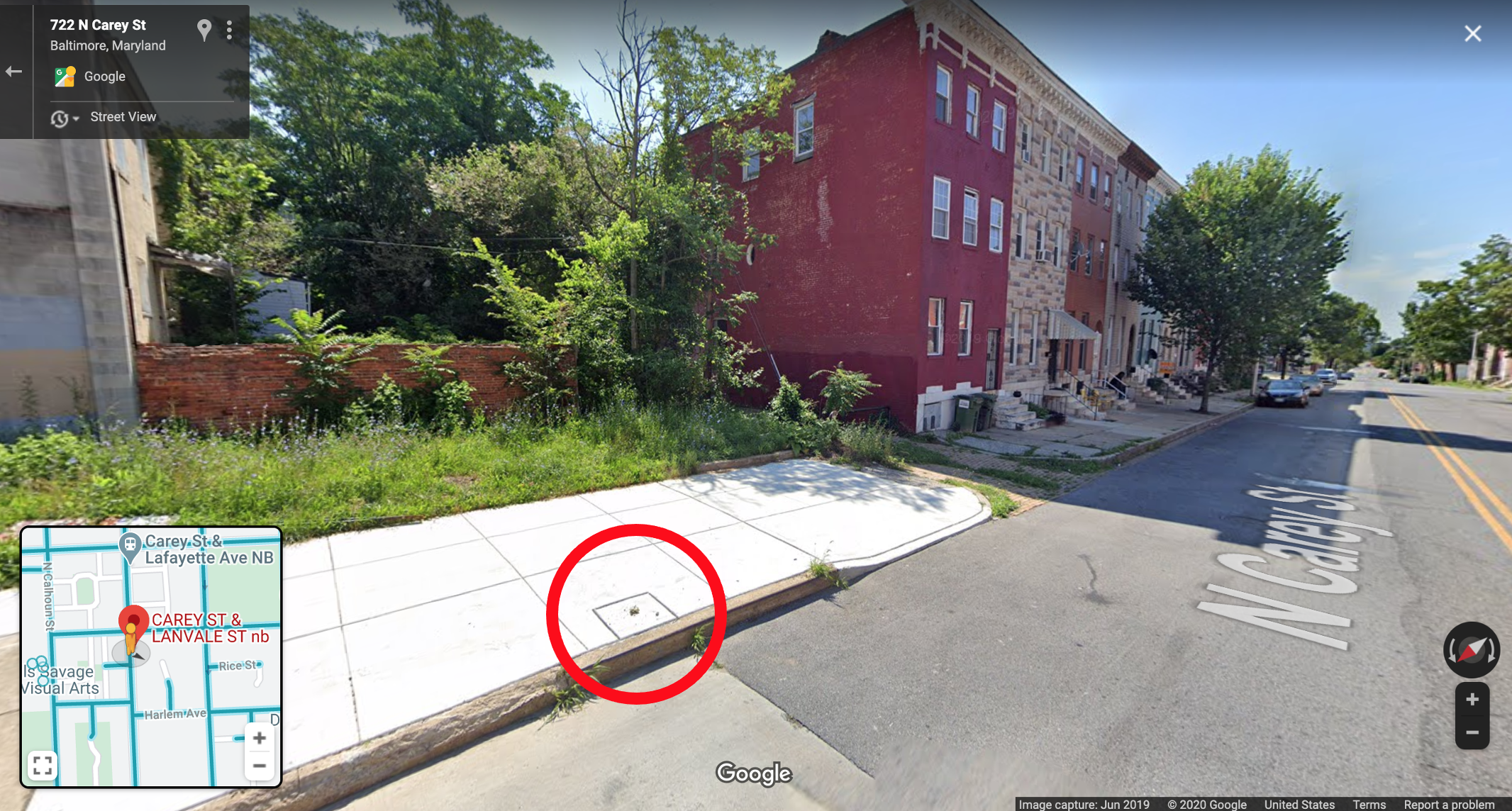
Image of a “bus stop” in Harlem Park, Baltimore. A red circle shows a hole in the ground where signage has gone missing. There are no benches or overhangs to provide shelter for riders (Source: Google Maps Street View).

Access to reliable transportation is crucial for healthy living and economic mobility. For individuals without personal vehicles, public and non-motorized forms of transportation (walking and biking) define the services and activities they can participate in. As suggested by the hypothetical situation at the beginning of this article, the ability to choose between alternative transportation modes is equally important. Imagine being disqualified for a promotion at work because you were late a few times due to no-show buses. Or being unable to take a job that is beyond the reach of existing transit routes. Urban sociologists and geographers define “social exclusion” as a process in which transit-dependent populations cannot access quality employment and services due to a lack of transit infrastructure.

How do we begin correcting the mistakes made in transportation toward minority and poor communities? The process begins on a personal level of reflecting on our biases toward users of public transportation. In the 1960s, efforts to expand public transit in Baltimore were met with heavy resistance from suburban residents. They saw the expansion of transit routes into their neighborhoods as potential sources of crime. Light rail trains were given the nickname “loot rail” by residents that believed “undesirable elements” from the inner city would use these trains to commit crimes in the suburbs before quickly escaping home.

Even today, misconceptions about crime and public transportation prevent expansions in service to take place. In Houston in 2017, suburban residents packed a meeting held by the local metropolitan transit authority to voice similar concerns. In situations like these, the fears of a few resourced elites prevent projects that would benefit a larger working-class population because of their knowledge on how to influence the process (while certain crimes do increase with poverty rates, and transit primarily serves low-income and communities of color, blanket statements that these services inherently makes neighborhoods less safe are speculative). Ironically, crimes involving cars—theft, vandalism, and road-rage violence—are more common than crimes associated with public transportation.

The narrative surrounding public transportation must be rewritten as a public good that generates economic revenue, reduces carbon emissions, and enhances personal opportunity.

Once we agree that public transportation is a collective good that poses minimal, if any, inconvenience to some, we need to turn beliefs into action.  One strategy that urbanists and everyday citizens employ to improve transportation within their communities is known as DIY urbanism. Also known as tactical, or “guerilla” urbanism, residents can take matters into their own hands by building street furniture at a bus stop or painting their own crosswalk or bike lane. This might seem unfeasible and slightly precarious but there are significant resources by non-profit organizations to make this possible.

DIY Urbanism has arisen from the failure of budget-strapped governments to make much-needed change at the neighborhood or block level. Regardless, planners and municipalities are often receptive and willing to work with to residents formalize these changes. The construction or painting of a bench is a minimal intervention that improves and humanizes the experience of riding public transit astronomically.
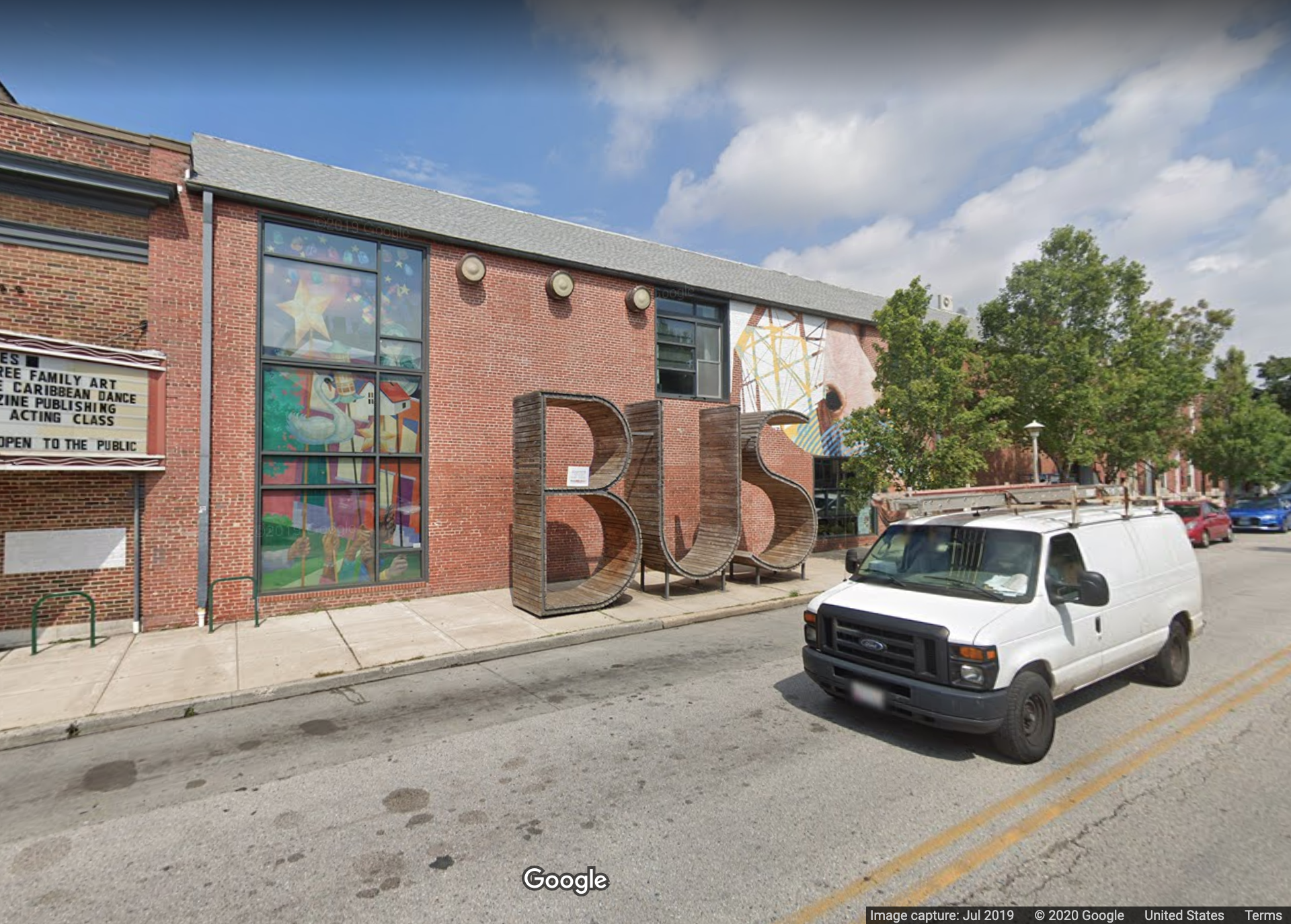
Image of a creative bus stop design in Baltimore. This unique design, in which wooden planks used for benches spell out the word BUS, also offers those waiting for transportation seating and shelter from the elements (Source: Google Maps Street View).

Beyond the neighborhood level however, transportation improvements inherently require political involvement and cooperation. A new bus route requires funding and a good bit of traffic analysis to determine the optimal route. The good news is, in town halls and public meetings across the country, urban planners want to hear from residents on how to design and improve transportation within communities. Historically, these events are attended by the same few outspoken citizens or random community member that stumble upon a public meeting in the library. Given that many transit riders cannot participate in public meetings due to space-time constraints, we must all become advocates for more equitable mobility. This includes holding public officials accountable for decisions adversely affecting marginalized mobility.

In 2015, Maryland Governor Larry Hogan struck down funding for a new metro line in Baltimore that would have served as a crucial connection between the city’s east-west portions, including the Harlem Park neighborhood. Hogan refused $900 million in federal funding that had already been committed to the project. Former Maryland Senator Barbara Mikulski stated at the time, “I never thought, ever, in my closing year in the US Senate, I would see a letter saying the Baltimore region rejects $900m in federal investment.” Hogan felt as though the benefits of the project did not outweigh the costs to taxpayers. State funds allocated to the project—totaling $736 million—were instead reallocated for road improvements outside of city limits.

Hogan’s decision to divest funding from Baltimore’s Red Line to road improvements in the Washington DC suburbs brings us back to the question about whose transportation we choose to fund. A transportation economist cited in a legal complaint estimated that the switch from a subway line to the new highways initiative cost African Americans $19m in user benefits by 2030, while white Maryland residents stood to gain more than $35m in user benefits in the same period. From my own geospatial analysis, the Red Line would have situated high-frequency transit within half a mile to approximately 55,000 African Americans, or 15% of Baltimore’s Black population.
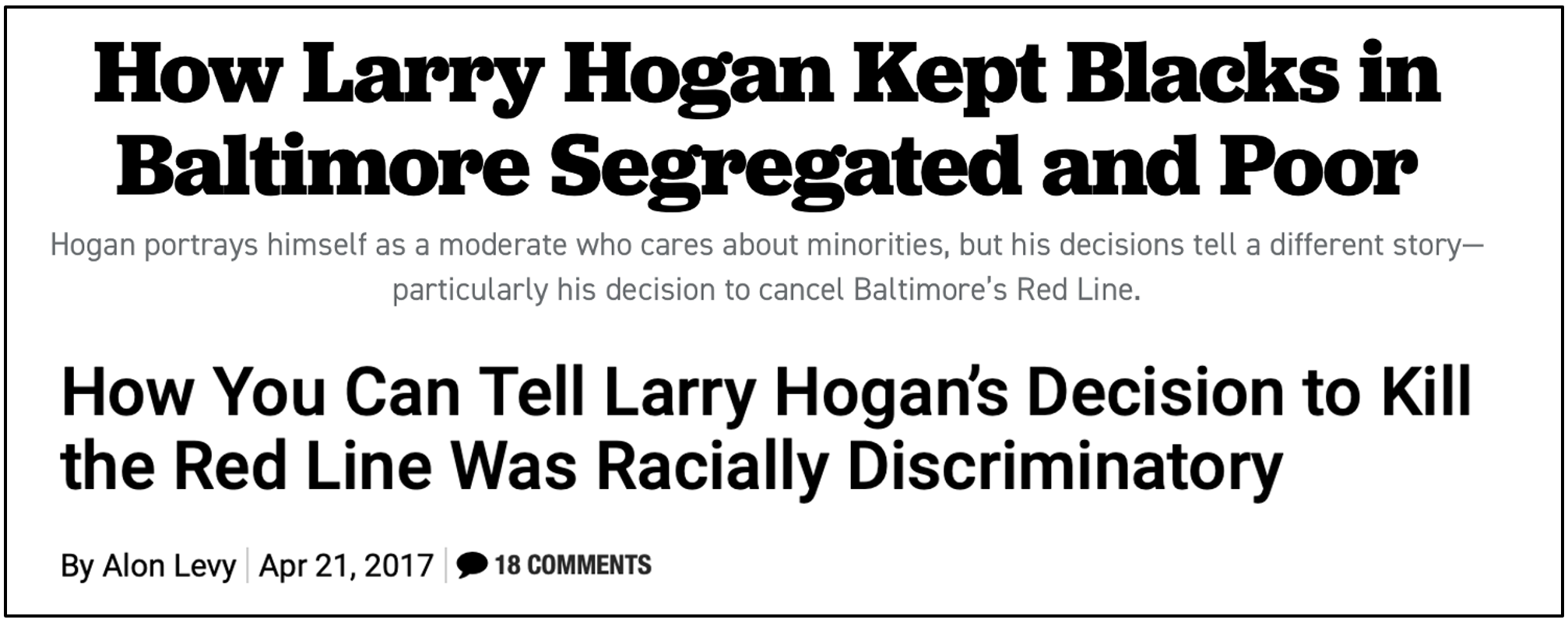
Headlines following Gov Hogan’s decision to terminate Baltimore’s Red Line (Sources: Politico Opinion [top] and Streetsblog USA [bottom]).
The potential benefits that the Red Line could have provided for Baltimoreans prompted news headlines and lawsuits charging the Governor of racial discrimination. Transit advocates filed administrative complaints under the Title VI of the Civil Rights Act of 1964 that his decision disproportionately and adversely impacted minority and low-income communities. While the Trump Administration threw out complaints filed with the US Department of Transportation, advocates are now gaining traction with demands for the creation of a regional transportation authority to take the reins on transit from the MTA. Support from civic and business organizations, including the Greater Baltimore Committee and Greater Washington Partnership, demonstrates the importance of transit to the economic success of the city moving forward.

While sociologists often study the effects of residential segregation on communities of color, more research could explore how municipal governments weaponize transportation to maintain racial and economic hierarchies. For the time being, or until we all use our platform to get involved in the transportation planning process, the restaurant worker will continue rising early and praying that the bus makes it on time.

Letter from the Editor

December 11, 2020 By Nick Suarez

This project is the culmination of a semester’s work in applying my sociological education beyond academia to reach the many publics that live in cities and have a right to their future direction and development. Studying sociology has been a privilege that has helped me understand my life and experiences within the context of structural and cultural trends. The entries in this electronic magazine were intended for those of us who inhabit urban spaces, move along city streets, but, most importantly, have been left out from conversations shaping them thus far.

Typically, populist visions of urban planning have been limited to efforts of placemaking and DIY urbanism. I hope this project illuminates how we might influence various aspects of urban development and steer our communities as we see fit.

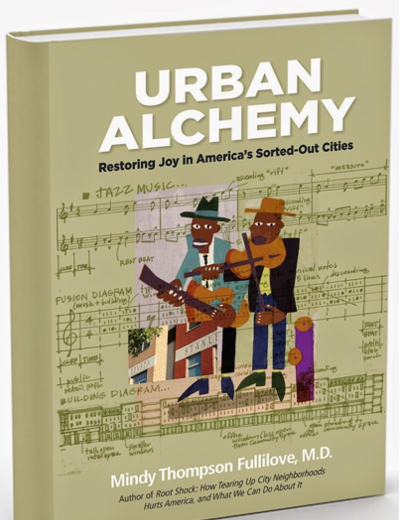
This installment’s feature piece, Transportation for Whom?, critically examines Baltimore’s transportation policy, calling for elected officials nationwide to support transit in the aftermath of COVID-19. On the issue of re-investing in our most vulnerable communities, Mindy Thompson Fullilove has spent most of her career exploring the tangible implications of misguided urban renewal policies on personal and community trauma. She offers a path forward in her book, Urban Alchemy: Restoring Joy in America’s Sorted-Out Cities, which is reviewed here.

Of recent relevance, this zine’s culture piece digs into fast-casual architecture—the horridly generic style of apartment building that has come to dominate the American landscape—and the urban planning policies that have led to its proliferation. Housing is much needed in today’s cities but municipal regulations surrounding new construction has resulted in tasteless developments that lack regional distinction.

Also of significance, I hope this zine illuminates that the COVID-19 pandemic has not signaled the decline of urban living—far from it. As this issue’s photo essay reveals, there is hope and an unparalleled sense of community that is derived from urban space.

A special thank you goes out to Professor Theo Greene and the “Imaginatorium” (Sociology 3325) for guidance and direction on this project.

And thank you to the reader, for embarking on this journey with an interest for a more sustainable way of living, You and Urban Planning.


All the Best,

Nick Suarez (Bowdoin College Class of 2021)


Rather than a symbol of gentrification, fast-casual architecture points to a larger housing crisis

December 5, 2020 By Nick Suarez

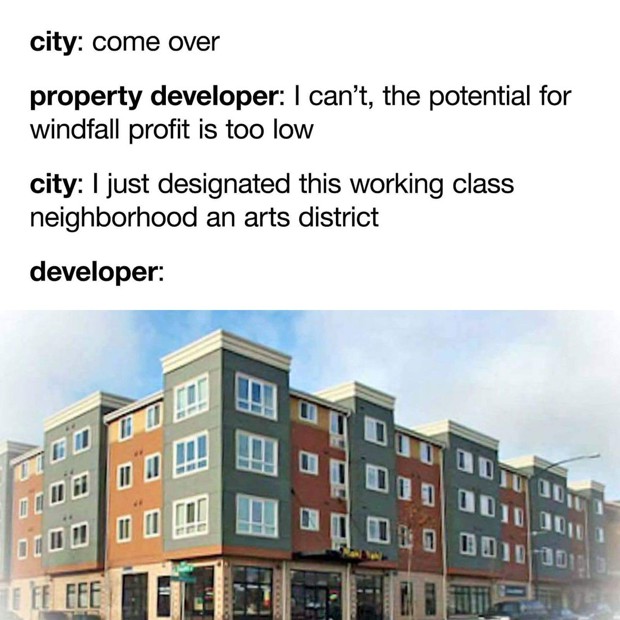
Source: Google Maps Street View

In an almost dystopian fashion, a new kind of housing is dominating the American landscape. Stretching for entire blocks and ranging in height from three to seven stories, these boxy assemblages of different colored panels are popping up in every city across the country.

Dubbed “fast-casual architecture” for their resemblance to better-than-fast-food chains such as Chipotle or Shake Shack, these apartments share many of the same characteristics as these restaurants, including their inoffensive presence, decent value, and assemblage of common ingredients. From an urbanist perspective, they bear no architectural resemblance to their region and are incredibly generic. The pictures above could double for any city in different corners of the county, and no one would be able to tell the difference.

However, it would be elitist for anyone to discuss the aesthetic of housing developments without analyzing the reasons for their proliferation. Digging into the popularity of fast-casual architecture reveals an urban housing crisis brought upon by restrictive land-use regulations and rising land values.

Fast-casual architecture like the ones pictured above usually contain rental apartments but could also be built as college dorms, condominiums, hotels, or assisted-living facilities. In internet memes (like the one pictured below), this architectural style has become a scapegoat for gentrification. In reality, housing is built in this style for all classes of people, pointing to an underlying culprit in land-use regulations and how developers can build in cities.

Despite their external similarities, these developments have more in common with each other by what’s on their inside. Their light-frame wood build turns out to be the most cost-effective way to house the most number of people on the smallest parcel of land, a priority for developers looking to build both affordable housing and luxury apartments in crowded downtowns. Throw in fire safety code and the majority of these apartments are also built on concrete podiums that serve as retail space or underground parking structures (I could write an entire article on the defects of municipal parking requirements, but for now, just imagine the additional design constraints on property developers if municipalities force them to accommodate so much parking on a small plot of land).

Zoning in cities has also drastically limited the available parcels that allow for the amount of housing needed today. To assure residents that their neighborhoods would not change adversely, urban planners developed strict guidelines for the kind of developments that could be built by designating “zones” on city maps since the early 20th century. Homeowners were afraid that industrial warehouses or large housing projects in their vicinity would lower their home values. As a result, the remaining land that allows for the housing density needed in today’s housing shortage is incredibly finite and expensive for developers to acquire, resulting in the most economical construction methods.

Restrictive land-use regulations drive up developers’ costs, and high costs drive down the possibility for unique architectural designs. Blocky mixed-use buildings are the market’s only answer for working under the strict costs and restraints of building in cities today. Unless we actively try to break from NIMBY (“Not in my back yard”) ideologies of the past that have restricted housing density, the monotonous architectural style of fast casualism will persist.

Making ourselves at home in desperate times

November 30, 2020 By Nick Suarez

2020 has been a year of disproportional significance. With a global pandemic, a high-stakes presidential election, and national protests against police brutality and racial injustice, it is difficult to envision all the implications this year will have on our collective futures. There is little doubt that our children and grandchildren will ask what it was like to live through this moment and maybe even what life was like before it all. Looking back on this year might conjure up memories of everyone wearing masks in public or of violent protests as our national politics seemed to hang in the balance.

In our city streets and neighborhoods, events from this year have also left a visible mark. Outdoor seating is perhaps the most prominent example, but other signs point to this unique historical moment — signs that offer hope.

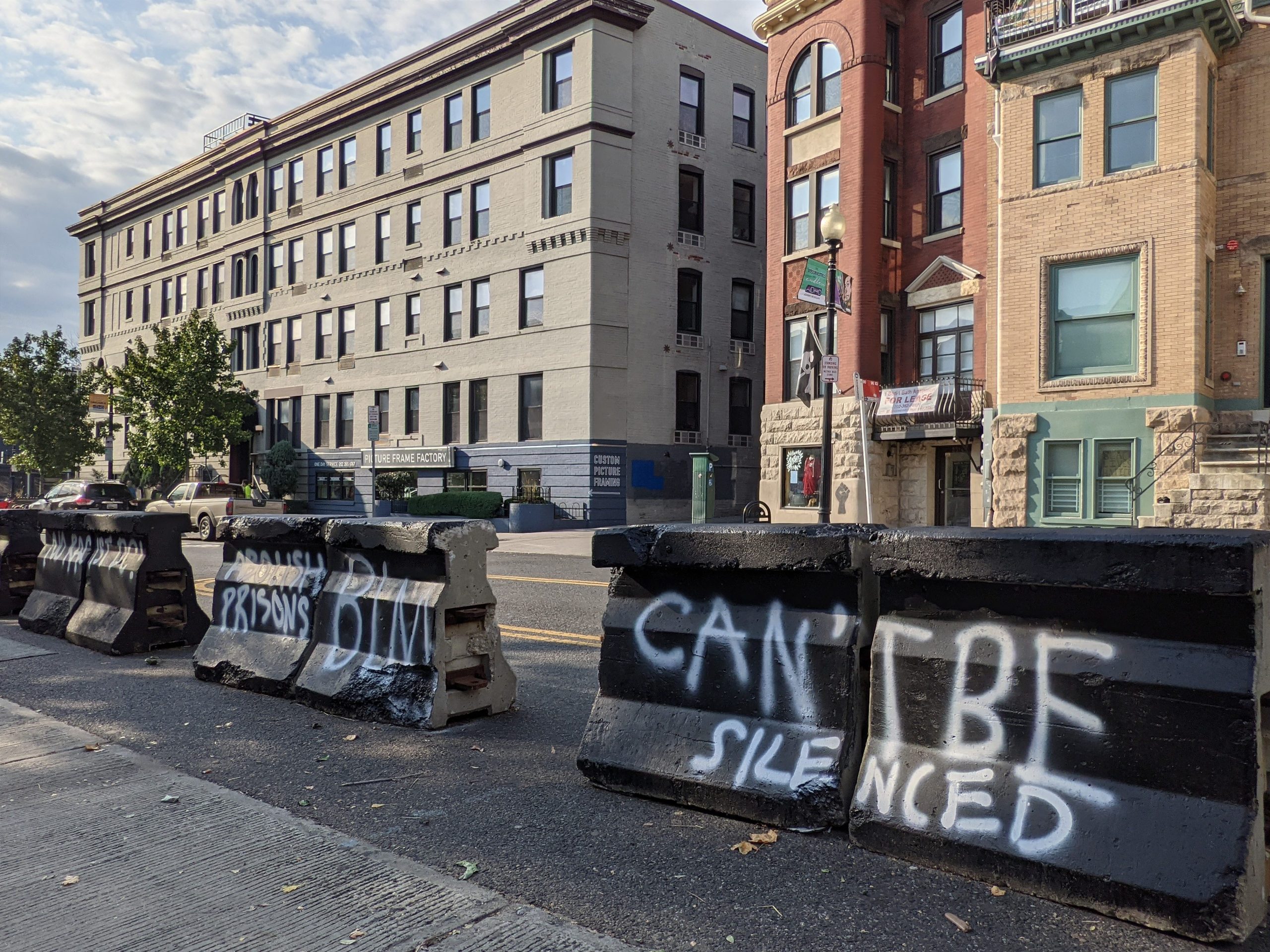
Decorated traffic barriers provide additional protection for outdoor restaurant seating. Occupy DC, a sister movement of Occupy Wall Street, protests economic inequality and continues to have a presence in the city despite forming nine years ago.


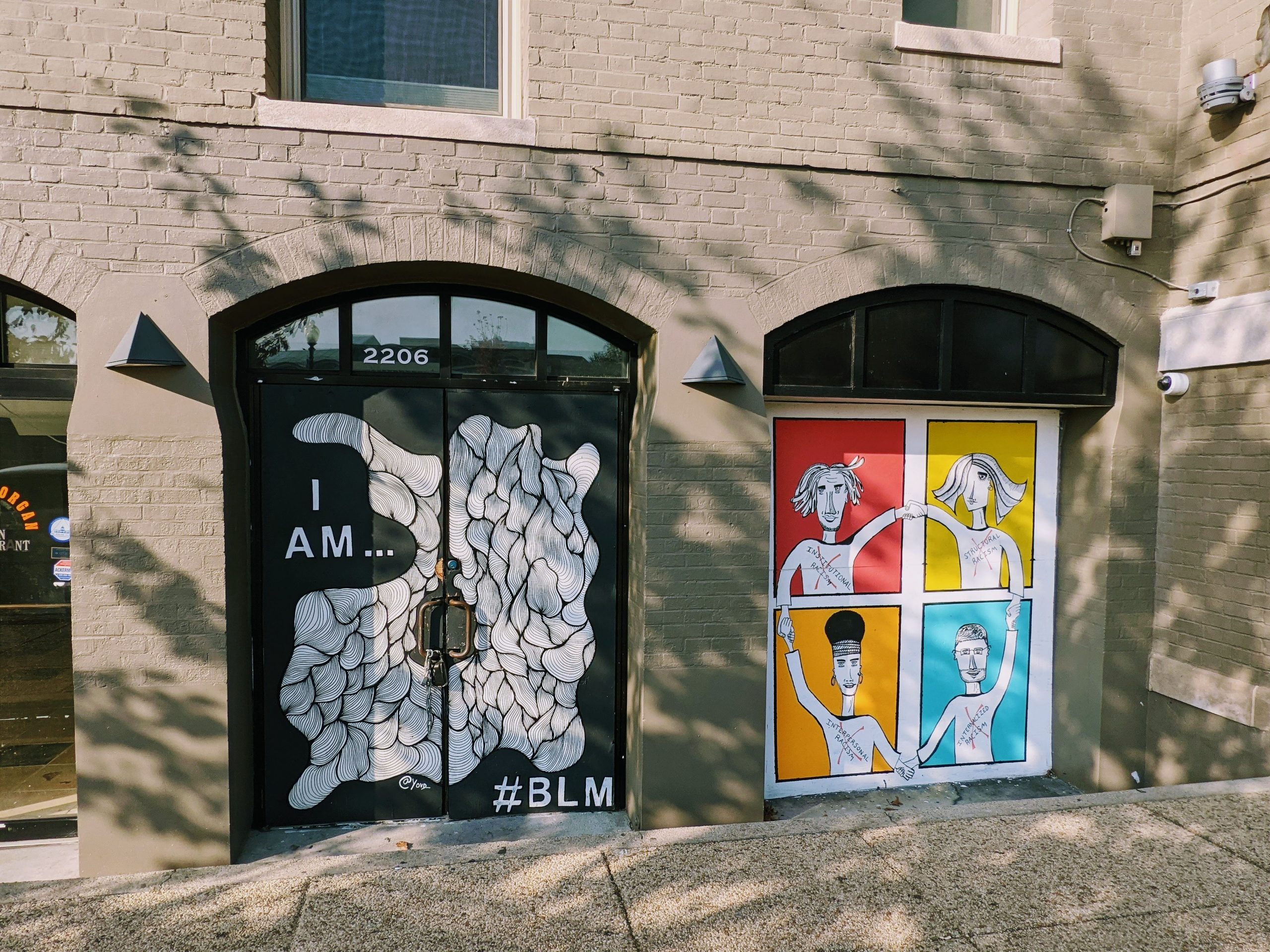
Murals facing the street provide passing cars and pedestrians with messages that matter to the community.

Taken predominantly in the Adams Morgan neighborhood of Washington DC, these pictures lay out the neighborhood’s sights on a blustery November morning. Visible messages supporting Black Lives Matter and racial justice strengthen and reinforce this neighborhood’s values. Despite the national divide over racial justice demonstrations, residents can look to their neighborhood and feel reassured that they live in a welcoming space that shares their concerns.

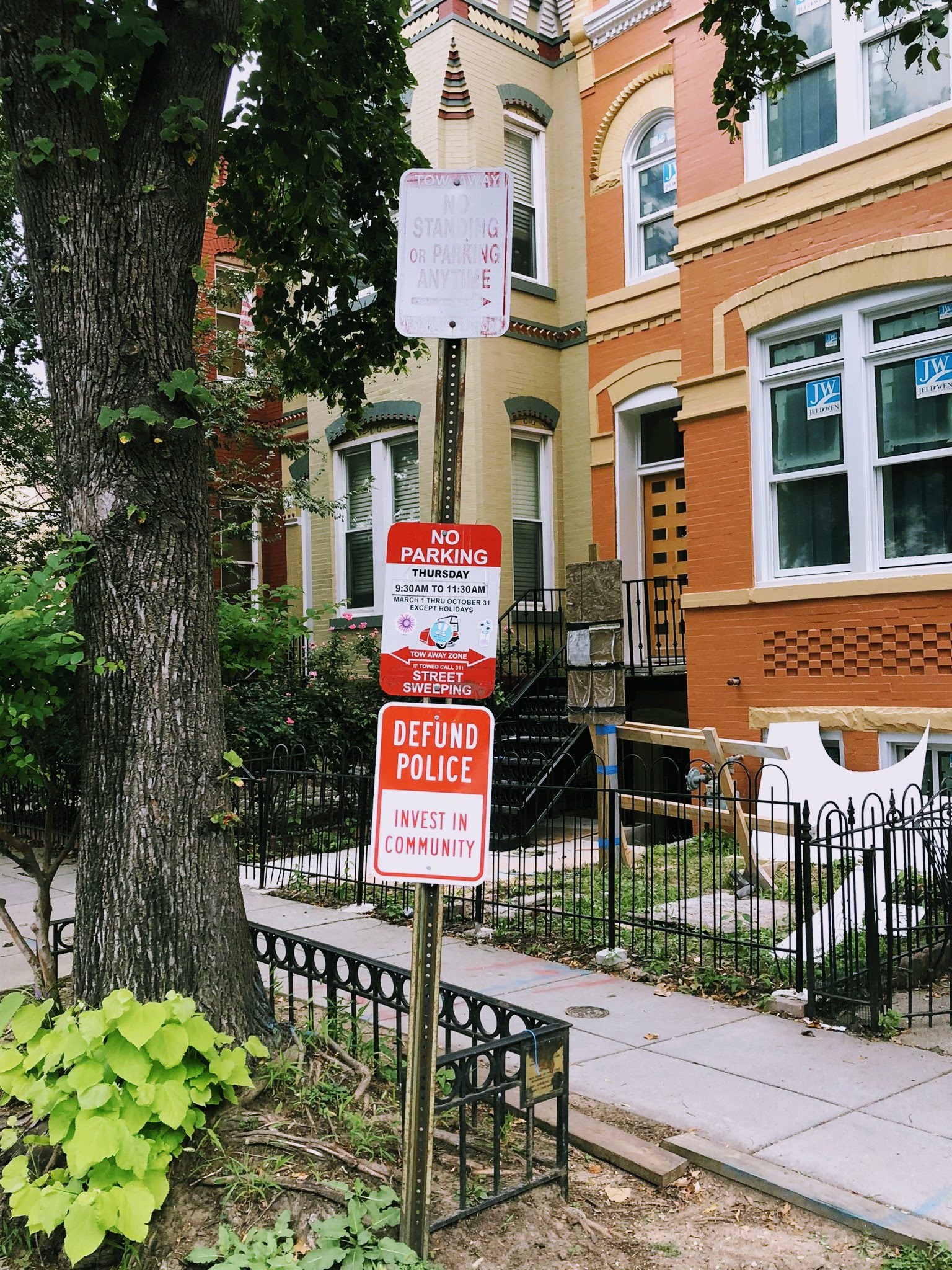
Via Twitter. An unauthorized sign in a DC neighborhood with a positive message: “Defund Police: Invest in Community.”


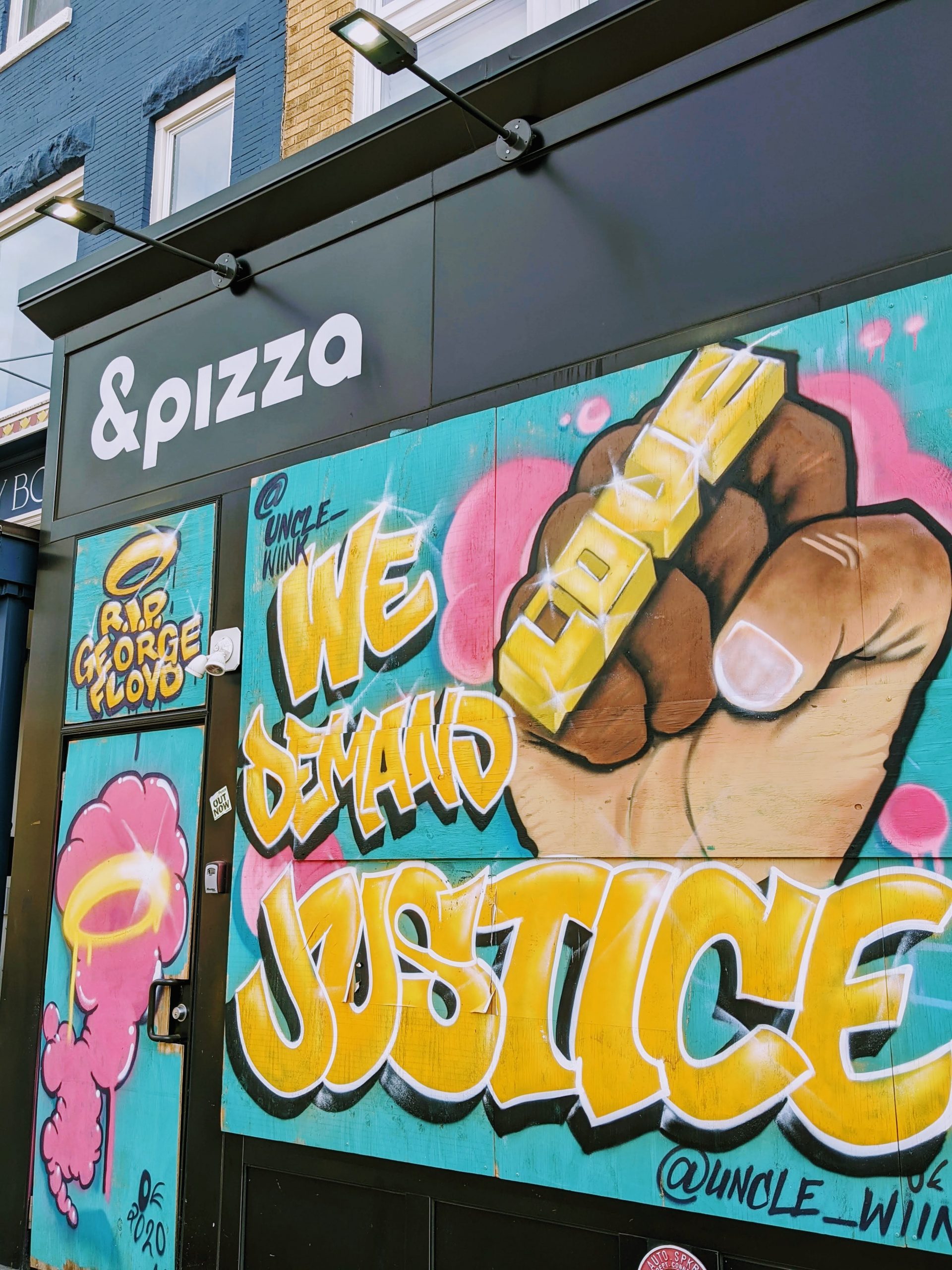
Wooden boards on the window and door of a restaurant have been remade into a colorful demand for justice.


Traffic barriers erected to protect pedestrians also urge the community to protect those most vulnerable from police brutality. From left to right, they read, “No Racist DC!”, “Abolish Prisons,” “BLM,” and “Can’t be Silenced.”


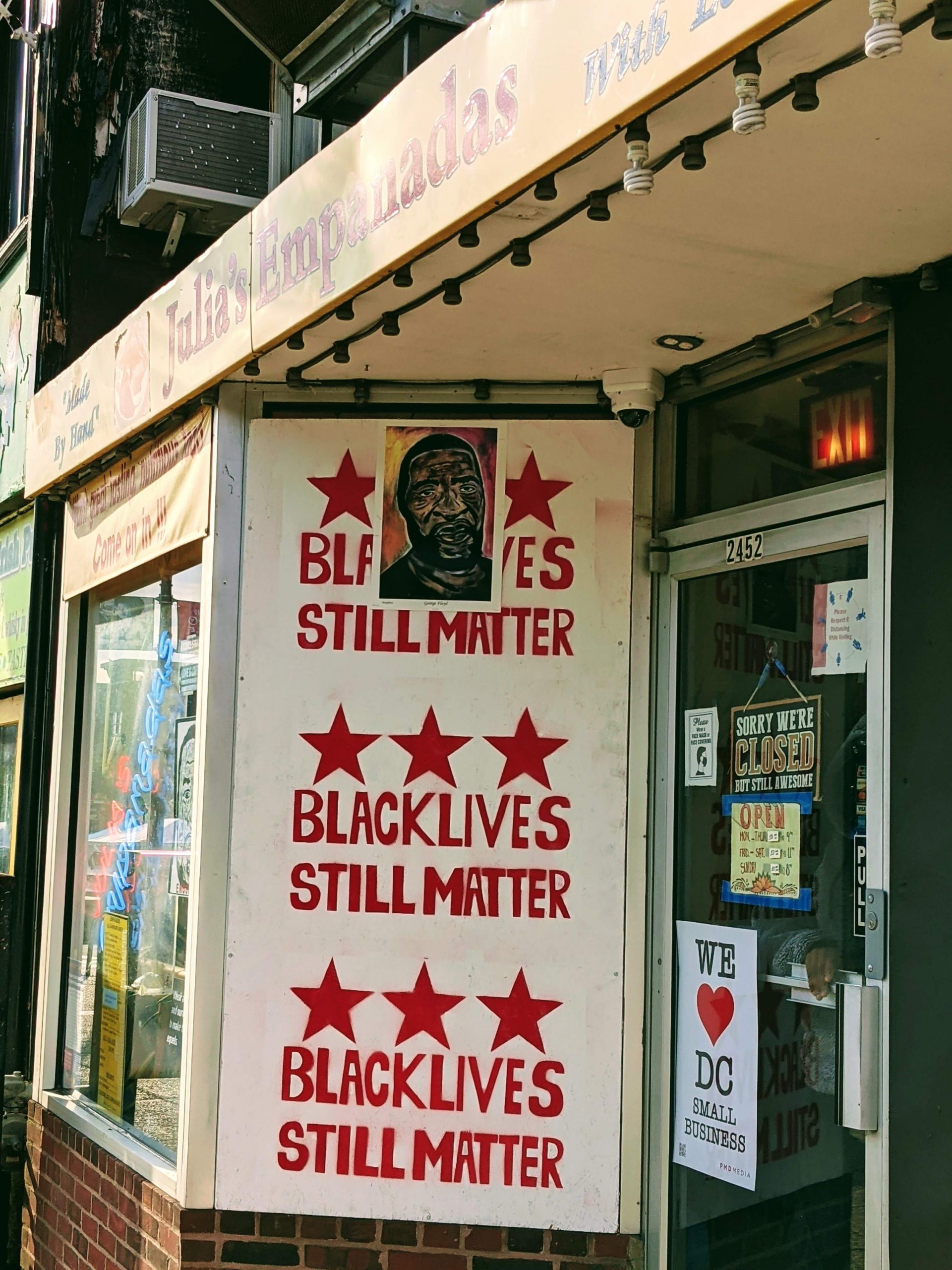
On a storefront, an image of George Floyd, a father killed by police in Minneapolis, hangs over the words “Black Lives Still Matter.”


For someone who might not share these beliefs, these exhibitions might err on the side of vandalism as something undesirable. But what more could people ask from their neighborhood than to feel respected and have their values reflected by the places they go shopping or walk their dog? Suburbs, in many ways, embody the opposite of what is pictured here. Some homeowners associations forbid any political signage to be visible from the street, which is perfectly fine with many individuals who choose to live there.

I am not arguing that people should live segregated by their political beliefs (one could say this already happened as a product of redlining and discriminatory mortgage loans). Rather, I point to how people can make their neighborhood feel like home and display shared values with their neighbors. To those living in Adams Morgan, these pictures represent precisely what makes their neighborhood feel like home and have been shaped to do so very strategically. Taking a second to study the urban environment in these trying times of health and social crises shed light on what matters most to people.

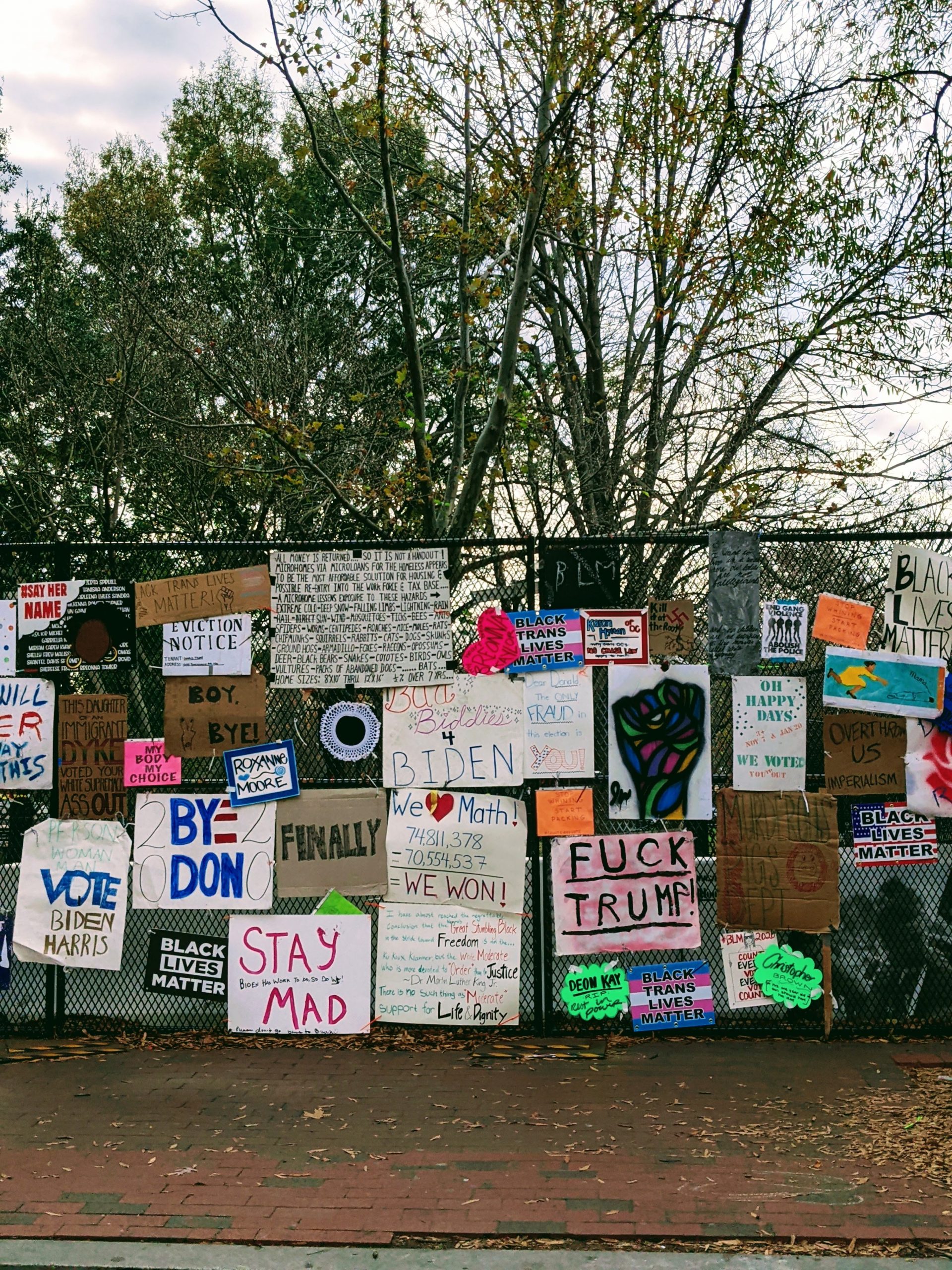
Posters crowd the fence that delineates the expanded perimeter of the White House. Despite the hundreds of messages, the posters share an unequivocal opposition for the sitting president.


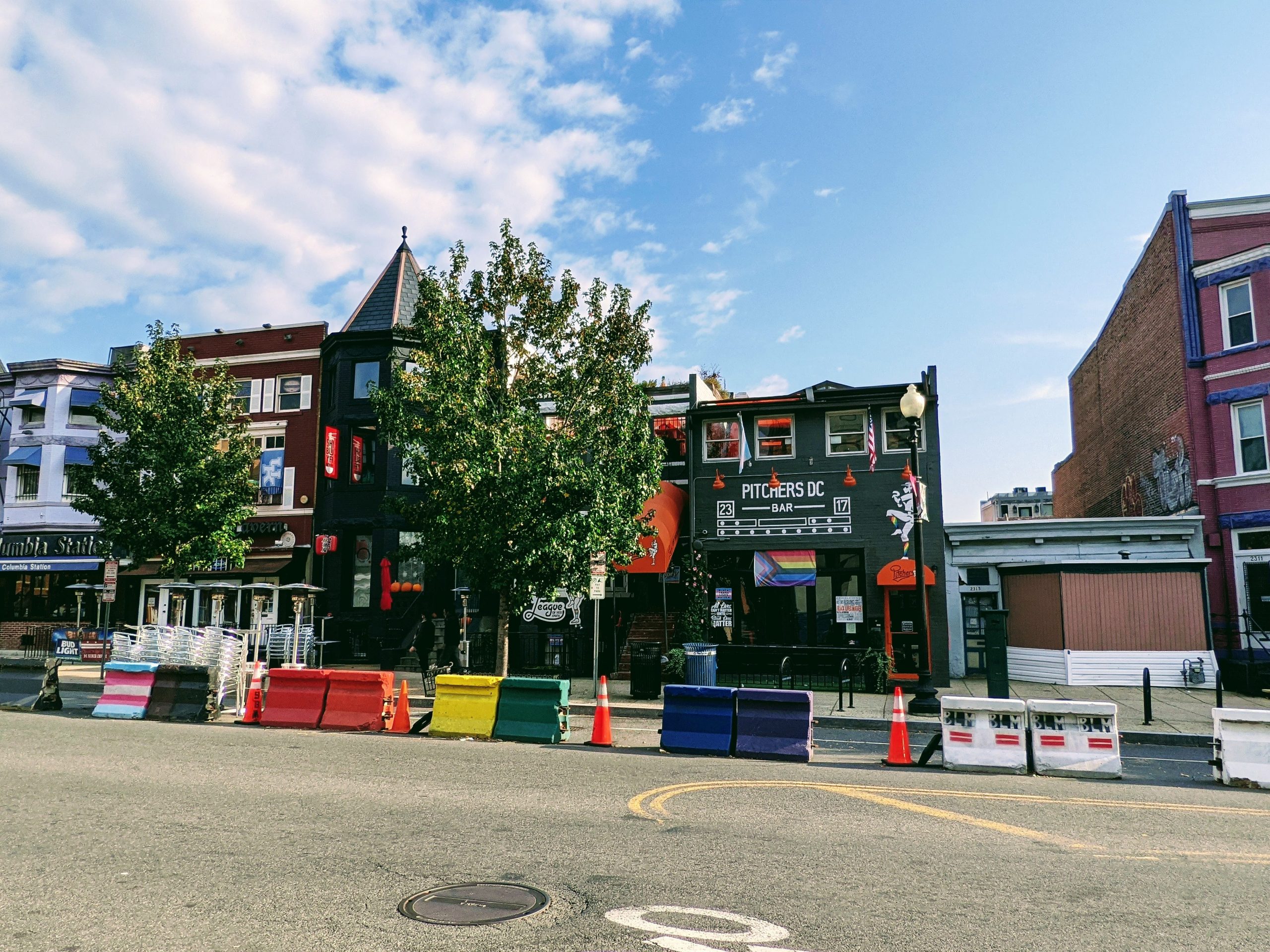
Traffic barriers of various colors and flags summarize a message central to the LGBTQ+ community and urban placemaking: You are welcome here.

Urban Alchemy Book Review

October 19, 2020 By Nick Suarez

As a psychologist studying the AIDS epidemic in black and Hispanic communities in the 1990s, Mindy Thompson Fullilove developed her interest in fixing American cities, discovering that the cause of individual diseases resulted from neglected neighborhoods. In Urban Alchemy, anecdotes from years of community organizing come to life, as Fullilove and her collaborators work with residents and public officials to restore dignity and joy in the places we live. Accompanied by French urbanist Michel Cantal-Dupart, Fullilove brings readers along on their efforts in placemaking that range from urban beautification to community hikes to neighborhood barbecues. While Urban Alchemy offers inspiration for anyone interested in the well-being of the city, many of its case studies are made possible by the support of influential community actors, ultimately raising questions about the individual’s impact on placemaking.

Fullilove’s medical training informs her approach to cities, offering a refreshing perspective to urban planning issues of segregation and displacement.  Under this framework, neighborhoods typically considered slums, are seen as symptoms of a larger disorder, rather than the disorder themselves (19). These neighborhoods have been “detached” from municipal efforts of economic development, transportation, and public education, and it is these fractures that must be repaired.

In this way, Urban Alchemy effectively presents the horrors of past urban planning policy while recommending guiding principles for anyone interested in correcting these past offenses. In the South Bronx and Harlem, New York City officials in the 1970’s closed fire stations and let poor neighborhoods burn in the name of “planned shrinkage” (16). In Pittsburgh, redlining resulted in unequal investment in public education throughout the mid-20th century. The departure of industrial manufacturing in the 1980s affected the city as a whole, especially minority neighborhoods where low-income wage laborers concentrated. Pittsburgh’s ongoing economic renewal (dubbed by Forbes Magazine as “comeback city” in 2012) has primarily attracted white-collar jobs, again leaving inner-city residents economically stranded (47). Reversing the damage done by these past offenses is the primary focus of Urban Alchemy that yields mixed results. To lay the framework, Fullilove offers nine guiding elements that make up the chapters of her book:

  1. Keep the whole city in mind
  2. Find what you’re FOR
  3. Make a mark
  4. Unpuzzle the fractured space
  5. Unslum all neighborhoods
  6. Create meaningful places
  7. Strengthen the region
  8. Show solidarity with life
  9. Celebrate your accomplishments

Reviewing these elements might cause you to wonder how a book filled with examples of community organizing will aim at “unslumming” entire neighborhoods or strengthening a region. That is a valid question, but one that Fullilove is confident to take on with her influential companions Cantal or American design firm RDCollab by her side. For the rest of us interested in playing our part in the city, possibly having been involved in a DIY urbanism project or two, that is a tall order.

From a sociological perspective, one of Urban Alchemy’s biggest strengths is connecting trends of social disintegration in our cities with what we experience personally. The ‘sorted-out city’ is one in which real or perceived borders fragment our movement through the city, “mark[ing] the edges of that which is our space from that which is not” (78). Think of an example in your city, where a street might mark the boundary between where you frequent and an area where your friends or family say you shouldn’t. These divisions may be more subtle but, in their essence, create a checkerboard of places we visit and those we don’t.

For residents of neglected neighborhoods, these boundaries have very real effects. Drawing from a psychology study on childhood behavior by Eva-Maria Simms, Fullilove connects how disruptions to the Hill District neighborhood in Pittsburgh manifest themselves in the personal. Simms identified three distinct eras from interviewing long-time residents on their childhood memories that differed remarkably by their descriptions: 1930 to 1960, 1960 to 1980, and 1980 to 2004. The first historical period from 1930 to 1960 (which Fullilove calls Simms I) characterized a neighborhood with strong relationships and sense of community. By the 1960s, interviewees recalled neighbors moving in-and-out to the point that they had little impact on their upbringing. This period, known as Simms II (1960 to 1980), coincided with the construction of a major highway through the Hill and the loss of manufacturing jobs mentioned before. Chronic unemployment and increased policing of the neighborhood by 1980 brought upon the final era, known as Simms III. During this period, children were unlikely to be allowed to play outside, and uncertainty characterized the feeling of being on the streets. So how would one go about unslumming this neighborhood?

According to Fullilove, repairing the city requires reversing the downward spiral of destabilization that span the block, neighborhood, city, and regional levels. The book’s cover art features a great example of a placemaking intervention at these various scales. The Legacy of Jazz project represented a community attempt at asserting the Hill District neighborhood’s rich African American history through urban design. Taking a popular piece from Billy Eckstine, one of the city’s jazz greats, RDCollab mapped out the song’s notes and translated them onto building facades on the neighborhood’s main street. In tandem with city-wide interventions that strengthened the neighborhood’s access to the rivers, one resident stated it was “the first time in my life I feel respected by the place I live” (222). This project, along with countless others cited in the book, could hardly be considered grassroots as RDCollab and Fullilove worked under contract with developers and planning authorities to complete.

Despite the influence that Fullilove draws from collaborating with powerful community agents, Urban Alchemy forces us to reconsider notions of “top-down” and “bottom-up” development, making the strong case that community organizers work across these distinctions. At other points in the book, Fullilove promotes grassroots approaches to neighborhood beautification, claiming “when there are enough points of light, the whole neighborhood will be bright” (191). It is in this framework that Fullilove’s storytelling of personal anecdotes makes the most sense. Every community event, barbecue, or neighborhood party blurs the line between being an active community member and an urbanist dedicated to the city’s well-being.

The end goal of restoring the sorted-out city for Fullilove is one of humanity and unlocking social cooperation. In the final pages of Urban Alchemy, she writes, “We can’t think collectively if we can’t live together and we can’t live together in the sorted-out city… To get the economic, social, and physical connections needed for effective collective thinking, we must restore the urban ecosystem. Then we must use our collective thinking to answer the hard questions of our times” (300). These final lines address why Fullilove became interested in cities as a psychiatrist, and why we should all be invested in the repairing of our sorted-out cities.

Primary Sidebar

Posts

All Posts

courses.bowdoin.edu