Category Archives: Fashion and Gender in China

Footbinding: A Cultural Signifier

Moving forward with the topic of foot binding, we shift our focus to semiotics to dig deeper into the subject. Through a semiotic analysis, we can use our analytical skills to further understand foot binding on another level.

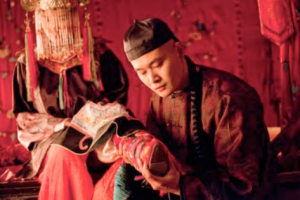
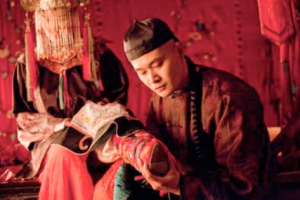
start from here: This image is from the 2011 movie, Snow Flower and The Secret Fan, written by Lisa See. The movie was set in nineteenth century China and it focused on how women are victims of problems like foot binding. According to See, she wants her fans “to imagine how a few such women might have found voices of their own within, rather than in opposition to, the Confucian social order, and how they found ways to self-fulfillment without flouting their culture’s fundamental values.” (Lisa See, introductory note, Snow Flower and the Secret Fan. New York: Random House (2005) p 18) .

This image accurately demonstrates the control that men have over women. nice statement
Screen Shot 2016-02-15 at 10.34.36 AM

In this image clip from the film, there is a man and a woman. The woman’s face is hidden in intricate headwear. Her foot, however, is the focal point of the image and is in the man’s hand. The foot is also is dramatically adorned, further cementing it’s importance. The environment of this image is primarily red. Both the man and the woman are wearing traditional outfits. All of this is taking place in a bedroom.

The atmosphere of this photo is intimate and sexual between the man and the woman. When looking at this image, the female’s face is hidden, demonstrating its unimportance.The identity is insignificant compared to the success of the individual’s foot binding practice. In addition, the man gazing at the foot shows the cultural norm of the feet being sexualized.

organize the analysis in a structure of denotation-connotation, complete one pair before moving to another one

This image represents control that men have over women on a greater scale. Seeing women as objects, and focusing on the ‘beauty’ of their body parts emphasizes this control. Women are mutilating their body to become what men want.

This image shows the control that men had over women in nineteenth century China. The ‘attractive’ women is one who has a small, delicate feet, that is only achieved through the torture and mutilation of oneself. Foot binding is a cultural expectation that women feel obligated to oblige by in order to have a future with a man.

We can connect foot binding to traditions such as the wearing of corsets, which were worn in order to maintain and show off an hour glass figure for men. Or the idea of the lighter the skin the more wealthy it proved someone to be. If you were tanner, it meant you were working in the fields.

Each of these traditions are somehow implemented into society’s expectations and are difficult to remove.

-Kelsey Mullaney
Screen Shot 2016-02-15 at 12.47.46 AM
Photograph from Peabody and Essex Museum
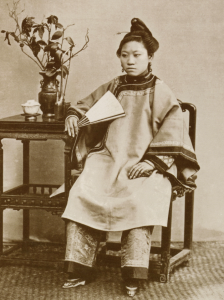
Foot binding was the sign of beauty for women in China of this time period. In order for a woman to be thought of as beautiful her feet needed to be between 3-5 inches. This type of mutilation of the feet was necessary for women to be married, and especially if they wanted to marry a wealthy man. Tiny feet represented femininity and civility for Chinese women during the Neo-Confucian era of China.  If a girl had tiny feet but a plain face it did not matter she still embodied beauty and sensuality, and would be able to be married.
The photograph above would have been a posed shot of a Chinese girl of some wealth, taken by a Western Photographer.
The photograph shows a young girl seated, not looking directly at the camera. She has her hair pinned up in a style that would been seen of other women in the time period. She is wearing long draping clothing that covers most of her body and fears out at the arms and at her knees. Her pants and sleeves seem to be highly embroidered. It is hard to tell from the colorless image but the cloth especially on her legs looks like it could be a silky material. The full attention of the view is drawn to the tiny feet just poking out of the long embroidered pant legs with beautiful embellished shoes. Lastly the girls face is plain with a blank stare. There is no make up on her face and no sort of embellishment around it. The plain face and the plain long putter shirt take the attention away from the girls head and has the viewer looking down towards the beautiful pant legs and the tiny little shoes that are almost lost in the pants. The size, shape, texture, and style of the clothing  makes the body seem hidden. As if it is swimming in all of this cloth and is lost until the view sees the tiny feet. The feet are also hidden away but the sea of cloth above it makes the feet look so dainty.
rich source of denotations and what does it suggest?
Except for the face and the hands no other part of the girl is being shown, and her feet are almost being hidden. This adds to the mystery. Men of this time would have never seen the women with unbound feet, even when they were married. The beauty was in the concealment. The men would have to wonder what the feet looked liked because women tried to hide them away, like seen in the photograph above.
The girl is seen with a plain face but yet she is still considered very beautiful, the beauty of the girls face really does not matter much at all. What matters is how small she can make her feet and how well she can draw attention to them. By embellishing the lower half of her body the girl has everyone looking for her tiny feet and not at her plain face, and she is considered very beautiful.
how does the notion of beauty find explanations from those denotations?

Footbinding: A Cultural Signifier

Moving forward with the topic of foot binding, we shift our focus to semiotics to dig deeper into the subject. Through a semiotic analysis, we can use our analytical skills to further understand foot binding on another level. This image is from the 2011 movie, Snow Flower and The Secret Fan, written by Lisa See. The movie was set in nineteenth century China and it focused on how women are victims of problems like foot binding.

According to See, she wants her fans “to imagine how a few such women might have found voices of their own within, rather than in opposition to, the Confucian social order, and how they found ways to self-fulfillment without flouting their culture’s fundamental values.” (Lisa See, introductory note, Snow Flower and the Secret Fan. New York: Random House (2005) p 18) .

This image accurately demonstrates the control that men have over women.

Screen Shot 2016-02-15 at 10.34.36 AM

In this image clip from the film, there is a man and a woman. The woman’s face is hidden in intricate headwear. Her foot, however, is the focal point of the image and is in the man’s hand. The foot is also is dramatically adorned, further cementing it’s importance. The environment of this image is primarily red. Both the man and the woman are wearing traditional outfits. All of this is taking place in a bedroom.

The atmosphere of this photo is intimate and sexual between the man and the woman. When looking at this image, the female’s face is hidden, demonstrating its unimportance.The identity is insignificant compared to the success of the individual’s foot binding practice. In addition, the man gazing at the foot shows the cultural norm of the feet being sexualized.

This image represents control that men have over women on a greater scale. Seeing women as objects, and focusing on the ‘beauty’ of their body parts emphasizes this control. Women are mutilating their body to become what men want.

This image shows the control that men had over women in nineteenth century China. The ‘attractive’ women is one who has a small, delicate feet, that is only achieved through the torture and mutilation of oneself. Foot binding is a cultural expectation that women feel obligated to oblige by in order to have a future with a man.

We can connect foot binding to traditions such as the wearing of corsets, which were worn in order to maintain and show off an hour glass figure for men. Or the idea of the lighter the skin the more wealthy it proved someone to be. If you were tanner, it meant you were working in the fields.

Each of these traditions are somehow implemented into society’s expectations and are difficult to remove.

-Kelsey Mullaney
Concealment in the practice of footbinding

ARTSTOR_103_41822003211313

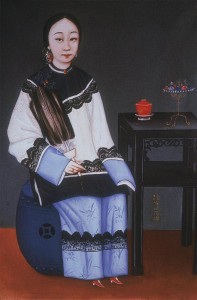
“Chinese woman with bound feet”, painting on glass, 19th century. Taken from Artstor, original source University of California San Diego.

This nineteenth century painting depicts a Chinese woman with bound feet sitting on a small piece of furniture in a minimally decorated room. Records indicate that the painting was found in China, however the nationality of the artist and the subject of the painting are unknown. Since westerners were already frequenting China and had already been exposed to footbinding it is possible that this painting is a western interpretation of the practice which, as Dorothy Ko explains in her article on western views of footbinging, could certainly influence the messages inherent in the painting (1). Although the room surrounding the woman is minimally decorated and somber, the ornate silk clothing with delicate embroidery, fine jewelry and fan in the woman’s hand as well as the ornamentation on the delicately carved side table suggests that the subject of the painting is of relatively high class in Chinese society. The position and relative size of the woman’s shoes indicate the importance of concealment inherent in the practice of footbinding and suggest that the concealment of the feet is the primary purpose of the ritual. sound claim

The colors of this painting are intentionally matched to convey the notion of concealment of the feet. The backdrop of the painting is black which is carried through the woman’s hair, as well as the side table, and the embroidery on the woman’s clothing. This backdrop gives the painting a somber mood. The white section of the woman’s clothing as well as her pale face stands in stark contrast to the black background drawing attention to the upper half of the body. The blue present in both woman’s pants and coat sleeves provides a contrast to the black and white upper half of the woman’s body but blends slightly into the blue chair which de-emphasizes the woman’s lower half. The wide pant legs not only make the feet appear extremely small but also diminish their importance relative to the rest of the woman’s body. Moreover, the shoes seem to blend into the red floor making them even less noticeable particularly relative to the white that stands in stark contrast to the black background in the upper half of the painting. The difference between the shoe color and the pant leg color also suggest that the shoes are not part of the woman’s body, almost as though they are small objects, not belonging to the woman but rather symbols representing an ideal of femininity. This matches Dorothy Ko’s explanation of the body being viewed as a part of the cosmos and not as parts belonging to an individual(2).

The relative size of the shoes particularly to the pant leg size not only emphasizes the importance of concealment in the practice of footbinding, it also emphasizes the idealized nature of bound feet. By using illusions to further reduce the size of the feet beyond the actual practice of footbinding the artist suggests that the central purpose of the ritual is to present a certain vision of femininity to the outside world, one wherein the feet themselves are concealed and replaced with an image of small well decorated parcels. why concealment?

In these ways the painting uses contrasting and blending colors as well as relative sizes to define an idealized notion of what it means to be a Chinese woman in the 19th century and central to this notion is the concealment of bound feet.

-Sophie B.

Bibliography

(1)Dorothy Ko (1997) Bondage in Time: Footbinding and Fashion Theory, Fashion Theory, 1:1, 3-27

(2)Dorothy Ko (1997) The Body as Attire: The shifting Meanings of Footbinding in Seventeenth Century China, Journal of Women’s History, 8:4, 8-27.

Foot-binding in the Family

footbinding

The exact origins of foot binding in China  can not be explained by one event or one reason. In actuality there are many theories of how and when foot binding in China took place, why it continued for so long and what in meant in a social, cultural, political, national and familial context. It is known that foot binding came into practice during the Song Dynasty (960-1279), and foot binding remained the popular fashion in China until the early 1900’s. Foot binding survived in China for hundreds of years and it has stood as a symbol for many different purposes. For example in the seventeenth century foot binding was used to demonstrate Han Chinese civility. A bound foot also has represented beauty, femininity, social status, political loyalty, female oppression and female liberation. Foot binding can not be reduced to one story or one meaning because it has served for so many different purposes over a vast length of time. However I want to focus on the relationship between foot binding and the family. may start from this statement, due to word limit

Foot binding in China, among many things, represented femininity and beauty in concealment. In order to get married a woman must have had her feet bound, in fact small feet were often more important then a pretty face. A woman with her feet bound had to take small steps and she couldn’t travel very fall. This gave off the illusion of a delicate nature and also led to female dependence on male counterparts. Concealment, delicate femininity and a submissive nature became desired traits a woman sought after in her home life and were subsequently passed down from mother to daughter through the process of foot binding. stay with your statement: foot binding and family

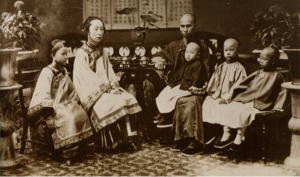
This photo was taken by a professional photographer and is of a Chinese family. In this photo the girls and boys are clearly separated, which expresses the divide of power among men and women in the home. The man,  presumably the husband, has his arm at rest and is staring directly into the camera. The sons are also staring straight into the camera, while the wife and daughter are staring off into the distance. This demonstrates that a woman is valued by her subtlety and reservedness.

Foot binding was a tradition that was passed on from mother to daughter,  (topical claim) so although it was practiced throughout China, it was also a personal and familial matter. In this photo the mother and daughter are seated next to each other and are both dressed and and positioned almost exactly the same way. This portrays how mother and daughter relationships advanced traditions. The women’s feet are predominantly concealed, with just the tip of the lotus shoe revealed, demonstrating the idea of beauty in concealment. The woman are sitting up straight while the men are allowed to slouch. The women’s clothing is silk, ornate and well preserved. Their hair is well kept and decorated. The women in this photo appear well-mannered, civilized, polished and decorated, while the men seem more relaxed, they are less decorated and there feet are not bound. Although bound feet did emphasize the importance of a delicate and submissive women, it also put the power of conserving Chinese civility in the hands (or feet!) of the women, clearly demonstrated by this family portrait.

In the family, foot binding was just as complicated and multi faceted as it was in all of China. It separated the women from the men and it continued through mother-daughter relationships. While one could argue that this practice kept Chinese women weak and dependent, foot binding also put the emphasis of maintaining Chinese civility on the women of the home.

paragraph organization: 1) different between men and women; 2) relation between mother and daughter