The Metropolitan Museum of Art’s exhibition, China Through the Looking Glass sparked discussion regarding cultural appropriation, and orientalism. Many well-known and influential western fashion designers were featured in the exhibition. The curator of the exhibition, Andrew Bolton, was quoted as saying, “When you posit the East is authentic, and the West is unreal, there’s no dialogue to be had.” Although the Chinese culture is often misrepresented in the West as something very exotic and dramatized, the influence of the East inspired many Western and Eastern artists to create beautiful pieces of art for the exhibition. nice intro but any thesis statement that you’ll introduce?
This blue and white evening dress designed by Roberto Cavalli (Italian born) that was displayed in the MET’s China Through the Looking Glass exhibition, was directly influenced by the iconic blue and white porcelain vases that are associated with Chinese culture, particularly the Ming Dynasty.
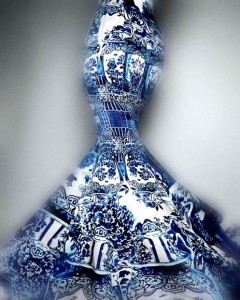
Cavalli’s dress adds to the discussion of cultural representation, but does not do so insensitively.
This dress is aesthetically beautiful. The shape of the dress adds to the elegance. White and blue are the two dominant colors. The shapes appear to be floral patterns. Only the bottom two thirds of the dress are visible in the image. The viewer only sees below the waistline to the floor. From the waist to halfway down the leg, the dress is very form fitting but then opens up and is loose and flowing around the feet.
If the viewer knew nothing about this particular dress it would be easy to assume there were no cultural associations and it was just a beautiful dress. However, with background knowledge the viewer would know that this particular dress by Cavalli was a part of the China Through the Looking Glass exhibition. The Western designer found inspiration for the dress from Chinese vases from the Ming dynasty. When comparing the two objects side by side the shape of dress matches the shape of the vase, and the curvy body of a woman helps the dress to be shaped like a vase. The colors of the dress were derived from the traditional blue and white colors of the porcelain vases. It is difficult to see all of the details that are a part of the designs on the dress, but at first glance the dress designs are very similar to some of the designs on the vases. The fact that the image is cutoff just above the waistline is more of an implication that the body has become the vase.
It is hard to know how informed Cavalli is about the specific designs he used, which adds to the cultural discussion regarding . Although it is common for Westerners to take a piece of Chinese culture and misrepresent it in a negative way, I think Cavalli has simply added to the discussion between East and West in a decent manner.
very nice description of the designed work and would be stronger should you make an argument
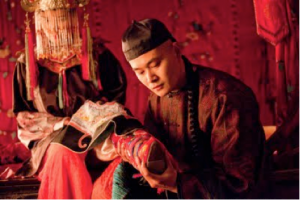 rnate headdress, and the man in the foreground dressed in traditional Chinese apparel examining her feet. The woman’s face is shielded so it is difficult to understand her facial expression, but the man looks very inquisitive. Connotatively, one might assume only the woman’s face is covered because women were seen as more submissive than men, and during this time covering everything was the norm for women. The man seems to not only be looking at her feet, but also judging them and seems appealed that this woman went through the foot binding process. Her face is less important than the fact that her feet are bound and that she is properly expressing the female image. stay with the statement of “the boundfeet as man’s sexual desiring object.”
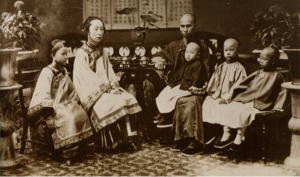 o symbolize the female image of Chinese culture. The men are looking at the camera, they appear more relaxed while the women’s feet are bound, and they are sitting very submissively making a conscious effort to not look towards the camera.