
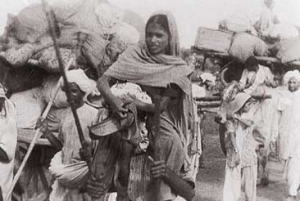
Refugees often had to travel hundreds of miles-by foot, caravan, etc- to cross the arbitrary border separating the new states of Pakistan and India.
The social impact of Partition-though clearly astonishing in its horrific scope- has only rather recently received significant academic attention, having long been ignored in favor of the complex politics of 1947. In the mid-1980s, however, the reemergence of communal violence in New Delhi (this time between Hindus and Sikhs) sparked the interest of sociologists, anthropologists and historians alike. The memory of the harrowing violence, bloodshed and loss of Partition resurfaced in the collective South Asian psyche, at last calling for an investigation into the outstanding humanitarian crimes of this period.
The discovered statistics of human loss that came of this frenzied study are truly appalling. As the brief description in “Blood: Communal Violence” suggests, the sheer number of violent deaths and injuries on both sides of the newly established border boggle the mind and revolt the senses. But casualty numbers-while in many ways useful to any academic (or politician)- still fail to do justice to what might be considered the greatest tragedy of this deplorable event: the incomparable gendered violence committed against the women of South Asia. Hundreds of thousands of woman and girls of both communities were raped, mutilated, tortured and abducted in one of the worst occurrences of sexual violence in recorded history.
But this epoch has been defined not only by this outstanding sexual violence, but by the pervasive silence that has characterized this type of violence. Literary depictions, male witness accounts, and the Fact Finding Organization established by the Indian Government all testify to the unfortunate reality of this sexual violence. But numbers and second-person narratives are chilling both in that they convey the magnitude of the gendered violence of this epoch, but also in that it takes away women’s voice and subjectivity. It is important to remember that for every hundred young women gone missing, it is much more than a hundred missing female bodies; it is one hundred people, each with an individual story belonging to the pages of human history.
But many of these personal stories remain unspoken, shrouded forever in silence. For one, despite the efforts of the Indian and Pakistan governments, many abducted women and girls were never located. And for those women and girls who did survive the various traumas of partition, the vast majority have chosen – whether or not of their own accord- to remain silent about their ordeal. The reasons for this silence varies, and is discussed in detail in another section.
This silence renders the few accounts that have been shared all the more valuable. These accounts- though at times discomforting in the horrifying reality of partition violence- place a much needed face on the anonymous character of the violated and abused South Asian woman, bringing to life a tale too heavy with detached numbers and details.