
In the midst of this chaotic communal violence- the killing, rape, abduction, pillaging and looting of the people of the Punjab and Bengal- India and Pakistan became two independent states, at last throwing off the yoke of British colonialism and establishing themselves as modern states in the immediate aftermath of the second World War. Though the major religious communities would soon find themselves embroiled in a campaign of unimaginable communal conflict (indeed, had already begun to engage in such inter-ethnic combat the year before), Muslims,
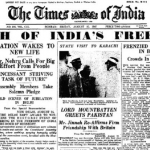
Headline News: August 15th, 1947
Hindus and Sikhs alike gathered on August 15, 1947 to celebrate the success of their independence struggle. Jawaharlal Nehru, the first prime minister of an independent India, hoisted the national flag above the Lahore gate of the Red Fort in Delhi, amidst cheers from a massive crowd. The extended struggle for independence had paid off at long last, and the hundreds who had sacrificed their time and lives had not died in vain, even if independence came with a truncated version of the India they had imagined.
But these independence celebrations were short lived. The newly formed Indian government was immediately faced with the national crises caused by Partition’s communal violence. And none was more intimidating, more controversial or more politically defining than the issue of abducted women. Before the newly appointed and elected officials could settle in their offices, before even the office supplies and documents could be properly partitioned between the two states in the same way that the country had been divided, the Indian government had to respond to the public’s outstanding and very vocal outrage at the mass abduction of their women and girls. And the Indian government- formed on secular and modernist principles- would find it much harder than they had hoped to escape the religious communalism that pervaded the population it was to govern.
Whether because of their own ideals of the symbolic role of women in maintaining community honor, or perhaps merely because they understood the importance of appeasing an enraged populace (but most likely some kind of fusion of the two), government officials immediately and publicly expressed their displeasure and concern at the reports of mass abductions occurring across most of Northern India. One MP in Parliament asserted what the incensed men of this beleaguered nation most wanted to hear, that the Indian state did not and would not view this issue with equanimity:
“If there is any sore point or distressful fact to which we cannot be reconciled under any circumstances, it is the question of abduction and non-restoration of Hindu women. We all know our history of what happened in the time of Shri Ram when Sita was abducted. Here, where thousands of girls are concerned, we cannot forget this. We can forget all the properties, we can forget ever other thing but this cannot be forgotten.”
Notable for its explicit reference to Hinduism (despite the acclaimed secularism of the new Indian state), this statement also stands out for the official’s frustration over not only the abduction of Hindu and Sikh women, but for their “non-restoration,” foreshadowing the incredible lengths to which the state would go to restore these kidnapped and dishonored women. Prime Minister Nehru would reiterate this frustration in a letter dated April 4, 1947, little less than a month after the particularly brutal violence in Rawalpindi:
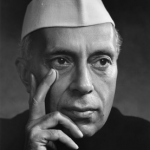
Jawaharlal Nehru
“There is one point, however, to which I would like to draw your attention, and this is the issue of rescuing women who have been abducted or forcibly converted. You will realize that nothing adds to popular passions more than stories of abduction of women, and so long as these … women are not rescued, trouble will simmer and might blaze out.”
The sentiment expressed in this letter, though, is more than mere frustration. It is clear that whatever his personal disgust or empathy with the mass abduction of innocent women and girls, Nehru also understood the pivotal importance of this issue for the state’s legitimacy of power, and the necessity of the state’s intervention to appease a people who’s confidence in the newly established institution was shaky at best. The “Women’s Question” would reveal much about the state’s struggle to define itself, and the surprising continuities of an allegedly modern state with its traditional past.
But whatever the underlying motivations (discussed in the next section), the Indian and Pakistani states quickly reacted to the issue of abducted women, adopting a number of ordinances (and eventually a bill) and establishing an elaborate system to rescue and rehabilitate their “innocent sisters” who had been so violated.
As early as November 23, 1946- before India and Pakistan were even officially divided- a resolution was proposed by Dr. Rajendra Prasad, and adopted by the Indian National Congress at Meerut.
The Congress views with pain, horror and anxiety the tragedies of Calcutta, East Bengal, Bihar and some parts of Meerut district… These new developments in communal strife are different from any previous disturbances and have involved murders on a mass scale, as also mass conversions… abduction and violation of women, and forcible marriage. Women who have been abducted and forcibly married must be restored to their houses; mass conversions have no significance or validity and people must be given ever opportunity to return to the life of their choice.
Communal violence escalated at such an unexpected rate, however, that the two governments realized that a mere declaration of disapproval and illegality of abductions and forced conversions was hardly enough to deal with this colossal crime of humanity. As early as September 3, 1947, representatives of both new states met to design a plan to rescue abducted women and restore them to their “proper” fold. On December 6, 1947, at an Inter-Dominion Conference in Lahore, the two states agreed upon steps to be taken for the implementation of this rescue, restoration and rehabilitation.
This meeting in December (the Inter-Dominion Treaty) was especially important in that it officially set out the specific plans, goals and methods to be used in the Rescue and Rehabilitation Program-which came to be known as the Central Recovery Operation- of the lost daughters of the Indian and Pakistani states. Ordinances were passed in both countries that remained valid until 1949 in India, and even longer in Pakistan. The Indian Government legislated an act (The Abducted Person’s Act, 1947) to facilitate the operation in India and create a “working definition” of what was meant by the term “abducted person.”. Some of the provisions of these ordinances and the act are listed below, and are important to know in order to begin to understand the long-lasting implications for the role of women in the new “modern” Indian state.
- The recovery operation itself was placed under the purview of the Women’s Section, Ministry of Relief and Rehabilitation, with Mridula Sarabhai as Chief All India Organizer, and Rameshwari Nehru as the Honorary Adviser (that it was largely women who shouldered the task or rescuing and rehabilitating women is worth further discussion, and I address this particularity in Social Workers).
- The Primary Responsibility for the actual recovery of women lay with local police, who would accompany the social workers (mostly females) when they visited villages where abducted women were reportedly kept.
- The rescue work was to be run by a social worker assisted by a unit comprised of: one ASI (Assistant Inspector General), two DSPs (Deputy Sub-Inspectors of Police), fifteen inspectors, ten sub-inspectors, and six Assistant Sub-Inspectors. The entire operation was heavily manned and well-funded.
- A tribunal consisting of judicial figures, and at times one social worker, would decide the fate of women who resisted restoration to their “correct” state, after hearing the case. After this decision was made, there was little/no recourse for a woman who as not granted her “wish.”