
Rather ironically, it was a comment made by an Indian politician during the Constituent Assembly Debates that turned my attention to the more spiritual and mythological explanations behind society and the new state’s preoccupation with the dishonor of women and girls.
“If there is any sore point or distressful fact to which we cannot be reconciled under any circumstances, it is the question of abduction and non-restoration of Hindu women. We all know our history, of what happened in the time of Shri Ram when Sita was abducted. Here, where thousands of girls are concerned, we cannot forget this. We can forget every other thing but this cannot be forgot… As descendants of Ram we have to bring back every Sita that is alive.”[i]
It is ironic given that India had just been established as a secular democracy, in opposition to the new Islamic state of Pakistan. And yet a government body was quoting a religious text (the Ramayana) as the reason for which legislation should be passed, funding be allocated and a new government body be created (Rescue and Rehabilitation, Women’s Section, under Rameshwari Nehru).
In retrospect, had I stopped to consider what I already knew- that millions of people had been killed, more displaced, and thousands abducted in the name of religious affiliation and difference- it becomes much less surprising that religion and its mythological origins should play some kind of role in the prevalent mentality concerning women and honor. As people killed each other for the “crime” of belonging to the “other” religion, communal affiliations generally grew stronger, and people likely turned to their Holy Texts (whether that be the Qur’an or the Vedic texts) to assert the identity for which they were being targeted.
The Hindu text referenced in the Constituent Assembly Debates is the Ramayana, one of the two great Hindu epics, and the most pertinent Holy Book given the situation at hand: the rape and abduction of an estimated 100,000 women. It is in the Ramayana that the greatest known abduction of Indian history occurs: the kidnapping and imprisonment of Sita, the Goddess of Wealth and Fertility and consort of Sri Rama. The tale contains some striking parallels to Partition abductions and their aftermath. Though composed in 300 B.C.E, the epic is based in 1500 B.C.E., making it difficult to ascertain the cultural influence; that is to say, it is difficult to tell to what extent life imitates art or vice versa. It is likely that the men’s attitudes towards Sita (following her abduction) are a reflection of pre-existing custom, but as the Ramayana has preserved this tradition as literature, and it was a known text to most all Indians regardless of literacy level, it likely influences men’s continued obsession with female chastity.
Sita’s Abduction and Rescue
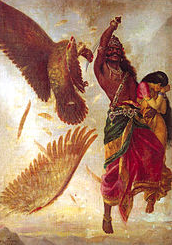
An artistic depiction of Sita’s abduction by Ravana
When Sri Rama is compelled to leave Ayodhya by his mother, he spends his exile in the forests of Dandaka with Sita and Lakshmana, who renounce the comforts of palace life to accompany him. In these forests, Ravana, the King of Lanka, disguised as a holy-man, abducts Sita. She is kidnapped while Sri Rama is away hunting a golden to please her. Ravana takes her back to his kingdom in Lanka, where he keeps her imprisoned in one of his palaces. She is kept here for a year, throughout which time Ravana expresses his desire for her. However, Sita resists and struggles to maintain her chastity. After some failed rescue attempts by various Gods, Sri Rama manages to rescue Sita in the glorious Battle of Lanka.
Upon rescue, Sri Rama makes Sita walk on fire to prove her chastity, so as to set a precedent for human society that no man and woman shall lay together outside of the bonds of marriage.
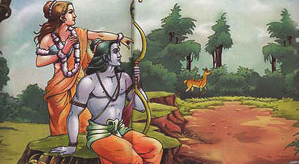
Artistic depiction of Sri Rama with Sita
Sri Rama and Sita return to Ayodhya for Sri Rama to be crowned king with Sita at his side. Some people begin to question Sita’s purity, despite Sri Rama’s conviction that she has remained chaste. Sri Rama hears of an incident in which a washerman, (while berating his wife) claims to be “no pusillanimous Sri Rama who would take his wife back after she had lived in the house of another man.”
Refusing to allow slander to undermine his rule, Sri Rama sends Sita away, though he still believes her to be pure. Sita goes into exile, pregnant with Sri Rama’s child. She is given shelter by a hermit, Valmiki, who takes her in despite others telling him not to as Sita is allegedly impure. It is here that she delivers her twin sons, Kusha and Luv. Sita raises her two sons as a single mother. Her sons grow to be valiant and intelligent.
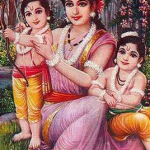
Sita single-handedly raises her and Rama’s twin sons
Sita’s sons are eventually reunited with their father. When she sees her children’s acceptance by their father, she seeks refuge in her mother Bhumi (the Earth). She pleads to be allowed back into the Earth to escape a world that has been unjust and rarely brought her happiness. The Earth opens for her and brings her to another world (back to Sri Rama as Vishnu in his abode).
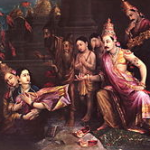
Sita returns to her Mother, the Earth, after her dishonor and long exile
There are several parallels in this tale to the tragic events of Partition. In fact, it seems nearly prophetic that this text should have so pre-dated Partition, as Sita is esteemed as a paragon of spousal and feminine virtues for Hindu women. She is the literary and religious symbol of the ideal Hindu woman, and so the fact that her abduction, dishonor, and resulting tribulations should so mirror those of Hindu women in the mid-twentieth century is remarkable. But it is also not coincidental. Anyone familiar with the text (and that encompassed most of Indian society) would naturally associate the abduction of their own women with that of the symbolic mother of India. Ravana might be equated to the lustful men of the “Other” community, and Sri Rama’s need to prove Sita’s purity resonated with the men of India. Like Sri Rama, many men rejected their wives, sisters and daughters to avoid association with their impurity; so many women during Partition were essentially exiled like Sita. In fact, many were also pregnant.
Thus, the role of the woman as the repository of male and community honor has a religious foundation as well, and the Ramayana has arguably served as an example (and even guide) to the attitude one ought to adopt in the face of dishonor, as well as what attitude to expect from society. In Pinjar, Puro’s father clearly has been influenced by some aspect of religion and culture, concluding that he- like Sri Ram, his great mystical ancestor- could hardly keep a disgraced female family member due to the inevitable judgement of others.
https://www.youtube.com/watch?v=XfexlE14hzY
While the similarities of the reactions of the men in both the epic and during Partition are striking, from their shared rage at their dishonor to their eventual renunciation of the women themselves (“such women were better off dead”[ii]) , the most tragic parallel is indubitably Sita’s pleas to her mother Earth. Most of the women abducted and sexually violated during Partition could not but have identified with this Goddess’ cries at the life she had had to endure, and her imploring to be given respite from such a cruel and unjust world.
[i] Constituent Assembly of India (Legislative) Debates, December 15, 1949, pg. 642
[ii] Kamla Patel