
“Whenever women serve as the boundary markers between national, ethnic and religious collectivities, their emergence as full-fledged citizens with concomittant rights will jeopardized.”
-Ritu Menon and Kamla Bhasin
“There are many young, half-mad women who keep laughing-perhaps at all of us, at the country, at religion and the propagators of these religions, at governments and their laws. Maybe they laugh at freedom-who knows what they’re laughing at?
-Anis Kidwai, Azadi ki Chaon Mein
The Rescue and Rehabilitation Operation bore no coincidental resemblance to the Vedic tale of King Ram saving Sita from her forced imprisonment by the evil Ravana. That several Indian government officials made blatant references to this legendary abduction only reinforces this parallel. The Indian State was depicting itself as Ram, saving Sita (the figure of the abducted woman) from the impure and evil grasp of Ravana (the Muslim, Pakistani man).
But there is a key difference between Sita and the hundreds of thousands of women and girls who were kidnapped or displaced from their original homes- Sita is (for all intents and purposes) a fictional character, and one who wanted to be saved. The reality lived by these real, abducted females was significantly more complex than the Indian State has ever admitted, even decades after this program has ended. Though this government has been applauded for its exceptional effort to restore its citizens, the language used by various government documents, speeches, and debates masks the reality of the violent nature of this program and the flagrant violation of citizen rights that it entailed.
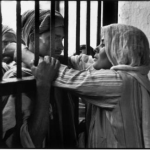
As is the case in most social histories, numbers are used – whether or not intentionally- to silence the personal stories of those actors whose testimonies might threaten whatever theme a historical narrative is trying to reinforce. In the case of the Indian government’s restoration of abducted women, success was spelled in the tens of thousands of women that government officials had managed to “rescue” from the “deplorable” conditions in which they’d been “forcefully” held captive. Boasting these successes and publicly congratulating the hard work of its social workers in building and maintaining rehabilitation centers in major Indian cities was meant to depict the Indian state as a paternal and civilized modern state upon which the Indian population could depend.
Ironically enough, it was a leader of this Operation who voiced concern over the management of the Rescue and Rehabilitation program, and the manner in which the Indian government was measuring its success. Rameshwari Nehru, who was appointed honorary advisor of the program and was in charge of the Women’s Section of the Indian government, believed that numbers alone did not measure the success of this particular endeavor. Social workers and legislators of the Abducted Person’s Act needed to look at this particular issue from the “human and woman angle,” for this crisis was simply too personal an issue to be managed at the administrative level.
Rameshwari Nehru was not suggesting that the Indian government should abandon this project as an unworthy investment of time and money. It would be a mistake to propose that this entire operation was misguided and that the government officials who advocated its creation were merely driven by ulterior motives unrelated to the well being of abducted women. This is by no means what I wish to argue, for there were hundreds of girls to whom the Indian government truly was a modern-day Ram, removing them from an environment they truly wished to leave. But I do believe that an analysis of social worker’s memoirs about their experiences working for the state reveal that there was an undeniable component of coercion and violence in the restoration of some women to their prescribed nation. Further, this violence was undertaken for a cause that was unquestionably religious and patriarchal, thus invalidating India’s claims to secularism and modernity.[i]
The 2007 film, Partition, captures the difficult decision facing a Muslim woman who has been “abducted” and then willingly married to a Sikh man, yet wishes to see her family who now live in Pakistan. She easily crosses the border, unlike her Sikh husband, but her wishes are foiled when her brothers refuse to allow her to return to her husband and child “for the shame it brings their family.” This is just one occasion of a woman’s heart being rendered in two, a partition of the soul that made choices impossible, even had she been allowed to make them.
https://www.youtube.com/watch?v=V-vh2W4qEs4#t=71m40s
It may be difficult to understand how any woman who had been abducted and forcibly converted and married could possibly resent being removed from this seemingly undesirable existence. But the vast majority of us cannot possibly imagine what this experience was like for the hundreds of thousands of women and girls who had to endure it and survive in whatever way they possibly could. It is not unheard of that those who are held against their will develop a relationship with their captors, sometimes forming complex and real relationships with those who had initially disrupted their lives. Now referred to as “Stockholm Syndrome,” this was more than merely a strategy of survival. Abducted women and girls had no way of knowing that the Indian government would ever locate them, that their families had even reported them missing, or that they would ever be accepted back into their communities and families. Women were not blind to the realities of their position as the embodiment of honor, a fact made abundantly clear by the numerous testimonies by female survivors who express a saddened acceptance if not complete apathy for their disposability. There was every possibility that some of the women abducted would spend the rest of their days as forced converts and wives of men they had no choice but to wed, so why not accept this possibility and make the most of it by taking on the role imposed upon them.
After all, was this so very different than the lives they had faced in their original homes? Even in times of peace, women had little to no say in their sex and love lives, and certainly no choice whether or not to bear children. Their abduction was an irrefutably traumatic and violent disruption of their lives, but perhaps not one to which the vast majority would have been exposed to some degree regardless of Partition.
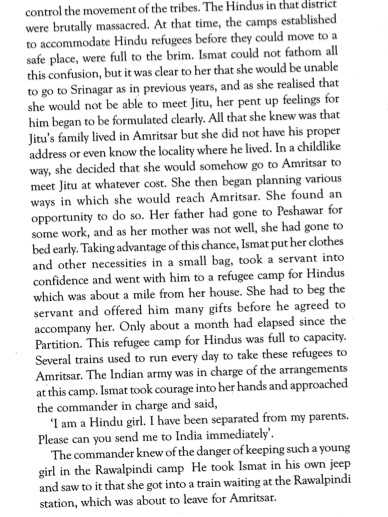
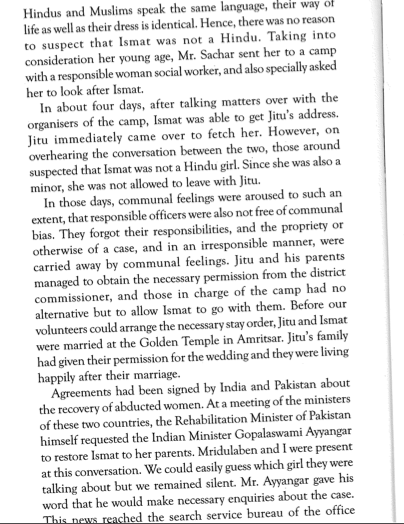
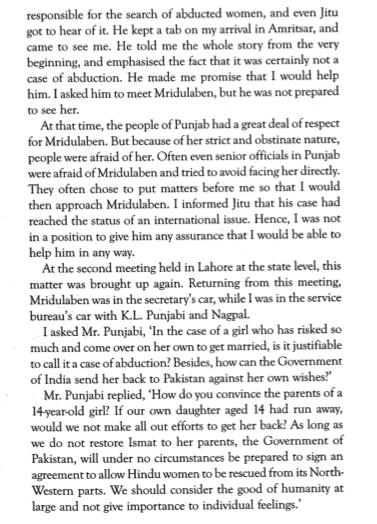
Below is a story of a couple (a Muslim woman and a Hindu man) Kamla Patel had met in her time as a social worker. She narrates their story in her memoir, Torn From the Roots:
Ismat and Jitu:

Ismat and Jitu 1
Ismat and Jitu 2

Ismat and Jitu 4
Ismat and Jitu 6
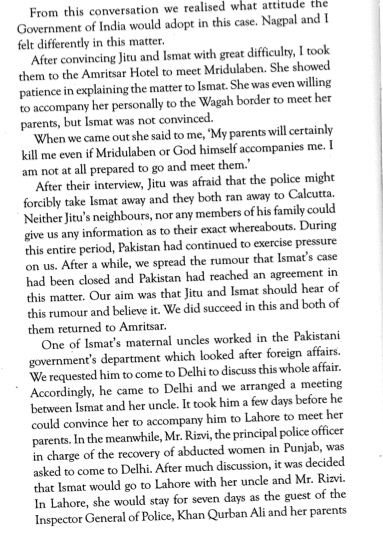

Ismat and Jitu 8
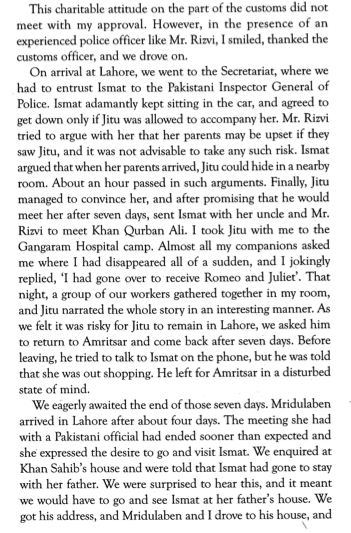
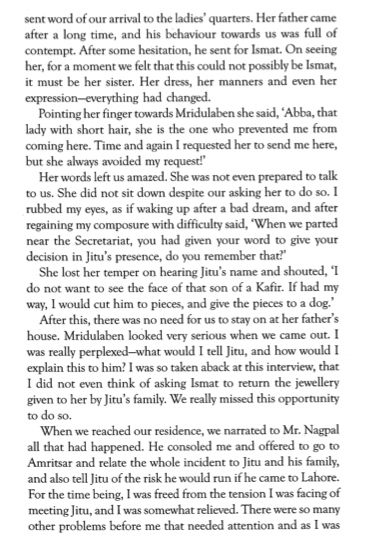
Ismat and Jitu 11

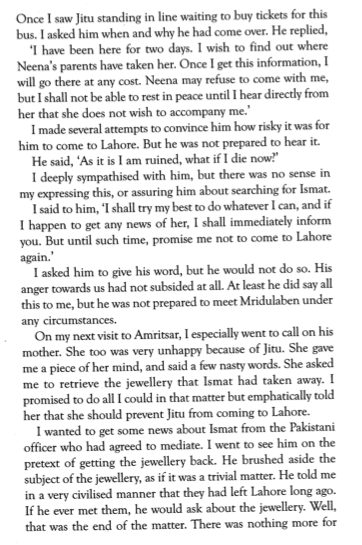
Ismat and Jitu 13
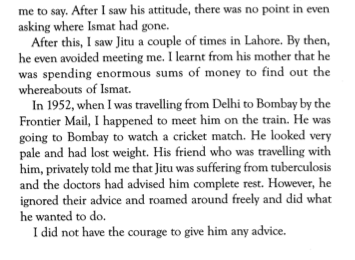
Ismat and Jitu 14
Why didn’t the Indian government provide any real opportunity for these women (for whom they had expressed such concern) to express their wishes? Or to even choose which nationality to which they would rather belong? This was, after all, a choice provided to all other South Asians living in the Punjab and Bengal. Why not too then the abducted woman who had already endured far more than anyone ought to?
The issue was that by claiming that non-Muslim women fell under the purview of the Indian government (and Muslim women under that of Pakistan), the Indian government was:
- Defining citizenship on the religion of abducted women.
- Defining nationality as belonging to a state, but by first and foremost belonging to the “correct” religion.
- Assigning-without her will or consent- the abducted woman to a nationality based on her religious affiliation prior to an arbitrarily set date, and thus re-validating the age-old tradition of symbolizing a community through the body of a woman.
The irony is evident: The Indian state was using the issue of abducted women to define what “Indian citizenship” meant and entailed by assigning a nationality to women based on their religious affiliation, all while denying these women the very rights implicit in a citizenship of a democratic and secular state.
Not all government officials were blind to this hypocrisy. One, Renuka Ray, called for greater attention to discrepancies in varying cases that were brought before the Rescue and Rehabilitation tribunal, pointing out that even if it were only one of every one hundred cases, a case of a woman who chose to remain in her second home must be considered and “given heed.”
“Would it not be another act of violence if they were again uprooted and taken away against their wishes?”[ii]
Here it was, admitted by an employee of the government itself: once again, women’s power of agency was being contained by the authorities of a patriarchal society.
Whereas in the case of honor killings women’s agency was confidently asserted in the historical and cultural narrative, that of women who resisted the dictates of the Indian government’s Rescue and Rehabilitation program was ignored. Even when a woman’s case was brought before the tribunal, the woman was rarely considered to be a “free agent.” If she chose to remain in the home of her abductors, it was assumed that she was choosing this because she was in a context of fear and coercion on the part of her abductors, and thus her agency was not her own. Yet this reasoning was not considered if she chose her “right” home, even if her family were placing the same pressures on her decision-making as her new one.
Think back to Basant Kaur’s description of the fear she and her female peers felt when choosing to commit mass suicide, and the discrepancy between this memory of fear and Manghal Singh’s assertion that the women martyred in Rawalpindi knew no fear. In the case of female agency displayed in honor killings, the context of their decision-making (arguably replete with even greater fear and male pressure than that of the Rescue and Rehabilitation tribunal) is not considered at all. Why then is it so central to the understanding and restriction of female agency in the second case?
I believe that the key difference is the type of agency being practiced by women, or rather the goals of their agency. Female agency is not necessarily circumscribed in a patriarchal state – be that colonial or “modern”- but only if the agency being practiced is preserving the status quo and hierarchical order of things. In the case of honor killings, women must be depicted as having a great deal of agency in their choice to commit suicide or allow themselves to be martyred because honor killings would otherwise take on a violent nature that does not prescribe to the patriarchal ideal of the passive woman and protector husband. But in the case of the restoration program, female agency must be silenced completely, with any dissenting voice being attributed to a her “lack of free agency,” so as to disguise the state’s violence and violation of citizen rights. Female agency is not nonexistent, but it is certainly reduced to a mere tool of the patriarchal authorities.
[i] I would like to qualify this statement by stating my personal belief that even modern states were/are by any means not really non-patriarchal.
[ii] Other side of silence, 137