
As discussed in the section addressing the incomparable sexual violence that defined Partition, the study of the social and gender-specific experience of India’s Partition is a relatively recent addition to the vast collection of political research on this cataclysmic event. For several decades following Indian independence, there was little to no public discourse about the mass rape and abduction of women and girls of the Hindu, Sikh and Muslim communities. This pervasive silence was likely due to a variety of factors, just some of which I have addressed in the following sections (Prolonged Silence, ‘Honor’), which have to do with the particular status of women in South Asian society.
The 1980s did at last bring increased interest in this subject matter, as scholars like Urvashi Butalia, Ritu Menon and Veena Das shed light on the unspoken women’s history of 1947, from victims of rape to widows and women dislocated from the homes they had before barely left. Interviewing women of various religions, class, ages and experiences, pioneering researchers unearthed narratives of women who had never articulated their experiences, adding a much needed chapter to India’s modern history.
But even with this impressive emergence of before unspoken narratives from Indian and Pakistani women, the history to date on this subject is not enough. This is not to say that this endeavor (the unearthing of a gendered historical perspective on Partition) is not an entirely worthy one. Indeed, the necessarily innovative use of generally scarce sources is a great practice in historical research and lends to new perspectives on the past. Recorded interviews and testimonies, journals, diaries and memoirs – of which this history is mostly composed- have been highly criticized in academic society as unreliable and subject to bias and the faulty memory retrieval of said witnesses. But this particular history has shown these sources to be no less critical to a comprehensive understanding of India and Partition than any governmental document.
Rather, the issue rests in the innumerable questions that these silences (once they are finally included in the historical narrative) demand answered. Though hardly the first time that the study of a woman’s history was delayed to that of society (i.e. men) at large, the fact that this particularly notable piece of the history of Partition remained silenced for so long made me wonder:
- How are such historical narratives created, and by whom?
In most every historical narrative, there are implicit silences, both out of convenience and necessity. It would be impossible, and not particularly useful, to include every minute detail of any historical moment; it is-after all- far too difficult to establish temporal parameters for Partition conflict (When did it really begin? End? Has it ended?) and somehow incorporate the personal tales of the millions of South Asians affected by this tragedy- the hundreds of thousands of female victims included.
Some silences are due to technical matters; that is to say that some sources are more accessible than others. Government documents-for example- tend to be better preserved on the whole than personally kept diaries and journals. Further, Partition occurred at the precipice of the technological and communications revolution. Events that might have been better documented (by film, photographs, etc.) in today’s world were lost to the pages of history in 1947 India.
However, other silences are not simply matter of facts of an imperfect world. Some silences are not mistakes, but are explicitly suppressed from the overarching narrative, hidden behind other facts or versions of the historical reality. In the case of the long silenced sexual violence of Partition, there is clear motive for an active censorship of this facet of history: mid-century India’s obsession with sexual purity and –above all- honor. Thus, I hypothesize that historical narratives are created by weaving together facts that do not threaten the legitimacy of those who are meant to maintain this honor- men and the state.
- What other aspects of Partition and gender-specific history remain silenced?
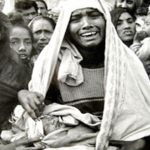
1984 New Delhi Riots
Nearly forty years separate Partition and the initiation of a study of this period’s sexually violent nature. And one might argue that this history may very well have remained silenced had it not been for the triggering event of Indira Gandhi’s assassination. The reemergence of not only inter-ethnic feud (this time between Hindus and Sikhs) but also the sexual violence with which it was accompanied left no room for further ignorance. The subjugation and victimization of women could not be so easily hidden in the era of the press and television.
Though this topic was-and still to some extent is- a societal taboo, it has become a part of the historical narrative of Partition specifically, and South Asia at large. And given the continued animosity between India and Pakistan (and Hindus and remaining Muslims in India), this history fits quite neatly into the political narrative that pits these two states (and religious communities) against one another.
However, the fact that it took forty years for this history to garner real academic and public attention suggests that different histories- or rather varying silences within history- come to light at different times depending on the changing exigencies of the present. This made me wonder what other facets of women’s history of Partition had yet to come to light, and have remained in silence due to the difficulties they presented to the standing narrative.
What I found- through the scarce recorded interviews, journals and memoirs of people who had survived Partition or who witnessed the human destruction of the years spanning from 1946-1950- was rather an expansive continuum of sexual violence that not only included violation of women of opposite communities, nor was it limited to the years of the Partition. There are silences of the sexual violence of Partition that have yet to be fully discussed in the way that the rape, molestation and kidnapping between communities has been.
Two acts in particular caught my attention as acts of unquestionable violence that have somehow failed to be truly integrated into the historical narrative of Partition:
1) Honor Killings: The choice of some women to either commit suicide, or accept to be killed, rather than be captured and raped by the opposite community. The most prominent case of these honor killings is the tragedy of Thoa Khalsa.
2) Rescue and Rehabilitation Programs of the Indian and Pakistani Governments: Responding to the outrage of the community at the kidnapping, forced conversion and marriage of their women and girls, the newly independent Indian government – in tandem with the Pakistani government- organized and funded a Rescue and Rehabilitation Program led by Mridula Sarabhai and Rameshewari Nehru in order to “rescue each and every Sita.”* Women social workers were employed to run Rescue camps. But their various reports, memoirs and testimonies demonstrate the coercive measures that both governments employed to forcefully return even other women and girls who had found comfort in their new homes, subjecting them to the equivalent of another kidnapping and life rupture.
These two acts of gender-based violence were central to the Partition, but have in the meantime come to be hushed over and ignored by scholars preferring to concentrate on the violence that occurred specifically between religious and ethnic communities.
The continued silence that surrounds these violent acts is not a coincidence, but is driven by certain motivations. Therefore, it is important to ask why these acts should even occur, but it is equally important to ask:
- How do we define violence? How have these two clearly violent acts escaped categorization with the rest of the violent acts committed during Partition?
- How do we define victims when there is an element of their choice involved in their own violation? And should one choose violence whilst in a environment of familial and community pressure and violence, how do we define choice, or agency?
- How much does Partition/Indian independence represent a rupture with the past? How much is it a continuity of subjugation of social and political invalids, given that the state has committed an act of gender-based violence that exists on the same continuum as that of communal violence?
These questions have yet to be fully answered from the female perspective, in large part because Stree Parva, a woman’s history, has yet to be written. Stree Parva a woman’s history, one about women, written by women. So long as Stree Parva remains unwritten and unexplored, human history will stand incomplete.
*A reference to the goddess Sita, Ram’s consort, who was kidnapped in the Ramayana