
Similarly to the accounts of sexual violence between communities (and indeed Partition history in general), the historical narrative of honor killings is overwhelmingly dominated by the voice of men. The few female testimonies we have are all the more valuable for this, especially given that it was women who were most often subjected to this violence. But this does not mean that men’s voices on the matter should be silenced completely. Rather, men provide a very important perspective on this kind of violence, as its most common perpetrator, supporter and (later) commentator.
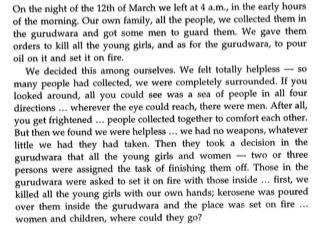
There are various testimonies of men who either witnessed or partook in the violence of honor killings. Below are the accounts of just three of these men, whose testimonies capture not only the motives behind honor killings, but also the (I would argue false) understanding of women’s agency in this kind of violence. All three accounts capture what I believe to be crucial themes that run through honor killings narratives:
- Honor killings were thought of as honorable sacrificial events; men who killed their women were doing them a favor by saving them and themselves a dishonor.
- Women were choosing to be killed or commit suicide; their power to choose was in keeping with the patriarchal order.
- Honor killings were not considered a violent event. Because women were making this decision, and are by definition non-violent beings, honor killings could not and were not considered violent.
Manghal Singh
M.S. 1
M.S. 2
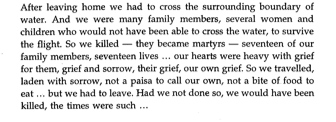
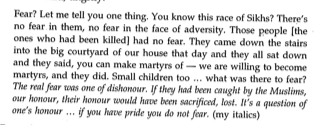
Manghal Singh’s testimony not only reinforces the argument made by most male witnesses and perpetrators that they were not killing their women so much as martyring them-denying the woman their label as victims and instead elevating both the women and themselves to a “heroic” status- he also makes a remarkable claim about fear that stands as a stark contrast to Basant Kaur’s description of the fear she herself felt. Manghal Singh makes the outstanding claim that Sikhs do not feel fear-indeed that the women he and his male relatives killed (“martyred”) were not fearful of death, but only fearful of dishonor. Manghal is speaking for women who are no longer alive to speak for themselves, denying these women subjectivity so as to justify his actions, and isolating honor killings from other incidences of violence. This is a tactical maneuver, even if it is not a conscious one. By denying women this subjectivity, and removing them from the category of “victim,” Manghal and men like him render honor killings a non-violent act that glorifies-rather than questions- traditional notions of honor and patriarchal right.
Gurmeet Singh
G.S. 1
Bir Bahadur Singh

pg.1
pg.2
pg.4
pg.5
pg.6
pg.7
pg.8
pg.9

pg.10
pg.11
pg.12
pg.13
pg.14
pg.15

pg.16

pg.17
pg.18
pg.20
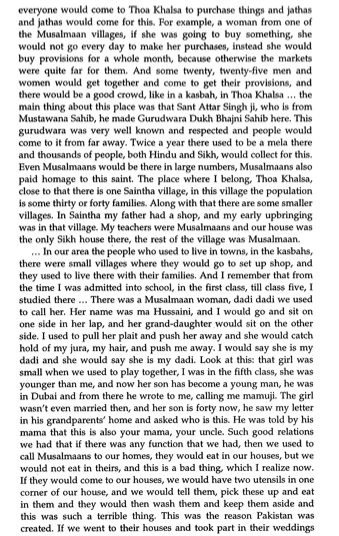
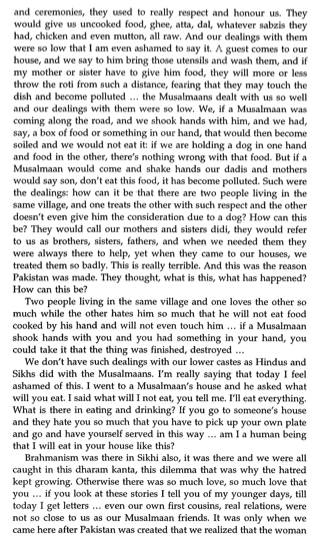
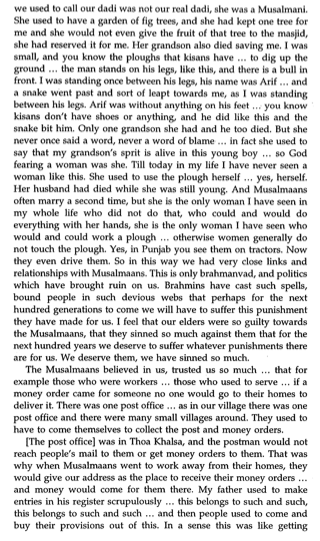
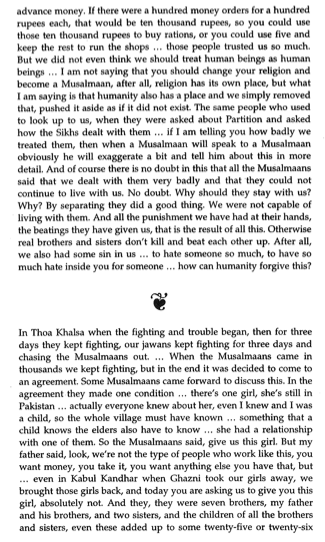
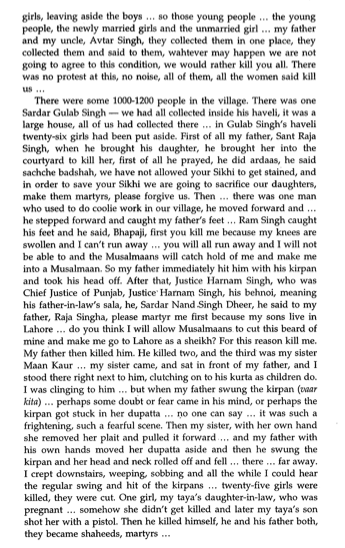
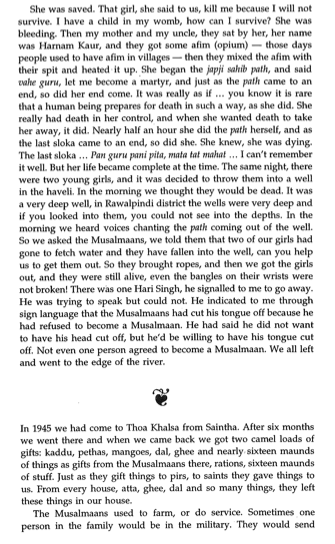
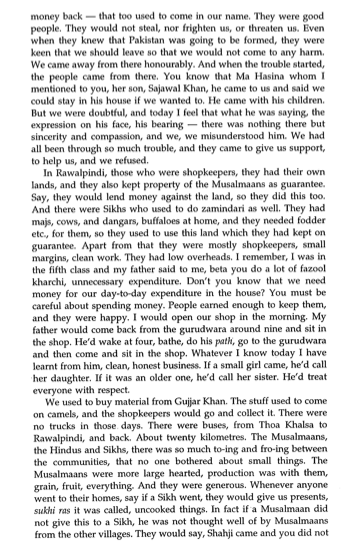
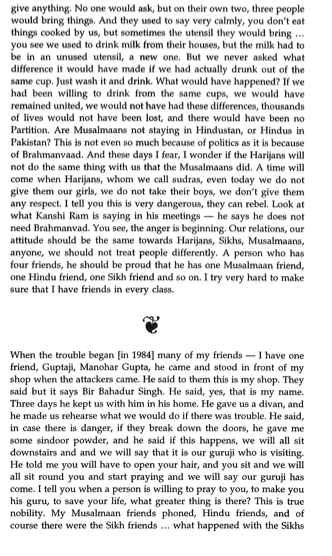
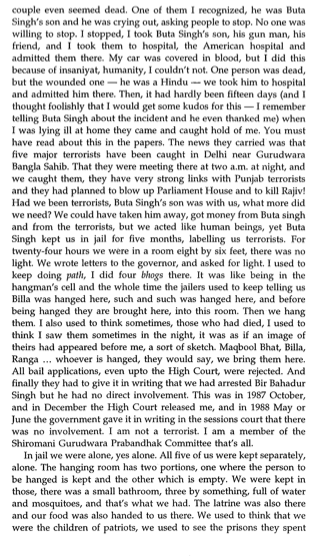
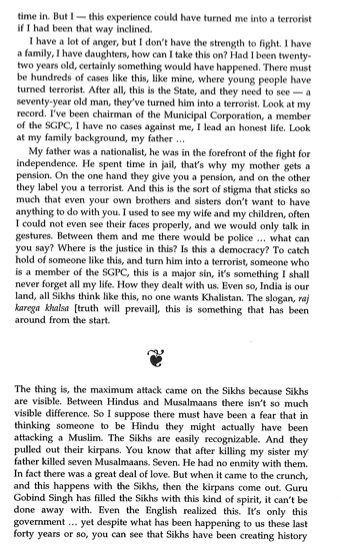
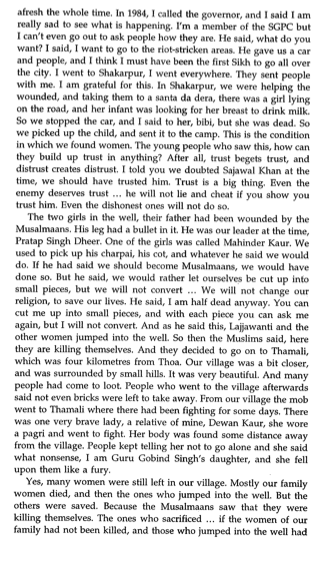
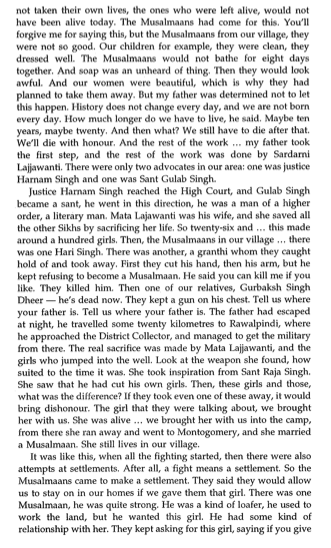
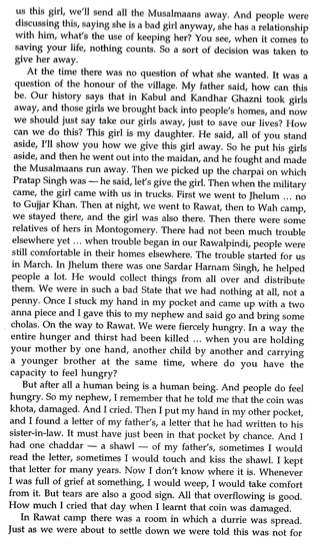
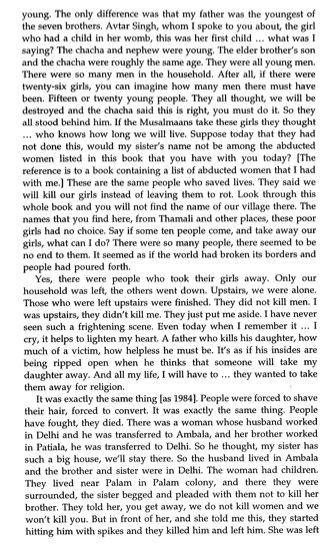
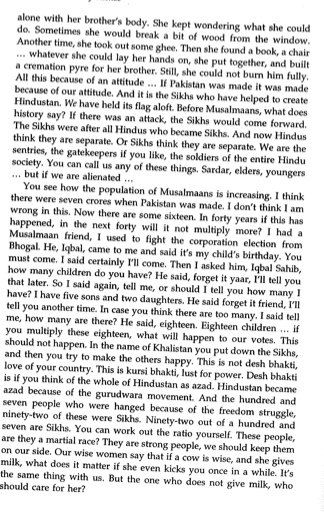
There is much to be taken from Bir Bahadur Singh’s account. It is a detail-laden account that truly contributes to our knowledge about honor killings. And while there are many things that ought to be discussed in this testimony, there are a few things that are most applicable to this particular study, which I would like to outline below:
- Bir Bahadur Singh’s simultaneous glorification of his sister and his father’s heroism and sacrifice.
Of all the appalling, and genuinely repulsive accounts of violence during the Partition, Bir Bahadur Singh’s account of his sister’s murder is the one that truly affected me the most. Whether it was the horrific circumstances themselves, or rather the manner in which Bir Bahadur describes her heartbreaking submission to death, this story remained with me long after I had finished the formal part of my research. But what really struck me was not only the sympathy and sorrow Bir Bahadur expresses for her loss (a shockingly rare thing in most male testimonies of this history), but that which he also expresses for his father. And more than even sorrow, Bir Bahadur expresses unmistakable pride in both his sister’s and his father’s actions in his use of sacrificial language. When he recounts his father’s prayer before using his kirpan to behead his own daughter (“..going to sacrifice our daughters, make them martyrs, please forgive us”), he is sympathizing with more than merely the death of his sister; he is sympathizing with his father’s loss of a daughter even though it is his father who is killing her. It is as if Bir Bahadur feels worse for his father’s loss than his sister’s loss of life. In his eyes, she at least escapes to the next life with her honor intact, but his father “must” give her up. Nothing speaks to this more than his lamentation on the “victimization” of fathers who kill their daughters:
“A father who kills his daughter, how much of a victim; how helpless he must be.”
By implying that his “poor” father was helpless, Bir Bahadur is claiming that his father had no other choice than to sacrifice his daughter, which not only denudes his father of violence, it also depicts him as a hero who did what had to be done.
- Failure to mention that one of the women who survived the mass drowning (whom he refers to by full name) was his mother.
Bir Bahadur Singh admits to lamenting his sister’s loss too, stating that he wept after he witnessed her bloody end. But when he mentions his mother, he does so in a most detached way, not even noting that the women of whom he spoke (Basant Kaur) was not only the survivor from the mass drowning, but also the women who birthed and raised him.
Upon closer examination, what might seem like a disregard for the women in his life seems to be more of a sense of shame. Whereas Bir Bahadur explicitly states his relationship to Maan Kaur, his “martyred” sister, he avoids association with the woman who failed to do what his sister had- sacrifice herself for the honor of the community as a whole. Even decades later, Bir Bahadur senses a shame that his mother- by no fault of her own- had survived.
His silence regarding her speaks volumes- because she did not die for her community, because her agency did not ultimately contribute to the maintenance of patriarchal values of honor, it does not subscribe to the patriarchal historical narrative.