La Spedizione Siciliana

Italian 3008 – Spring 2016 – Professors Barbara Weiden Boyd and Davida Gavioli

  • About
  • Authors
  • LoginPress
  • About
  • Authors
  • LoginPress

The Temple at Segesta

March 25, 2016 By dbanks

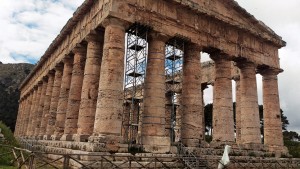
The temple at Segesta served as a good introduction to Doric temples.  Because it is unfinished, it lacks ornament and refinement, such as a friezes and fluting, that might distract from the essentials of its construction.  Regarding its unfinished nature, it is entirely likely that the people of Egesta began building this monument to impress the Athenians who were coming to assess their assets, and then stopped as soon as the trick had been completed.  It was just so cool to see the effects of what we were reading in class over two-thousand years after the events documented by Thucydides.
IMAG0291

           Back to why this temple is such a good template, the monument displays all of the characteristic features of the Doric style of the day, in which all of the temples we saw were built.  It is six columns wide by 14 long, almost the desired proportions, which are an even number of columns wide (x) by 2x+1 long.  These refined proportions and smaller echini help to date it to later in classical Sicily, around 420 BC.  It still has pieces of stone jutting out of the base (the crepidoma) that would have been used to lift and transport the pieces.

           Also, one of the things I found most interesting about this temple was that its base was not flat.  In fact, it was far from flat.  Counterintuitively, this was done in order to give the structure a normal appearance on the hill.  This tendency to distort proportions in order to make this look proportional extends to the spacing between the columns and the entasis of the columns themselves.  This irregularity is in fact fairly normal for these temples.
Filed Under: Sicily

The Cappella Palatina

March 25, 2016 By dbanks

IMAG0246

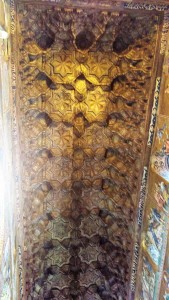
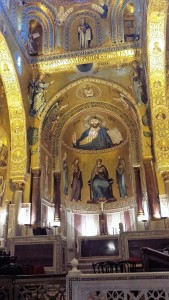
On our second day in Palermo, the group visited the Cappella Palatina, a Norman chapel built in the 12th century under Roger II.  The chapel combines Norman, Byzantine, and Arab traditions in its architecture under the roof of Christianity.  First of all, the main architectural elements are Norman.  The Byzantine features are the mosaic style and triple-apsidal plan.  Muslim influence most obviously presents itself in the muqarnas on the ceiling and the abundance of geometric designs.  Additionally, there are inscriptions not only in the traditional Latin and Greek, but in Arabic, as well. La Zisa, which we toured the day before, is yet another Norman structure in Sicily with strong Arabic influence.  There are plenty of geometric designs and and Arabic inscriptions (mostly on the bowls inside) in La Zisa.  Also, its muqarnas is made in brick instead of wood, revealing that the Normans made the traditionally Islamic feature their own.  However, the muqarnas of the Cappella Palatina separates itself again from that of La Zisa in that it was painted with figures, obviously straying far from Islamic tradition.

IMAG0247

The last interesting thing that I will point out about the Cappella Palatina are the columns.  Not only are such Corinthian columns uncommon in Norman architecture, but it is interesting that original classical columns are integrated into the arches.  The Cappella Palatina is quite literally a combination of the cultures present in Sicily.

Filed Under: Sicily

Pupi

March 25, 2016 By dbanks

IMAG0225

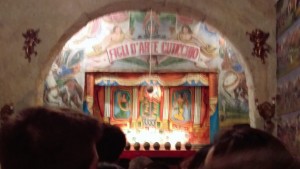
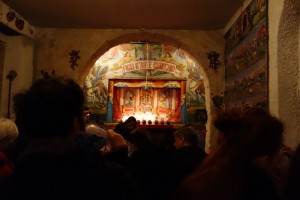
On the first night in Sicily, we all sat down to una opera dei pupi in Palermo.  Though technically an amusement for children (we all know that kid in the front row was getting really into it), the show we watched provided some valuable insight into the uniquely complex culture of Sicily.  The factions of “paladins” and “infidels” pitted against each other, as they are traditionally in the Carolingian cycle, reveal the extent to which some of the more recent cultural influences are the most prevalent.  Though the Arabs took hold of Sicily as early as the 9th century CE and held it for nearly two centuries, the French (of which nationality the paladins are supposed to be) never had a stake in the island.  This goes to show that the Christian influence from groups whose presence we saw, such as in the Norman Cappella Palatina and the Spanish inquisitor’s building, was strong enough to make the island associate more closely to a people that were never there than those who once were.  Although La Zisa, which we saw earlier that day, shows a clear integration of the artistic traditions of the two faiths nearly a millennium ago, this cooperation does not seem to have lasted.  We can confirm that, at least in recent history (since the pupi rose to popularity in the 19th century, which is recent for us classicists), there has been a negative attitude toward Islam in Sicily, or at least one strong enough to sustain the tradition of pupi.

Filed Under: Sicily

Post #7: Motya

March 25, 2016 By kvise

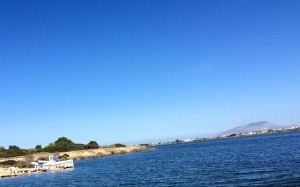
Hey guys! I have to say, I’m getting to the last few posts about Sicily and I’m a tiny bit sad. At least we’ll be ending with some gems.  This place surrounded by crystal-blue water is the beautiful island of Motya. Here, you’ll find some archaeological remains and a small museum including other parts of Carthaginian culture that have been preserved from the port of Lilybaeum, established in 397 BC (Holloway 155).

12115724_904749649560314_170513048429585147_n

Of course, not all the remains found fit with this lovely, picturesque atmosphere above.

What were these rather un-picturesque remains?

Well….

12112084_904749409560338_9150862240411772238_n

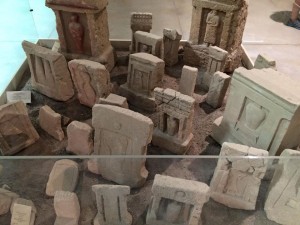
Tombstones, which many scholars believe belonged to children who were sacrificed on the island are featured in the Motya museum :(. Of course, since the Romans were the sworn enemies of the Carthaginians, there are some scholars that believe this was all Roman propaganda. However, the archaeologist Whitaker is thought to have found a Carthaginian altar, called a tophet, where some kind of human sacrifice took place on the island, with evidence that it continued into the second century. (Holloway 155).

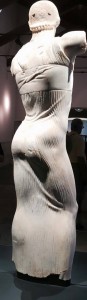
A much less depressing part of the museum is the Motyan Youth, put on proud display at the front of the small building. The statue itself was only recently discovered in ’79 and consequently, still has many scholars clamoring over it. The uniqueness of its stance and its almost seductive, yet strong and some might say masculine figure perplexes many. In addition, it is likely that it was sculpted in the fifth century BC, although there is contention among writers in this also. Scholars such as Bell agree that the youth is a charioteer, due to its dress.

Whatever may be the case, it is beautifully positioned in the museum, and certainly helps visitors to take their minds off the tophet tombstones.

12079649_904749369560342_3095841709180842933_n

Works Cited:

Bell, Malcolm. “The Motya Charioteer and Pindar’s “Isthmian 2″”. Memoirs of the American Academy in Rome 40 (1995): 1–42. Web.
Holloway, R. Ross. The Archaeology of Ancient Sicily. London: Routledge, 1991. Print.

Filed Under: Sicily

Day 2 – Sleepy arrival & Puppets

March 24, 2016 By mkim

After our long journey to Sicily, we met our amazing bus driver, Carmelo, and drove off to start our trip. We had some yummy arancini for lunch and had a walking tour of La Zisa, led by my favorite, Prof Gavioli, who showed us all the important spaces associated with Il Gatopardo. After that tour, I was pretty much a walking zombie…. but the tour could not end there!

That night, we went to see a puppet show. We walked into this small, dim space with rustic wooden benches. From what little I remember (again, I was a walking zombie), the puppets were so beautifully crafted and each had unique costumes. They were well animated to the point where they moved like real people. I just remember all the children sitting on the floor, laughing every other minute and just wondering what it would have been like if I had grown up learning about history through puppet shows.

DSC00647

Filed Under: Sicily

  • « Previous Page
  • 1
  • …
  • 14
  • 15
  • 16
  • 17
  • 18
  • …
  • 26
  • Next Page »

Authors

  • abradley
  • aglynn
  • agorman
  • alamont
  • bboyd
  • cdewet
  • dbanks
  • dgavioli
  • djohnso
  • dvargas
  • gmaslak
  • jglewis
  • jhartley
  • kgilmore
  • kvise
  • mcolbert
  • mkim
  • ssim
  • vwu
  • About
  • Authors
  • LoginPress

courses.bowdoin.edu