
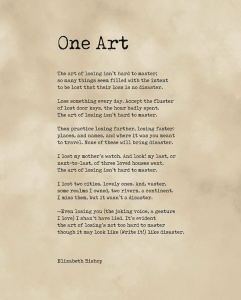
One Art by Elizabeth Bishop
A list of negligible losses introduces us to Elizabeth Bishop’s One Art. More specifically, it is a list of things a person could lose throughout their lifetime. However, Bishop only does this in order to soften the damage caused by the global pandemic during 2020, mixing trivial things with more serious matters. What Bishop is doing in her introduction is an example of a cognitive appraisal process. In Jack Barblet’s book, Emotion, Social Theory, and Social Structure: A Macosociological Approach, a cognitive appraisal process is where “the type and intensity of an emotion depend on the subject’s interpretation and evaluation of its circumstances” (51). In this poem, Elizabeth Bishop establishes her own interpretation as an artform. The “art of losing” she calls it. Downplaying the pain associated with her lifetime of losses, praising the acceptance of loss, and valuing the ability to forget and move forward, Bishop paints her own interpretation of what a model human should do. However, this can be viewed as deep acting. A term introduced by Arlie Hochschild; deep acting occurs when a person actively tries to influence his/her feelings to align them with separate or contrasting emotions. In this case, Bishop says that we must “accept the fluster of loss” and simply ignore the intense emotions tied with grief and depression. We “lose something every day”, she says. And because we do, “the art of losing isn’t hard to master”. An appropriate requiem for the losses that occurred during the COVID-19 lockdown. In one way or another, we have all faced loss in the wake of the global pandemic. Deep acting became a necessity as we endured inevitable hardships. Furthermore, as we were isolated and confronted with unforeseen challenges, management of our emotions became a central, personal responsibility. This unprecedented time brought forth new circumstances that we have never dealt with before. The rules of society were flipped upside down: masks, social distancing, public restrictions, curfews, new laws and regulations. Bishop notices this critical moment and establishes her own feeling rule. A feeling rule that urges us to master our intense emotions associated with loss and suppress it. Afterall, “their loss is no disaster”.
 Hospital in Oregon by Marilyn Chin
Marilyn Chin illustrates how she manages her emotions as she watches her grandmother take her last breath on earth. Unfortunately, this became a common site in the wake of COVID-19. In intense situations, such as a death of a loved one, there are feeling rules. In The Managed Heart by Arlie Hochschild, the term feeling rules is defined as scripts on how to feel and display emotions in various social situations. Feeling rules often create a disparity between “what I feel” and “what I should feel”. In this poem, Chin is seen containing her emotions of depression and grief. Usually, when humans experience a death of a family member, strong feelings of sadness begin to percolate. However, a common feeling rule for public settings is to avoid discomforting others. (Managing Emotions in Public. Cahill and Eggleston). Containment of emotions tends to be enforced in public situations. Individuals are induced to self-monitor their emotions and conform to social norms and etiquette. Often times, healthcare workers were forced to perform emotional labor, which is emotion management catering to the work environment. Due to the influx of high-risk individuals who were infected with COVID-19, healthcare workers needed to maintain a strict level of professionalism. Professionalism in this sense meant that nurses and doctors had to watch as people would die alone/isolated and then move on as the next patient rolled in. A feeling rule of keeping strong emotional feelings in check and maintaining a professional level of productive work became a staple requirement during the pandemic.
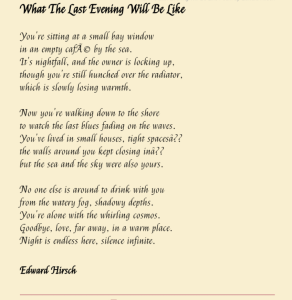 What The Last Evening Will Be Like by Edward Hirsch
With his poem, Edward Hirsch defies conventional feeling rules and emotion management. Instead, he offers the reader to be vulnerable and open to expression. A feeling rule imposed within modern society is to express emotions that maintain peace and comfort. We see this in Cahill and Eggleston’s Managing Emotions in Public. They use wheelchair users as an example to point out specific public interactions where maintaining a stranger’s peace is enforced. We have seen similar feeling rules in the two poems by Bishop and Chin. However, Hirsch does not stray away from the harsh realities of loss. He paints a detailed picture that embodies the lasting sorrows that come with grief and depression, a stark contrast to society’s feeling rules. Through his poetry, Hirsch challenges restrictive social norms and brings forth the interrelationship between beauty and pain.
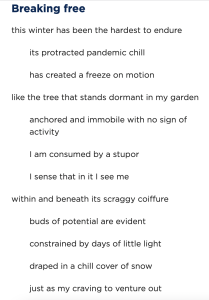
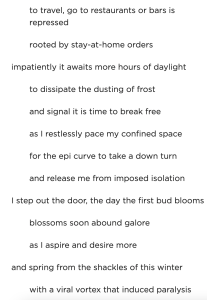 Breaking Free by Dr. Michael Stacey
In Dr. Stacey’s poem, Breaking Free, he speaks about the joys of breaking away from being locked away in isolation. He imagines himself stepping out the door and looking at the “blossoms soon abound galore”. Literature such as Dr. Stacey’s brings consequences. Dr. Stacey is performing emotional labor in order to ease tensions with the lockdown. However, this can also perpetuate oppression. By discrediting hardship and forcing people to find and earn joy in their lives poses problems. The “tyranny of happiness” Shuster and Westbrook calls it. In their book, Reducing the Joy Deficit, they speak about how happiness has become the “incarnation of today’s ideal image of the good citizen” (4). This is one example of how feeling rules can pose severe consequences to society. Breaking Free can be seen as an example of how feeling rules can be leveraged to justify oppression.