
Vox presents:
We shouldn’t go back to “normal.” Normal wasn’t good enough.
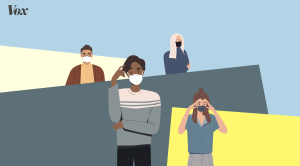
With the prolonged existence of COVID-19, as well as the production of the vaccine, many people have slowly tried to return to normality after 3 years of disruption and uncertainty. However, the Vox article challenges the principle behind this concept, discussing how perhaps we shouldn’t wish to return to normality. The article also explores how the pandemic has illuminated issues that were marginalized and ignored by society such as those surrounding mental health, career pressure, and wealth inequality.
“The idea that everyone is ‘okay’ at all times — and that we should pretend we are if we’re not — has been shattered, and it should stay that way.”
In the reading we did in class called “From good Cheer to “Drive-By Smiling”, Kotchemidova talks about the transformation of emotion culture over time and space, specifically how the conceptualization surrounding melancholy and cheerfulness have changed. Despite certain emotions undergoing de-intensification after the 1920s, cheerfulness was socially, economically, and individually beneficial, making the emotion persistently socially encouraged (Kotchemidova, p.17). As a result, there is an inherent pressure on the average American to constantly be cheerful, making it a national ethic (Kotchemidova, p.17).
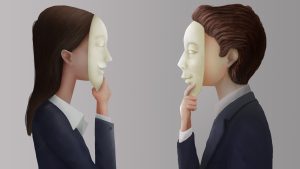
I believe this idea can explain the anxiety the Vox article highlights, about returning to the old normal. The article discusses how the pandemic made it socially permissible to discuss issues that were typically sidestepped, such as mental health struggles and the rigidity of the modern workday. Quoted from the article, “people’s increased willingness to intentionally care more for their mental health during the pandemic reveals the problem of just how taboo it is during ‘normal’ times”. Kotchemidova would argue that America’s expectation for cheerfulness to be an all-pervasive social norm explains why mental health discussion is so taboo. She explains how the hegemonic quality of cheerfulness has kept it invisible to the naked eye, making people constantly undergo emotion management and perform emotional labor to convey the facade that everything is okay. However, as emphasized in the Vox article, because of the pandemic, “the idea that everyone is ‘okay’ at all times — and that we should pretend we are if we’re not — has been shattered, and it should stay that way.” Returning to the normal would entail a return to the national ethic of cheerfulness and dismissal of mental health issues. We should not want to return to normality.

In the reading “From good Cheer to “Drive-By Smiling”, Kotchemidova provides another explanation for why mental health discussion, as labeled in the Vox article, is so taboo. Since cheerfulness is inversely related to depression, a cultural norm of cheerfulness leads to negative perceptions toward depression (Kotchemidova, p.24). “What is deviant about the depressive is his or her failure to engage in the pursuit of happiness or in the love of self that is considered to be normal” (Kotchemidova, p.24). This American expectation for a positive life experience and a positive emotional experience turns sadness pathological, and thus unacceptable (Kotchemidova, p.25). The Vox article provides a good reminder of the absurdity of this idea, communicating how the pandemic transformed sadness from a discouraged emotion to one of normality and acceptance.
Temple Now presents:
The coronavirus pandemic has made communication more important than ever
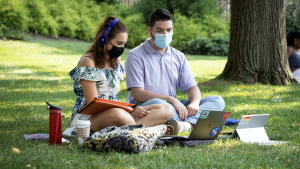
Temple University posted an article written by Tricia Jones on Temple Now, a platform for newsletters, titled The Coronavirus Pandemic has Made Communication More Important Than Ever. The article discusses how COVID-19 has disrupted the way we communicate, leading to the formation of new norms and communication strategies that have been adopted by the public. In the article, Professor Jones also explores the likelihood of the adoption of these strategies due to generational differences, stating that these new strategies and habits may become permanently adopted by young people. The role of our increasing dependency on technological devices was also discussed. Since devices do not require the use of nonverbal cues, Professor Jones found that we as a society are becoming worse at connecting and reading people.

“There’s this marking that we really aren’t being authentic the way we used to be [when we were] together because we’re having to put on this kind of performance.”
As I was reading this article posted on Temple Now, I began to find connections with Arlie Hochschild’s The Managed Heart. In chapter 2, Hochschild discusses the concept of managing feelings, which encompasses surface and deep acting. Surface acting refers to the body language we adopt to change how we outwardly appear, whilst deep acting refers to cognitive techniques one may adopt to actually manipulate self-induced feelings (Hochschild, pg.47). The Temple article argues that the pandemic has altered the way we communicate, placing more emphasis on nonverbal communication. Nonverbal communication includes tone of voice, eye contact, facial expressions, and body language, all of which are encompassed within surface acting. Thus, one can deduce that the pandemic has affected the way in which we perform surface acting. The pandemic has challenged preexisting modes of surface acting. To respect social distancing rules for example, society has found substitutes for regular ways of communication, such as elbow bumps instead of first bumps, or leaning in, a common technique of surface acting to convey one’s interest, on zoom instead of in person. However, with this change in surface acting, emerges another challenge. The Temple Now article discusses how the pandemic has also affected our ability to convey authentic and genuine emotions. Actions such as elbow bumps may send a message of artificiality. Professor Jones emphasizes that “There’s this marking that we really aren’t being authentic the way we used to be [when we were] together because we’re having to put on this kind of performance.”. One can assume that Hochschild would argue that the pandemic is affecting our ability to successfully perform surface acting, preventing us from forming genuine connections and relationships with one another.
The New York Times presents:
A Two-Year, 50-Million-Person Experiment in Changing How We Work
“The office was never one size fits all. It was one size fits some, with the expectation that everybody else would squeeze in”
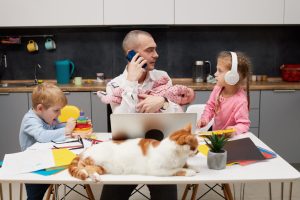
The New York Times article, titled “A Two-year, 50-Million-Person Experiment in Changing How We Work, questions the traditional idea of working at the office. The article argues that COVID-19 made it more apparent that “The office was never one size fits all. It was one size fits some, with the expectation that everybody else would squeeze in”. What The New York Times article writer Emma Goldberg means by this, is that the design of the office fits the needs of a particular employee: one that has the luxury to spend 9 hours away from home. The pandemic has made people realize the feasibility of working from home, and as a result, some companies attempting to call their staff back, are facing a wave of resistance from workers who are questioning the way things were. However, the article also acknowledges the disparity of families’ experiences working from home during the pandemic.
“My husband will sometimes come home and turn on the T.V., and I’m like, you turned on the T.V. in my office!”
Again, this New York Times article reminded me of an earlier course reading called “Formation of feeling rules in the context of a pandemic”. Whilst discussing the dissimilarity of experiences from working at home, the New York Times article mentions how to some people, the pandemic meant: “Let me just retreat to my lake house.” Others from less economically stable backgrounds however, struggled substantially more. The course reading expands on this idea, elaborating how working from home created a lack of time and space to meet the needs of both family and work (Rudrum et al., p. 3). Rudrum states that “Managing paid work could not be separated from managing family members and household tasks, which required emotion work”, ultimately leading to men and women being equally burdened and exhausted whilst working from home (Rudrum et al., p. 4). Families that are less privileged endured more of a blurred segregation between work and home life. For instance, families who could not afford childcare or a nanny meant that women were “never not a mom” (Rudrum et al., p. 4). Additionally, less privileged families with smaller houses were more likely to encounter issues of disruptive work life, as depicted in the New York Times article: “My husband will sometimes come home and turn on the T.V., and I’m like, you turned on the T.V. in my office!”. However, the socioeconomic inequalities that existed at work and at home were never made apparent until the pandemic occurred. Both The New York Times article and the course reading convey how the pandemic led people to reflect on the flawed structures in which we live and work in.