• Skip to main content
  • Skip to primary sidebar
  • Course Description
  • About the Author
  • All Posts

COVID-19 on the Navajo Nation

Elizabeth Sweeney - Professor Theo Greene - Public Sociology

esweeney

Letter from the Editor

December 13, 2020 By esweeney

From a very young age, I knew that I wanted to help people. Sociology at Bowdoin College has really exemplified ways in which I can make my dream a reality. Social Epidemiology in my sophomore year spiked my interest in health inequities and allostatic load (toxic stress from oppression and other social factors, which is physiologically manifested into poor health outcomes). I was connected with Bowdoin Alumna ’04, Dr. Amanda Burrage, MD, MPH, who is a pediatrician and leader of the Epidemic Response Team at Tuba City Regional Health Care Corporation (TCRHCC) in Northern Arizona on the Navajo Nation. I accepted the opportunity for an internship with Dr. Burrage and quickly came to love and appreciate Arizona and the ancestral land of Indigenous Americans. I worked as a student intern at TCRHCC for the Epidemic Response Team and led several virtual seminars on COVID-19 Infection Prevention Control Techniques. I also created many special connections with others that I will always hold close to my heart. As a privileged, white individual, I have struggled with how to properly find my place in this project and further pursuits. But this is a start. And I am thankful for this journey I am on to make the world a healthier and more equitable place.

Thank you for taking the time to visit my page. If you have any questions or would like to chat, please email me at [email protected].

All the best,

Elizabeth
Background Information

December 9, 2020 By esweeney

The mission of this electronic magazine is to focus on how the COVID-19 pandemic, caused by the SARS-CoV-2 virus, has perpetuated inequality among Indigenous populations. Specifically, this E-Zine focuses on the impact of the pandemic on the Navajo Nation. The Navajo Nation occupies nearly 27,500 square miles of land that spans Arizona, New Mexico, and Utah. As of the 2010 U.S. Census, there were nearly 332,000 individuals who claim to have Navajo ancestry.

The Navajo Nation is the largest occupied Native American Reservation in the U.S. Studies have shown that Native Americans and Native Alaskans born today have a life expectancy that is 5.5 years less than the U.S. all races population. Native Americans and Alaskan Natives continue to die at higher rates than other Americans in many categories, including chronic liver disease and cirrhosis, diabetes mellitus, unintentional injuries, assault/homicide, intentional self-harm or suicide, and chronic lower respiratory diseases. With bodies that are more prone to disease because of generational trauma and oppression (see Book Review: An Analysis of Dee Brown’s Bury My Heart at Wounded Knee: An Indian History of the American West), these bodies are more prone to developing severe disease from SARS-CoV-2 virus.

This E-Zine discusses the history of generational trauma and its physiological impacts to this day among the Navajo people. I connect the disproportionate burden that COVID-19 has had, and continues to have, on the Navajo population to generational trauma and toxic stress. This E-Zine acts as a platform to amplify Indigenous voices. My personal voice is only pronounced to give objective information that allows readers to understand context-specific information.


References

Indian Health Service. “Disparities: Fact Sheets.” Indian Health Service, U.S. Department of Health and Human Services, Oct. 2019, www.ihs.gov/newsroom/factsheets/disparities/.

Navajo Division of Health, and Navajo Epidemiology Center. “Navajo Population Profile: 2010 U.S. Census.” Navajo Epidemiology Center, Dec. 2013, archive.org/details/perma_cc_PYS5-VR8M.

Masks on the Navajo Nation

December 7, 2020 By esweeney

One day I went for a hike in the San Francisco Mountain Range in Flagstaff, AZ. It was a gorgeous day with bluebird skies. I knew many people would be outside that day. While I was heading up the trail, I passed numerous individuals. Hard to count how many. All of the people I passed on the trail were white. Except one. This one individual was Native American. And he was the only person I had passed on the trail that wore a mask.

Another day, I went into a restaurant to pick up a take-out order. The restaurant was open for indoor seating, and the place was filled. All with white people. Maskless, close together in large groups, walking around. No hand sanitizer in sight. The restaurant workers had worn masks, many of whom were Native American.

By the time I arrived on the reservation in early June of 2020, a mask mandate for the Navajo Nation had already been implemented for nearly one and a half months.[1] Nightly curfews and weekend lockdowns were continuing. And every person on the reservation was wearing a mask in public. The Intensive Care Unit (ICU) at Tuba City Regional Health Care Corporation, the hospital I had begun working at, was above capacity levels, as was nearly every other hospital in the state.

The Navajo Nation has been the hardest hit Indigenous population in the U.S., which influenced Arizona’s cases per capita to surge above that of New York and New Jersey in late May. The Navajo Nation ordered all people living on the reservation to wear a mask in public in mid-April. The state of Arizona never ordered a state-wide mask mandate, but specific local areas have, with other locations implementing mask wearing recommendations.[2]

During my time working and living on the Navajo Reservation, it was quite obvious to me that Native Americans are hyper-diligent about wearing masks in public and opting to stay home. It was also quite apparent how unaware and inconsiderate all other people in Arizona, that I saw, were. A recent study found that Arizona reported the greatest anti-mask wearing sentiment in the U.S.,[3] and this is due to white Arizona residents.

Native Americans are aware of their vulnerable status as a population. They are aware of their health disparities. They are aware of the hyper-segregation of opportunity and prosperity between them and white Americans. They are aware of their heightened risk at developing severe COVID-19. Because they have lived through all of it, and more. More than any white person could understand. Including me. But I have had the opportunity to witness minute pieces of it.

When I would drive through populated areas, it looked as though families were on vacation. Groups of maskless white people gathered in restaurants, on trails, at scenic points, in bars. They seemed completely ignorant to the fact that a highly contagious virus had ravaged the state and the rest of the country. Worse, when I initially arrived in Arizona, there were virtually zero mask mandates in local areas. It seemed that white Arizona residents were ignoring the fact that although they may not be sick, their vulnerable neighbors are. And they are making it much, much worse.

Do your part. Wear your mask for the health and safety of not only yourself, but also for those most vulnerable. Be considerate. Do your research. Understand why public health crises affect marginalized populations more. Understand the harm that you are doing as a white person not wearing a mask. Really try to understand those consequences of not wearing a mask. Please.

Although the first major wave of COVID-19 cases subsided, a second wave is in full force right now. President Nez of the Navajo Nation requested a major disaster declaration on December 3, 2020 and asked the federal government for additional help.[4] The Navajo Nation cannot survive on its own.

If you would like to learn more about how you can help support the health and wellness of Native Americans, see some links below:

Why it is important to wear a mask:

https://www.cdc.gov/coronavirus/2019-ncov/prevent-getting-sick/cloth-face-cover-guidance.html

https://www.hopkinsmedicine.org/news/newsroom/news-releases/covid-19-story-tip-the-importance-of-wearing-a-mask

Ways that Native Americans are standing up against COVID-19:

https://indiancountrytoday.com/culture/native-artists-lend-skills-to-covid-19-campaigns-JmXIdijZLUGShCnCAYDOJQ

https://navajotimes.com/biz/cleanup-company-hiring-dine-workers-invited-to-join-the-fight-against-covid-19/ 

https://cronkitenews.azpbs.org/2020/08/13/covid-indian-country-navajo-women-elders/  

https://navajotimes.com/biz/even-with-a-mask-on-you-can-still-be-glam-and-support-a-dine-owned-business/

https://navajotimes.com/coronavirus-updates/grant-relief-on-the-way-for-navajo-businesses-artisans/

Help support Native American health and wellbeing as an outsider:

https://www.gofundme.com/f/official-navajo-nation-covid19-relief-fund?utm_source=widget&utm_medium=referral&utm_campaign=p_cp+share-sheet

https://www.gofundme.com/f/xjgrfa-navajo-amp-hopi-families-covid19-relief-fund

https://www.gofundme.com/f/protect-native-elders

https://www.nihb.org/about_us/area_health_boards.php

https://www.indian-affairs.org/

https://nativeamericancapital.com/

https://www.narf.org/

https://collegefund.org/

https://www.ncai.org/get-involved

http://www.nativepartnership.org/site/PageServer?pagename=pwna_home

Support Native American owned small businesses:

https://navajotimes.com/biz/almost-in-ruins-limited-access-to-covid-19-relief-ppe-leaves-businesses-struggling/

https://rezrising.org/

https://www.diversitybestpractices.com/news-articles/top-native-american-organizations-to-know


[1] Associated Press. “Navajo Nation Orders Masks Be Worn in Public on Reservation.”

[2] “AZDHS: Epidemiology & Disease Control – Highlighted Infectious Disease for Arizona.”

[3] Wilder, Emily. “The State Most Resistant to Wearing Masks for Coronavirus Protection? Arizona, Study Says.”

[4] Krisst, Rima. “’Crisis Mode’: Nez Requests Major Disaster Declaration, Extends Lockdown.”


References

Associated Press. “Navajo Nation Orders Masks Be Worn in Public on Reservation.” U.S. News & World Report, U.S. News & World Report, 18 Apr. 2020, www.usnews.com/news/best-states/arizona/articles/2020-04-18/navajo-nation-orders-masks-be-worn-in-public-on-reservation.

“AZDHS: Epidemiology & Disease Control – Highlighted Infectious Disease for Arizona.” Arizona Department of Health Services, www.azdhs.gov/preparedness/epidemiology-disease-control/infectious-disease-epidemiology/index.php.

Krisst, Rima. “’Crisis Mode’: Nez Requests Major Disaster Declaration, Extends Lockdown.” Navajo Times, Navajo Times Publishing Co., Inc., 4 Dec. 2020, navajotimes.com/reznews/crisis-mode-nez-requests-major-disaster-declaration-extends-lockdown/.

Wilder, Emily. “The State Most Resistant to Wearing Masks for Coronavirus Protection? Arizona, Study Says.” USA Today, Gannett Satellite Information Network, 15 July 2020, www.usatoday.com/story/news/nation/2020/07/15/arizona-most-resistant-wearing-covid-19-face-masks-study-finds/5442738002/.  

Native Land: In Pictures

November 30, 2020 By esweeney

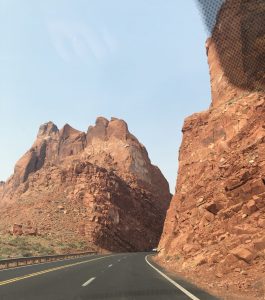
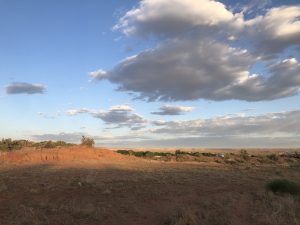
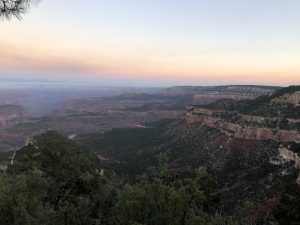
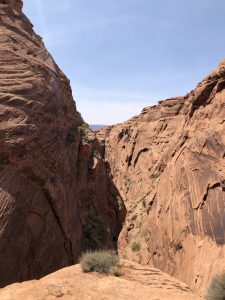
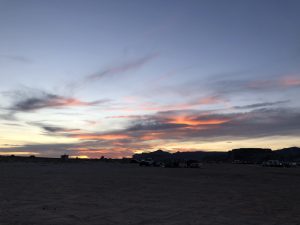
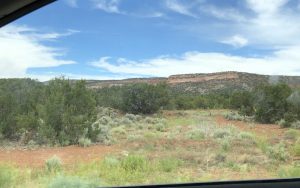
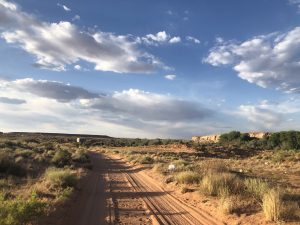
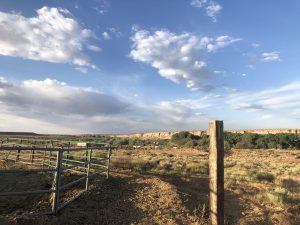
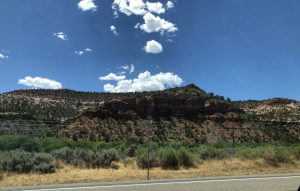
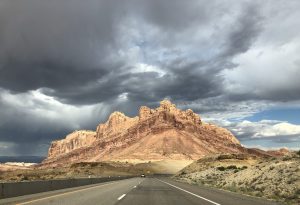
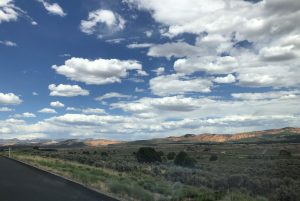
The following photographs were taken by the author, Elizabeth Sweeney, around Northern Arizona and Southern Utah on the Navajo Reservation. As you will see, some of the photographs contain street art that speak to Native American cultures and community.
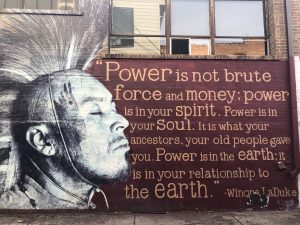
“Power is not brute force and money: power is in your spirit. Power is in your soul. It is what your ancestors, your old people gave you. Power is in the earth; it is in your relationship to the earth.” -Winona LaDuke — Flagstaff, AZ. July 10, 2020.


Tuba City, AZ. June 27, 2020.

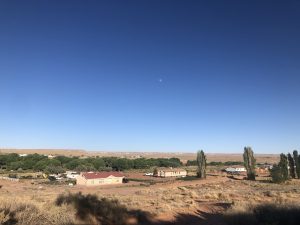
Photographs from Tuba City, Arizona are where I was living and working.

Antelope Point; Page, AZ. June 20, 2020.

Antelope Point is a scenic spot just south of Page, Arizona and is part of Lake Powell, which is a large body of water that spans across Southern Utah and Northern Arizona.

Bitter Springs; Page, AZ. June 19, 2020


Tuba City, AZ. June 27, 2020


Kaibab National Forest; North Rim of the Grand Canyon, AZ. July 17, 2020

Kaibab National Forest is a large forest that stretches to the very edges of the North Rim of the Grand Canyon in very remote areas.

Marble Canyon; Page, AZ. June 20, 2020

Marble Canyon is in Page, Arizona, and this scenic spot looks out toward the Colorado River.

Glen Canyon National Recreation Area; Big Water, UT. June 20, 2020

Glen Canyon National Recreation Area surrounds parts of Lake Powell in both Northern Arizona (Page) and Southern Utah. This photograph above is at a scenic spot on Lake Powell called “Lone Rock,” because there is a giant rock that sticks up out of Lake Powell.

Marble Canyon; Page, AZ. June 20, 2020

Marble Canyon is one of many canyons that are called “Slot Canyons.” Slot canyons are what you see above: very small pathways through exquisitely water-carved rock formations.

Holbrook, AZ. June 25, 2020


Tuba City, AZ. June 27, 2020


Tuba City, AZ. June 27, 2020


Bitter Springs; Page, AZ. June 28, 2020


Tuba City, AZ. June 27, 2020

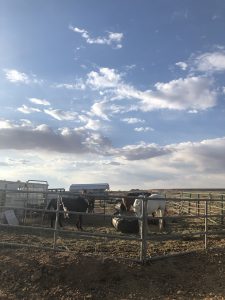
Many Native Americans own horses or cattle. The photograph above gives a small glimpse into the wide variety of domestication on the Navajo Nation.

Bitter Springs; Page, AZ. June 28, 2020


Tuba City, AZ. July 1, 2020


Coconino National Forest; Flagstaff, AZ. July 10, 2020


Tuba City Regional Health Care Corporation; Tuba City, AZ. June 11, 2020

Tuba City Regional Health Care Corporation is comprised of numerous small, relatively short and wide buildings congregated together. For example, the Behavioral Health Department is in a separate building from the Emergency Department and inpatient services. Many physicians have their offices in small trailers behind the main medical building.

Tuba City, AZ. June 11, 2020


Tuba City Regional Health Care Corporation; Tuba City, AZ. June 11, 2020


North Timp Point; North Rim of the Grand Canyon, AZ. July 18, 2020

North Timp Point is just one of countless lookout points on the North Rim of the Grand Canyon, right next to Timp Point, in which there are dispersed, free camping sites and endless opportunities to enjoy the view in quiet solitude.

Tuba City Regional Health Care Corporation; Tuba City, AZ. June 11, 2020


Kaibab National Forest; Marble Canyon, AZ. July 17, 2020


Navajo Trail, Coconino National Forest; Flagstaff, AZ. July 10, 2020


Kaibab National Forest; Marble Canyon, AZ. July 17, 2020


Kaibab National Forest; North Rim of the Grand Canyon, AZ. July 17, 2020


Kanab, UT. July 18, 2020


Kanab, UT. July 18, 2020


Kanab, UT. July 18, 2020


Navajo Trail; Tuba City, AZ. June 13, 2020

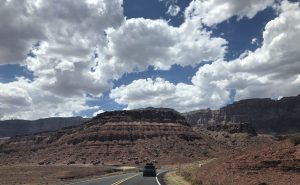
The Navajo Trail used to be an old Native American and sheepherding trail that has now become Route 160 in Arizona. Before the Navajo Trail roadway was Route 160, it was Navajo Route 1, which connected Flagstaff, Arizona with Tuba City, Kayenta, and the Four Corners region. This facilitated easier transportation of and access to coal, oil and uranium deposits outside of the Navajo Reservation. Today, the Navajo Trail spans all the way to Cortez, Colorado.

Orangeville, UT. July 18, 2020


“This is no longer your world. It is our world. The people’s world.” -Unknown — Flagstaff, AZ. July 10, 2020


*All photos were taken by the author, Elizabeth Sweeney.

Running as Medicine Indigenous Youth Prayer Run

November 9, 2020 By esweeney

https://www.youtube.com/watch?v=z3DJWcVdAFc&feature=youtu.be

“Running for awareness, running for each other, running for health, and running as one.”

A pair of towering buttes stand beside one another against red rock and juniper forests. The vast, open landscape is comprised of creeks, petroglyphs, ruins, cliff dwellings, and historical ties to several Native American tribes. Bear Ears National Monument in San Juan County, Utah, is where ten Native American runners began their five-day journey.

On September 1, 2020, these ten runners began their 360-mile run from Bear Ears National Monument to their destination in Warm Springs Park in Salt Lake City, Utah. These ten compassionate, dedicated runners ran in honor of their families and communities who have been affected by COVID-19. Running as Medicine Indigenous Youth Prayer run has existed as an annual event for years as a way to honor Indigeneity and the adversity of Native friends, family and ancestors. The run in 2020 looked a little different, however.

Normally, supporters gather along the trek route to cheer on their runners. Due to the SARS-CoV-2 Pandemic, support for and awareness of the trek was exclusively online. Advantageously, news of the trek extended across the country through social media and news outlets. Everyone was cheering on these ten talented and passionate runners. Moreover, 2020 has encompassed social unrest and violence that has left the soul of our nation aching. In the wake of several more innocent Black Americans being killed in the hands of police officers and a months of Black Lives Matter protests, running participants additionally ran in honor of Black Lives Matter and in memory of those who unjustly passed. In the video above, a runner wears a shirt with the writing, “Indigenous for Black Lives.”

Running Medicine believes in the power of community and movement to heal. Formed as a program of the Native Health Initiative (NHI), Running Medicine works to improve the health and wellbeing in Native American communities. Since being founded in 2005, Running Medicine has partnered on running races, running camps, and other events that work toward their mission. Running Medicine emphasizes cultural, mental, and spiritual aspects of running and walking, which has allowed for Native communities to congregate in honor of their culture and communities. Spirituality and the power of prayer is an integral aspect of Native American cultures and running on cherished ancestral land pairs well with that.

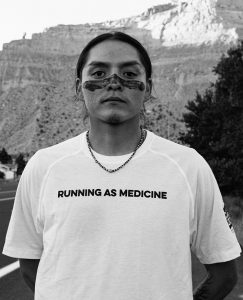
A participant of the 2020 Running as Medicine Indigenous Youth Prayer Run and avid runner, Marcus Onesalt has been creating opportunities for just that for years. Marcus is 24 and Diné from Northern Arizona. He is the oldest of nine siblings and takes pride in his ability to care for and protect his younger kin as well as his elders. Marcus is deeply tied to family, culture and spirituality. In his own communities in Northern Arizona and Southeastern Utah, he has helped organize and map out half marathons and marathons. Additionally, Marcus helped to fix the Navajo Mountain Trail along a distance of over twenty miles and camped for four nights to fix trails leading to Rainbow Bridge in Lake Powell, Utah. These are only a few examples of how Marcus engages with his community and strives to make the world around him a better place. Marcus is passionate about his culture, his ancestry, his family, and the well-being of his communities. He is a strong advocate for the youth as well as Indigenous rights and representation. His past and present actions clearly illuminate that.

When a friend of Marcus told him about the Indigenous Prayer Run less than a week before September 1, he accepted the offer without hesitation. “I wanted to represent myself, my community, my family, even the little area I’m from to amplify my voice in a different way.” Marcus is a creator; a writer, a painter, a runner, a student, an employee, a family man. He wrote the following poem after participating in Running as Medicine Indigenous Youth Prayer Run:

We are runners, it’s in our blood, it’s how we feel, to

Connect the real, to embrace the heal

We ran through mountains and hills

To show our love & support to the ones we love

Through prayer, it heals

It was an honor to run beside my Native brothers & sisters

From all over to raise awareness of our missing brothers & sisters

From rubble to blisters, our prayers were whispered

Through Creators rivers to the Eagles guiding our figures

In our long run, we ran for everyone

Ahé’héé for sharing your energy with me

Teaching me & laughing with me

Diihi’ nizhonigo ni’hee’ adoo’aal, ahé’héé*

Participant of the 2020 Indigenous Youth Prayer Run, Marcus Onesalt. Image from @runningasmedicine on Instagram

Risks and challenges of crowds associated with the COVID-19 pandemic created opportunities for creativity in media. Author and founder of Justin Susan Productions, Justin Susan is a student, filmmaker, and Youtuber. He followed the group of ten runners along their trek and produced a video that promoted the team of runners and their 360-mile mission (link to teaser above): “The prayer run was an event to bring awareness to the importance of running and how running is medicine for who we are as people. It brought Indigenous runners together in a healthy and social distanced way to persevere the challenges we face, not only with COVID-19, but also Indigenous challenges.” Justin’s video of the trek emphasizes strength in community, strength in prayer, and strength of Indigeneity.

The runners ran for five straight days in high elevation and at times, ran through 108-degree heat. This 360-mile run was a journey to honor, pray, heal, laugh, and empower community. Running as Medicine Indigenous Youth Prayer run was a powerful experience for its participants to embrace connection to ancestral land, to heritage, to the people they have lost, and to the inherent strength of American Indigeneity.

The Indigenous Youth Prayer Run is just one example of collective effervescence in action. Used as a method of healing for deeply entrenched adversity and ill health, this run serves as a social strengthening institution, not only for its participants, but also for each and every Native American.

“The way I see it now, it was more of a calling to me.” -Marcus Onesalt

Running as Medicine Indigenous Youth Prayer Run was organized by Native-led non-profit Salt Lake City Air Protectors, partnered with Running Medicine, and the Urban Indian Center of Salt Lake (a federally qualified health center).

*Have a good day today, thank you.

Book Review: An Analysis of Dee Brown’s Bury My Heart at Wounded Knee: An Indian History of the American West

October 19, 2020 By esweeney

To truly grasp the history of Native American oppression, one must read Dee Brown’s Bury My Heart at Wounded Knee: An Indian History of the American West. Brown’s historical non-fiction recounts historical relations between Indigenous Americans in the American West and white European settlers. Unlike most other writing about American Indigeneity, Brown rewrites the history of white expansion into the American West, not from the sovereign perspective, but more importantly, the perspective of the diminished and oppressed. Accounts written of white settlement in the West have contained quite Eurocentric views and lacked perspectives from the displaced and neglected. Brown’s history revolutionizes the way readers understand the broken promises and subjugation of Native Americans. By problematizing the role of European Americans in the History of American Expansion, Bury My Heart at Wounded Knee: An Indian History of the American West unconventionally depicts them as antagonists.

Brown begins his history at the start of the Civil War, several years after white settlers began invading the “permanent Indian frontier” and concludes at what he calls the “symbolic end of Indian freedom” at Wounded Knee in December 1890. Some interviews from Indigenous survivors of the Indian Wars in the late 19th century were available. Brown takes them with a grain of salt, considering a language barrier and possible distrust. He relies on published minutes from formal meetings between Natives and white men in which both parties spoke honestly. Within this thirty-year setting, the stories that take place are gruesome, unwarranted, and telling of differential power relations that still exist today. Brown put the elimination of the Native into context by exclaiming that “In 1860 there were probably 300,000 Indians in the United States and Territories, most of them living west of the Mississippi. According to varying estimates, their numbers had been reduced by one-half to two-thirds since the arrival of the first settlers in Virginia and New England.” In chapter thirteen Brown recounts “The Flight of the Nez Perces” in which European Americans fulfill their antagonistic representation. Chief Joseph of the Wallowa band of Nez Perce led his band during the most tumultuous period in their contemporary history. They were forcibly removed from their ancestral lands in the Wallowa Valley by the American federal government and were forced to move northeast onto the significantly reduced reservation in Lapwai, Idaho territory. The Wallowa band of Nez Percé is a tribe indigenous to the Wallowa Valley in northeastern Oregon, in the interior Pacific Northwest region of the United States. He was quoted saying:

“They say they are my friends…and that I shall have justice, but while their mouths all talk right I do not understand why nothing is done for my people. … General Miles promised that we might return to our own country. I believed General Miles, or I never would have surrendered. … I have heard talk and talk, but nothing is done. Good words do not last long unless they amount to something. Words do not pay for my dead people. They do not pay for my country, now overrun by white men. … Good words will not give my people good health and stop them from dying. Good words will not get my people a home where they can live in peace and take care of themselves. I am tired of talk that comes to nothing. It makes my heart sick when I remember all the good words and broken promises…”

No one listened to Chief Joseph and he and about 150 others were shipped to Nespelem on the Colville Reservation in Washington where they lived out their lives in exile.

Conditions we see today on Native American reservations are real-life products of these historical relations, but this is what Brown had missed in articulating. As a career historian, Brown exclusively discussed the history of white-Native American relations and failed to interpret and elaborate on the long-term consequences of this exemplification of conflict theory. Although he acknowledges the entrenched poverty of tribal reservations, he had the opportunity to dig deeper and analyze the long-term psychological, physiological and social ramifications. In Chief Joseph mentioning the complete disregard of European Americans for the health and wellbeing of Native Americans, Brown could have elaborated on the federal government denying access to health care and land for this population. Then, readers would have a greater understanding of how elimination and mistreatment of Native Americans in the late 19th century impacted their health and status today.

The broken promises and subjugation expounded upon in the thirty years that Brown’s book covers illuminate the omnipresent continuation of ethnic domination and betrayal. Misrepresentation, stigmatization, and apathy toward Indigenous Americans have resulted in a perpetual disregard for this population’s lives and well-being. Brown does an excellent job of portraying the disingenuous actions of white settlers. A prominent example in this book illustrates the unending belief in the other by Natives and sincere efforts of this population to amend connection and establish a civil and collaborative society. For instance, to live in peace and without conflict, white settlers ordered Natives to convert to Christianity. This was still not satisfactory enough for the white settlers, and they further confirmed their antagonistic nature through massacres of several of these tribes.

Using a more recent example, the lack of federal aid given to Indigenous Americans during the COVID-19 pandemic was only 60% of what a coalition of tribes had asked for from the U.S. government. Specifically, the Navajo Nation has relied mostly on donations from international organizations and individuals from Ireland and the United Kingdom (to read more about this, click here). The poignant generosity of compassionate international organizations and governments highlights an understanding of Native American oppression and adversity but a blatant disregard and inaction by the United States federal government. The missionary work of well-to-do Americans in African countries is in parallel with this. What will it take for the federal government to own up to its mistreatment of Native Americans? When will the federal government fully realize what they have done and take action to begin repairing it? Will we ever get to this point?

Although Brown’s history of Native American extermination in the West is essential and immensely helpful in understanding the depth of maltreatment and its immediate social and economic consequences, I wish he had allotted space to discuss long-term effects and hardship to these early relations. Not only do Native American reservations inhabit extreme levels of poverty, but they are also accompanied by potent health disparities. “The scarcity of the things that a lot of people take for granted, like water and electricity, is a true struggle for many, many people here,” said Dr. Jarred McAteer, who practices internal medicine at Tuba City Regional Health Care Corporation in Arizona. McAteer said his hospital had been running at capacity for weeks and had to repurpose parts of the facility to care for coronavirus patients, many from the Navajo Nation. Due to incredible health disparities among Indigenous Americans, the life expectancy of Native Americans and Native Alaskans is 5.5 years less than that of the total United States all-races population. Although this gap in life expectancy seems minimal, it is quite extreme from a public health perspective. Indigenous populations have always suffered more severely from diseases than other populations with high-quality health care and access, such as smallpox, tuberculosis, alcoholism, diabetes, cardiovascular diseases, and other chronic medical afflictions.

Tribal reservations are food deserts with poor infrastructure and have very poor access to quality health care. Although the federal government has implemented programs to aid in advancing health care on reservations, such as the Indian Health Service, the actual level of availability and equipment is scarce. It is also worth noting that the Indian Health Service was not established until 1955. Despite the United States’ obligation, a 2018 report by the U.S. Commission on Civil Rights found that health care spending per person by the Indian Health Service was $3,332 — only a little over one-third of federal health care spending per person nationwide. Moreover, this government-funded program is only available to federally recognized tribes, and the process in which a tribe becomes federally recognized is exceptionally tedious and burdensome.

To thoroughly comprehend the extent to which the COVID-19 pandemic has disproportionately affected Native Americans, it is imperative to connect the history of oppression and maltreatment of Natives to their current condition today. To put the impact of the current pandemic in context, the per capita COVID-19 infection on the Navajo Nation in May of 2020 had surpassed that of New York and New Jersey, both of which were perceived to have the highest number of cases in the country at that time. Although Brown’s historical analysis of Native American dehumanization aids in understanding how this population has evolved into a marginalized, deprived population, it lacks an evolutionary analysis of current conditions. The COVID-19 pandemic illuminates inequity and health disparities of Native Americans, which will continue to be discussed and evaluated.

It is the responsibility of all white American citizens, regardless of their relation to or interaction with Natives, to understand their power differential over Natives and how it inherently subordinates and disadvantages them. I highly recommend reading Brown’s accurate and timeless representation of the roots of this inequality that persists today.

Primary Sidebar

Posts

All Posts

courses.bowdoin.edu