Categories
Gallery Bios

Blakeslee Galleries

Active Dates: 1890-19141“Theron J. Blakeslee,” American Art News, March 14, 1914, XII edition. https://books.google.com/books?id=-cFIAQAAMAAJ&pg=RA3-PA14&lpg=RA3-PA14&dq=theronblakeslee&source=bl&ots=YwZolVQpi2&sig=ACfU3U0fNaYTCYHSz9eow-arwdg5crD31w&hl=en&sa=X&ved=2ahUKEwiK6tio2u_oAhVpl3IEHVUKCVc4ChDoATAGegQIChAt#v=onepage&q=theron blakeslee&f=false.

Gallerist: Theron Blakeslee

Location: 1891: 218 5th Ave 26th Street2Julian Alden Weir, Catalogue of recent paintings by J. Alden Weir: exhibited at the Blakeslee Galleries, January twenty-first to February seventh (New York: Blakeslee Galleries,1891), https://archive.org/details/catalogueofrecen00weir/page/n9/mode/2up.

1898: 353 5th ave 34th street3Theron J. Blakeslee, 1914, Exhibition of Early English, Dutch, And Flemish Paintings At the Blakeslee Galleries (New York: Blakeslee Galleries, 1898), https://babel.hathitrust.org/cgi/pt?id=hvd.fl2sel&view=1up&seq=4.

Later move to knickerbocker trust and co on the opposite corner (5th ave and 34th street)4“Theron J. Blakeslee.” 

5th ave and 53rd (renovating prior to death)5“Theron J. Blakeslee.” 

Specialty: Blakeslee specialized originally in American works then quickly moved to Old Masters Paintings.6“Theron J. Blakeslee.”

Gallery History: 

Well known in its own time, the Blakeslee galleries became eclipsed by the fame of its owner, Theron Blakeslee, in 1914 when he killed himself in his shop.7“Art Dealer Ends his Suffering: Theron Blakeslee, Owner of Great Masters, Kills Himself,” Sacramento Union, Volume 175, Number 8, ( March 8, 1914) https://cdnc.ucr.edu/?a=d&d=SU19140308.2.16&e=——-en–20–1–txt-txIN——–1. Though his death was attributed to a great depression and stress he experienced due to business affairs, Blakeslee’s ventures were noteworthy feats. Born in Plymouth, Massachusetts in 1849, the gallerist started his career with Noyes & Blakeslee in Boston. He relocated to New York city in 1890 to establish his own gallery and tap into a larger market, originally selling modern American Dutch paintings along with popular Barbizon landscapes until 1892. He then pivoted his gallery towards the sale of Old master paintings. He produced sumptuous catalogues to go along with these sales, highly descriptive and full of reproduced images. Though his clientele for this kind of work was initially quite small, it quickly expanded across the continental United States. His charisma and known “infallible” eye made him one of the few trustworthy American sources for Old Master paintings. His initial success in the United States inspired other galleries to open across the country.8 All information retrieved from “Theron J. Blakeslee.” Nonetheless, by the dawn of the Twentieth Century he participated in auctions of his works with others such as Eugène Fischoff in 1900 and Dowdeswell in 1904, the latter at which works sold for notably low prices, implying that his works were not selling particularly well.9 Eugène Fischhof, Theron J. Blakeslee, and American Art Association, Illustrated Catalogue of Master Works of the Early English, Dutch, French And Flemish Schools: Belonging to Eugene Fischhof, Paris, And T. J. Blakeslee, New York, to Be Sold At Absolute Public Sale At Chickering Hall … March 9th And 10th … (New York, 1900), https://catalog.hathitrust.org/Record/008700728. and “Record prices, bargain sales and the complications of dealing with Duveen: the early 20th century history of art dealers Dowdeswell’s in the pages of The Burlington Magazine,”The Burlington Magazine Index Blog, April 29, 2016, https://burlingtonindex.wordpress.com/2016/04/29/record-prices-bargain-sales-and-the-complications-of-dealing-with-duveen-the-early-20th-century-history-of-art-dealers-dowdeswells-in-the-pages-of-the-burlington-magazine/. In 1915, at the behest of Blakeslee’s widow, the American Art Association auctioned off his collection and remaining Gallery at the famous Plaza Hotel on 5th and 59th in NYC. The catalogue was extensive, luxurious, and full of certifications and descriptions of the works by European academics.10Theron J., Blakeslee, -1914. Illustrated Catalogue of the Extensive Collection of Highly Valuable Paintings by the Great Masters of the Early English, French, Flemish, Dutch, Italian And Spanish Schools, From the Widely Known Blakeslee Galleries, (New York: American Art Association, 1915), https://archive.org/details/liu-31289009872021/mode/2up.  
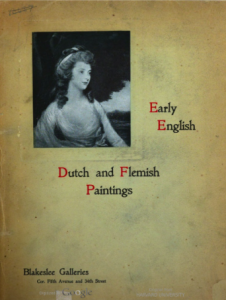
“Catalogue cover of Early English Dutch and Flemish Paintings,” Blakeslee Galleries, New York, 1898.
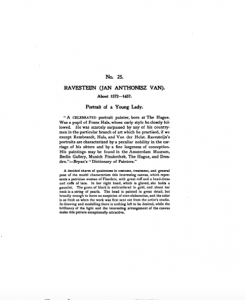
“No.25. Ravesteijn (Jan Anthonisz Van), Portrait of a Young Lady,” Catalogue entry, Blakeslee Galleries, New York, 1898.

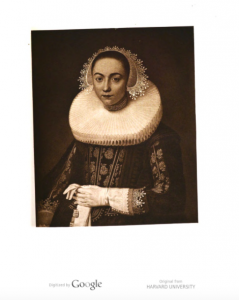
“Reproduction of Portrait of a Young Lady,” Catalogue entry, Blakeslee Galleries, New York, 1898.[mfn] Images 1-3 From: Exhibition of Early English, Dutch, And Flemish Paintings At the Blakeslee Galleries.[/mfn]
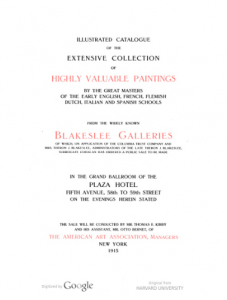
“Catalogue cover for 1915 Auction of Theron Blakeslee’s estate,” Catalogue entry, The American Art Association, New York, 1915.[mfn] Catalogue of recent paintings by J. Alden Weir: exhibited at the Blakeslee Galleries, January twenty-first to February seventh. [/mfn]
 

Date Written:

April 17, 2020

Author’s Initials:

CC


Primary Sources

“Art Dealer Ends his Suffering: Theron Blakeslee, Owner of Great Masters, Kills Himself.” Sacramento Union, Volume 175, Number 8, 8 March 1914. https://cdnc.ucr.edu/?a=d&d=SU19140308.2.16&e=——-en–20–1–txt-txIN——–1 


Blakeslee, T. J. Catalogue of the Blakeslee Collection of Valuable Paintings, Principally Portraits by the Early English, French And Dutch Schools ..: Public Sale … New York: The Amer. Art Assoc, 1905.https://archive.org/details/liu-31289009872021/mode/2up.  
 

Blakeslee, Theron J., 1914. Exhibition of Early English, Dutch, And Flemish Paintings At the Blakeslee Galleries. New York, 1898. https://babel.hathitrust.org/cgi/pt?id=hvd.fl2sel&view=1up&seq=4 


Blakeslee, Theron J., -1914. Illustrated Catalogue of the Extensive Collection of Highly Valuable Paintings by the Great Masters of the Early English, French, Flemish, Dutch, Italian And Spanish Schools, From the Widely Known Blakeslee Galleries … New York: American Art Association, 1915. https://archive.org/details/liu-31289009872021/mode/2up.   
 

Fischhof, Eugène, Theron J. Blakeslee, and American Art Association. Illustrated Catalogue of Master Works of the Early English, Dutch, French And Flemish Schools: Belonging to Eugene Fischhof, Paris, And T. J. Blakeslee, New York, to Be Sold At Absolute Public Sale At Chickering Hall … March 9th And 10th … New York, 1900.https://catalog.hathitrust.org/Record/008700728


“Theron J. Blakeslee.” American Art News. March 14, 1914, XII edition. https://books.google.com/books?id=-cFIAQAAMAAJ&pg=RA3-PA14&lpg=RA3-PA14&dq=theronblakeslee&source=bl&ots=YwZolVQpi2&sig=ACfU3U0fNaYTCYHSz9eow-arwdg5crD31w&hl=en&sa=X&ved=2ahUKEwiK6tio2u_oAhVpl3IEHVUKCVc4ChDoATAGegQIChAt#v=onepage&q=theron blakeslee&f=false.   


Weir, Julian Alden. 1891. Catalogue of recent paintings by J. Alden Weir: exhibited at the Blakeslee Galleries, January twenty-first to February seventh, inclusive. New York: Blakeslee Galleries. https://archive.org/details/catalogueofrecen00weir/page/n9/mode/2up


Secondary Sources

“Record prices, bargain sales and the complications of dealing with Duveen: the early 20th century history of art dealers Dowdeswell’s in the pages of The Burlington Magazine.”The Burlington Magazine Index Blog. April 29, 2016. https://burlingtonindex.wordpress.com/2016/04/29/record-prices-bargain-sales-and-the-complications-of-dealing-with-duveen-the-early-20th-century-history-of-art-dealers-dowdeswells-in-the-pages-of-the-burlington-magazine/.  


Categories
Gallery Bios

Map

Categories
Gallery Bios

Kurtz Gallery

Kurtz Gallery

Active Dates: 1874-1883

Gallerist: William Kurtz (1833-1904)

Location:  1874-1883 6 &7 East 23rd Street, New York

Specialty: European and American pictures. Kurtz ran a photography studio on the ground floor of the Kurtz Gallery, specializing in photographic portraits.

Gallery History:

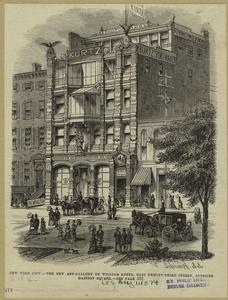
The Kurtz Gallery opened in 1874 facing Madison Square Gardens on East 23rd street as a photography studio and picture gallery.  William Kurtz emerged as a prominent figure in the American photography scene after a varied early career as a lithographer in Germany, soldier, and sailor. Rescued from a shipwreck and brought to New York, Kurtz worked in several photo galleries and fought in the civil war before opening the Kurtz gallery in 1874. The lively gallery employed 40 assistants and occupied a decorative multistory building worth $130,000 in 1883.

Visitors enjoyed galleries on upper levels and open gathering spaces for special events such as poetry readings and speakers.  The gallery featured artists from both Europe and America including Hunt, Gifford, Johnson, Zamacois, Fromentin, Vibert, Simonetti, Coret, Breton, and Degraffe among many others. Highlights included high caliber shows such as exhibitions organized by famous art dealer Knoedler, featuring “One Hundred and Fifty Examples of the Best Contemporary Schools” in 1875. A few years later, a notable show on young, emerging artists gained significant attention. The ambiance of the gallery was considered one of the “finest in the city” for its decorations, flowers, and elegant  New Yorkers. The Kurtz gallery was frequently featured in the New York Times and other news publications.

Alongside shows, Kurtz ran a photography studio on the ground level of the gallery.  As an accomplished experimenter and innovator in the field of photography, Kurtz had made a name for himself in inventing the “Rembrandt Effect” in portrait photography as well as the vibrotype and the conigraph devices. He also pioneered picture retouching to capture more sensitivity in facial expressions. In 1883, Kurtz installed electric light which illuminated his studio and attracted a lucrative business in photographing high-society New Yorkers in their finery after attending balls, operas, and parties.  Kurtz became an expert in reproduction and was awarded recognition in Paris, Vienna, and Philadelphia expositions.  William Kurtz was the first American photographer to win these honors, and over time he grew one of the largest photographic repositories in the world, specializing in busts and portraiture. Later, Kurtz championed colored photographic reproduction.

In 1880, James Sutton took over the Kurtz Gallery and renamed the space the American Art Gallery. Soon after, the American Art Association was established in the Kurtz building the 1883.  The association became the first American auction house and remained on East 23rd street until the American Art Association moved to Madison Ave and 56th Street in 1922.

Date Written: April 15th, 2020

Author’s Initials: CT

Illustrations 

“New York City–the new art gallery of William Kurtz, East Twenty-third Street, opposite Madison Square.” The Miriam and Ira D. Wallach Division of Art, Prints and Photographs: Picture Collection, The New York Public Library.

Figure 2. “Catalogue of a collection of choice modern paintings from the galleries of M. Knoedler & Co.: (successors to Goupil & Co.): comprising one hundred and fifty examples of the best contemporary schools: now on exhibition at the Kurtz Gallery, no. 6 East Twenty-third Street, on Madison Square, where they will be sold at auction on the evening of Wednesday and Thursday April 14th and 15th, 1875.” Getty Research Institute Internet Archive Gallery,

The Getty Research Institute. 


Figure 3: “New York City–the reception to William Cullen Bryant given by the Goethe Club, November 14th–Mr. Bryant responding to the address of welcome.” The Miriam and Ira D. Wallach Division of Art, Prints and Photographs: Picture Collection, The New York Public Library. 


Primary Sources

“A Plea for Finish in Art.” New York Times. March 17th, 1878. https://timesmachine.nytimes.com/timesmachine/1878/03/17/81722778.pdf?pdf_redirect=true&ip=0

Edwards, Richard. New York’s Great Industries: Exchange and Commercial Review. New York: Historical Publishing Company, 1884. https://books.google.com/books?id=d6ieSXFM2kIC&printsec=frontcover&source=gbs_ge_summary_r&cad=0#v=onepage&q=kurtz&f=false

“Pictures at the Kurtz Gallery.” New York Times. December 17th, 1876, p 7. https://timesmachine.nytimes.com/timesmachine/1876/12/17/81700930.html?auth=login-email&pageNumber=7

“Catalogue of a collection of choice modern paintings from the galleries of M. Knoedler & Co.: (successors to Goupil & Co.): comprising one hundred and fifty examples of the best contemporary schools: now on exhibition at the Kurtz Gallery, no. 6 East Twenty-third Street, on Madison Square, where they will be sold at auction on the evening of Wednesday and Thursday April 14th and 15th, 1875.” Getty Research Institute Internet Archive. Accessed April 14th, 2020. https://archive.org/details/catalogueofcolle00some/page/n14/mode/2up


“New York City–the new art gallery of William Kurtz, East Twenty-third Street, opposite Madison Square.” The Miriam and Ira D. Wallach Division of Art, Prints and Photographs: Picture Collection, The New York Public Library. Accessed April 14th, 2020. http://digitalcollections.nypl.org/items/510d47e1-2cf8-a3d9-e040-e00a18064a99


“New York City–the reception to William Cullen Bryant given by the Goethe Club, November 14th–Mr. Bryant responding to the address of welcome” Still Image. The Miriam and Ira D. Wallach Division of Art, Prints and Photographs: Picture Collection, The New York Public Library. Accessed April 14th, 2020. http://digitalcollections.nypl.org/items/510d47e1-10db-a3d9-e040-e00a18064a99


“William Kurtz, 1833-1904.” Newspaper clipping. The Miriam and Ira D. Wallach Division of Art, Prints and Photographs: Print Collection, The New York Public Library. Accessed April 14, 2020. http://digitalcollections.nypl.org/items/510d47e2-a868-a3d9-e040-e00a18064a99

Secondary Sources

Emil Carlsen Archives. “American Art Association.” Emil Carlsen Archives. Accessed April 14th, 2020. http://emilcarlsen.org/portfolio/american-art-association-1883-1964/

Goldstein, Malcom. Landscape with Figures: A History of Art Dealing in the United States. Oxford: Oxford University Press, 2000.  https://books.google.com/books?id=Z9MJCAAAQBAJ&pg=PT99&lpg=PT99&dq=rufus+moore+kurtz+gallery&source=bl&ots=IL0VqbbGkR&sig=ACfU3U308uNkEQOyvlj7wWIqt98IJK-2dQ&hl=en&sa=X&ved=2ahUKEwivrNOGjufoAhUIgK0KHTXAALsQ6AEwAHoECAsQKQ#v=onepage&q=rufus%20moore%20kurtz%20gallery&f=false

Lossing, Benson, History of New York City: Embracing an Outline Sketch of Events from 1609 to 1830, and a Full Account of Its Development from 1830 to 1884, Volume 1. New York: Perine Engraving and Publishing Company, 1884.

https://books.google.com/books?id=MZZe-BT4BbwC&pg=PA414&lpg=PA414&dq=kurtz+gallery+nyc+catalog&source=bl&ots=5gpJcDXgte&sig=ACfU3U3eDoz-xLD7PgxTUWtXdjI9ectENw&hl=en&sa=X&ved=2ahUKEwiGzvTvhOToAhVDX60KHegjChYQ6AEwB3oECAwQLw#v=onepage&q=kurtz%20gallery%20nyc%20catalog&f=false

Shields, David S. “William Kurtz.” Broadway Photographs. accessed April 14th, 2020. https://www.broadway.cas.sc.edu/content/william-kurtz

“Selected Dealer Archives & Locations.” The Getty Research Institute. Accessed April 14th, 2020. https://www.getty.edu/research/tools/guides_bibliographies/provenance/dealer_archives.html


Categories
Gallery Bios

American Art Association

American Art Association Gallery Bio.docx

Categories
Gallery Bios

Leo Castelli Gallery

“Founded by Leo Castelli in 1957, the gallery maintains a commitment to showing the best of post-war American art, with a focus on the art movements to which it has been home for so many years, alternating exhibitions of new work with rigorous critical presentations that shed new light on the understanding of Pop, Minimal and Conceptual Art today.”