The Unity of The Students

Screen Shot 2016-03-30 at 1.13.23 AM

In mid to late 60’s China a movement was created. First by student from wealthy military families who did not believe in the teachings they were receiving in school, so they retaliated against their teachers and their principles. Soon students everywhere were refusing the teachings of the school and brutally beating their school administrators. These children labeled themselves Mao’s red guard and wore either their parents or homemade Mao suits, which were truly old army issued uniforms. The Red Guard linked itself to Mao at first but soon he saw the movement of children as a way to bring forth the cultural revolution.

The image above is an example how the Mao suit allowed the nation to be unified. Now with the suit there were no visible gender differences or economic differences, all were one. However there was a lost of personal identity or individuality and that is replaced by unity. nice description
Denotations: The image at fist glance just looks like a mob of hands and the color red. However  with closer examination these are all students probably both male and female, at a rally with their Mao suits on and their little red book with Mao’s words in them. In the background there is a political building with a very large image of Mao posted on it.
In half of the photograph it is a sea of green and red. In the upper half there is the red political building with Mao’s image and a brilliant blue sky above that.
Connotations: The mob of children that appear mohave no gender but seem to be passionately supporting a cause have completely lost their individuality. Instead of seeing individual students there is instead one group, one cause, one goal. The suit that each student is wearing itself represents unity and also power. Having been what military men used to wear the suit itself carries an “air” of power with it. Especially with such a large group of people wearing the suit it is almost like an army. The same goes for the abundance of the color red, which also represents power, just adding to the “army’s” status.
The political building (the gate of heavenly peace) in the background with Mao’s image, that is directly behind the students but also above shows how the students are ultimately under Mao’s control. He is further from the foreground of the picture but he the ruler, he is control of this united group. They have united under him and for him and for their country. The bright blue sky represents how the students believed that what the were doing, and even what Mao himself believed, that they were doing what was best for the country, so that it could be better. This bright blue represents the happiness that the Red Guard and Mao believed they were creating.
is it better to organize the denotation components and critical connotations in a side by side fashion?
 

The Women’s Liberation and Appreciating Women’s Bodies

Hu Ming, "Stand Up." Size: 140 x 106 cm. Oil on canvas painting, 2007.

Hu Ming, “Stand Up.” Size: 140 x 106 cm. Oil on canvas painting, 2007.

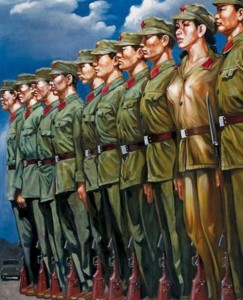
During the People’s Republic of China Era, the Mao suit was created to symbolize the unification of the country and the elimination of individuality. Mao Zedong tried to instill his socialist ideals through a uniform that publicly showed his people’s support for him. The Mao suit successfully supported the cultural revolution of socialism through its uniform look to disidentify with personal individuality and gender. Hu Ming, the female provocative contemporary artist, challenges the Mao suit ideals with her artwork as shown above. By highlighting the one female soldier in a hyper-sexual way, Ming forces the audience to realize that one cannot silence the beauty of the female body.

The painting “Stand Up” portrays the Red Guard army in their traditional Mao suit uniform lined up, ready for duty. Hu Ming’s artwork highlights the complications of attempting to hide individuality and forcing commonality, especially for women. Ming artfully used four modes of the painting to highlight her appreciation of women in the army—the uniformed look, color contrast, transparent uniform, and exposed female body. The artist used “Stand Up” as a way to comment on the women’s liberation movement that occurred in China during the Red Guard era. contemporary art about political past

Uniformed look:

At one quick glance, the audience can notice denotations of the uniformed look of the figures in the painting right away. Every figure in the painting has the same height and straight posture. Every soldier is in a tidy, clean Mao suit, indicating their involvement with the Red Guard army. We can conclude connotations that Ming wanted to accurately represent the Mao socialist party present at the time. She wants to indicate to the audience that these were soldiers, unified to protect their country, and complied with what is expected of them under Mao’s rule. It is clear that looking out of order is undesirable.

Color contrast:

Another easy denotation of this painting to notice is the explicit color contrast that is lighter on one of the soldiers, the visible woman, than the others. The audience can notice the lighter portion of the painting very quickly, that draws attention to the outlier of the seemingly uniform group. The color contrast seems to be larger and closer to the audience, as opposed to a figure later down the line. From these denotations, we can create connotations that assume that Ming wanted the audience to notice the woman first. The female figure blatantly does not physically look the same as the other soldiers. Ming used the color contrast to remind the audience that women will always hold a different place in the army, be it positively or negatively, that we must quickly recognize in such a monolithic society.

Transparent Uniform:

Perhaps the most important denotation to take from “Stand Up” is the transparent uniform of the one female figure in the painting. It explicitly reveals her breasts to highlight the subtle difference in her uniform. Ming painted her uniform slightly different that catches the eye of the audience quickly. From these observations, I would predict connotations that blatantly disregard Mao’s rule of uniformity. Although the female soldier may explicitly follow the socialist rule, Ming shows that women will be inherently different. Women cannot hide their feminine beauty, and they should recognize and appreciate their differences, although the liberation movement has been to their advantage.

Exposed Female Body:

The exposed female body is a denotation that cannot be ignored in this painting. As discussed earlier, Ming used several painting techniques to allow the audience to be drawn to the female soldier before noticing the other figures. I believe that Ming used such explicit denotations to comment on the beauty of femininity, even in a society that values uniformity. The connotations of the exposed female body indicate that one cannot ignore the qualities of womanhood.

Conclusion:

Ming used several modes of painting technique to allow the audience to slowly analyze denotations (no need to repeat the word too often) that reflect the connotations of her opinions. Ming supported the women’s liberation movement, and this is reflected in her work to highlight the beauties of the female body specifically in the Red Guard. In “Stand Up,” Ming used her art to comment on the Chinese Revolution as a time of change and anonymity, but not to forget about the celebration of the women’s liberation. Her work is important to provoke thought about how Mao’s China influenced public opinion, political affiliation, and army support, as well as its effect on the appreciation and respect of women.

nice organization and explanation!

Women’s Bodies: Propaganda Goes Two Ways

During the Maoist regime the fashion choices of Chinese citizens changed drastically. The unofficial uniform of the public was a Mao suit, a buttoned, neutral shirt with utilitarian pockets. These became the collective outfits of the people and they were worn by men and women alike. As time went on the Mao suit became a cultural icon for the Maoist regime and was equated with both support of the Republic and Mao himself. As such, the Mao suit morphed not only into a piece of clothing, but a symbol used in posters, art, and theater. In this analysis, I examine two images of women’s bodies that are shown wearing a Mao suit to support the Communist government, but in very different ways.
define “women’s bodies” and make a critical claim

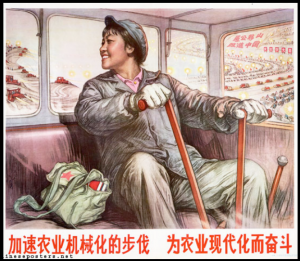
In this first example here, we see a poster of a woman operating a tractor or some other large  Screen Shot 2016-03-29 at 5.20.02 PM

agricultural machine. She is smiling and happy in her work, wearing comfortable and practical clothing. Here the Mao suit she wears is used as a tool to universalize her to the Chinese viewers of this poster. As the focus of this image, her female body is the most prominent aspect of the art. Interestingly, her body is draped in the baggy Mao suit fabric in a way that intentionally does not show off any curves she might have. We as viewers of this poster are not meant to think of her as sexual but instead as a worker. Her purpose as a supporter of the Communist regime is much more than as a reproductive female body, it is important also as a farmer working to support the country. how about the idea of gender/sexual erasure as the topical sentence?

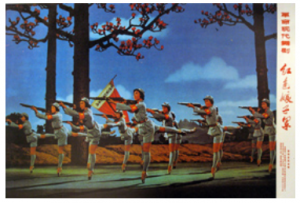
In the following image, we see a group of ballerinas performing in the ballet The Red Detachment of Women in 1971. These women of the Red Guard are holding guns and wearing the traditional Mao suit with a red armband. In stark contrast to the photo above, the women here are wearing a skin tight version of the same clothing. They are clad in short shorts and Screen Shot 2016-03-29 at 5.04.06 PM

high socks that accentuate the thigh and leg. Furthermore, their hair is all immaculately pulled back into a cap and they are gracefully posed within the painting. Their chest is forward and their legs in full view. This image, is intended to show off the female body as distinctly female far more than the other image we see. any connotations regarding this image?

While both these images of women wearing the Mao suit are meant to support the party’s cause, the reasoning behind each is very different. In the first image, it is about the physical power and ability of the woman to be a worker. This is meant to appeal to women who want to work and be productive members of society. The second image is meant to appeal to the desire for beauty and grace. Each is meant to support the Maoist regime, however, they use women’s bodies to do so in very different ways.

female body concealed in working uniform and female body exposed through military uniform: what do the images suggest?


Students and the Mao Suit

Screen Shot 2016-03-22 at 12.24.07 AM

http://hypocrisia.ro/content/cultural-revolution-and-great-leap-forward-reviews-red-scarf-girl-and-mao%E2%80%99s-great-famine

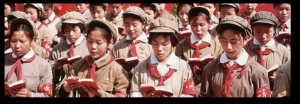
During the Cultural Revolution in China, personal identity disintegrated as a new group identity and subsequent group mentality were formed. Under Chairman Mao, millions of people, men and women, young and old, rural dwellers and urbanites, were all forced into the same mold, projecting a sense of unity but also resulting in a loss of individuality. From the image presented above, we can deduce that Mao especially targeted the youth with propaganda and attempted to suppress all individuality through wardrobe, education, and limited choice.

Continuation: The most obvious denotation upon first glance at this photograph is the seemingly endless number of students in uniform in an organized formation. Though this photo cuts the group off at five columns and four rows of students, it projects a sense of mesmerizing repetition. Because the multiple subjects of this picture take up both the foreground and background, and because there is no highlight placed on one specific subject as separate from the others, the photograph gives the viewer an overwhelming sense of continuation, and makes us believe that the students expand past this photograph’s edges into all corners of China and also into our reality, much like Mao’s rule during that time period.

Repetition and similarity: This constructed sense of repetitive identity dehumanizes the students into robots and clones. For instance, all the subjects of this photo have the same outfit, accessories, hairdo, and are also of the same demographic: Chinese pre-teen female students. All students are also holding the same exact book, Mao’s red handbook, most likely reciting/reading the same paragraph in tandem, and have the same physical posture and facial expression. This almost perfect unity leads the viewer to perceive a void of emotion, personality, and personal agency. Though the students are loyally honoring their country’s leader, their praise and devout following does not stem from a genuine place and instead seems forced. Furthermore, none of the students even acknowledge the camera, either intentionally or unintentionally avoiding all eye-contact. This additional lack of human connection perpetuates their clone-like selves. The girls presented in this picture were most likely swept up into the Cultural Revolution without the choice to accept or deny participation. Mao has chosen them as the face of the Cultural Revolution, substituting their own unique voices with his own and dictating how they will learn and live.

Gender: Another aspect of this photograph to consider is the gender of all the subjects. If we assume that the photographer intentionally chose to capture this moment with only females, what was his purpose? One answer could be to elevate the social status of women. By capturing females actively participating in this social and political movement, it incites a sense that Mao’s revolution was all-inclusive. By emphasizing female participation, we can conclude that the photographer wanted to communicate the importance of women and their involvement in the 1960s and 70s.

Small distinctions: Upon closer examination, though each student seems indistinguishable from the others, there are slight differences in the shade of the Mao jacket and collar that each student wears. Some jackets seem brown while others are olive green, and also some white collars are rounded and shown, while others are pointed and fitted underneath the outer jacket collar. Thus we can conclude that although Mao’s goal was to create national unity through the suppression and extinguishment of the individual, it would be impossible to fully and completely repress personal distinctions. While this photograph correctly captures the widespread jurisdiction of Mao and demonstrates his attempt at nation-wide uniformity, it also represents the underlying flaws and failures of his propaganda and forced sameness which is simmering beneath the Mao suit.

nice organization and detailed explanation

Uniformity in the Economy

 Screen Shot 2016-03-29 at 10.36.36 AM

Designer: Liu Wenxi (刘文 西)1975, December

Publisher: Renmin meishu chubanshe (人民美术出版社)

Throughout Mao’s rule in China, he aimed for uniformity and unification throughout the nation. He believed in creating a unified body where individuality was not valued, but rather a group mentality in which his own philosophies and beliefs were the exercised norms. He utilized propaganda, such as this, to encourage people of all genders to contribute to the economy, regardless of their abilities or desires.

The woman: or the female subject This propaganda immediately draws the viewers’ eyes to the woman working heavy machinery, looking very happy. Although it is possible to tell that she is, in fact, a woman, she has very masculine features and her hair is pulled back in the cap. The woman is therefore, stripped of her femininity in order to be most productive in the workplace. This prioritization of male over female features indicates a pro-masculine theory that Mao supported and encouraged. Although this uniform is supposed to be gender neutral, it masculinizes the female, rather than feminizing the male, consequently, leaving the male the same and changing the woman.  This woman was also placed into a field of work in which she biologically is less capable than men. By nature, men are stronger and can handle heavier equipment better than women. By placing a woman into this same exact workplace as a man, she is immediately at a disadvantage trying to keep up and having to work much harder to do the same labor that a man can do with less difficulty, therefore creating inequality in the workplace.

The little red book: The woman in this book has a little red book sitting next to her in her bag. Mao required everyone to carry around his little red book which was all that was learned in schools and taught to children. Growing up on only his philosophies, the people of China were, in a way, brainwashed by his thought. The carrying of the book was enforced, ultimately imposing his philosophies onto everyone so that everyone thought the same way, just as they dressed the same way. Intellectuals were discriminated against as they did not always follow Mao’s theories, and being a part of the working class was viewed as ideal.

the little red book as political rhetoric or education as well as visual element, due to its size and color

The vehicle in which the woman is driving: The woman, herself, appears to be enjoying her time in the vehicle, alone. She is smiling and by herself, and the viewer is able to see her identity and emotions. However, Mao discouraged against individuality and, rather, desired uniformity and homogenous unity. Because this propaganda appears to show that Mao was concerned with individual wellbeing and happiness, the viewer desires this type of work. It is important to recognize though, that this woman’s individuality is not valued. She is wearing the same thing as everyone else working there, and the viewer can see that there are hundreds of other people working at the same place in the background. This propaganda was well thought out in order to promote hard labor to improve the economy, but the vehicle is representative of the woman being only a working part of the internal machine, not the sole operator. machine is the focus but the paragraph seems bit off the focus.

good work, but the organization could be easily revised into: 1) the claim — the female subject/body as the masculinized 2) support the claim in terms of the uniform, the machine, the little red book, and the landscape (titled as modernization of agriculture)


Legacy Mantles (set of Five): A Critique of Modern China

sui-jianguo-1956-china-legacy-mantle-group-of-5-works-1844301-500-500-1844301

Sui Jianguo – “Legacy Mantle (set of five)” (2006)

Courtney Gallagher

ASNS 2076: Fashion & Gender in China

Lot: 940
Fibreglass with automotive paint
Size: Each: 63.5cm x 48.2cm x 30.4cm (25 x 19 x 12″)

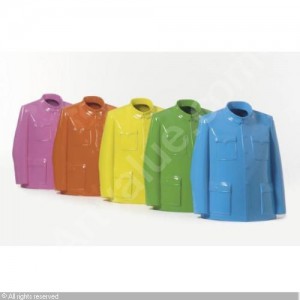
Sui Jianguo’s sculpture, Legacy Mantle, exhibits the socio-economic transformation from Mao’s China (socialist China) to commercial China (post-socialist China).


Body:

Jianguo’s sculptures of the Mao suit are exhibited body-less alluding to a Maoist past in which individual identity was rejected. The body becomes submissive, if not irrelevant, to the Mao suit that seems to be self-supporting. Through this presentation, the individual is seen to submit to the collective, which is represented by the Mao suit. The absence of the body highlights the absence of the identity and individuality in Maoist China, where the individual body only existed as a small part of the larger collective body. The absence of the body in Jianguo’s sculpture not only shows the loss of individuality, but also a submission to the collective. The Mao suits appear in a group of five and self-supporting in order to emphasize how the individual only exists as part of the collective [collective body and collective identity]. Through this piece, the artist criticizes the Maoist period where the absence of the physical body shows the absence of the individual person. The submission that is suggested by the absent body can be seen as a type of “rape” of the individual by the corrupt and unjust CCP.


Color:

The different colors of each of the five Mao suits, contrast with the absence of individuality. The vibrant colors displayed by Jianguo’s Mao suits are a representation of modern contemporary consumerist China. The bright colors give each suit its own uniqueness and individuality. In the Maoist era, the Mao suit generally appeared in all neutral and bland colors, portraying each body as part of the larger collective in the eyes of socialist China. The neutral colors were a representation of collectivity and similarity in that no body had an individual identity. The body was supposed to appear genderless, shapeless, and sexless (masculinized). In the Chinese socialist era, fashion was a form of political oppression—and this was most notably observed through the Mao suit. Politically, the socialist government, through the Mao suit, promoted a specific social behavior that fused the symbolism of Maoist thought and utility.  move these comments to the paragraph on body The artist purposefully uses bright colors in order to emphasize the individuality of each of the Mao suits—juxtaposing the collectivity invoked by the absence of bodies. Jianguo uses these colors to represent individuality and prosperity that describes commercial China, or post-socialist China. address how the artist, in terms adding color or coloring the mao suite, rewrite social-political history as china undergoes transition from mao to post mao


The sculpture contrasts two seemingly opposing ideas–the absence of the body and the presence of the vibrant-colored suit—in order to highlight the great changes that have occurred since the transition from socialist China to post-socialist China. He characterizes socialist China as a time where there was no individual, no identity other than that of the collective. Now, however, in post-socialist China, citizens are starting to determine their own identities—and through this they are becoming separate identities (represented by each color being different). Jianguo suggests in this sculpture that although there is a movement to the future, the Chinese people who lived through the Maoist period will not forget what it was like. Although there is a vibrant individual culture growing in China, in a past not so long ago this was not possible for the Chinese people. Through this, the artist celebrates the transformation of China from socialism to post-socialism.

nice post


Strong and United Chinese Girls in Uniform


Image number: 1656131, Bridgeman Education, color photograph 1973, Bridgeman Images

Image number: 1656131, Bridgeman Education, color photograph 1973, Bridgeman Images.

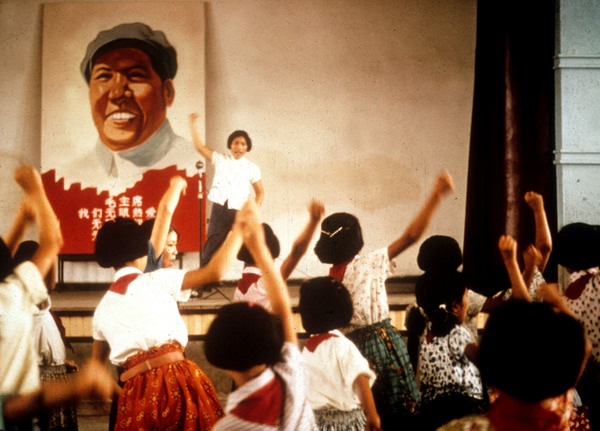
The photo in color titled In A School in China: Political Education: Children, With a Red Scarf, Rausing Fist in Front of the Portrait of Mao Zedong (1973) available through Bridgeman Images, the author photographed the moment Chinese girls in school uniform are raising their fists as one stands on stage in front of a poster of Mao Zedong. Because of the uniform these girls are wearing they are able to express themselves as leaders, speakers and at the same time followers of Mao Zedong’s social and political beliefs, but only through the acceptance of the uniform.

The power of the uniform similar to the Red Guard uniform in terms of connotations as explained by author Li Li in Uniformed Rebellion, Fabricated: A Study of Social History of Red Guards in Military Uniforms during the Chinese Cultural Revolution and Beyond, she says that when in uniform the people were able to represent their support for the revolution, Mao, and that they were all no different from one another in terms of social classes.[1] Although in this case the children that were too young to be a Red Guard so in school uniform they could show their support. The white short-sleeved shirt these girls are wearing carries that significance that male and female workers would wear in the mid 1900s. The white short-sleeved like the People’s Liberation Army weren’t designed for a specific gender which was the ideology during the time into the end of the Cultural Revolution.[2]  This meant that women could be seen through a different view, yet only when the uniform was a part of their identity. The white shirt was also paired with a red handkerchief that was worn around the neck, which was the color of the revolution.[3]The girls in the picture are also wearing flower patterned skirts, instead of pants, this represented the reminder that although they could be active in the movement it was limited.

These young Chinese girls are gathering in a school auditorium and not in a public space, they still feel powerful because the photograph shows the different levels of positions that could be attained even if they were wearing the same simple uniform. There was student on the stage and the rest as people from the audience. Lastly another important aspect of this photograph is the fists that are being raised with momentum because some of the girls’ hands are blurry in the photo, which is symbolizing the strength of their support.

Being in uniform was an opportunity for young girls like older women to participate and lead a movement. In the photograph the girl on stage is pictured standing aside from the microphone which represents needed someone to help their voice be heard, I think is significant to this idea that in uniform there was female voice and presence.

the denotation/connotation could also be paired in terms of 1) the uniform 2) mao’s portrait 3) on-stage and off-stage 3) raised fists/performance. then you can explain the signified meanings of each sign.

[1] Li, Li. “Uniformed Rebellion, Fabricated: A Study of Social History of Red Guards in Military Uniforms during the Chinese Cultural Revolution and Beyond,” in Fashion Theory 14, no. 4 (Berg: 2010) 441

[2] Li, Li. “Uniformed Rebellion, Fabricated: A Study of Social History of Red Guards in Military Uniforms during the Chinese Cultural Revolution and Beyond,” in Fashion Theory 14, no. 4 (Berg: 2010) 447

[3] Tina Mai Chen. “Proletarian White and Working Bodies in Mao’s China,” in Positions 11, no. 2 (Duke University Press: 2003) 382

Uniformity and Heightened Status among Students in Maoist China

SS7730856_7730856_10326984

Students at Beijing University, Joseph, William, Collection: “Serve the People!” 1972.

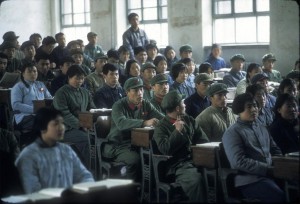
Above is a photo of students at Beijing University listening to a history lecture. This photo was taken in 1972 by William Joseph a political science professor at Wellesley college as part of a series called “Serve the people! Images of daily life in China during the Cultural Revolution”. Professor Joseph visited China as a member of the Committee of Concerned Asian Scholars, a committee dedicated to the improvement of Chinese-American relations (1). Despite the relative uniformity of all the students which can be observed through the blue and green colors of clothing as well as the masculinization of the female students, the heightened status of the Red Guards is still evident and clearly displays their importance in Chinese society during the Cultural Revolution thus revealing a contradiction between the desire for uniformity and the elevation of certain members of society as Red Guards.

First, the presence of a ‘uniform’ is evident in this classroom setting through the blue and green colors. Although there are slightly different hues of blue and green, which is likely due to individuals making their own ‘uniforms’ with available materials, nobody deviates drastically from the the norm of blue and green clothing which is striking evidence of uniformity. Moreover, since all clothing bears the same box-like shape with a high collar and long sleeves, there is no evident distinction between male and female bodies which only furthers the sense of uniformity among the students. Additionally, the women all either have short hair or tightly pulled back hair which erases any remaining traces of gendered bodies and normalizes everyone to a masculine standard. little more comments on the political indication of this “uniform”

However, despite the general uniformity, the Red Guards stand out from others signifying their importance. First the patches of red on their collars and hats stand in stark contrast to the sea of blue and green and serve to distinguish the red guards from ordinary students. Second, the hats on the red guards seem to increase their height relative to other students thus literally and figuratively elevating them among the crowd. Finally, the uniforms of the red guards seem to be better tailored, made of better cloth and generally of higher quality than their peers. All of these elements converge to signal the heightened and important status of the red guards above other students. the political status of the red guards?

There seems to be an interesting contradiction between the strong uniformity of the garments worn by students and the distinct contrast of the red guard uniforms. During the Cultural Revolution the individual was devalued in favor of the larger group and thus uniformity was a fundamental component of society so it seems contradictory that certain individuals would be elevated to a higher status(2). Specifically because, as is evidenced in Professor Joseph’s image, these individuals seemed to break the uniformity of the rest of the crowd.

However, an important factor, which could change the interpretation of this image, is the potential for bias. Although Professor Joseph is an academic and thus presumably educated on the subject of Chinese culture and society his position as an outsider and specifically a westerner certainly created a bias in the way he chose to capture images of daily life during the Cultural Revolution.

there were no schools in those days and the colleges were only open to “workers, peasants, and soldiers.” we may see the class identity from what they wear.

(1) http://academics.wellesley.edu/Polisci/wj/China1972/intro.html

(2)Li Li (2010) Uniformed Rebellion, Fabricated Identity: A Study of Social History of Red Guards in Military Uniforms during the Chinese Cultural Revolution and Beyond, Fashion Theory, 14:4, 439-469

Controlling Through Uniform: Mao Zedong and The Red Guards

600-7

(http://alphahistory.com/chineserevolution/red-guards/)

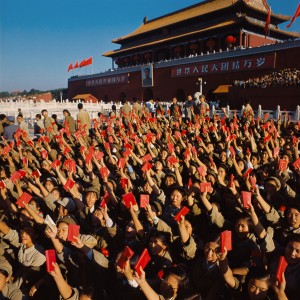
This photo shows hundreds of Red Guards united together at a Tiananmen Square rally in 1966. I selected this image for this week’s Mao Suit topic for a couple reasons. I felt like this photo combined a lot of unique qualities that several of the images we have seen in class. Another reason I chose this photo is because of the powerful message it eludes when you look at it first glance. When I first saw the photo, the mass amount of people in uniform created an extremely  compelling feeling that forced me to examine it further.

Focusing in on the denotations, there are three primary features of this image that stand out. The first being the photo of Mao which is posted behind the mass crowd of red guards. Clearly Mao is displayed high above the people, as a leader. He is clear that he is the person that these people are fighting for. However, there is only one small photo of him. What also stood out to me about the photo of Mao is that it is very small and there is only one photo of him. This is extremely powerful, because it proved that Mao was represented in all aspects of these people, not just just the photo of him. Within the crowd of people, Mao is represented through the matching uniforms, the red books, and the expressions on these people’s faces. I would go even go further to say that the small individual photo of him hanging up would not even make a difference if it was not there. This is extremely significant because at this moment, Mao is so powerful that every aspect of this photo eludes him and is connected to his leadership in some way.

The second significant denotation is Mao’s Little Red Book that is grasped tightly in every single person’s hand. With each person holding the books up high, they are able to be seen clearly by anyone there. The mass amounts of the color red also reiterates the dedication and fight behind Mao.

need more connotation on the topic of Mao’s little red book

Lastly, each person is wearing matching brown uniforms, which gives up a person’s individuality in exchange for the feeling of belonging. These matching uniforms play an extremely important role in Mao’s goals of utilizing young students in his fight for power and change. These matching uniforms demonstrate the feelings of unification and alliance that the youth needed at this time. The feeling of belonging and being needed for a cause is why most of these people joined in the fight for Mao. However, in reality, these matching uniforms allowed for no individuality or independence to be displayed. Instead, it was an army of people with the same identity and no opportunity to speak one’s mind. This clearly was an intentional move.

What also stood out to me about the photo of Mao is that it is very small and there is only one photo of him. This is extremely powerful, because it proved that Mao was represented in all aspects of these people, not just just the photo of him. Within the crowd of people, Mao is represented through the matching uniforms, the red books, and the expressions on these people’s faces. I would go even go further to say that the small individual photo of him hanging up would not even make a difference if it was not there. This is extremely significant because at this moment, Mao is so powerful that every aspect of this photo eludes him and is connected to his leadership in some way.

Overall, this photo has qualities that clearly stand out. However, it is the unification, dedication, and lack of individuality that are the biggest elements. Taking a quick glance at this photo, Mao Zedong’s control and power can be read through every aspect of this photo. This is a testament to his intelligence and ability to create a movement, whether it was a honorable movement or not is another question.

I re-organized your post which make it cohesive

Dressing the Red Guards Over Time

Beginning in 1966, China witnessed an extraordinary explosion of violence across the perpetrated by young middle and high school students. Teachers, intellectuals and other “enemies of the state” were dragged from their homes, savagely beaten in the streets, tortured, and summarily executed by these children. This chaos unfolded with the blessing of Mao who exploited it to seize power after being pushed aside following the tragic Great Leap Forward that caused tens of millions of people to starve to death. His deliberate intervention in the movement helped shape the identity of the Red Guards, validating their appropriation of the Red Army uniform and the militaristic adherence to Mao Zedong Thought.

To understand the significance on Mao’s influence on the sartorial choices of the Red Guards, one needs simply to examine propaganda prior to his receiving the Red Guards in Tiananmen Square.

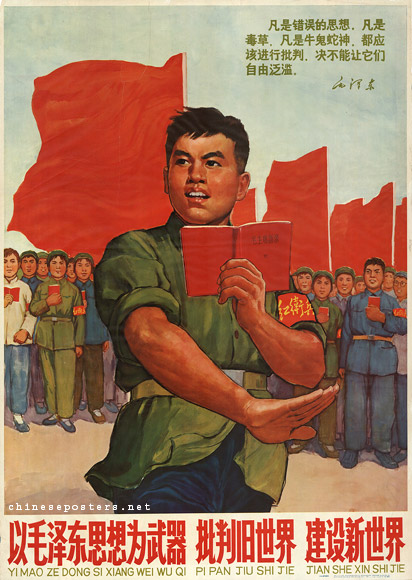
"Criticize the old world and build a new world with Mao Zedong Thought as a weapon." Sept, 1966. Reproduced from chineseposters.net

“Criticize the old world and build a new world with Mao Zedong Thought as a weapon.” Sept, 1966. Reproduced from chineseposters.net

In this poster, the title reads “Criticize the old world and build a new world with Mao Zedong Thought as a weapon” and it is from September, 1966. In the center of the poster is a young man who is wearing a green People’s Liberation Army jacket with the sleeves rolled up with blue pants and the typical red armband and carries Mao’s Little Red Book. Behind him are young people in varying outfits: some are wearing completely PLA uniforms, while others are wearing only partial uniforms like the green jacket without matching pants; others are wearing blue Mao PLA suits or plain shirts and pants. Behind them are large red banners.

The discord between this image and the legions of identically dressed youngsters clad in PLA uniforms can be resolved by noting that this image was produced in September, 1966. Mao only appeared clad in his olive PLA uniform on the gates of Tiananmen Square on August 18, 1966. This early in the movement, it is very possible that the Red Guards as a whole had not coalesced around that form of dress even if the elite members from Tsinghua already dressed that way. Instead, careful analysis of the image reveals that they conceived of two unifying symbols: Mao’s Little Red Book and the red armband. Despite their being dressed differently, each person holds a Little Red Book. More importantly, the artist has configured each person so that the book is over their heart. Subtly, the artist wishes to state that what defines the Red Guards at this moment in time is not what they wear, but that they take Mao’s words to heart and always carry his words with them.

yes, the poster intends to address that mao’s little red book, thereby mao’s thoughts, is the leading rhetoric for the CR.

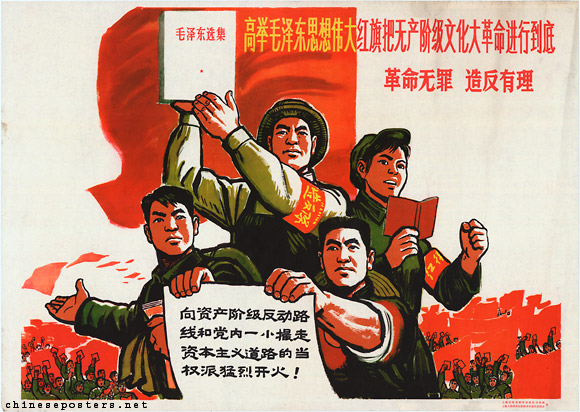
"Hold high the great red banner of Mao Zedong to wage the Great Proletarian Cultural Revolution to the end", 1967, reproduced from chineseposters.net

“Hold high the great red banner of Mao Zedong to wage the Great Proletarian Cultural Revolution to the end”, 1967, reproduced from chineseposters.net

Less than a year later, the Party produced a poster titled “Hold high the great red banner of Mao Zedong thought to wage the Great Proletarian Cultural Revolution to the end – Revolution is no crime, to rebel is justified.” The poster prominently features two red guards in the center wearing the characteristic olive military uniforms of the PLA. The Red Guards holds a copy of Mao’s Little Red Book in her hands and wears an armband on her left arm. Between them are two peasants who are also wearing red arm bands, as well as overalls and sun hats. Behind them are legions of Red Guards wearing the military uniforms and holding Mao’s Little Red Book high above their heads.

workers, peasants, soldiers, and red guards are the social political subjects of the poster, thereby the focal point.

One must note the significance of placing two peasants between the two Red Guards. The Cultural Revolution and its Red Guards were predominantly an urban phenomenon in China. To place two peasants between them symbolizes the unity of the two important segments of Chinese society. Furthermore, this is supported by the peasants’ wearing of the red armband. Not only their location in the image, but the sartorial choices made by the artist are intended to illustrate ideological harmony between the two. Lastly, one should emphasize the sartorial uniformity of the Red Guards in the background. When comparing it to the preceding image, the Red Guards in the background are all wearing olive military uniforms. Contextualizing this difference with the date disparity between the two – 1966 to 1967 – illustrates that the movement quickly coalesced around the olive green military uniform with the red armband as the proper uniform in just a few months. Perhaps this might be due to the influence of Mao’s appearing at Tiananmen Square several times in the span of a few months wearing this exact uniform. Their desire to emulate his thought might have been augmented by their desire to emulate his person.