Monthly Archives: April 2022

Book Review: The Beyonders

For my book, I chose The Beyonders (1977) by Manly Wade Wellman, an American author born in Portuguese West Africa, who spent most of his adult life in North Carolina. The novel describes the attempted invasion/arrival of an alien race known as the “Beyonders” and the humans that fight against them. The Beyonders have a clan of allies on Earth, the Kimber family, who reminded me of the Cullen family in Twilight because of their reclusive habits and their comfort with the esoteric. At its heart, this novel is an alien invasion story, but there is the added layer of “invasion” by a slick out-of-towner (also an ally of the Beyonders) who wants to transform the poor, sleepy town of Sky Notch, North Carolina, into a wealthy hub for science and technology.

Wellman did a good job subtly discussing class in the apt dual invasion by both true aliens and the city-slicker who tries to turn the townspeople against each other for his own selfish gain. The author’s faith in humanity was an unexpected treat. On the other hand, he does glorify a stereotypical, tough, stoic masculinity that defends itself with guns; if you’re looking for a feminist story, this is not it. There is a female character with an important role, but they continually call her kind of a nickname that stems from not wanting to say her real name (“Slowly” instead of “Celola” because it’s “easier” to say); I’m not sure what to make of this.

I chose this story because I wanted to read a piece that had strong ties to its setting. Southern Gothic is one of my favorite genres of literature, and from the synopsis, The Beyonders appeared to borrow from that tradition. Michelle also helped me solidify my choice by recognizing him primarily as a horror writer—another indication that this might inherit from the genre. In general, the text matches those expectations. I would recommend this book, then, if you’re looking for a quick, fun read about defeating some aliens who want to exterminate an Appalachian town.

Wellman, Manly Wade. The Beyonders. Warner Books, 1977.
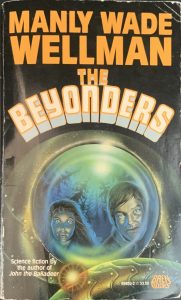
Cover of the first edition of Manly Wade Wellman’s novel The Beyonders

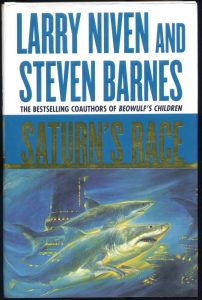
Book Review: Saturn’s Race

I chose Saturn’s Race because I was intrigued by how the author would tie together science fiction, love, and conflict. I also thought the cover of the book was intriguing. Saturn’s Race is set in the near future when humanity has created artificial islands which are home to some of the wealthiest, smartest, and most powerful men and women in the world as well as revolutionary technological innovations. The islands are practically nations in the way they operate with countries around the world: selling goods and technology, providing aid, protecting their assets and interests.

The story revolves around Lenore Myles, a brilliant recently graduated college student invited to Xanadu(one of the main islands) for a recruitment event. At the event she becomes entangled with Chaz Kato, a scientist and citizen of Xanadu, who gives her unrestricted access to Xanadu’s systems to gain her trust and convince her to work on the island. While exploring the island, Lenore discovers a paramount secret about Xanadu that could change the world. Unsure of what to do next, Lenore flees the island but is pursued by Saturn, a powerful mysterious entity that protects Xanadu’s secrets. In this thriller, Lenore seeks to survive as Saturn races to protect Xanadu’s secret and Chaz Kato decides where his allegiance lies.

The main themes within the book are cybernetics, utopias, and advanced computer technology. My favorite parts of the book are the depiction of sci-fi technology and the pace at which the story is told which keeps me on the edge of my seat. I would recommend this book to anyone looking for a thrilling adventure novel with themes of advanced technology, a utopian society, and computer systems.

Authors: Larry Niven and Steven Barnes, Publication year: 2000


Green Hand Book Review: R is for Rocket

I chose this book knowing that Ray Bradbury was an excellent writer. I had only read his novel Ferenheight 451 prior to this class. After reading some of his short stories assigned to us, I was reminded of how much I enjoy Bradbury’s writing. Furthermore, I was compelled by the short form fiction style of SF we read in class. R is for Rocket stood out to me for two reasons. 1) It was an anthology and 2) all of the stories were written by Ray Bradbury. The book provides a wide range of story material; however, there are definitely strong themes throughout the book that provide insight into Bradbury’s outlook on the state of the universe. Space and time travel are frequent topics within this anthology. Although, rather than purely idolizing these concepts, Bradbury is quite thoughtful about his plot lines. Often, Bradbury uses space and time travel to critique aspects of contemporary society: the capitalist agenda, financial inequality, American escapism, and environmental exploitation. I can see how his stories attracted a huge age range; on the surface, these are stories for the adolescent boy desperate to get his hands on some spacey rocket story. But as a 21-year-old, I am compelled by many of the stories within the anthology. A very common theme within almost all the stories is loneliness: on earth, in space, in time. Many of his stories convey feelings of desperation, a deep longing to be free from the gravity beneath our feet or the confines of a job or the limitations of our earthly bodies. Yet, the grass always seems to be greener on the other side. Bradbury seems to truly believe that humans are destined to live grasping for the next scientific discovery, only to find that the loneliness we all seek to escape follows us wherever – or whenever – we may end up.

I would certainly recommend this book or any of Bradbury’s short stories (if you want some of my favs, A Sound of Thunder, R is for Rocket, The Rocket Man, The Long Rain).

Bradbury, Ray. R Is for Rocket. Doubleday & Company, 1962.

R Is For Rocket by Ray Bradbury. Bantam Books. This ...

E.C. Tubb, Mayenne (1973)

When I went to the Green Hand, I was looking for a light read that had good enough writing to get me through. My expectations were delightfully exceeded in this book! What I did;t realize when I bought it was that it was part of a 33-book sf series by Tubb. Despite this, the book does a good job introducing each character, even if they had been a part of the series for a while, so it was easy to enjoy standalone. The novel is about Dumarest et al. finding themselves on a conscious planet as they attempt to repair a broken space liner, where they are put through trials by the planet as the planet seeks to understand love. The novel, as the cover suggests, has a smutty part or two that is tasteful enough to recommend the book to a family member without it being weird. My favorite parts of the book were the action scenes, the fight choreography is concisely described and it held my attention throughout. A pretty short read too, coming in at just under 160 pages for a book with about a third the footprint of a piece of printer paper.

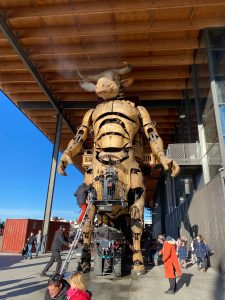
La Machine – France

On New Years Day I was visiting Toulouse, France with my dad and we went to a museum hosting the work of the group La Machine, a “street theater” group that creates large-scale machinery for performance. The group’s creations remind me a lot of the steampunk genre of sci-fi we talked about briefly in class, which features retro steam-powered machines over more modern, electronic ones.

Their website has tons of information about and images of their works: a giant spider which was part of a performance through the streets of Toulouse, their newest design “Heron Tree” and many more. I’m fascinated by how the group incorporates the steampunk aesthetic into so many different aspects of performance (giant animals, natural objects and musical instruments to name a few). The site describes the animals as performers which “feed an unusual vision of theatre, reading movement as a language, and in turn a source of emotion. The operators, engines, animals and musicians intermingle, confront and tune in with each other, thus creating images that change our relationship with the city, suddenly transformed.”

They have so many projects it’s impossible to capture them all in one post. On my visit to the museum, I was lucky enough to ride on this giant centaur they had created out of wood and machinery. It was extremely detailed (you can see the steam coming from its nostrils, the chest moved up and down as it “breathed” etc.) and it moved around the property, operated by two individuals who used VR and motion sensors so the machine would mimic their movement.

There’s so many other intriguing parts of the museum and I highly suggest checking out the site for a bit (especially their musical performances). I thought this group and their work really connects to this class and expands the steampunk genre into the theater/performance realm. We haven’t seen many live performance pieces (other than Defekt, of course) so I thought I would share their super unique work!

Robot dolphins to end animal captivity?

Blog Overlord: Kate Fosburgh

The short story we read the other week by Vina Jie-Min Prasad, “A Series of Steaks” (Singapore, 2017) begged the question of whether artificial replacements for animals, or in this case animal meat, is humane or an abuse of science. The story described fake beef that looks and tastes exactly like the real thing, to the point where consumers cannot tell the difference.

Plant-based meat, such as “impossible burgers” or “beyond beef”, is becoming increasingly popular. However, while these products claim to taste like real meat, they do not aim to deceive the consumer into thinking they are real meat. Is this lack of transparency the reason many of us were uncomfortable with the fake beef in the story versus the fake meat we eat in real life?

I was scrolling through instagram the other day and came across a video posted by a tech company called “Edge Innovations”. It was an informational video about mechanized dolphins they have built to replace dolphins in aquariums and therefore eliminate the cruel treatment of dolphins in captivity. They note that while the dolphins are currently operated by humans, they are working on giving them AI that will allow them to behave like real dolphins on their own. They also explain that when the dolphins were put in a tank with real fish, the fish seemed unable to tell the difference between mechanized and real dolphins. They say that these robot dolphins could take photos and swim with aquarium and park visitors instead of the real ones.

Is this a similar concept to eating plant-based meat? Or are artificial animals on a completely different level? I think that, again, the level of transparency with the use of this technology becomes important. Will people know they are not swimming with real dolphins? Is it a problem that fish treat robots as real dolphins? Maybe limiting the cruel treatment of dolphins for human entertainment is worth the deceit. The caption of the video on instagram asks, “Thoughts!?” I recommend you follow this link, watch the video, and check out the comments/debates!

https://www.instagram.com/reel/CcXAmpkl0wB/?igshid=YmMyMTA2M2Y=

Or, if you do not have instagram, you can watch a short YouTube video about it here:

https://www.youtube.com/watch?v=dQwnbcymI_w

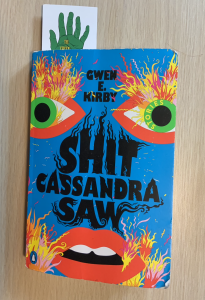
Green Hand Book Review: Shit Cassandra Saw by Gwen E. Kirby

The cover of Shit Cassandra Saw immediately caught my eye. It looks bright, modern, and unique. The short description of the book on the back cover reads “Margaret Atwood meets Buffy in these funny, warm, and furious stories of women at their breaking points, from Hellenic times to today”. I have really enjoyed the stories we have read written by women and about women’s experiences. I find feminist readings of science fiction fascinating, and this book sounded like a unique compilation of short stories written about women and written by a woman. 

The book consists of many short stories that all center around a female main character or characters, but vary significantly in content and message. Most of the stories ended up being fiction, but some are science fiction. My favorite of the short stories, which I will focus on for this post, is called “A Few Normal Things That Happen a Lot”. The story recounts the experiences of women being harassed by or fearful of men throughout their daily lives, but each one ends with a science fiction twist. Some women possess alien powers that make them unable to be bothered by these men, others gained superpowers from a radioactive cockroach bite or a surgical operation that gave them vampire teeth or werewolf claws. As women find out about these solutions to their fears, they gain popularity and society is turned upside down. New power dynamics and issues arise, leading to very different experiences.

This story is a mixture of hard and soft SF. It consists of details of technological innovation and alien phenomena, at one point even focusing on the lab work of two women. However, it also focuses on women’s experiences and addresses issues of patriarchal oppression. This focus on societal issues is more characteristic of soft SF. 

The style of writing is quirky, unpredictable, and fun! It is a very interesting read with engaging stories and themes throughout. I wish more of the stories had science fiction themes, but the fiction stories are fun as well. They range from light and playful to heavier in content and message.

I would definitely recommend this book.

Reviewer: Kate Fosburgh

Citation: Kirby, Gwen E. Shit Cassandra Saw. New York, Penguin Books, 2022.


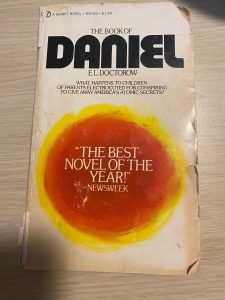
Green Hand Review – The Book of Daniel

I chose this novel by E.L Doctorow thinking it would be a soft sci-fi story that deals with the issues related to the atomic bomb through the eyes of children. I was imagining something similar to the story “That Only a Mother” (Merril 1948), that I really enjoyed from the beginning of the semester. All of the reviews stated that it was a resonating book that would leave me “dazed and drained” (Chicago News). I am more interested in the softer sci fi stories we have read, and have especially liked those that critiqued the government or the country’s actions in some way so I was very excited to read this.

While I did very much enjoy the book, it didn’t contain really any elements of sci fi that we have encountered so far. I don’t think if I were to categorize this book I would put it in the sci fi genre at all. Though it’s not technically sci fi, The Book of Daniel does examine several of the same topics we have been discussing in regard to the short stories we have read.

The story follows Daniel, the son of two communists living in Brooklyn in the 1950s who were arrested and executed for espionage. They were (falsely?) accused of leaking secrets regarding the atomic bomb, leaving Daniel and his sister Susan to foster homes. The story has a non-traditional narrative that includes many time shifts, POV shifts (third person “Daniel” to first person “I” in the same sentences…very confusing), letters, news reports, and biblical passages. His parents’ story is told simultaneously as the story of Daniel’s present (1967), where he is in graduate school at Columbia with a wife and a young child.

Daniel models his own political views after his parents’ as he reveals his socialist/communist leanings. His disdain toward the government in the late 60s is evident (and understandable) after the death of his parents. The novel explores this impact through his storytelling but also through his sister’s life which is riddled with mental hospital visits and eventually ends with suicide. If anything, the book relates to sci fi stories we have read in the sense that it provides a historical critique of overbearing government actions through the lens of those indirectly impacted by it.

The story is very dark, and I would recommend it to people with that caveat in mind. There are several sexually explicit, violent, and triggering parts mixed with sometimes quite boring history of the communist party. I found it was a bit slow at times, but the narration style was super unique and kept me intrigued. It is said to be loosely based on the Rosenberg’s, a couple from the 50s who were arrested for spying for the Soviet Union. If anyone’s interested in this historical moment being told from a fictional (but not so science fictional) point of view, I would definitely recommend The Book of Daniel.

Full Citation: Doctorow, E. L., 1931-2015. 1971. The Book of Daniel. New York: Random House.


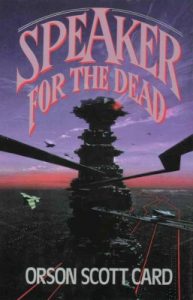
Green Hand Book: Speaker for the Dead (Orson Scott Card, 1986)

Card, O. S. (1986). Speaker for the Dead. Tor Books.

I had very fond memories of reading Card’s Ender’s Game as a pre-teen, so I was very excited to dive into the sequel, which also won the Nebula Award (1986) and the Hugo Award (1987). For those of you who’ve read Ender’s Game, this sequel is set about 3,000 years after a human starfleet under Ender’s direction essentially wiped out an advanced ant-like race of aliens known as the “Buggers” (more on that later). Humans have spread out across the galaxy in colonies, and Ender himself is only middle-aged because of frequent near-light speed travel between these colonies. Among most humans, he is now reviled throughout the galaxy as “Ender the Xenocide,” though few know that he is still alive and is also the founder of a popular religious movement which emphasizes candidly and empathetically speaking about those who have died. He is called to Lusitania, a Portugese Catholic colony planet, to “speak the deaths” of two Xenologists who have been inexplicably murdered by the “Piggies,” an otherwise amicable pig-like intelligent alien species native to the planet. Unlike Ender’s Game, this book is much more interested in questions of  xenobiology and religion than those of conquest or war. It ends up reading a bit like a detective story as Ender unravels the secrets of complex social and biological networks which Card has cleverly designed.
I’ve read online that Card, a Mormon, has a long history of homophobic remarks. While I don’t doubt these charges, I must admit that I find them hard to square with the compassion that exudes from this novel. Ender, the clear hero of this story, redeems himself from his near-genocide by restarting a community of the “Buggers” on Lusitania. He is at his best as he adeptly breaks through the skeptical walls of everyone from Catholic priests to Piggies to the ansible-distributed AI whom he considers his best friend. This is sophisticated science fiction written with a loving and wise touch. While its author is certainly flawed, I’d still strongly recommend this book, particularly if you enjoyed Ender’s Game.

MATH

Last week we had a little debate on whether math was created or discovered and I wanted to share a couple of my thoughts on this topic.

I am in favor of the idea that math is discovered rather than invented. I have a couple instances that I believe support this side of the argument. The example that most stands out to me is the existence of black holes. Until recently, I do not believe we had photographic evidence of black holes and yet through math we were able to know what they were and where they existed. We have been able to know that black holes exist and some of their properties through math. Basically, through our knowledge of math we were able to discover a new type of entity in space.

Another argument is that math all fits together so nicely. Math has been discovered over of thousands of years. There have not been any contradictions to math yet which seems unlikely. An example of this is the invention of calculus. Most people attribute calc with Newton, but it was actually invented by two different people at the same time. The other person, Leibniz, invented calc at the same time as Newton. The fact that these two came up with the same ideas at the same time and had no real contact with each other is insane. If math were invented as opposed to discovered I see no way they could have fabricated the same exact methods and formulae that make up calc.

Math is able to explain natural occurrences as well. This shows that math is able to describe the world around us. This makes it feel real and inherent as opposed to made up.

Another point is that math is closely related to the sciences. I believe (and could be wrong) that people accept science as being discovered instead of invented. Math is tied into the truths of sciences especially chem and physics.

To sum up, math seems too universally used and connected to too many truths and is tied together so well with itself to be made up and therefore for the examples I have listed above I believe that math is discovered.

Let me know what you think. I would love to hear support or counter arguments to this post.