Green Hand book Review – The Corridors of Time by Poul Anderson

Poul Anderson’s The Corridors of Time, originally published in 1965 (my copy is 1981) is a winner of both the Hugo and Nebula awards and provides a phenomenally entertaining read within the Time-Travel sub genre . At a brief 186 pages this novella read swiftly while still managing to do a solid job of world building and immersing the reader. The plot revolves around a young man named Lockridge, who is wrongly convicted of murder but suddenly legally and financially backed by a mysterious figure named Storm Darroway who manages to successfully defend Lockridge. In exchange for her services, Storm takes Lockridge on as her apprentice in fighting a Time War between her faction and their rivals. Storm and Lockridge venture through several eras in history, and along the way we are introduced to several epic Novums. For instance, gravity belts that allow its users to glide effortlessly through the air, or Time Corridors that are just massive hallways (navigated usually by hover bikes) with doors for several periods of time – each equipped with its own room full of money and clothes appropriate for the period as well as a Diaglossa – a white orb that floats in the ear and suggests the proper language forms and customs. In addition to these novums I found some of the writing rather witty, such as the line “How easily one becomes a God” (Made Me chuckle 🙂

While all this makes for an entertaining read, I found that women were oversexualized and men were not accountable for their actions and it was honestly a bit uncomfortable. Whether with Storm, an adult woman, or Auri, a young teenager, women are constantly under the gaze of Lockridge and the author drills into these tensions throughout the book. Lines like “The battle ax men weren’t bad by nature – they were just overbearing. Like untrained boys” further paint a dated view on masculinity that propagates the “boys will be boys” motif. Personally, I don’t Love that.

All being said, I did have some qualms with the morals of the book but as a piece of entertainment this was a ball to read. If anyone’s curious about other time travel books I would Recommend “This is how you Lose the time War” by Amar El-Mohtar and Max Gladstone as better literature, but if fun is what you want this book will do the job – just be aware of the gender dynamics as you read.

Anderson, Poul. The Corridors of Time. 1981.


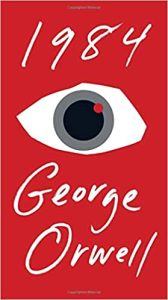
1984 George Orwell – Green Hand Bookshop

1984, written by George Orwell and originally published in 1949, is considered by some one of the most well known and popular dystopian science fiction books of all time. I chose to read 1984 because I have been told by multiple people that I need to read it eventually and it also relates to the world today in an eerie way, especially with current events. The book is about a man named Winston Smith who discovers he is not satisfied with the government Big Brother’s constant surveillance and control of society. He finds a way to rebel and falls in love with a woman named Julia, only to end up being captured, tortured, and eventually brainwashed into loving Big Brother. 1984 is considered soft science fiction since it mostly deals with a society and it’s dystopian government’s political aspects and control over the people it rules, and though technology is not unbelievably advanced, it’s surveillance ability is heavily abused. This book is very fascinating because of the parallels found to today’s current society. It depicts a government and society similar to one that could be found in reality, the main difference being that the control those in the upper class have is not only evident all the time, but is also absolute. Winston’s job involves rewriting journals, books, and other sources to make Big Brother’s predictions of the future always accurate and even change the occurrence of events in accordance with what Big Brother wants. The story is a haunting depiction of what could happen if those in power decide to exert more control and instances of this occurring can be seen on a smaller scale in real history and the present, and I would definitely recommend it because of how creative yet accurate and ultimately hopeless the tale becomes.

Orwell, George, and Erich Fromm. 1984. Signet Classics, 2017.

Marvel Cinematic Universe and H.G. Well’s Law

H. G. Well’s Law states that a science fiction or fantasy story should contain only one extraordinary assumption. This law has always fascinated me and been something I love to think about whenever I watch or read science fiction or fantasy, and though some people don’t like restrictions such as this one when it comes to writing fiction, for me it makes the impossible seem just a little more plausible. In Harry Potter magic exists in secret. In Star Wars everything tales place in a galaxy far, far away. And I can’t even count the number of stories that take place after some apocalyptic event has occurred or is about to occur. However, every time I watch a Marvel Avengers movie combining a multitude of stories and characters, I can’t help but think, “Does Marvel not follow this law?” Marvel even adapted H.G. Well’s book The Invisible Man into a comic, but the Avengers still colors way outside of the lines of his law. If we look at each story separately they all appear to work within the confines of the law: Spiderman is bit by a radioactive spider, Captain America is injected with a super serum, and Iron Man is a genius with a ridiculous amount of money. But when they all come together and the crazy powers of superheroes such as Doctor Strange are combined with aliens in Guardians of the Galaxy, things get a little dicey. When creating Avengers movies, the Marvel Cinematic Universe creates a lot of extraordinary assumptions for the understandable purpose of creating a lot of money and captivating their audiences. Stan Lee’s mind was insanely impressive to come up with all of the storylines in his comics and I will always hold him in high standing for that, but while watching Avengers movies I can’t help but feel as if it all is a little too unbelievable.

Ender’s Shadow (Green Hand Book)

This book was recommended by a classmate who was also choosing books at that time. Ender’s Shadow is a companion novel to Ender’s Game, which I have read and very much enjoyed. I was interested to see how Orson Scott Card would rewrite a story from a different perspective.

The book is about earth’s response to an alien invasion of B.E.M. The strategy is to train young gifted children in battle and command. This book follows a child named Bean through his journey as an orphan on the streets to being an officer in the final battle against the Formics.

It is an Alien Invasion story with political elements, specifically Russia and China as dominant world powers. It also includes space exploration and technological advancements like controlled genetic mutation. The author describes the two companion novels as a type of parallax. I read the companion novel Ender’s Game first, and there is a similar structure that explains certain parts of the book that aren’t necessarily missing without the companion but definitely enhanced when read together. I greatly enjoyed the book and would recommend it to others.

Card, Orson Scott. Ender’s Shadow. New York: Tom Doherty Associates, 1999.  Awards: New York Times Bestseller (Fiction, 1999), SF Site Reader’s Choice (1999), Alex Awards (2000), ALA Best Books for Young Adults (2000), Geffen Award (Best Translated Science Fiction Book, 2001), ALA Popular Paperbacks for Young Adults (2004).


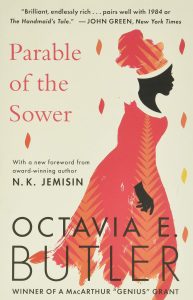
Parable of the Sower (Green Hand Book)

Before I chose this book, I had no idea who Octavia Butler was, and when I walked into the Green Hand bookstore, I didn’t have an idea of which book I was going to choose. However, in the bookstore, both a random man and the owner recommended Parable of the Sower, the 1993 novel by Octavia Butler. Parable of the Sower is a post-apocalyptic novel set in California, that depicts the devastating effects of climate change. It follows the story of Lauren Olamina, a teenage girl, and how she deals with the terrible events that affect her and her family. It also explores religion in an interesting way. Parable of the Sower is a dystopian SF novel, that also deals with themes of climate change and social/wealth inequality. I loved this novel for many reasons. I loved Butler’s writing, the characters she develops, and how real the scenarios and characters felt. I also loved (and was scared by) how prescient this novel (and Parable of the Talents, the sequel) were. I would highly recommend this book, and the sequel, to anybody, not just SF fans.

(Nominated for the Nebula, and a NYT Notable book of the Year)

Butler, Octavia E. 2019. Parable of the Sower. London, England: Headline Book Publishing.

Written in 1993.


The Representation of Time and Time Travel in Interstellar

The other day, I rewatched Interstellar, a 2014 science fiction film directed by Christopher Nolan. I really enjoyed rewatching it, especially while taking this course. The movie utilizes a lot of hard SF, and attempts to be quite realistic in explaining time dilation and time travel.

The movie starts in a future Earth where the environment has been ruined, with crop failure and extreme amounts of dust present. I won’t completely spoil the film, but the main character, Joseph Cooper (Matthew McConaughey) goes to space to attempt to find a new habitable planet. The fascinating part of the film was how time and time travel was depicted.

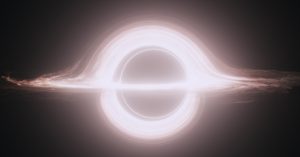
The first instance of time (travel?) I want to explore is on a water planet that Cooper and his team visited, where one hour on the planet is seven years on Earth, due to the planet’s closeness to a massive black hole, and the distortion of time. I found this idea extremely interesting, and upon further research after watching the film, it actually seems to be scientifically possible. The film utilized Kip Thorne, a former Caltech physicist, for the science, and he actually wrote a long book about the science of Interstellar, explaining what was scientifically possible and what was just for the film.

The second interesting thing I thought about in this film was how they represented time travel. Cooper enters the blackhole, and finds himself in a Tesseract, which represents time as a physical dimension. Thus, through moving about the Tesseract, Cooper is able to go back in time and influence the past by creating a signal in his daughter’s room, which in turn is the signal that causes him to go on this journey many years ago. It all gets quite confusing, as this seems like a paradox, but I won’t go too far into it as I don’t want to spoil the film, which I highly recommend!

Overall, I found this film extremely interesting and one of the best SF films I’ve seen, partially because of the plot and cool SF devices, but also because of the attempt at scientific realism.
This is the visual representation of the black hole.

-Ezra Jones

Robot Warriors (Green Hand Book)

At the Green Hand, I picked out two books, but the one I’m posting about is an anthology of short stories called Robot Warriors, edited by Martin Greenburg and Charles Waugh.

I actually really enjoyed several of the stories in the anthology with my favorite being “Kings Who Die” by Poul Anderson. This story focused on a Cold War-esque conflict carried out entirely in outer space to protect the Earth from weapons of mass destruction. The story focuses on an American soldier who barely survives a space battle and is rescued by a new type of enemy ship. Onboard, he meets with an enigmatic Russian General who has a plan to end the war but requires the soldier’s cooperation. Without spoiling the story, I’d recommend it to anyone interested in the themes of the sub conscience, human-computer integration, the cost of war, and questions of free will.

That said, they weren’t all highlights. One story in particular that frustrated me was “Second Variety” by Philip K. Dick. It wasn’t that the story had uninteresting ideas, but I figured out the twist about halfway through the story and spent the entire last half being annoyed with the protagonists’ stupidity.

Despite a few duds, it was a very enjoyable collection of stories that present interesting variations of many classical tropes of robotics. A few other stories from the collection I enjoyed were “A Relic of War” by Keith Laumer and “There Is No Defense” by Theodore Sturgeon (of Sturgeons’ law fame!).

–Isabella Angel


EDIT:

Wow, I can’t believe I completely forgot to actually include some of the most important information! Thanks so much for reminding me Professor Saiber!

For any who are curious, the reason I chose this was because I really love short stories, I also really love robots, and it was within my price range so I could get another book as well!

And the citation format for the book:

Dickson, Gordon R, Charles G. Waugh, Martin H. Greenberg, and Joe Adams. Robot Warriors. New York: Ace Books, 1991. Print.

http://www.isfdb.org/wiki/images/f/f7/RBTWRRRS1991.jpg

High Weirdness: the new psychedelic worldview in SF

High Weirdness (Drugs, Esoterica, and Visionary Experience in the Seventies) by Erik Davis explores the emergence of a new psychedelic spirituality in the works of PKD, Terence McKenna, and Robert Antin Wilson. I’m super psyched to read this!! Davis navigates readers through consciousness, the hierarchies of their perceived realities, synchronicity, and a plethora of other weird aspects of our human experience that is suggested by these major counterculture sf writers.  Magic mushrooms, flying saucers, the invisible trickster entities of the 70s, SF, what more could you want? (the attached photo has popular modernSF novels)
Parthenogenesis: Is It Possible?

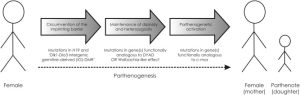
Joanna Russ’s short story “When it Changed” got me thinking: with the right science, would human parthenogenesis be possible? The answer is, maybe. This concept was explored in a paper by biologists Gabriel Jose de Carlia and Tiago Campos Pereira entitled “On human parthenogenesis,” which first appeared in the journal Medical Hypotheses (a publication which, to me, appears to propose ways to make biological science fiction phenomena into hard science–kinda cool). Carlia and Pereira address three barriers that must be overcome in order for human parthenogenesis to be realized: genomic imprinting, diploidy and heterozygosity, and zygotic behavior.

Source: “On human parthenogenesis”

Genomic imprinting refers to the “tagging” of paternal or maternal DNA that prevents a certain allele (i.e. a trait) from being expressed, meaning the allele from only one parent is expressed in the embryo. This process is crucial to human development. Carlos and Pereira suggest that deletion of several genes functionally comparable to those that allowed the creation of viable bi-maternal offspring in a mouse model could allow a human egg  to compensate for the absence of a paternally imprinted set of chromosomes, meaning it would be able to express proper alleles only using maternal DNA. Achieving diploidy and heterozygosity may be possible with the use of a bacterium, Carlia and Pereira hypothesize. The bacterium Wolbachia sp. can live symbiotically within a cell and is capable of inducing parthenogenesis in mites–parthenogenesis is advantageous to the bacterium, as it allows it to be transmitted to the host’s offspring (sounds wild, I know). Finally, the properly diploid, heterozygous gamete must be able to function as a zygote. In mice, the precise mutation of a proto-oncogene (a gene allowing for regular cell growth that, upon mutation, may induce cancer) can cause parthenogenetic activation, so it is proposed that the mutation of a similar gene in humans may do the same. In combination, these techniques would theoretically allow for viable human parthenogenetic offspring.

Putting these techniques into practice today would, of course, be considered unethical. However, the advent of “designer babies” and other uses of genetic engineering to ensure health and longevity suggest that genetic alteration for the purposes of parthenogenesis may not be an impossibility in the next hundred years, especially due to the so-called “male fertility crisis.” Who knows, maybe Beyoncé’s “Run the World (Girls)” was prophetic 🙂