Confession

To be candid, I grappled with the readings this week (blame it on break, I suppose). Though I enjoyed the Gogol story, I struggled to thematically connect it to the other readings in a clear way. To me, “Diary of a Madman” reads as an ironic juxtaposition to the Chaadaev writing. Gogol’s story highlights alienation and mental disintegration over time, as well as a struggle between who the narrator truly is and who he presents himself as. Perhaps most interestingly is the representation of Poprishchin through his dating system: “Don’t remember the date. There was no month either. Devil knows what’s going on”; eventually,  his date is upside-down and right-side-up. The sheer absurdity of this story contrasted with the hyper-Russian-centric responses from Chaadaev and Pushkin demonstrates a sad disconnect in the conversation of Russian cultural domination. “Apology of a Madman” is immensely inspiring: “It is a wonderful privilege to be able to contemplate and judge the world from the height of independent thought, free form unrestrained passions and petty interests which elsewhere disturb man’s view and pervert his judgement,” (314). That is one hell of a sentence. The pride so deeply rooted in this Russian identity is unfaltering, as echoed in Pushkin: “Russia will rise, a joyous, dazzling constellation, will leap from sleep to life and fame; on tyranny’s stark wreck the nation will write for evermore our name!”

Again, I struggled with the conflicting tones of the Gogol story and the Chaadaev/Pushkin combo. However, the arguments asserted by both were vastly striking.

Excitabo Monumentum

Chaadaev’s “Apology of a Madman” expresses a patriotism that falls into neither the ideology of the Slavophiles or those who wished to emulate the European world. It acknowledges the problem of Russia’s “vague” national character, the lack of deep-rooted traditions that allowed Peter the Great to impose his reforms with the success he had.

His conclusion somewhat echoes the savior complex of the slavophiles: “I believe that we have come after the others so that we can do better than the others.”

But he is careful not to align himself with them. Before declaring his love for Russia, his belief in its potential, he first enumerates all its problems and flaws, its unique situation: “alone of all the peoples of the world, we have not given anything to the world, and we have not learned anything from the world.” His potentially subversive message, especially given the country’s totalitarian history, is that it is not possible to be truly patriotic by blindly glorifying one’s country, exalting it based on nothing real. Instead, one has to look for its defects to see how they might be fixed or used to its advantage—as Russia, with no ideas of its own during the European Enlightenment, might learn from the mistakes of other nations and advance more quickly.

(Apologies if this isn’t the most lucid post—I’m still getting over an illness and not completely sure I remembered my Latin well enough for the title: “I will raise a monument”?)

Youth in Revolt

It is important to note that when Alexander Pushkin wrote “To Chaadaev”, he was all of 19 years old. Ah, 19! What an age! The milksop brutalities of adolescence fight for their right to the body and soul, while, meanwhile, the life of the mind adds signatures to its petition, humbly submitted but forcefully composed. Tonight many of us will see Doctor Chomsky speak, and as we leave the hall the air will crackle with the most mixed of messages-thoughts of power and freedom will mix with a strange energy, a longing…but I digress. I don’t want to project. Rather, I note these things because, in this work of the young Pushkin, we many of these energies channeled into crosscurrents that will provide a ‘hard and fast’ glimpse into what made Romanticism tick.

The first few lines of the poem seem to indicate that earthly cares of youth, placid youth, has faded- “Love, hope, [our] private (or quiet) fame” has been banished, lies and illusions have ceased to pamper the poet and his generation (nedolgo nezhil nas obman). The enjoyments of Youth are replaced by a different sort of passion-that for freedom, escape from under the yoke of repression. The narrative, at first glance, appears simple: the poet abandons (or is abandoned by) the pursuits of careless youth, and the transition from adolescence into adulthood is a process of politicization

I believe, however, that this interpretation is too simple. Freedom from tyranny and one-man rule (samovlastie) is oddly personal: Pushkin calls not for social revolution, but rather for intellectual and erotic self-actualization. On the ruins of tyranny the poet and his generation will write their names-the end of the old order is the path to the immortality of the self. The fatherland calls to duty, and beckons to the soul. Liberty appears not as the grey maiden, holding scales- she is the unspoken desire, yearned for as a “young lover” waits for the promised meeting (kak zhdyot lyubovnik molodoi minuty vernovo svidaniya). Russia rises from sleep, the national spirit is aroused.

This poem reminded me quite a bit of Wordsworth, another pillar of Romanticism- like Pushkin, the English poet’s youth is permeated by charged crosscurrents-the blossoming into manhood, the promise of the French revolution, etc. For our purposes, Pushkin leads us towards a rudimentary mock-up of ‘Romanticism’-the national-political overlaid onto (and at times, overcome by) the erotic and intellectual energies of the self.

The Russian Peasant, Through the Artist’s Gaze

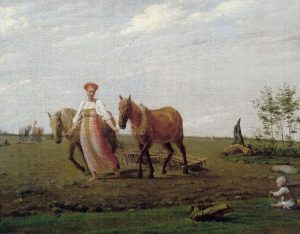
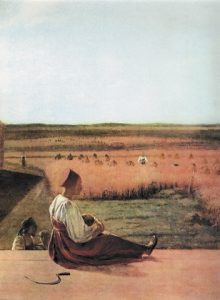
Alexei Venetsianov, was the first and the single one of his Russian contemporaries to find inspiration in the Russian countryside and in its landscapes and inhabitants. In contrast to Russian painters like Karl Briullov and Sylvester Shchedrin, who seem to have lived in Italy for most of their professional lives and were so heavily inspired by its influences that their identity as Russian painters vs Italian painters seems contestable,  Venetsianov glorifies the seemingly simple and pristine peasant way of life. With him, we see this shift of focus from the exterior and foreign towards Russia and its distinctness, which gives way to feelings of nationalistic pride on the part of the painter. In my mind, this is exemplified in his Spring, Plowland, and in his Summer, Reaping:

springplowland summerreaping

In these two paintings, the idea of simplicity is very prominent: there is little to no action occurring in the two works, eschewing a certain sense peace and serenity. The colors are very light and the sky is blue and very clear; although depicting scenes of hard manual labor, the scenes are very lighthearted.

Another observation to be made in this depiction of peasant life, is the tying together of the traditional garb of the peasant to the season: the spitefulness of the pink in spring, and the heaviness of the red in summer. Venetsianov in his paintings shows the strong relationship of the Russian peasant to nature: the peasant’s ties to Russia and its nature becomes an essential part of the Russian peasant cultural identity through the eyes of the painter.

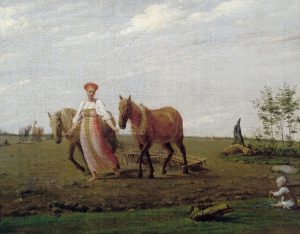
However, the depiction of the Russian peasant in these paintings is incomplete. In attempting to portray the peasant life in his paintings, Venetsianov shows his disconnect to the Russian peasants and their culture, depicting only a superficial ideal of the peasant life. This can be first seen in the way he paints the peasant maidens, though in traditional garb, they are painted in a style strongly resembling neoclassicism; especially in Spring, Plowland, where the form and movement of the maiden is reminiscent of those found in other neoclassical European paintings. The disconnect is further exemplified in the simplicity of the peasant life depicted. When I first listened to the peasant’s folk music, when I read the folktales, and when I first saw the traditional folk dancing, I was struck by its prevalent vivacity and variety; there was nothing simple and peaceful, in the literal sense of the word. Nowhere can we see in these paintings this underlying passion for life that manifests itself in beautiful harmonies, at times full of life and energy and sometimes beautiful and haunting, nor can we see the rich and colorful imagery of the peasant’s folklore.

The confusion surrounding what it means to be truly Russian is again manifested in Venetsianov’s paintings, where he is still too influenced by Europe in his art to perceive or depict a truly distinct Russian identity.

Tragedy in Ignorance (Paint for your Audience)

Throughout history, lower classes in practically every society have been severely disadvantaged and depressed, often without hope of improving their circumstances or social mobility. Almost never has this been more true than in Tsarist Russia. Before the Serfs were liberated by Alexander II in 1861, they were bonded to the land they worked. Without being overly pessimistic, the Serfs had very little going for them during the time most of the painters we studied for today were active. Although Orest Kiprensky was technically born a serf, he was quickly sent off to boarding school at the Imperial Academy of Arts, no doubt an educational institution for the privileged. In this way, he was divorced from serfdom, and from the direct experiences of the group he was born into. He, like so many of his contemporaries, spent extensive time in Western Europe, specifically Italy. This travel, especially at the time, would have been a luxury incomprehensible to 99% of the Russian population. Briullov was educated at the Academy as well, and also traveled widely. This was also the case for Alexander Ivanov. Tropinin was born into serfdom, but lucked into an Academy education, and probably had an experience far from his family and those he grew up with. Alexei Venetsianov came from a privileged merchant background. His wealth and stature is evident considering the fact that he “bought a village” and “painted scenes of peasants and rural life”. As a member of the “higher” classes, and definitely not a serf, it is easy to see why Venetsianov painted pictures showing happy peasants. He would have wanted to believe, like we all do in some way, that he was not complicit in the suffering of classes lower than his own. This is plainly evident in this portrait of a radiant peasant girl plowing the fields in spring, exerting no energy.

 springplowland

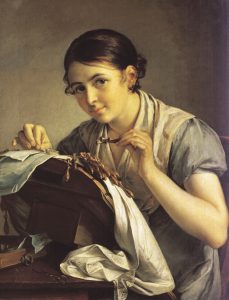
Venetsianov’s reasons for painting bucolic serf and peasant scenes are closely aligned with the experiences of Briullov and Ivanov. This doesn’t explain why Kiprensky and Tropinin painted peasant scenes free of turmoil, as they were both “from” the lower classes in a way, and would have a better understanding of their struggle. It comes down to marketing: Kiprensky and Tropinin needed to sell paintings to nobles and aristocrats who had no interest in seeing pain and suffering on their walls, particularly in the context of the serfs they oppressed. This is evident in Tropinin’s portrait “The Lace Maker” which depicts a peasant girl approaching her labor with the utmost serenity and grace.

0 T


This would have been a very non-confrontational image for the aristocracy to view and purchase. It only supports their world view. Thus, Tropinin and Kiprensky compromised their knowledge of the true peasant experience to obtain the widespread dispersion and appreciation of their art.

(Peasant) Life and Fate

As the first painter to depict Russian peasant life in fine art, Alexei Venetsianov used certain visual cues to evoke ‘peasantness’-traditional dress, implements of rural labor, and pastoral scenes are all used to evoke a unitary and naturalistic peasant life-world. The semiotic universe of these works is fascinating in and of itself, but I would like to hone in on two paintings in particular- ‘Reapers’ and ‘Fortune-Telling.’ I hope to show that, by doing a brief ‘close reading’ of each of these paintings, it can be shown how themes of fate and human agency are evoked and encoded by the use of peasant motifs.

In ‘Reapers’, the peasant subjects are placed against a background of wheat, establishing their milieu and ‘natural’ environment as the realm of agriculture, of cyclical growth and production. Cyclicity is further produced by the positioning of the peasants’ sickles: implements of agriculture that enable the peasants to interface with the cycles of the land, the sickles themselves are positioned as to inscribe a circle around the peasant couple, further linking them to the aforementioned cycles. Moving inward from this ring, we arrive at the peasants themselves. It is unclear whether they are a young couple or siblings, but in any case the positioning of their bodies evokes images of reproduction, birth, and regeneration. The male peasant encloses the form of the female with his grasp, delineating the space she occupies. Simultaneously, the female peasant’s head overshadows that of the male-resplendent and elevated in bright colors, the image of the female seems to generate that of the male, ‘birthing’ her counterpart. The circle of life (and of peasant social relations) is inscribed onto the subjects. Finally, we arrive at the two butterflies on the female figure’s hand-evoking a predictable cycle of transformation and rebirth, the butterflies prove the capstone symbol to successive ‘circles’ inscribed around peasant life. 

The imagery used in the 1842 painting ‘Fortune Telling’ is of a drastically different nature. The Russian title of the painting, Gadaniye, implies a process (perhaps futile) of arriving at the future- the ‘fortune’ which is to be ‘told’ is semantically absent. The subjects are placed against a black and indefinite background-although they themselves evoke ‘peasantness’ by their dress, the series of regenerative circles structuring the life-world of the subjects in ‘Reapers’ is missing. Fate is no longer predetermined by the cycles of the natural world, but instead is made uncertain and shrouded. The act of ‘fortune telling’ with cards gives the illusion of a greater agency, but, detached from the cycles and meanings ‘meant’ to structure rural life, this agency is portrayed as vain grasping in the dark.

Thus two different modes of agency are presented. In the first, the peasants are both ‘in’ the land and ‘of’ the cycles of nature, of harvest and growth, birth and rebirth: placed into sharply delineated spatial and symbolic ‘places’, the subjects partake in a form of eternal life. In the second, agency through human means, detached from the life-cycles of the rural sphere, is made meaningless: wrenched from their ‘places’, the peasants are obscured and their ‘fate’ is left uncertain.

I am over my word count. But there is an ideological element here.
 

A Portrait of Peasant Life

The Russian painters and their styles exemplify the struggle we’ve discussed throughout the course to establish a unique Russian identity, and the confusion and idealistic and stylistic disagreement between prominent artists. Alexander Ivanov still hung onto the tradition of Neoclassicism. Rubens and Van Dyck, the “old masters”, were held up as ideals (with comparisons to Karl Bruillov’s and Orest Kiprensky’s works.) Many of the artists studied traveled abroad to learn and improve, often to Italy. This follows the tradition of Westernization since Peter’s time, the borrowing of Western Europe’s styles and ideas, and perhaps a sense of inferiority or insecurity about Russia’s own culture.

It also shows a slight increase in social mobility; Vasily Tropinin and Orest Kiprensky were both born serfs, but Kiprensky was freed and educated, while Tropinin pursued education on his own, attending drawing classes in secret. Alexei Venetsianov was from a merchant family, not a serf, chose to depict peasant life, and taught paintings to serfs and people from poor families. Although he did not always meet with approval, his choices still demonstrate perhaps a trend of more people taking note of the serfs’ lives and struggles, and trying to give them a chance to have better lives.

Framing the Working Class

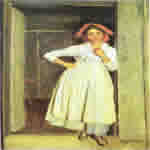
These 19th Century Russian portraits certainly serve as a tribute to Russian peasants. Each painting captures individuals working–sewing, feeding animals, working in the fields–focusing on the individual, rather than the work. This trend fits in with the larger one of romantic realism: these painters do paint the individuals of the Russian working class (realism), but they do so in a very romantic light, that doesn’t truly capture the harshness of their grueling work day (romantic). Alexander Ivanov’s work clearly depicts that phenomena. In his 1830s painting of “A Girl from Albano Standing in a Doorway”, he paints a classic country woman.

girlfromalbanostandinginadoorway

He really romanticizes the country life. She isn’t working and she is wearing an overly pristine white dress. The clean white conveys purity and a certain degree of luxury; after a day (or week’s) work her dress should be ragged and filthy, but it remains simply well worn and clean. The state of her dress, paired with the pop of pink color on her head contrasts deeply with her dirty, broken in shoes and the beaten up door, and the deeply sad and pensive look on her face. All of these contradictions and surprising pairing encourage the trend of romantic realism that focuses on an idealized version of country life.

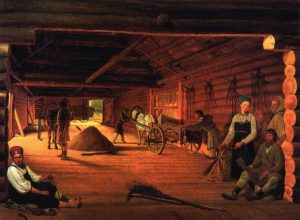
Alexei Venetsianov is known for his emphasis on peasant life and natural landscapes. His work contributes to this trend.

onthethreshingfloor

This scene is set in a barn, with working individuals. This is fitting for the time and the working styles of the era. This painting does also frame the working life as one of beauty and purity and simplicity. The backlight is overly rosy and its characters remarkably well dressed; the red and green hats stand out to me. The emphasis on landscape is characteristic of Venetsianov work, and the barn’s beautiful glow is really the focus of this almost fantastical piece.

Amuse-bouche

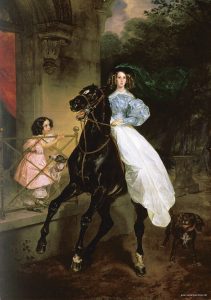
Without giving too much away for my presentation tomorrow, I would like to discuss the beautiful early 19th century Russian paintings. As artistic expression began to include more concepts, artists flourished. Painters like Karl Briullov and Vasily Tropinin shifted from the traditional portraits to expressive moments captured in vivid detail. I was especially interested in the handful of women depicted in varying ways that varied from the rigid usual way:

0 T

Instead of propping this woman up in front of a mantle with her father (which still happened in these paintings, but…) Briullov depicts this woman as autonomous, impressive, and expressive. Her eyes are calm and confident, and her horse’s are wild and roused, but the child admiring her adept says the most. The young girl watches with hope and love in her eyes, dreaming that one day she will grow into a beautiful woman on a majestic horse.

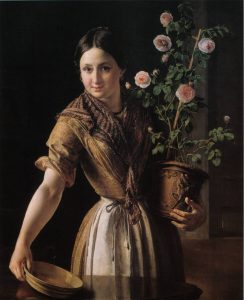
girlwithapotofroses

Though this portrait is less groundbreaking, the naturalistic element of a bouquet of roses in an equal foreground with the subject is striking. The woman’s beauty is complemented and mirrored by an egalitarian appreciation for nature’s elegance — roses.

These two examples demonstrate a freeing of artistic expression and a new appreciation for the earth’s bounty and how lovely it can be replicated on canvas, especially in regards to women’s portrayal in early 19th century Russian art.

Eluding Happiness

In the 1958 movie production of the opera Eugene Onegin, Onegin answers, “I am stronger to happiness,” when responding to Tatyana Larina’s love letter. He, just as Tatyana expected, derides Tatyana and condemns her for her lack of self-control, regarding himself as too wise to value frivolous joy . Tragically, over the course of the opera, Onegin eludes both self-control and happiness.

What does this say about how young or fleeting love was viewed in Russian culture and by Pushkin? Both Vladimir Lensky and Tatyana Larina are struck by love’s spontaneity in the first portion of the opera. Lensky proclaims that he does not fear eternity, yet by the second half of the play he has renounced his love for Olga. Tatyana expresses her adoration for Onegin, asking, “are you my guardian angel?” However, she also expresses fear and shame at her expressiveness, and in the final scene of the play, even subdues her admission of love in favor of stability. She deliberately chooses to elude her desires for happiness, if those are to be equated with her lingering love for Onegin. Likewise, Onegin destroys the only sources of happiness in his life. He trifles with Tatyana’s feelings for him and with Vladimir’s feelings for Olga and as a result of these actions, finds himself in a duel with Vladimir wherein Onegin kills his best friend. Ultimately, this opera presents an even bleaker message than many Russian movies and stories. In most tragedies happiness is absent in reality, fate, situations, etc.; In Eugene Onegin happiness knocks on the door of characters, only to be rejected and eluded by them.