The False Search for Love

Alexander Pushkin’s “Ruslan and Liudmila” continues and adds to the recurring theme of false love and the corrupting search for amorous connection in Russian culture. The The Snow Maiden presents a kind of twisted utopia that values love as a sacrificial means to provide the sustenance that society needs to function; it centers on the search for false love. In contrast, “Ruslan and Liudmila” focuses on the superficial quest from both a male and female perspective; it centers on the false search for love.

A Finnish sorcerer presents the story of his own quest for love to Ruslan, who has had his wife Liudmila taken away from him by mysterious means. The old sorcerer laments his years lost trying to prove himself worthy of the maiden Naina’s love. His attempts as a shepherd, warrior, and finally sorcerer exemplify the futility in searching for love, for none of these endeavors can help forge a connection. Naina’s love, or the force of time, is always a barrier. The old man relays this story to Ruslan, who seeks to cement his legitimacy as Liudmila’s husband by finding her. The sorcerer, however, tells Ruslan that fate will take care of his concerns. Furthermore, through his tale, the old man implicitly cautions Ruslan not to try to make the acquisition of love and marriage a matter arrived upon by free will. By the end of the excerpt, one message about love rings clear: love can only come about by fate, not by free will.

What is “Old” Is New Again

As I myself have written at length about, Russian culture is obsessed with the idea of itself. The Russian nation’s identity is inexorably tied with its self perception, perhaps to an unhealthy level. In the 1800s, introspective pondering took maximum hold over the nation’s psyche. Russia found herself finally with a rich, unified history to look back on, and from which to derive a “Russian” identity. 500, 400, and 300 years beforehand, the direct impact and remnants of the Mongol occupancy were too fresh for Russia’s arts and culture to flourish in a self-derivative way, unconscious of their bastard influences. Before Muscovy united the lands east of the current Baltic states, and until that event was in not-recent memory, the singular Russian cultural focus of “Russian-ness” couldn’t be pursued.

Tchaikovsky’s seminal ballet Swan Lake (1875) represents an era of culture that would have been impossible hundreds of years prior. The great artists of the 1800s, (Tchaikovsky and Pushkin included) drew heavily on a Russian folk tradition that emerged after the solidification of a singular Russian state. The plot of Swan Lake is derived mostly from Russian folktales, just as Pushkin’s epic poem Ruslan and Liudmila is. Pushkin uses devices and imagery extremely reminiscent of folktales to craft a distinct story that is absolutely separate from any of its influences. Pushkin builds a poem that has a folktale-like framework, one that would be familiar to any adult in the 19th century from their childhood. In Swan Lake, the choreography is very similar to the basic structure of the Moiseyev ensemble dances. Extended sections of Swan Lake feature male and female dancers in front of a gender-balanced ensemble. This pairing by gender, as well as the basic ensemble structure is very alike when compared to the folk dancing. Musically, Swan Lake has many folk influences as well. Some melody lines in the ballet are starkly simple, giving reminder to the homophonic, almost monophonic Russian folk music. Often a single voice (melody line) dances above a drone-like, semi-static accompaniment. This is also a motif evident in Swan Lake.

Song and Dance: Lively, Haunting, and Russian

Many of the folk songs here and the songs from Snow Maiden are sung in beautiful four part harmonies with many people in each part, that I find incredibly beautiful. But the harmonies convey this wonderful and lively sense of community that seems almost too perfect in the village setting. Music, song, and dance are such vital components to ones identity in a country, and for the community to be able to sing such beautiful songs together creates a very beautiful imagery. The dancing also conveys this imagery by how many people are involve in the dance, playing off of each other. The range of feeling depicted through these songs, especially in the Cossack songs (I’m listening to the “Now the Sun is Hidden” on repeat while writing this) the range goes from incredibly lively with so much spirit, with the whoops, to incredibly beautiful and haunting harmonies. I think its really easy to think of the peasants as being only miserable and unhappy under the yoke of serfdom; however, that does not take away the fact that the peasants had a colorful, lively, and thriving culture amongst themselves. The breadth of self expression seen through their songs shows us that their is another extensive dimension to the Russian serfs.

After being exposed to their songs, dances, and folktales, it has opened my eyes to another side of Russian culture feels thoroughly Russian. The peasants don’t seem to be concerned with their stance in contrast to European culture, and this ignorance allows for a Russian culture to exist without this constant self-comparison to the West.

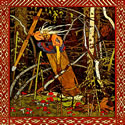
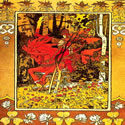
Looking at the titles of the songs, many seem to be concerned with nature and Russia’s landscape. This admiration is also seen on the second page of Pushkin’s Ruslan and Liudmila, as a form of introduction for the poem. This distinctly Russian folk culture seems to be inextricably tied to Russian lands. The folktales itself seem to come straight out of nature in Pushkin’s introduction: “Across the wood, across the wave,/ a warlock bear’s a warrior’s brave;/ See Baba’s Yaga mortar glide/ All of itself, with her astride.” This imagery than sends us back to the folktales we read and the illustrations drawn up by Ivan Bilibin. Many of the illustration have lavish depictions of Russia’s landscapes.

vasilisathebeautiful3:vasilisathebeautiful5

“Who are we? Where did we come from? Where are we going?”

This seems like a period where the originality of Russian culture is distinct. Perhaps because the music we’ve listened to in the past was religious music, all of it was highly influenced by European art, attempting more or less to imitate it. I don’t have a lot of knowledge about European folk music in the 19th century, but many of these folk songs had a distinctly ‘Russian’ sound to me.

The same thing was true of the Moiseyev dance. Instead of an attempt to imitate or borrow the classical forms of ballet and such from European culture, it was unique, different from any other sort of folk dancing I’ve ever seen. The costumes look almost stereotypically Russian, unmistakable. This could be another example of the divide between the peasants and their folk culture, and the nobles trying to emulate other forms of artistic expression. But these recordings demonstrate that folk culture was eventually recognized as being valuable as well. Moreover, it’s impossible to completely divide culture into ‘folk culture’ and ‘high culture’ with no overlap or influence in both directions (look at Gogol’s writing!). Just as pagan themes were adapted to fit the narratives of Christianity instead of destroyed completely, so ‘folk culture’ continued to have a strong influence on the Russian identity.


Learning to Settle

I really enjoyed Sophie’s discussion of the fairytales in her post — her arguments resonated with me. The tales were my favorite of the core work for this week because they left me analyzing society in the deepest way (which is a tad ironic, I think). Our class discussions were great, and I’m still left pondering the cultural reasoning behind the stories’ nature. Though they weren’t quite as shocking as Frol Skobeev, they were nowhere near as watered down and painfully unrealistic as the Hollywood “Happily Ever After”, and they strayed from the typical religious undertones of prayer and suffering leading to salvation. Instead, these strange tales echoed themes of fated situations of strife — usually familial — in which protagonists invoked the help of magical creatures. Tsarevich Ivan and the Grey Wolf piqued my interest the most, though, because the moral seems to read: “if you’re going to misbehave, misbehave well.” Tsarevich Ivan must appease his father (by and large the greatest consistency through all the stories) by stealing; and yet, when his siblings steal his spoils (as he did) AND quite literally murder him, the happy ending is the reversal. The grey wolf revives him, he returns home, and his ending is cold and emotionless: “Tsarevich Ivan told him [Tsar Berendei] how the Grey Wolf had helped him, and how his brothers had killed him while he slept and Grey Wolf had torn them to bits. At first Tsar Berendei was sorely grieved, but he soon got over it,” (54). I laughed when I read that, because it’s absolutely ridiculous, and yet, it pokes fun at fratricide, great expectations, and settling into stealing when you must. The moral compromises of this tale were far more satisfying to me than everyone turning out A-OK in the end. As Pushkin says in his dedication for Ruslan and Liudmila, “And no one’s praises do I ask from fate, but shall be pleased to thank it”… The Russians know how to settle into a less-than-splendid situation when push comes to shove.

What Says the Izba?

As we consider Russian folk culture as reflected in Russian high culture, it is important to keep in mind the roots from which this ‘folk culture’ (whether authentic or reworked, presented or constructed) springs. What does the life-world of the Russian peasant look like? From what components is it constructed, and how do these components syncretize into a ‘folk culture’ ? Village culture would, naturally, center to a degree around the izba, the peasant hut. To draw a direct link between spatial features of the izba to the manifestation of folk belief in high culture is too big a jump, but I do think think that elaborating on a few aspects of the izba could be useful here.

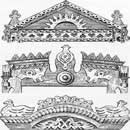
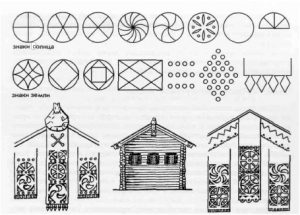
Let us begin by looking at two sets of illustrations, that of the ‘signs’ (znaki) inscribed onto Russian peasant houses, and that of the doorway decorations. The znaki are divided into two types: signs of the sun, and signs of the earth. The motive behind decorating peasant houses with such signs can be guessed at: the symbols link the houses (and thus the peasant families living within them) both to pre-Christian beliefs surrounding the sun and earth (remember the Ukrainian Easter egg?), and, more directly, to the agricultural rhythms of village life: without sun, without earth, there is no harvest.

The effect of such symbols upon ‘folk culture’ as such, and its distillation into forms for consumption and reproduction in the form of ‘high culture’, should not be ignored. What does it mean that the lifeways of the Russian peasant are inscribed onto where he lives (which, followingly, is both the space in which he is imagined and the space from which he signifies his ‘essence’)? The izba becomes a multi-layered symbol: a place of residence, yes, but also a piece of ‘folk art’ signifying agricultural ties and a shrouded pre-Christian legacy.

The doorways, the physical entrance point to this ‘signifying’ space, are themselves covered in signs: chickens, the sun-the pre-Christian/agricultural vocabulary stays the same. Entering the izba, the peasant is reminded of the rhythms that structure his life, while the writer or artist passing or imagining the izba is reminded that there are proscribed symbols and rhythms linked with ‘folk life’. ‘Folk culture’ is given architectural unity in the form of the izba, thus creating a building block from which ‘high culture’ can begin to construct the image of the peasant village (and from there incorporate the song, the dance, the peasant himself, into a unity of allusions).izbadecorations3 izbadecorations2

Happily Ever After

After reading the folk story of Frol Skobeev’s schemes, I expected these Russian folk tales to be far more unfamiliar and twisted than I found them to be. Actually, each story felt remarkably familiar and held clear strains of folk tales I have read growing up. Vasilisa the Beautiful began with stepsisters who were “two of the most spiteful, mean and hard to please young women that ever lived”. The evil stepsisters gave her unreasonable tasks, that could only be completely with the help of an old doll or a fairy godmother. Vasilisa’s outer beauty matches her inner beauty, so she is far more beautiful than her sisters and mistreated because of it. The first part of Vasilisa the Beautiful echoes Cinderella poignantly. Then it continues with a Little Red Riding Hood-esque storyline, where Vasilisa must navigate through a forest and then collect something from a haunted house. The moral of the story is clear; the stepsisters are evil because they treat Vasilisa poorly, but the good and beautiful Vasilisa, with the help of her doll, manages to preserve her kindness and beauty earning not an American “happily ever after”, but a comparable “And thus are they living to this very day, waiting for us to come and stay”.

Tsarevich Ivan and Grey Wolf reflects the Wizard of Oz in its scavenger-like tasks and personification of animals. Ivan must collect the items he has been instructed to collect. His obedience serves him well, while he suffers the consequences of his bouts of disobedience. Once more, the runt of the litter succeeds with the help of outside magical forces, encouraging children to live obediently and ethically. The Tsar loves the youngest child more because of his earnings and his honesty. Ivan is rewarded with a life of “health and cheer for many a long and prosperous year”. The moral of the story lies in honesty and obedience, encouraging Russian children to listen to their elders and to treat their siblings ethically.
Finally, the Frog Tsarevna overlaps with the Princess and the Frog, and then forces Tsarevich Ivan to prove his worth by demonstrating that he treats both animals and people well. Morality corresponds to proper treatment of animals and to ethical treatment of those lower on the social hierarchy. The good and the bad are easily distinguishable. The good always triumph, frequently with some magical aid. The stories rhyme occasionally, in a simple, nursery rhyme fashion. These folk stories felt remarkably familiar and preached similar morals, using very comparable techniques.

The Fiction that is Petersburg

The ability to quite literally make something out of nothing has been a reoccurring theme since we started to discuss the city of Petersburg. In the Bronze Horseman, Pushkin presents us with the idea and image that Peter is this God-like figure that managed to erect this city of majestic proportions from the water and its vast nothingness. This nothingness over time fulfilled the purpose of its creation, and became a window into Europe, bridging Russia to the West, and as a result it became everything, being both Russia and Europe, but not quite able to be distinctly either one of them. This conflict in its identity is fascinating to watch as it is explored by the writers inhabiting it. The origin of the city is in itself a miraculous feat, it having been built in spite of the laws of nature, and therefore, along those lines, should not have existed. With that in mind, the identity of the city is already compromised through its very creation.

The story in The Nose then perfectly encapsulates this idea, where this absurd scenario is most likely dreamt up by the inhabitants of the city and spread around the city as a rumor. This story than becomes a reality in the mind of inhabitants of the city, the same way that a guide to the city would present the monuments of the city along with places of action in famous literary works about the city of Petersburg. All this feeding into the mythical aspect of the city, in which the city is partly defined by fiction and false realities, in other words nothingness. The false story  itself is emblematic of this conflicted sense of identity where the character of the Major loses his nose, a part of the body that is not typically emblematic of the whole of one’s identity, but as a result of losing it has a an identity crisis. This identity crisis at the loss of such an insignificant part of oneself is emblematic of the fragility of the identity of the Major: the identity of the Major is also then based on nothing, like the city. But then the fact that the nose could then in turn gain an identity all of its own is then also testament of the precarious of nature of identity in the city.

The theme repeats itself again in the movie Lieutenant Kizhe, where the entire movie is then based on the non-existence of its main character, made into being to cover the mistakes and inadequacies of some palace guards. Throughout the movie, this non-existant character is recognized as being a real person without corporeal form, and is treated thus. He was whipped, exiled, brought dinner, promoted, married, dies, demoted, and finally buried throughout the course of the film in one extremely short span of time. This character lived through so many experiences without really existing.

The identity of the city is unlike anything I have encountered in literature, where it, though concrete, is yet nothing while also being everything projected onto it. It is a city then full of possibility, more than any other place in the world, but this potential is then also tainted by the idea that the result of that possibility is somehow also fictional.
A Palm Full of Copecks Helps the Medicine Go Down

In the United States, we find ourselves at an extremely contentious time in terms of national politics. The New Right conservative movement has reached its zenith and ultimate form with the candidacy of Donald J. Trump, while another Clinton is poised to ascend to the nation’s “throne”. The Republican and Democratic parties are extremely divided over many issues, perhaps none more so than the structure and size of government in the USA. The Democratic Party stands for government as a tool to aid the nation’s citizens in many areas, and thus favors increased power, breadth, and size of government. The Republican stance is one of limited government, where government serves as the common bond between a collection of states with self determined laws, and a mechanism for common national defense. In the Republican view, less government oversight allows citizens to aid themselves with increased efficiency and effectiveness.

It is no small coincidence that the term “bureaucracy” was introduced practically simultaneously with the beginning of our discussion of St. Petersburg. Although Russia was a monarchy until the early 20th century, civil servants dominated St. Petersburg, much as they do today in Northern Virginia, The District of Columbia, and Metro-area Maryland. With this acknowledgment, a study of some rudimentary mechanisms of Petrovian-bureaucracy seems highly in order.

Bureaucracy, in a Petersburg-ian context, is a major theme throughout every one of the assigned works. According to Brodsky, Petersburg was home to “a web like bureaucracy”. Bureaucracy is also a central tenant of Lieutenant Kizhe. Most specifically, though, a convoluted bureaucratic system that would give modern Republicans fits is displayed in The Nose. Bribery is mentioned often. When the police officer returns his nose, Kovalyov “got the message and pressed a 10 ruble note into his hand”. Likewise, when arriving at the Police Superintendent’s home, it is thought that even if Kovalyov had “brought with him a few pounds of tea or a bolt of cloth” (as a bribe) the Superintendent would not have granted him “a particularly effusive welcome”. By emphasizing that these gifts usually would get a kind welcome, and that this was out of the norm, Gogol shows how pervasive the bribe was at this time. It would appear again in Soviet times. Earlier in the story, during the print shop episode, Kovalyov says “I would be extremely grateful to you, and very glad this incident has brought me the pleasure of your acquaintance. In normal context, this may be perceived as simple niceties, but in the context of bureaucratic St. Petersburg and The Nose, we can be sure that “grateful” has some monetary connotation. Although the story is incredibly irreverent and humorous, some comment on Gogol’s residence of St. Petersburg and its corruption circa 1835 is plainly visible.

Individualism in Petersburg

The satirization of power structures looms large over the works of “The Nose,” “A Guide to a Renamed City,” and Lietenant Kizhe. In the midst of a new city, St. Petersburg, that incorporated aspects of all of Europe, and an increasingly centralized and powerful political structure, wherein collectivism and obligation to the state was of paramount importance, I’d like to focus on the concept of the individual. How is he or she presented in each of these works, and to what extent does he or she matter?

Lietenant Kizhe both opens and closes with a sleeping Tsar. Paul’s unawareness positions him as the center of ridicule in the movie, yet also makes a statement on the importance of an individual: namely, that there is none. The individual is merely a scapegoat for the masses in Lietenant Kizhe. When faced with exile, Count von Pahlen and his uncle uphold the fictional character of Kizhe. Yet, when the guardsmen send Tsar Paul an insulting letter, they have no individual to load there problems unto. Tsar Paul claims that a “state is lonely without faithful servants.” Ironically, his one faithful servant is no more than an apparition in Tsar Paul’s world, where personal connection and individualism counts for less than nothing when compared with rules, positions, and respect. Thus the film presents a lonely reality, not because of the absence of society, but because of the absence of an individual.

Joseph Brodsky claims that St. Petersburg “is the city where it’s somehow easier to endure loneliness than anywhere else: because the city itself is lonely”. This is not because there is an absence of people or culture, but rather because there is an absence of an individual identity for the city. It is split between Leningrad and Peter, many different Western influences, capital or disconnected city.

In “The Nose,” by Nikolai Gogol, we see the effects of a part dismembered from a whole, on an individual anatomical scale. Kovalyov loses his nose and subsequently loses his identity as a confident man looking for a promotion and young ladies to seduce. The Nose is able to completely break off from the whole and hide as an individual. To what extent does this mean that the part needs the whole, or that the whole needs the part? Furthermore, how much does the individual need the state? How much does the state need the individual?