Another face of Sicily that doesn’t get discussed in the vision of the picturesque is the island’s baroque side. Among the many rulers of the island are the Spanish who brought with them baroque design and aesthetics.
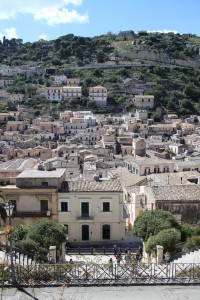
Modica was one of my favorite places we visited on the island. Visitors are greeted by a wall of stairs and are encouraged to taste the famous chocolate, made without any additives. As a traveler, Modica is enjoyable, and it made me wonder why 1800s travel magazines, like Cosmorama pittorico, that I looked at in my independent study never talked about it. Then again, I remembered that of the ten depictions of southern Italy in one year, they all show only scenes of nature and the landscape. Talking about a place like Modica would acknowledge civilization.
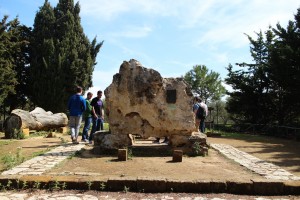 One particularly good story, though, was that of his burial. Yet again, Italy makes a spectacle of itself and visitors get to enjoy its comical inefficacy. Pirandello had expressly written that he wished to have his body burned and his ashes scattered with no public funeral. The Sicilian writer died in Rome during Mussolini’s rule, and the fascist dictator capitalized on the opportunity to make a spectacle of this adored writer, giving him an elaborate funeral and burying his body in Rome.
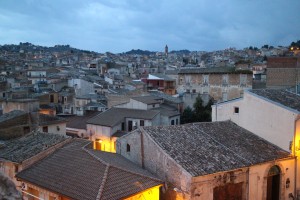 Racalmuto, a small town further inland, is home to the important writer Leonardo Sciascia. Signs indicate places important to Sciascia, and his statue can be found in the town center (a man who works at a nearby museum assured us that the statue’s small stature is that of Sciascia: he used to see the writer walking around town but informed us that he was much, much fatter than the statue). We passed by the Circoli, a sort of social club meets workers union, and his home. We walked the streets of the town that inspired Regalpetra.
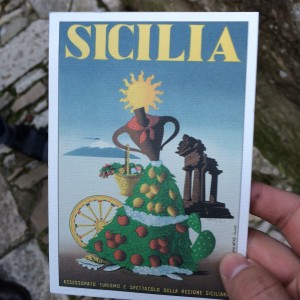 Stepping away from the mafia, I found this postcard while we were walking around Erice. While on the one hand it evokes Josephine Baker and her famous and problematic banana skirt, on the other it encapsulates everything I studied in my independent study this past fall.
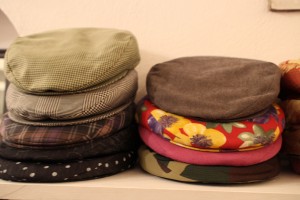 As a Sicilian-American, I remember my grandmother getting upset whenever people would ask her about the mafia as soon as she mentioned she’s Sicilian, as for so many people the mafia is all they think of when they consider Italy, especially Sicily. Our visit to the Coppola Storta was one of my favorites. The owner taught us about this hat which is traditionally popular among mafiosi. His store is part of a project in which people reclaim this hat from mafia iconography and instead own it as something for everyone. Today, people can send in old fabrics or materials and have them custom made into a coppola. While the store was making an appeal to tourists (the owner offered us half off during the tour), as a souvenir a coppola is much healthier for Sicily’s image than The Godfather aprons and mafiosi magnets that proliferate throughout the island.