La Spedizione Siciliana

Italian 3008 – Spring 2016 – Professors Barbara Weiden Boyd and Davida Gavioli

  • About
  • Authors
  • LoginPress
  • About
  • Authors
  • LoginPress

Day 1: Letizia

March 23, 2016 By mcolbert

Hello to the readers of this Bowdoin Sicilian Expedition blog. I’m Michael, a senior Romance Languages major, and a lot of my posts will focus on the representation of Sicily in tourism. After doing an independent study with Professor Gavioli last semester on the orientalization of Southern Italy and the country’s North/South Divide, and as a travel blogger, I’m interested in considering how historic prejudices against the island live on today.

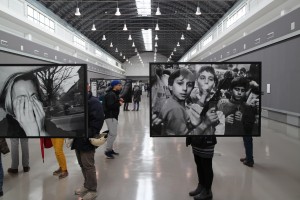
On day one, we hit the ground running once we landed in Palermo, and after a visit to La Zisa, we went to a photo exhibit at the Cantieri Culturali where Letizia Battaglia’s work was on display. Battaglia is an Italian photographer who focuses on Sicilian life but is most famous for her work on the mafia. While the mafia is sensational in a lot of ways today, for so long its existence had been denied. Leonardo Sciascia was among the first writers to confront the mafia, and Battaglia has been similarly important in exposing it through her work.
IMG_4078

The exhibit, located inside an old factory building, is striking as her black and white photographs hang in several rows from the ceiling. Guests wind up and down the aisles and disappear behind photographs, some harrowing and others light. Many pictures are disturbing, like this one of children holding guns, and I think they do a good job showing the real, lived consequences of the mafia in a medium different from something like The Godfather. 
Filed Under: Sicily

The Streets of Catania

March 23, 2016 By ssim

20160320_181455

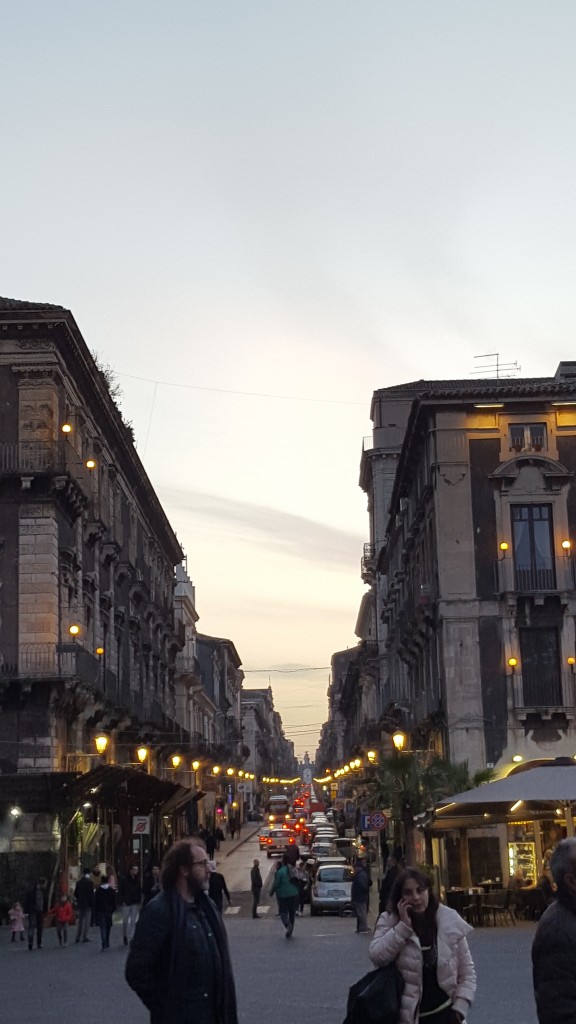
Similar to many other cities in the south-eastern region of Sicily, Catania was heavily affected by the destructive power of the earthquakes common to the area. However, Catania is particularly unusual because of its proximity to the legendary volcano, Mt. Etna. As the focus of many stories in mythology, Mt. Etna dominates the landscape of the city, looming in the background as a constant reminder of the enormous force contained within its rocky bowels. In the 1600s, an eruption from the volcano followed closely by a heavy earthquake allowed the city to be rebuilt in the Baroque style. The sheer destruction of these sequential two catastrophes enabled the inhabitants to start from scratch and design their city with more purpose and foresight; the long and straight main streets, as seen in the picture above taken from the Piazza Duomo, are a result of the careful planning during this rebuilding process. Another interesting feature of the architecture in Catania is that many of the buildings are made out of the readily available source of volcanic rock, lending the structures their characteristic dark color.

Filed Under: Sicily

Greek Theater, Syracuse

March 23, 2016 By ssim

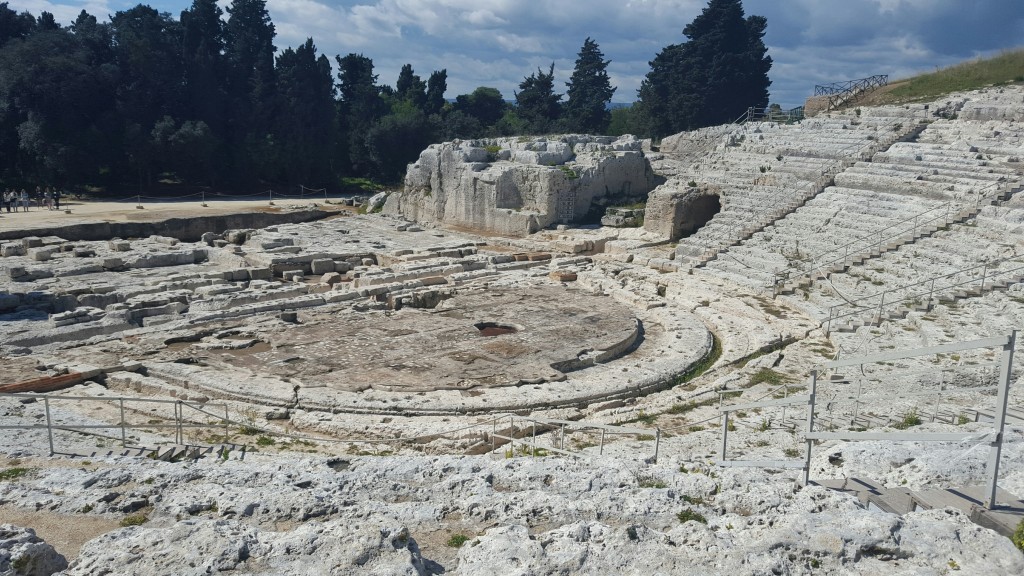
20160319_102906_resized

The Greek Theater in Syracuse exemplifies the architectural ingenuity of Classical builders and also highlights the contrasts between Ancient Greek and Roman styles. The basic structure reflects the fundamental values of the original Greek artists who conceived its initial design. The theater is located on a beautiful site that offers a stunning view of the surrounding countryside (although the landscape is blocked now by a row of trees). In addition, the seats are carved directly out of the “living rock”; the Greeks preferred to shape and mold natural elements for their artistic purposes. The consistent presence of nature even in their man-made structures was an important component of Greek architecture. On the other hand, the Romans chose to assert their dominance over nature. When the Romans eventually extended their influence into Sicily and took control over the island, the theater was modified to fit Roman tastes. In the renovated theater, an elaborate scene structure, whose remains can still be seen, would have completely blocked out the view of the landscape in the background. In addition, holes can be seen in the semi-circle of the orchestra where the Romans would have been able to insert their “special effects” (i.e. figures jumping out from underneath, smoke flowing out onto the scene). The Romans were less interested in a harmonious blend of nature and more focused on the entertainment value of their theaters.

Filed Under: Sicily

Church of San Giuseppe, Ragusa

March 23, 2016 By ssim

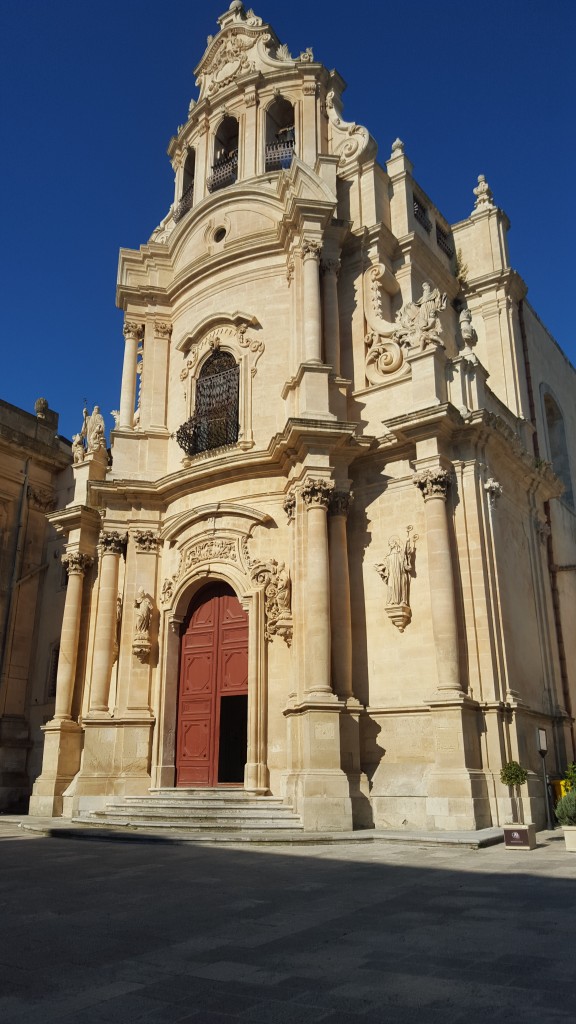
20160318_084247

Once we had traveled to the south-eastern part of Sicily, the architectural style of the buildings began to look less medieval and more Baroque. This region had been continually plagued by earthquakes, and a particularly devastating earthquake in the 1600s destroyed many of the buildings in Ragusa and in other surrounding areas. Thus, the structures were rebuilt in popular Baroque style of the period. This church in Ragusa (seen above) encompasses the most important characteristics of Baroque art.

Baroque architecture can be considered as a dramatic re-imagination of the Classical style. The columns on the façade of this church are Corinthian, but the entasis is highly exaggeration. Entasis, or the slight bulging of the columns in the middle, was utilized by ancient architects to create the illusion of perfectly straight and aligned columns; without entasis, and other tricks to fool the eye, a temple can look as if it is falling inwards. In this case, however, column entasis was used to heighten the dramatic flair of the entire structure. The Baroque artists also preferred the more elaborate and decorative Corinthian column to the more simple Doric and Ionic styles. Additionally, the tympanum above the columns was modified from its original, triangular structure into an assortment of warped shapes. The curved contour of the overall church façade also departs from the emphasis in Classical architecture on straight lines and imparts a sense of exaggerated motion. Finally, the statues on the exterior of this church are found in poses that express a dynamic movement to their forms. Baroque art was supposed to inspire awe and feeling within its viewers, coinciding with the mission of the Catholic Church in this period which encouraged its members to focus on a purely emotional relationship with religion. The Church wanted people to be swept away by the grandeur and glory of God and to experience their faith through sensation rather than reason.

Filed Under: Sicily

Temple of Concord, Agrigento

March 23, 2016 By ssim

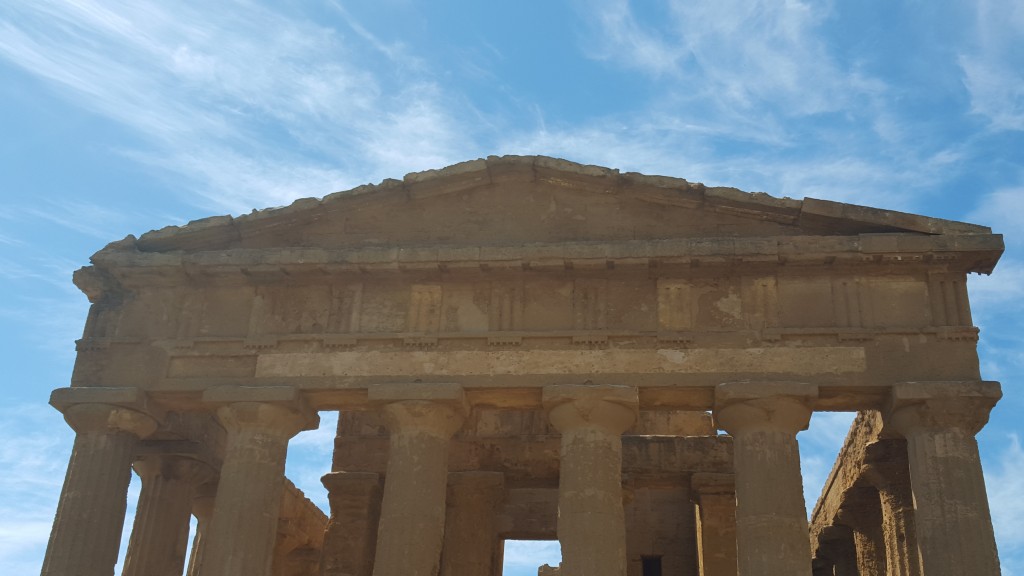
20160317_130804

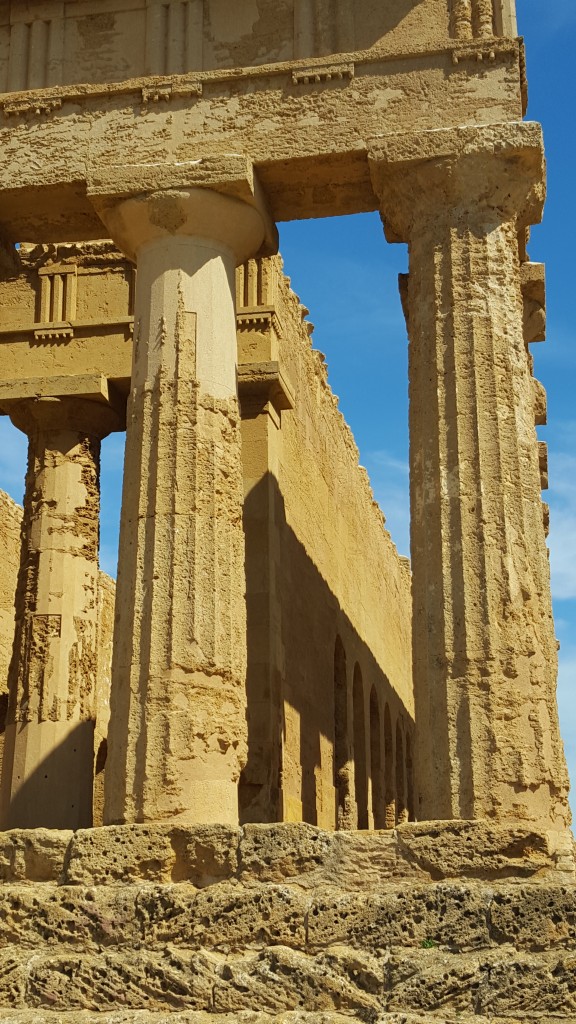
The Temple of Concord located in the Valle dei Templi of Agrigento is one of the most well-preserved examples of a Greek temple that remains in the modern world. This Doric temple exemplifies the most important goal of Classical architects: to create the most harmonious and balanced structure. The arrangement of metopes, the slight column entasis, and the inclination of the columns were all used to further the illusion of a perfectly straight building. The roof (or the pediment) of this temple is in particularly outstanding condition. This incredible preservation is due to the fact that this temple was converted into a Christian church; the remnants of the walls and arches of the nave can still be seen standing within the temple. Although we had seen several examples where temples had been deconstructed by later builders, since those monuments were an excellent source of pre-cut and moveable rock, the Temple of Concord also demonstrates that sometimes religious spaces and holy sites were conveniently re-purposed.

The layout of an Ancient Greek and Roman temple was not designed for interior seating; the design of a Christian church was actually based upon the layout for a basilica, which accommodated the congregation of large groups of people inside a building. In fact, most Ancient Greek and Roman worshipers remained outside the temple and performed their sacrifices on an altar separate from the main building. The temples served as “houses” for the honored deity; worshipers could gain a glimpse of the cult statue located in in the interior of the temple (the cella) through the columns but were not allowed to enter the sanctuary of the god. Thus, in order to fit the needs of the Christian faith, the later builders converted the temple into a church by essentially using the cella and the interior colonnade to build the structure of a typical nave; these engineers decided interestingly enough to preserve the exterior columns and the pediment of the temple, creating a structure that is an unusual mixture of two drastically different religions.

20160317_132503

Filed Under: Sicily

  • « Previous Page
  • 1
  • …
  • 20
  • 21
  • 22
  • 23
  • 24
  • …
  • 26
  • Next Page »

Authors

  • abradley
  • aglynn
  • agorman
  • alamont
  • bboyd
  • cdewet
  • dbanks
  • dgavioli
  • djohnso
  • dvargas
  • gmaslak
  • jglewis
  • jhartley
  • kgilmore
  • kvise
  • mcolbert
  • mkim
  • ssim
  • vwu
  • About
  • Authors
  • LoginPress

courses.bowdoin.edu