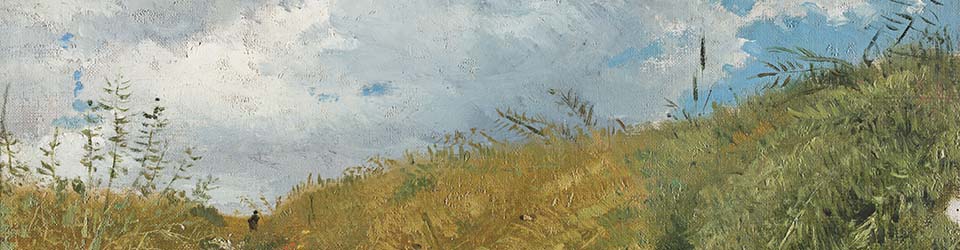
Meaning Follows Form: Sergei Esenin and Russian Imaginism

In this week’s reading, I found it very helpful to historically situate the works of Russian poet Sergei Esenin, as I feel that chronological context allows for a deeper textual extrapolation of his rhetorical choices, such as his frequent use of the passive voice. In fact, I noticed that he often  omits verbs altogether. After some historical analysis, I found that using passive voice to describe a series of images (rather than the traditional succinct narrative connected by tasteful verbs we often see in Russian Romantic works) is indicative of Russian Imaginism— the literary movement that Esenin himself helped found, alongside scholars Anatoly Marienhof and Vadim Shershenevich (Hirsch, A Poet’s Glossary, 2014). This movement quickly followed the Revolution of 1917— the fall of Emperor Nicholas II, and the rise of The Soviet Union. At this sensitive time juncture, there formed workers’ councils— called soviets—that protected workers’ rights and attempted to give power back to the newfound proletariat. (Klein, “Soviet”,1920).

Throughout all this research, I often found the word “grassroots” repeated over and over, referencing not only the soviets and their constituents, but also referencing the general public’s re-adaption to subsistence agriculture (Carmichael, A Short History of the Russian Revolution, 1964). Reading about subsistence agriculture, or farming focused entirely on the goal of self-sufficiency, revealed various aspects of Esenin’s pieces that I had not originally noticed. For example, most of his selected poems deal with pastoral themes regarding Russian countryside. Many of them begin and end with stream-of-consciousness depictions of desolate farmland. I think that each of these scenes tells a different story, and it is the overall negation of verbs that depicts the void of emotion that poor farmers felt due to economical and agricultural strife during this chronological tipping point.

To begin, I think that “Land of mine in dire neglect…” perfectly introduces us to the superimposed, verb-less phrases used by Imaginist writers when documenting Russian countryside at the onset of the Revolution of 1917. Purposefully trite remarks about a “country run to waste,/ Fields of hay unmown as yet,/ Monastery, estate” (Esenin 2-4) offers the reader a sense of the sad, barren countryside. The sun’s rays are deduced to “foam as shadows fall,” and bright sunset becomes a “tinge,/ Mould of dove-grey hue” (8, 11-12). It seems to me that there is a strong sense of vapidness and desolation described here, despite the lively depictions of “crows” weaving past “windows” (14). There is something backwards here—(much like the backwards syntax, i.e. “crows past windows weave”): despite the liveliness of the crow scene, there is still a large sense of disjointedness that is complemented by Esenin’s truncated, unusual images and their awkward, forced juxtaposition.

Furthermore, it is at the end of this poem that the connection between Russian life and a “fairytale,/ A legend of the past” (17-18). What I take from this ending (up for interpretation) is that the economical and agricultural strife that I mentioned before, along with the constant degradation of the farming class during the 1910s, resulted in a sense of desolation and anguish across Russian farmland/countryside. The quotation “a legend of the past” leads me to think that Esenin attempts to perhaps suggest a nostalgia for the past, i.e. an agriculturally and economically easier time in Russia.  I think that it could be the impending revolution and the grassroots dialogue has caused a vacant and distraught environment for not only Russian farm-country, but more generally, the Russian working class.

If I had more space in this blog post, I would love to comment on various other sentiments communicated through the unusual series of images in Esenin’s “Song about a Dog,” “The Hooligan,” “It can’t be dispelled…,” and “The disquiet of vaporous moonshine…” Still, this shorter poem “Land of mine…,” along with our analysis, nonetheless shows how that even though subject matter can denote a certain narrative, the methods that the author takes to express that narrative can potentially alter (or perhaps even reverse) the greater meaning of the text. Weaving crows and a lively snowstorm were both utilized in “Land of mine in dire neglect…” however the overall sentiment achieved in this piece was sad and desolate, due mostly to the sentence structure. In fact, restating this example reminds me of our class discussion on Tuesday about Russian writer Turgenev, and how his elongated sentence structure in “Forest and Steppe,” for example, expresses a long and fluid movement through the Russian countryside. In each of these pieces from both last class and today, meaning follows form, whether that is the sad, barren pre-revolutionary countryside, or the long fluid depiction of the thriving agriculture of Russia nearly seventy-five years before Esenin and his pieces. Each moment in history can be complimented effectively through not just the literary works produced during that time i.e. Russian Imaginism, but more importantly, as a product of the modes and styles in and through which those works were crafted!

Please let me know if you noticed any other interesting literary techniques evolving throughout our selected pieces. Perhaps, it would be interesting to see if there is any simultaneous historical context that could potentially strengthen our textual analyses. Would love to hear from you!

Virgin Mary the Ideal Communist


“The Motherland of Electricity” wrestles with the consequences of communism on the human psyche and the forced perception of a Baconian environmental relationship (meaning the environment is there to be used for scientific and humanitarian gains). One of the most striking moments of imagery in the story is a page long description of a necklace of the Virgin Mary, one which is depicted without her son and as her being more of a laborer than a saint. In this passage, I believe Platonov is asking the reader to consider the parallels between Mary and the Communist worker.


The comparison begins with the doomed fates of both Mary and the Communist worker. If you take the immaculate conception away from its religious valor, Mary herself is a doomed laborer of God. She has no choice in her fate of motherhood, and the production of children in the case of Jesus can be (problematically) consider a commodity. Platonov describes that the Mary in the amulet is without the son in her arms, highlighting her role as mother and taking away her piousness. Additionally, Platonov depicts this Mary as, “simply an unbelieving working woman who lived by her own labors and received no favors from any god” (265). Platonov’s Mary looks at the world “without meaning or faith,” (265) directly subverting the very ways in which Mary is exalted, at its most extremes within the Catholic church, for her unwavering faith.


If we consider Jesus as Mary’s production of a commodity, Platonov’s amulet begins to elevate the importance of labor and the production of commodities within Russian society. As Mary’s labors are the salvation from sin, Platonov is implying that the common worker’s labors are the cause of the salvation of the country. Just as Mary unquestionably birthed Jesus and proceeded in her labor with no complaint, so should the Russian worker, such as our electrician

Esenin- Reflections on Tumultuous Lifestyle Change

The selected poems from Serge Esenin’s collection demonstrate a progression in the evolving attitude toward Russian lifestyle. This progression  reflects the rapid historical changes occurring during the tumultuous early 20th century. Stepping from one poem to the next, the reader can see how each next work features a shift in lifestyle, based on the contextof war and revolution.

First, the earliest poem in the collection purely praises the narrator’s pre-war countryside lifestyle. I assume it was written in 1914 still before the war. Esenin colors the traditional Russian countryside lifestyle in a pleasant way, celebrating the “never-ending land of wonder” of Mother Russia. He provides a full sensory depiction of the simple joys of this lifestyle: “Smelling of sweet honey and apples…/And the sounds of festive dancing/Fill the fields and meadows broad.” Esenin’s love for his country is rooted deeply in the countryside lifestyle, surrounded by nature.

In his next poem, “Land of mine in dire neglect…” Esenin reveals the loss of this countryside lifestyle which he so adores. I assume that this was written just months after his previous poem. Perhaps by this time, the war has begun, and the villagers have left their homes to fight in the war. He now looms sorrowfully on how the countryside lifestyle is being abandoned. It only remains as a distant “fairytale” whose remnants are only left in the feather-grass. Esenin depicts an eerie image of the disintegrating countryside and cottages that remain.

By the time Esenin writes his 1924 poem, “It can’t be dispelled…”, his tone devolves further into his feelings of loss. Whereas in the previous poem, the abandonment of the countryside lifestyle was just beginning, here he demonstrates his nostalgia for the past. He observes the decimated landscape, and laments that, “All this is familiar and close to me,/That’s why I so readily cry.” Esenin writes of post-revolution Russia, in which life as he knew it has been completely changed, and his “white linden blossom” can no-longer be revived.

Lastly, in his 1925 poem, “The disquiet of vaporous moonshine…”, Esenin takes a different approach, cautiously embracing the new industrialized lifestyle. He appears to denounce the old lifestyle: “For nothing on earth would I like now/To hear that sound [wagon wheels] ever again.” However, he continues to feel out of place in this new Russia, saying, “I’ve no place in the new life, I feel, Yet still wish to see poor drab Russia/ A prospering country of steel.” Esenin reveals his conflicted feelings, as he himself tries to abandon his love for Russia’s countryside, in favor of a new Russia.

Nature Calls?

The first time I read through Blok’s “Autumn Day” I was struck by his sad tone, especially because, on the surface, it seemed to deal with very similar natural themes to the other works we have read. Upon my second reading, I was interested in the double meaning of the word “crane.” Though at first I read it as crane the animal, it could also be a construction crane. The leader, who I initially assumed was the leader of the flock of birds, could be the head worker crying out instructions to his other workers. The dark imagery of the rest of the poem supports this reading of industrialization. Blok writes that “no eye can count or measure… / and burning a hole in the dusk / a fire in a distant pasture…” (90). This “fire in the distant pasture” could symbolize the destruction of nature, specifically the idealistic pastoral image that occupies so much of Russian natural literature.

After witnessing the destruction of the land first-hand, the speaker of the poem questions “poor land, poor land, what do you mean / to the heart that moves in me?” (91). Though the speaker is devastated by the sight of the demolition of nature, he is already questioning what the natural land really meant to him. I think that this shows that, although there are many advocates for the environment and for preservation of natural landscapes, people are too quick to embrace industry, regardless of the natural cost.

What it there to live for but ‘The Opiate of the Masses?’

In The Motherland of Electricity by Andrey Platonov, the absence of God and the emphasis of labor in the creation of a new world creates a sense of alienation for the characters, a loneliness of setting out into uncharted territory without a supernatural force looking out for you. These characters are the participants in a revolutionary movement attempting to do what has never been done before, to progress past capitalism, religion, and other traditions and create a state of utopia. And this conflict between the revolutionary zeal of the revolution and generations of religious faith in Russia has thrust the characters minds into doubt and confusion, and their lives into a dreary existence of menial work and poverty.

Throughout the text, Platonov implies that the life of the worker is miserable. He compares the weary eyes of the worker to to the beauty of a statue of the Virgin Mary, a relic of Russia’s Christian past: “…the dark beauty of her face, her fine nose or large eyes—which did not seem like those of a worker, since such eyes tire too quickly.” The worker Platonov is describing is specifically a worker living in a world where atheist thought prevails. A world where work has no heavenly purpose, it is solely being done for the real, physical world. This lack of meaning in the most basic, daily part of their lives causes the characters to question their existence and purpose in this new communist world.

Feelings of loneliness are emphasized in this Soviet world; while the decision that the people’s will is law, and that everyone is in complete charge of their future, is of course empowering, it is also intensely depressing to walk throughout the world and make decisions without the confidence that is guaranteed by the idea of a higher power. At the end of the story the narrator is sitting at night, thinking, and is struck by that feeling of intense loneliness: “I sat in thought by the river, which was quietly flowing into the distance, and I looked up at the concentration of stars in the sky, that future field of humanity’s activity, that deathless sucking emptiness filled with anxious and diminutive matter beating away in the rhythm of its unknown fate…” The cosmos are empty, and thus he realizes that the consequences of his actions are entirely his, and the consequences of humanity entirely ours, a profoundly heavy burden to bear.

There is, of course, meaning to be found in this communist world, not necessarily in the menial nature of the work, but rather in the grand spirit of socialist idealism. This is expertly shown in the character of Secretary Zharyonov, the party leader who creates poetry out of his life of bureaucracy. This is especially apparent in the image of him sleeping with his two hungry children: “Only their father lay there with a happy face that was as welcoming as ever; he was in command of his body and of all the tormenting forces of nature, the magic tension of genius continually bringing joy to a heart that had faith in the mighty future of proletarian humanity.” He is able to compartmentalize his suffering for what he believes is the common good. And not only is he able to do that, but it is also that very faith in the system and a brighter future that keeps him going each and every day.

Longing for the “old” Russia in Sergei Esenin’s selected poems

With the theme of the countryside and village life in times of change in mind, while reading Esenin’s poems I sensed a certain longing for the Russian homeland before the changes occurred and a certain resistance toward the industrialization and deforestation that was rapidly altering the natural state of the country. “Hey there, Russia, mother country…” really captured this resistance. The last stanza reads:

 If the heavenly host should beg me:

“Come to live in heaven above!”

I shall say: “Don’t give me heaven

But the Russia that I love.”

Using religious metaphor to emphasize the poet’s desire for the Russia that he once knew, by turning down the theoretical offer of the Lord to return to Heaven, we get a glimpse of the sadness and longing the poet feels. A similar idea is portrayed in “It can’t be dispelled, can this sorrow…”. The third stanza read:

Familiar views and expanses

By moonlight now seem not so fine.

Ravines … tree-stumps … bare slopes have saddened

These Russian horizons of mine.

What the poet once appreciated about their homeland is now less attractive and is seemingly “unfamiliar”. After describing the new landscape, the poem reads in the sixth stanza:

All of this is what we call the homeland,

Because of all this we meanwhile

In rainy days cry and drink vodka

While waiting for heaven to smile.

This stanza really conveys how disheartened the people of Russia are through the changes brought upon their once worshipped homeland. Lastly, the poem “The disquiet of vaporous moonshine…” directly references the industrialization and deforestation of the Russia countryside and village land by referencing “things made of steel and of stone” and the soil-tilling, primitive plough, and poplar and birch trees suffering anguish in the fifth stanza. The sixth stanza really stuck out to me:

For myself, I don’t know my own future…

I’ve no place in the new life, I feel,

Yet still wish to see poor drab Russia

A prospering country of steel.

These lines accurately portray the loss of identity and belongingness residents faced as a result of industrialization and deforestation. Suddenly people are unsure of their future and the role they play in their rapidly-changing homeland.

What Seems vs. What Is

What lies on the surface can be deceiving; once one starts to dig deeper the truth is revealed. Turgenev’s The Singers highlights this idea as it depicts favorable peasant life despite an undesirable country landscape setting. While other works we have examined, such as Uncle Vanya, have presented a strong connection between the natural environment and the character’s behavior, the peasants in The Singers appear to act in a manner contrary to the negative influences of the environment. The narrator begins the story by describing the village of Kolotovka as “poor” and never a “cheerful sight” no matter the season (1,4). He observes the lack of water as well as the oppressive heat near Kolotovka, pointing to the lifelessness of the village and the likely poor condition of its residents (4). The narrator’s description leads one to wonder how and why under such conditions anyone lives in the village.

Instead of continuing with the description of the poor environment, Turgenev turns to the life of the peasants and focuses on their interactions at a local pub. A surprising part of this scene is how the narrator blends into the background and acts as a spectator to the events in the pub by not interacting directly with any of the peasants. Although the narrator is physically present, his removal, yet observation of the situation creates the idea for the reader that one is viewing the peasant in his or her natural environment. The convivial atmosphere around the singing competition within the pub plays out in stark contrast to the miserable country environment. Yashka’s emotional song brings both the narrator and the rest of the peasants to tears, shortly followed by all of them “talking loudly [and] joyfully,” momentarily forgetting about the problems of their past and the present (19). The narrator’s rapid departure from the pub, so as to not “spoil [his] impression” of the peasants, reveals the narrator’s desire to remember the peasants in a positive light despite their terrible environment (20). He wishes to retain this image of the peasants, as it is not plagued by the ills that the environment undoubtedly imposes on them. Particularly since the narrator reveals the difficult pasts of some of the peasants, he wants his memory of them to be this positive experience in the pub, which could very well differ from that of the peasant’s everyday lives given the harsh environment. While the narrator leads one to believe that the peasants lead a satisfying life, there is much that the narrator withholds or does not know about their everyday life, and the poor environment serves as an indicator that the way the peasants appear may not necessarily be the truth.

In the Dead of Night

The darkness, the more common occurrence of the thinning veil between the living and the dead mimics the rarer All Saints’ Day. Turgenev’s “Bezhin Meadow” emphasizes this mysterious and haunting time. The first suggestion of death weighing on the narrator, “a bulging game bag cut into my shoulders mercilessly,” counters the victory of a successful hunt with the burden and pain of carrying the dead around with him (24). This theme continues as the five boys, as many youths around a campfire are wont to do, tell ghost stories based in Russian mythology. The first tale of a water nymph, a rusalka, also takes place at night when a traveler loses his way. Some researchers, such as Ivantis in Russian Folk Beliefs, report the belief that the rusalka and other household spirits are actually the dead who have continued residence on this earth. The melding of worlds does not stop at the living and the dead, but also the future and the past: “you can see a living man too. I mean one whose turn it is to die in that year” (39). And the evidence of the accuracy of these portents is portrayed as steadfast, between the Ivanshka Fedoseyev that died in the spring and the ominous ending of the story in which the narrator notes that Pavlusha “died the same year” as when he heard the dead boy calling his name from the water (48). Interestingly, the Russians in this story take a rather fatalistic approach to these omens, “No use running away from your fate, is it?” which recalls many Greek tragedies like Oedipus that reinforces the accuracy of said prophecies (46).

The bridging of life and death arises again in Turgenev’s “Forest and Steppe” as he recounts, “You breathe in peace with every breath, yet a strange unrest comes upon the spirit…all the time images and faces of the beloved, dead or alive, keep coming to mind” (395). The black and blank night acts as a tapestry on which the mind projects these images, called forth by the haunting, cloying emptiness of night. Pushkin takes a darker turn in his poem, “When Lost in Thought” when he contrasts, “slimy graves awaiting with a yawn” and “some ancestral village keep, / Where all the dead in solemn stillness sleep” (200:13, 20-21). The chilling assumption in the latter that in the graveyard he stumbles upon, the dead are not as restful as one would hope (or expect). These reflections on Russian perceptions of the afterlife and the joining of the past and the present in the form of the living and the dead reveal the ongoing prevalence of folk beliefs merging with Christianity.

Note: I would have liked to delve deeper into the idea presented in the last sentence based on the conflict and comingling of Christian values and pagan beliefs. Examples include the use of the cross to ward off the rusalka and the changing views towards the spirits (the “evil” water nymph and forest demons in contrast with the helpful and omniscient wolf in “Ivan and the Grey Wolf”). This is a theme I found to be quite prevalent in Ivantis’s Russian Folk Beliefs and found quite interesting and compelling.

Foreign Agent Law – Just like the Past

In “State Suppression of Baikal Activism,” Kate Pride Brown sheds light on the convoluted power play of the Foreign Agent Law. De facto, the law, enacted in 2012, essentially allows for the government to label NGOs as “Foreign Agents” if they are acting in a way contrary to the state’s agenda. Although it defines some specific parameters for what types of organizations are subject verse exempt from the law, these are misleading. On the other hand, some of the wording is intentionally broad, such that the state can selectively use the law to suppress certain organizations that it disagrees with;  Brown describes such execution of this law as a form of “legal nihilism.”

Brown shows the detailed ways in which the Foreign Agent law impacts one environmental organization in particular. In order to undergo the check (proverka), the state demands extensive documents in unreasonable time frames. If anything, even so simple as receiving money from another Russian company peaks the state’s interest, the organization can be fined or shut down. 

As Brown alludes to the ways in which the law is one example of how Putin’s Russia harks back on Soviet-era censorship and overstepping power. This idea connects directly to the ways in which many of our authors have commented on the distraught state of Russian life, living under Soviet regime. One work that particularly stands out to me in terms of its commentary on the oppression by the regime is Uncle Vanya. 

Sidenote: I am personally curious to learn more about how the Foreign Agent law impacts collaboration among scientists. Although they are listed as an exception, since so much science is done through NGOs with multiple missions, and since the state doesn’t really follow the exceptions guidelines anyway (as with the Baikal Environmental Wave organization), I am curious to know more!

Superfluous Dictatorship

Brown’s depiction of the Russian state in the field of power explains the “intrinsic aspect of Russian national culture that demands a ‘strong leader’ rather than wide participation” (165). The recurring trope of the superfluous man in much of the Russian literature we have read seems to mock this intrinsic “need” for a strong, overpowering male leader. Brown introduces the role of democracy as to “ensure and the rule of law  help to ensure that state power does not become overbearing,” but “the tight fist that has held state power in Russia since the days of Empire has left little opportunity for alternative powers to expand the field” (165).

In the texts that we have read, such as “Uncle Vanya” and “Amongst the Plants and Animals,” there is a lack of powerful male characters. This deficit is shown when male characters, who would traditionally be the strong head of the household, spend time in nature and do not prioritize their money-making or success. The trope of the “superfluous man,” who is often resented by his wife who wishes for more social status and a more lavish lifestyle, could be a quiet rebellion against the endless dictatorship in Russia. The female figure that demands a stronger husband is symbolic for the rejection of democracy and the many years under what Brown calls “the rule-making machine.”