Category Archives: wsf

Star Trek and non-biological beings and souls oh my!

Hi guys, resident Trekkie here! I kept thinking about Star Trek in class yesterday (like I usually do) because the intersection of robots/androids/non-biological beings, religion and who has a soul is often explored so I thought I’d share some examples I thought of!

In TOS episode “The Ultimate Computer” the M5 super computer believes in God and ultimately cuts its own power after determining for itself it has committed grave sins and does not deserve to live.

Throughout TNG series they repeatedly explore and question the nature of the android Data’s existence. The episode “The Measure of a Man” is focused on whether or not Data is a sentient being, does he have autonomy with rights and does he have a soul? The crew of the enterprise and the audience would definitely say yes due to our emotional connection to him.

In Voyager, the ship doctor is a hologram and as the series progresses he seems to become a sentient being. Similar with Data in TNG, the nature of The Doctor’s sentience is continually called into question and explored. Is he owned by Starfleet or is he an autonomous lifeform? By the end of the series it appears very clear, at least to the crew of Voyager (and me), that The Doctor is a sentient being. The series eventually creates the category of “photonic lifeforms” which includes sentient holograms such as The Doctor. The distinction between sentient holograms and non-sentient holograms is also explored. In connection with today’s class, the relationship between religion and holograms is specifically explored in the episode “Flesh and Blood” where other sentient holograms are religious radicals in a way and rise up against their biological creators. Their leader considers himself a prophet and even creates a new religion for his fellow “Children of Light”. Their religious zealousness and crusade for freedom is so human that it serves to reinforce the sentience of these photonic lifeforms.

The question of what is a soul and who has one is often explored in Science Fiction. These explorations of the nature of sentient existence shake us out of binary thinking and leave us to ponder what other forms life can take on. Who are we to dictate who has a soul?

Star Trek characters The Doctor (blue: a sentient hologram) and Data (yellow: a sentient android).

Research on Women in SciFi

Blog Overlord Post #4: Statistics on the visibility of Women in SciFi

Here is the beginning of some research that I am doing in which I have compiled the names listed across various rankings of “Best SciFi Authors” in an attempt to gain insight into how the public views the Female authors of Science Fiction. Ill put the data that I have so far below. Overall I’ve found that amongst internet rankings Women make up about 9% of the spots on “Best Sci Fi Authors of all time” lists. This is disproportionately small to the fact that 15% of all Sci Fi writers are estimated to have been Female (Lisa Yaszek, “The Future is Female” Introduction). This 9% figure is also extremely small to the percentage of women that have been named Grandmasters of Science Fiction by the Science Fiction and Fantasy Writers of America. Of the 38 recipients of this prestigious award, 9 have been women, which amounts to 24% (Andre Norton (1983) Ursula K. Le Guin (2002) Anne McCaffrey (2004) Connie Willis (2011) C.J. Cherryh (2015) Jane Yolen (2016) Lois McMaster Bujold (2019) Nalo Hopkinson (2020)    Mercedes Lackey (2021)).My final project will look into some of the history of Science fiction and venture into why these discrepancies occur.

Overview of my findings so far:

Total in Lists 117
Count of Men’s Mentions 106 90.60%
Count of Women’s Mentions 11 9.40%
Average Birth of Men 1926.8
Average Publication of Men 1966.7
Average Birth of Women 1913.9
Average Publication of Women 1953.3
Excluding Shelley Birth 1933.3
Excluding Shelley Publication 1973.2

Amount of Women included in Each List used:

Total In List Women in List
10 1
10 0
8 1
36 4 https://www.ranker.com/crowdranked-list/greatest-science-fiction-authors-v1
17 3
36 2


A full list of names is included in this Spreadsheet, and it might also work as a good sci-fi book rec list! Albeit a bit too heavy on Male authors: https://docs.google.com/spreadsheets/d/1-4ODpeW2F3W8z-xou1Lj_dJ_Chu4-04i3OlIVwal5c0/edit

Cheers,

SB

1984 in 2022

There is a rich history of science fictional novums crossing into the real world, though we’re still waiting on time travel.

I read this article in the Atlantic (https://www.theatlantic.com/magazine/archive/2020/09/china-ai-surveillance/614197/) as part of a Government seminar paper I’m writing on the fusion of AI and authoritarianism, and I couldn’t help but remark at Orwellian-ness of this vision that Xi’s pursuing.  Consider this passage: “[Xi] wants to build an all-seeing digital system of social control, patrolled by precog algorithms that identify potential dissenters in real time.” To Orwell, the idea that smart cameras could constantly monitor even slight displays of dissent was mostly a convenient allegory for Stalinist surveillance regimes. Yet with “hundreds of millions of surveillance cameras in place” already and facial recognition AI that claims to identify emotions, the future seems to be here already. There’s also pervasive surveillance of the internet, financial transactions, and even “Spy Bird” drones that look like doves swooping over cities! China hasn’t fully integrated all of these data streams yet, but there seem to be no major boundaries in their way to doing so, as China’s fusion of a productive tech sector and legal disregard for personal privacy make it a fertile ground for these kind of developments (particularly in Xinjiang as part of the genocide against the Uighur people). Is the the future of autocracy? Can it be countered? Perhaps we should all re-read 1984 or rewatch Black Mirror for some guidance.

P.S. I love the original gifs and artwork by Jonathan Djob Nkondo that accompanies this piece in the Atlantic. I attached one above, but I recommend that everyone checks all of them out!


Daft Punk’s Interstella 5555: The 5tory of the 5ecret 5tar 5ystem (2003)

Overlord Post #2 – Daft Punk Music Video Series

As an avid house music and electronic music fan, Daft Punk is a staple of my library, and I’m sure many of you have enjoyed daft punk in your free time or on a dance floor at some point. Famous for songs like “Around the World,” “Digital Love,” and “Harder Better Faster Stronger”, Daft Punk is one of the most iconic names in the electronic music world.

What many people don’t know about daft punk is that instead of normal music videos for their second studio Album, “Discovery,”  they produced a series of videos that forms one movie!! It runs just over an hour and I’ve attached the link here. There are no words except for the music itself and the story is an awesome animated sci-fi adventure where the members of an alien band are kidnapped and brainwashed into making music for an evil capitalist and stripped of all joy!  Seeing that this has happened, a powerful alien friend has to come rescue the band members and break them free. The story is exceptional, the music suits the visuals perfectly, and there are several sci-fi elements to both the music and the video.

Do watch this if you get the chance! It is one of my favorite musical/visual creations ever 🙂

https://www.youtube.com/watch?v=3Qxe-QOp_-s

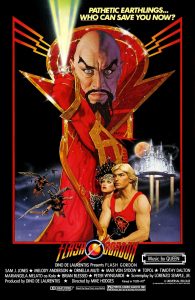
Flash Gordon- Movie about War

Flash Gordon the comic book first appeared in the 1930s. There were TV shows in 1954, 1979, 1982, and more, along with the 1980 film that for whatever reason was a large part of my childhood. Having not watched the movie since I was 12, there were several interesting tropes and representations I recognized in my recent most viewing. Since the original character and the film itself come from different decades, I noticed many historical influences in the movie.

The first substantial note would be the red and gold emperor, who is ruthless and all powerful. His subjects are seen with one hand raised calling “Hail Ming Hail.” The red sun reminded me of the Japanese flag, and the signal of supporters seemed reminiscent of Nazi German. Once connecting the villain of the story to the axis powers of World War II, the scene of placing Flash into a gas chamber for his execution took on different meaning. Even though Flash may be a perfect example of Aryan youth, tall blonde athlete, he has gone against the emperor and therefore must die. There is also a secret police force in the film that could be representative of the Gestapo.

The other possible representation of these secret police would be the KGB. Produced during the Cold War, the red and gold could also be that of the Soviet Flag. The theme song, “he’s for every one of us/ stand for every one of us” resembles Cold War propaganda against the red threat of Russia, urging people to stand for their country and fight with them.

Book Recommendation – Stranger in a Strange Land by Robert Heinlein

Blog Overlord Post #1

So a few months ago I wandered into The Book Barn in Brunswick (2 Lincoln St) and I have just started making my way through the books I picked up there. First of all, the store is awesome! Its essentially a house that only consists of bookshelves that are packed by the man who runs the place with collectors editions of books, go check it out! The place is riddled with Sci-Fi and the owner has plenty of his own recs. Number one on his list was Dune, but having already read it, I opted for #2 — Stranger in a Strange Land (the Uncut Version) by Robert Heinlein.
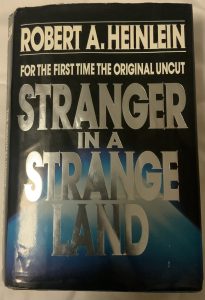
The book is quite long, 525 pages to be exact, and is worth every page from the editors note through the back cover. The story of how this version came to be is fascinating and told in the editors note. In short, the version of this book that was originally published was limited to 160,000 words because the Publishers thought it would fail horribly, so Heinlein cut his 220,000 word manuscript to meet the quota. It then wins the Hugo award! But After Heinlein’s death this longer version was released and it has become an essentially  unanimous decision that this version takes the cake for being the true masterpiece.

The plot focuses “The Man From Mars,” Michael Valentine Smith, a human who was born on Mars, raised by Martians, and brought back to Earth by humans to “be with his own people.” As the heir to a massive wealth on Earth, it seems the Terran government is trying to hold Michael hostage, so his Nurse and some of her friends work to free the Man From Mars. In an epic turn of events we learn that the Martian human has powers beyond the Terran human realm of understanding, and page by page we see how he utilizes and develops these power once he is free to roam the Earthly world — including through stints in carnivals, fry kitchens, temples, and what could only be described as a nudist sex cult of infinite love and empathy. The importance of Religion, Language (Martian and English), and Sex, and the entanglement of the three are huge philosophical themes in this novel, but others remain relevant including the meanings of family, truth, and love.

One interesting component of the book is that Heinlein coins several “Martian” phrases including, most notably, the word “Grok”, which you better get used to seeing and saying if you intend on reading this novel (it will briefly work its way into your thoughts while, and immediately after you read this book). One Main tenet of the plot is that “Language itself shapes a man’s basic ideas” (212), which is used as a possible explanation for why humans struggle to find happiness, and is also essential to understanding the differences between The Man From Mars and his Earthling peers.

While I really enjoyed reading this, there are some problems with this book:

TRIGGER WARNING: Sexism, Racism, Racial Slurs/Violence, Possible Sexual Coercion, (Attempted Suicide, Cannibalism, also in the book, though not mentioned below)

There definitely is some sense of gender inequality stemming from certain characters, but I have not been able to fully Grok its place amidst a seemingly anarchist / anti-capitalist / sex positive  book. Women definitely derive power from their bodies throughout the story yet sex is de-stigmatized, making me think that from that point on it is purely character that drives attraction rather than physical traits. Nonetheless there is one character who regularly makes quips towards women that are belittling, despite the women playing significant intellectual, religious, and professional roles. I could not fully grok whether these were meant to be in jest and part of a two way banter between the sexes, or whether these were indeed sexist remarks (or perhaps they were both?). Maybe someone with more of a GSWS theory background can input after reading , or else I will just find out with more time to Grok. Michael often says in the book, “Waiting is until fullness.” For now, I wait.

Another similar problem has to do with religion. There are Jews, Christians, Cultists, Catholics, and Muslims in this book. They all work with each-other but one character frequently makes comments about his Muslim friend that I didn’t quite Grok to fullness but did make me feel a bit uncomfortable.

There is at least one instance where a woman coerces a man into having sex, asking multiple times and being told no, before the man gives in eventually. Technically the women knows the man’s real thoughts and that he is willing, and the man was admittedly being polite in regards to age customs, however, I Grok this could be read otherwise and in any non telepathic communication setting is most definitively rape.

Lastly, The N* Slur along with a suggestion of Lynching is used towards the main character in the final chapter. I thought this was unnecessary, although it is a reflection of the time of writing and a reminder of the hate acts that were occurring then and still occur to this day.

All this being said, the book was written in 1960 and was written as counter-culture sci-fi. While it is progressive in some elements in remains outdated in others. Overall I think that it is still very much worth a read for the thought that it provokes and the thoroughness, and entertainment value of the plot. Perhaps a second reader with a more critical theory lens will rip this to bits. But for me, this was a brilliant book that has, for better or for worse, aged.

Weird, Thought Provoking, Entertaining, Page Turner. And yes, probably controversial.

I give it a 9/10 and Very much recommend it.



The Dispossessed by Ursula K. Le Guin

Diego Lasarte’s book review. Posted from Stephen Boe’s account because I don’t have access to the blog.

Fidelity and the Concept of Nostos in The Dispossessed

“If you evade suffering you also evade the chance of joy. Pleasure you may get, or pleasures, but you will not be fulfilled. You will not know what it is to come home.” (334) This line is from, perhaps, the most moving passage of Ursula K. Le Guin’s The Dispossessed. It takes place after Shevek returns home from work during the famine, seeing his partner Takver, and their child, for the first time in four years. He is filled with emotion—sadness at missing so much time with the woman he loves and pride at the important and difficult work he has accomplished—and is forced to reckon with the, often suffocating, march of time. But instead of feeling like the time he has missed has stifled him, he feels liberation in the very sacrifice he has made. 

“Fulfillment…is a function of time. The search for pleasure is circular, repetitive, atemporal. The variety seeking of the spectator, the thrill hunter, the sexually promiscuous, always ends in the same place. It has an end. It comes to the end and has to start over. It is not a journey and return, but a closed cycle, a locked room, a cell. Outside the locked room is the landscape of time, in which the spirit may, with luck and courage, construct the fragile, makeshift, improbable roads and cities of fidelity: a language inhabitable by human beings.” (334)

I choose this passage to center my review of this book, not only because of how much it moved me but because it gets to the kernel of what Le Guin has shown in her brilliant novel about an anarchist society living on a sparse, dusty moon. She has succeeded in a rare feat: creating an admirable, realistic utopia. She has shown that a truly anarchist, communitarian society could only exist in a world with minimal resources and no surplus of wealth. In other words, she creates a society that is rough and a way of life that is difficult and prone to suffering, and she shows that, contrary to the dominant negative views of suffering in our society, suffering is a necessity for building a strong and lasting family, community or society. 

This is principally because of two ideas: the importance of fidelity in finding freedom and a distrust in the virtue of pleasure. “The promise, the pledge, the idea of fidelity, [is] essential in the complexity of freedom.” Le Guin is arguing that imposing limits on one’s self is the only way a person can truly be free. It is a complex idea, difficult to grasp because of its seeming contradiction, but it makes more sense when you understand freedom as contingent on the freedom of others. This is where the mistrust of pleasure comes in. Basic market economics harness an individual’s desire and attempt to create a society out of everyone striving to make their life pleasurable as possible. This way of structuring society encourages shortcuts and devalues hard work. More than anything, it shrinks a life down to something that is only focused on the individual. 

This is why I find Shevek’s return to Takver so indicative of the beauty of this book. He has just spent years doing something difficult and not at all pleasurable, alone without the company of his family. But, in the process he has done something deeply human: he has taken care of others. By putting the needs of the collective ahead of his own needs, he has found a deeper satisfaction. This deep satisfaction has made the love he shares with Takver even better because their love does not stem from the search for pleasure of two individuals, it stems from a common commitment to fidelity and a loyalty to the world around them. Being with her is a homecoming, a Nostos, and the only reason he gets to feel the sweetness of returning to her, is because he left her out of loyalty to the world around him.      –Diego Lasarte

Life on Mars by Tracy K. Smith

9639765In my junior year of high school, in an English class focusing on the formation of senses of place in the natural world, I read Tracy K. Smith’s poem anthology, Life on Mars, winning the Pulitzer Prize in 2012. The title is inspired by the David Bowie song of the same name, stylized as Life on Mars? The song itself paints a surreal picture of violence, confusion, injustice, and an ongoing battle between entertainment and ennui as the “girl with the mousy hair” watches a performance toeing the line between metaphor and reality.

The anthology serves as an elegy to Smith’s late father, a fan of David Bowie, who worked on the Hubble Space Telescope. Life on Mars serves as an homage to her father’s work as she processes the pain, confusion, and yearning of grief.  The work may be called at once transcendentalist and Afrofuturist as Smith finds paternal comfort in the vastness and potentiality of outer space. An excerpt from the poem “The Speed of Belief” reads “I didn’t want to believe/What we believe in those rooms: That we are blessed, letting go, Letting someone, anyone;/Drag open the drapes and heave us/Back into our blinding, bright lives.” In those unbelievable moments of suffocating, claustrophobic pain, the space left by her father can be used to separate her from a world that is trying to manufacture her healing.

Some poems from the anthology are easier to understand than others certainly, but if you like poetry I think that you will love this read. It is an adept fusion of poetic styles and symbolism, offering a space for healing in the potentiality of the cosmos. While drawing on the fascination that has inspired science fiction writers for the past century, her Afrofuturist lens creates an outer space that is not a frontier to be conquered and explored, but a mystic realm to which we can retreat to process and find meaning and inspiration through loss.

More reviews on Goodreads

Repulsor Lift Technology

My favorite part about science fiction is the futuristic technology within the stories and the implications it could have today. A piece of technology I’m most fascinated by is the Repulsor Lift, a machine in the Star Wars universe that can be installed on objects, vehicles, spaceships, or even cities to allow them to defy a planet’s gravity and levitate by pushing against a planet’s gravitational force. If this technology existed today, it would vastly change our lives. Commercial travel would be revolutionized by levitating cars and trains, planes wouldn’t rely on the force of lift, space exploration would become exponentially cheaper and easier, floating cities and space elevators could be developed in addition to toys like the hoverboard.