Category Archives: wsf

Severance – A Sci Fi Office

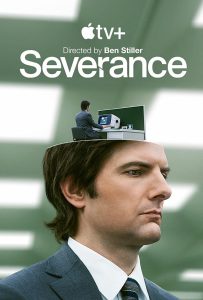
Over the past few weeks, I’ve been loving this new show Severance. Much of our society allows our work life to intersect with our home life. In Severance, one company named Lumon developed an alternative: a procedure that separates your home and work mind. While at work, you only remember work life. While at home, you only remember home life. The company seems to have much more sinister intentions, but I completely understand why some people would choose to work there. The show’s basic premise fits in with HG Wells’s Law of containing just one extraordinary assumption but takes this assumption to the extreme. This one simple procedure, when used mysteriously by Lumon, drives the story.

Severance is a critique of the modern office worker lifestyle. The employees at Lumon complete seemingly arbitrary work throughout the day, serving some larger purpose that is not made clear to the viewer. These employees are supposed to blindly complete tasks for the corporation and face serious consequences if they disobey.

Anyway, I highly recommend the show! The final episode of the first season came out last week, so you can watch the whole thing on Apple TV+.

Severance, created by Dan Erickson, Red Hour Productions, 2022. Apple TV.

Watch the first episode for free here: https://tv.apple.com/us/show/severance/umc.cmc.1srk2goyh2q2zdxcx605w8vtx?ctx_brand=tvs.sbd.4000&ign-itscg=MC_20000&ign-itsct=atvp_brand_omd&mttn3pid=Google%20AdWords&mttnagencyid=a5e&mttncc=US&mttnsiteid=143238&mttnsubad=OUS2019927_1-582619190592-c&mttnsubkw=133111427260__fAcU9Yov_&mttnsubplmnt=

Star Trek

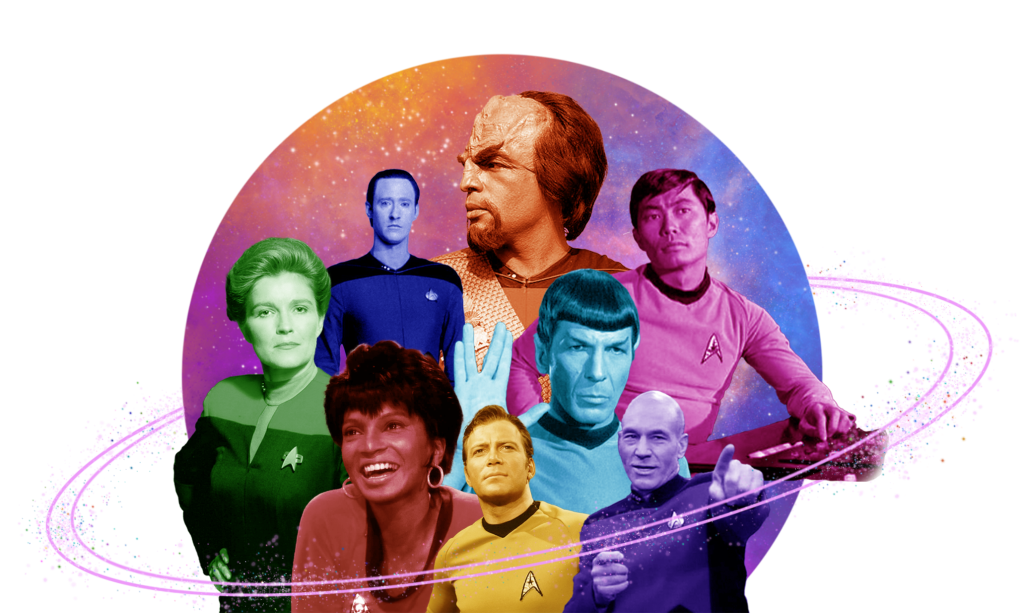
Photoshopped/ digital art of different Star Trek characters.

Created using Photoshop and Procreate. Original character images found on getty images.

“Space: the final frontier. These are the voyages of the starship Enterprise. Its continuing mission: to explore strange new worlds. To seek out new life and new civilizations. To boldly go where no one has gone before!”

After about the fifth time my parents laughed at a reference in a movie and brushed it off as “oh it’s a reference to Star Trek,” I demanded they introduce me to the iconic show. My mom picked out her favorite episode in the Original Series, “The Trouble with Tribbles” and I was hooked. Nine years later and I’m taking a Science Fiction class as a senior in college all because of those pesky tribbles. I may not know how to speak Klingon or have a cosplay costume ready to go in my closet, but I have come to the conclusion, alongside many others, that Star Trek is the greatest science fiction franchise of all time. It continues to stand the test of time with the current Star Trek canon including eleven TV series (with more on the way) and thirteen feature films. But why is it so great?

Star Trek, to its core, embodies hope. It’s had a purposeful mission from the beginning, not only to boldly go where no one has gone before, but to show viewers that the future can be good. It portrays an optimistic vision of humanities future where the defining characteristic of humans are our curiosity. In this vision, humans are dedicated to science and exploration, of both space and themselves. Star Trek imagines an Earth without war, poverty, or pollution where technology works FOR us rather than against us. The current geopolitical tensions that rule our world’s governments are described as petty squabbles that have been solved and left behind in humanities’ dark past. Star Trek shows how peace and discussion are far more interesting than war and violence. Differences are respected and actively depicted as good. Gene Roddenberry, the creator of Star Trek was invested in showing how humanities strength lies in our differences.

Star Trek has embraced diversity from the beginning, not only in the stories but in casting. In the Original Series, Nichelle Nichol’s Uhura and George Takei’s Sulu were main officers on the bridge. As the first black woman in a position of respect and power on an American television series, Uhura was unprecedented in 1966. Famous endorsements of Uhura came from Martin Luther King Jr. encouraging Nichols to continue playing the role after the first season and Whoopi Goldberg who was inspired as a nine-year-old watching the show for the first time. Ahead of its time, the 1968 kiss between the Uhura and Kirk is, among much debate, often cited as the first interracial kiss on television. Star Trek: Deep Space Nine put a black man in charge through Avery Brooke’s Sisko and the next series Star Trek: Voyager has Kate Mulgrew’s Janeway as a female captain of the crew.

The franchise came into itself on television in a time where special effects were limited and so although most of Star Trek is in space, it devotes itself to talk over action. While the more recent series and films can take advantage of incredible special effects to give viewers the space battles and martial arts scenes we want, at its core the focus is still on asking big questions. Each episode and movie explore different philosophical issues. What does it mean to be human, Klingon, Vulcan, non-corporeal, immortal or an android? With many hours to explore ideas and questions, Star Trek tackles a wide variety of themes and tells many different types of stories such as mysteries, romances, horror stories, spy stories, workplace drama, family stories, and so many more. Many episodes explore emotions. What are they, when or how do we give into them, repress them, or make use of them? Vulcans repress them through their pursuit of pure logical thinking, while Data, a perfectly logical android seeks to be more human and emotional like his friends. Star Trek: The Next Generation has two regular characters who function as therapists for the crew, Deanna Troi as ship counselor and Whoopi Goldberg’s Guinan as the wise and ageless bartender.

Something that always stood out to me was how the characters of the show are “cool” because they are intelligent and good at what they do, not because of wealth or looks. They are curious and ask questions, determined and passionate about what they do. In their pursuit of interplanetary goodwill and space exploration, they unapologetically ask “why?” and “what if?” As the resident Trekkie of the class, I wanted to share why I love it and continue to go back to it. Star Trek embraces the awe and wonder of the universe that is at the core of what science fiction means to me.

** If you want to get into the franchise but don’t want to watch eleven series and thirteen films, I recommend watching the recent trilogy that features a younger version of the original crew in a different timeline! The cinematography, special effects and music is stunning! (Star Trek, Star Trek: Into Darkness, and Star Trek: Beyond)

Sources/ inspiration for this post:

Roddenberry, Gene. Star Trek. 1966-present.

Lloyd, Robert. “’Star Trek’ Is the Greatest Sci-Fi Franchise of All. Why It’s Stood the Test of Time.” Los Angeles Times, Los Angeles Times, 28 Oct. 2021.
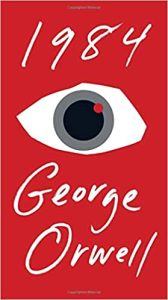
1984 George Orwell – Green Hand Bookshop

1984, written by George Orwell and originally published in 1949, is considered by some one of the most well known and popular dystopian science fiction books of all time. I chose to read 1984 because I have been told by multiple people that I need to read it eventually and it also relates to the world today in an eerie way, especially with current events. The book is about a man named Winston Smith who discovers he is not satisfied with the government Big Brother’s constant surveillance and control of society. He finds a way to rebel and falls in love with a woman named Julia, only to end up being captured, tortured, and eventually brainwashed into loving Big Brother. 1984 is considered soft science fiction since it mostly deals with a society and it’s dystopian government’s political aspects and control over the people it rules, and though technology is not unbelievably advanced, it’s surveillance ability is heavily abused. This book is very fascinating because of the parallels found to today’s current society. It depicts a government and society similar to one that could be found in reality, the main difference being that the control those in the upper class have is not only evident all the time, but is also absolute. Winston’s job involves rewriting journals, books, and other sources to make Big Brother’s predictions of the future always accurate and even change the occurrence of events in accordance with what Big Brother wants. The story is a haunting depiction of what could happen if those in power decide to exert more control and instances of this occurring can be seen on a smaller scale in real history and the present, and I would definitely recommend it because of how creative yet accurate and ultimately hopeless the tale becomes.

Orwell, George, and Erich Fromm. 1984. Signet Classics, 2017.

Ender’s Shadow (Green Hand Book)

This book was recommended by a classmate who was also choosing books at that time. Ender’s Shadow is a companion novel to Ender’s Game, which I have read and very much enjoyed. I was interested to see how Orson Scott Card would rewrite a story from a different perspective.

The book is about earth’s response to an alien invasion of B.E.M. The strategy is to train young gifted children in battle and command. This book follows a child named Bean through his journey as an orphan on the streets to being an officer in the final battle against the Formics.

It is an Alien Invasion story with political elements, specifically Russia and China as dominant world powers. It also includes space exploration and technological advancements like controlled genetic mutation. The author describes the two companion novels as a type of parallax. I read the companion novel Ender’s Game first, and there is a similar structure that explains certain parts of the book that aren’t necessarily missing without the companion but definitely enhanced when read together. I greatly enjoyed the book and would recommend it to others.

Card, Orson Scott. Ender’s Shadow. New York: Tom Doherty Associates, 1999.  Awards: New York Times Bestseller (Fiction, 1999), SF Site Reader’s Choice (1999), Alex Awards (2000), ALA Best Books for Young Adults (2000), Geffen Award (Best Translated Science Fiction Book, 2001), ALA Popular Paperbacks for Young Adults (2004).


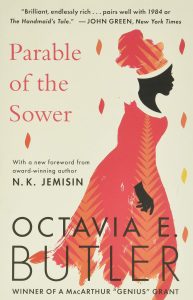
Parable of the Sower (Green Hand Book)

Before I chose this book, I had no idea who Octavia Butler was, and when I walked into the Green Hand bookstore, I didn’t have an idea of which book I was going to choose. However, in the bookstore, both a random man and the owner recommended Parable of the Sower, the 1993 novel by Octavia Butler. Parable of the Sower is a post-apocalyptic novel set in California, that depicts the devastating effects of climate change. It follows the story of Lauren Olamina, a teenage girl, and how she deals with the terrible events that affect her and her family. It also explores religion in an interesting way. Parable of the Sower is a dystopian SF novel, that also deals with themes of climate change and social/wealth inequality. I loved this novel for many reasons. I loved Butler’s writing, the characters she develops, and how real the scenarios and characters felt. I also loved (and was scared by) how prescient this novel (and Parable of the Talents, the sequel) were. I would highly recommend this book, and the sequel, to anybody, not just SF fans.

(Nominated for the Nebula, and a NYT Notable book of the Year)

Butler, Octavia E. 2019. Parable of the Sower. London, England: Headline Book Publishing.

Written in 1993.


The Representation of Time and Time Travel in Interstellar

The other day, I rewatched Interstellar, a 2014 science fiction film directed by Christopher Nolan. I really enjoyed rewatching it, especially while taking this course. The movie utilizes a lot of hard SF, and attempts to be quite realistic in explaining time dilation and time travel.

The movie starts in a future Earth where the environment has been ruined, with crop failure and extreme amounts of dust present. I won’t completely spoil the film, but the main character, Joseph Cooper (Matthew McConaughey) goes to space to attempt to find a new habitable planet. The fascinating part of the film was how time and time travel was depicted.

The first instance of time (travel?) I want to explore is on a water planet that Cooper and his team visited, where one hour on the planet is seven years on Earth, due to the planet’s closeness to a massive black hole, and the distortion of time. I found this idea extremely interesting, and upon further research after watching the film, it actually seems to be scientifically possible. The film utilized Kip Thorne, a former Caltech physicist, for the science, and he actually wrote a long book about the science of Interstellar, explaining what was scientifically possible and what was just for the film.

The second interesting thing I thought about in this film was how they represented time travel. Cooper enters the blackhole, and finds himself in a Tesseract, which represents time as a physical dimension. Thus, through moving about the Tesseract, Cooper is able to go back in time and influence the past by creating a signal in his daughter’s room, which in turn is the signal that causes him to go on this journey many years ago. It all gets quite confusing, as this seems like a paradox, but I won’t go too far into it as I don’t want to spoil the film, which I highly recommend!

Overall, I found this film extremely interesting and one of the best SF films I’ve seen, partially because of the plot and cool SF devices, but also because of the attempt at scientific realism.
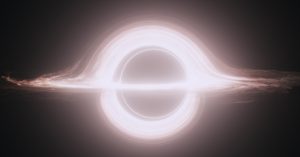
This is the visual representation of the black hole.

-Ezra Jones

Robot Warriors (Green Hand Book)

At the Green Hand, I picked out two books, but the one I’m posting about is an anthology of short stories called Robot Warriors, edited by Martin Greenburg and Charles Waugh.

I actually really enjoyed several of the stories in the anthology with my favorite being “Kings Who Die” by Poul Anderson. This story focused on a Cold War-esque conflict carried out entirely in outer space to protect the Earth from weapons of mass destruction. The story focuses on an American soldier who barely survives a space battle and is rescued by a new type of enemy ship. Onboard, he meets with an enigmatic Russian General who has a plan to end the war but requires the soldier’s cooperation. Without spoiling the story, I’d recommend it to anyone interested in the themes of the sub conscience, human-computer integration, the cost of war, and questions of free will.

That said, they weren’t all highlights. One story in particular that frustrated me was “Second Variety” by Philip K. Dick. It wasn’t that the story had uninteresting ideas, but I figured out the twist about halfway through the story and spent the entire last half being annoyed with the protagonists’ stupidity.

Despite a few duds, it was a very enjoyable collection of stories that present interesting variations of many classical tropes of robotics. A few other stories from the collection I enjoyed were “A Relic of War” by Keith Laumer and “There Is No Defense” by Theodore Sturgeon (of Sturgeons’ law fame!).

–Isabella Angel


EDIT:

Wow, I can’t believe I completely forgot to actually include some of the most important information! Thanks so much for reminding me Professor Saiber!

For any who are curious, the reason I chose this was because I really love short stories, I also really love robots, and it was within my price range so I could get another book as well!

And the citation format for the book:

Dickson, Gordon R, Charles G. Waugh, Martin H. Greenberg, and Joe Adams. Robot Warriors. New York: Ace Books, 1991. Print.

http://www.isfdb.org/wiki/images/f/f7/RBTWRRRS1991.jpg

High Weirdness: the new psychedelic worldview in SF

High Weirdness (Drugs, Esoterica, and Visionary Experience in the Seventies) by Erik Davis explores the emergence of a new psychedelic spirituality in the works of PKD, Terence McKenna, and Robert Antin Wilson. I’m super psyched to read this!! Davis navigates readers through consciousness, the hierarchies of their perceived realities, synchronicity, and a plethora of other weird aspects of our human experience that is suggested by these major counterculture sf writers.  Magic mushrooms, flying saucers, the invisible trickster entities of the 70s, SF, what more could you want? (the attached photo has popular modernSF novels)

Aliens, God, and Country Music?!

This week, I write to bring you the song “Tippin’” by Dale Hollow and the Long Con.

I’ve always been a fan of southern gothic and the weirder side of country music, and this song brings the two together well. When I first discovered this song, I didn’t consider it a work of sf, but this course has made me reassess that. I’m still not sure how I would classify this song, but regardless, the lyrics present a non-traditional view of aliens and/or God. Set in the frame of a drunken dream, the song also leads me to consider the role of altered states of consciousness (both natural and substance-induced) in thinking about our past and our future.

Maybe this is all a big stretch, but even in that case, it’s a fun song and definitely worth the listen.

(Links: https://open.spotify.com/track/7bnHGhyE1aiw83mSrPax3a, https://www.youtube.com/watch?v=692WeCngx1I)

LYRICS
I roved out in the field of the Lord
In my two s.k.’s and a Jim Beam getting loaded
For the task at hand, beast versus man
I’m going to tip a heifer over while the rest of the herd is out lowing
Out in the pasture, out in the land
I don’t know where the bull is but I think that I like my chances
As I made my approach the sky broke open and a voice said
“Dale what the hell do you think you’re doing?”
Well the voice was God and he said “Dale Hollow
You really gonna waste your whole life going out in the field going cow tipping?”
I said “You’re damn right, it’s a real good time
And if you don’t mind me I’m going to go and tip this cow…
Right now!”

And the lights came down from the sky
And I felt my body lifted up from the ground
And I went into the light
And I left the Earth behind me…
“Oh Lord, I’m so sorry… For everything that I’ve done
These aliens! They want to hurt me! But they’re not ready, for The Long Con!”

I woke up at three in the morning
Covered in sweat and a Jim Beam on the floor
Didn’t understand where I’d been
I was just in outer space but now I’m at home all alone
Well it’s hard to believe, but it’s safe to see
That everything that happened was only a dream
“Thank you Lord for saving me! It’s blessing that this was all just a dream.”
It was all a dream!