Category Archives: wsf

Spanish Sci-Fi for Spring Break


Just like in Italy, Science Fiction in Spain is somewhat rare due to the general conditions. Nevertheless, recently a show called El Ministerio del Tiempo (The Department of Time), has gained a lot of popularity.

The plot revolves around three agents that are recruited from different time periods in history in order to serve in the ministry in the present day. What hides inside the ministry is the only time machine possessed by humans… or so they think. The show revolves around a story line where time has to maintain unchanged while an American company is trying to steal the secrets of time travel… to apply it to stock trading of all things in the world.

Watch the show here

Additionally on the topic of American companies that steal technology; Timeless, the American show with a similar premise by NBC was sued by the creators of El Ministerio. NBC settled out of court. interesting to see some prescience in that aspect of Science Fiction writing too

Dune and the Machine

I would like to talk briefly on one of my personal favorite Sci-fi novels, Frank Herbert’s Dune, and the ways in which machines are and aren’t a part of the universe that Herbert creates in that novel and in all the stories following it.

Machines are central to the space-faring humans of Herberts future world. Interplanetary travel is carried out on massive tubular ships called “Heighliners” Spice is harvested in crawling factories. The Fremen, natives of the planet Arrakis (the proper name for the titular planet), have created desert-proof outfits called “Stillsuits”, along with a host of other bits of tech that enable them to live in parts of their planet deemed uninhabitable by offworlders. In short, there is no lack of cool future technology for Sci-Fi fans to get excited about.

However, there are two very notable absences that make Herbert’s books stand out from many other works of science fiction. There are no computers or artificial intelligences of any kind and there are very few lasers or projectile weapons.

In regard to the former, the absence of computers is explained in-universe by a war between humans and AI that took place 10,000 years before the events of Herbert’s 1st book. The humans won this war, and proceeded to outlaw artificial intelligence of any kind, replacing it with humans trained to be computers themselves, called “mentats”. These individuals have all the processing power of a computer, if not more, and yet are still definitively human. They have received no cybernetic augmentation, but have rather had their minds cultivated from a young age to hone them into powerful computing forces.

In terms of lasers and guns, their absence is explained by the creation of personal body shields that keep fast-moving bullets from hitting the wearer and which, if hit by a laser, create a reaction that kills both the shooter and the shield-wearer. This means that most combat is done with body shields and bladed weapons. A very fun twist.

Herbert, as with most great science fiction writers, is as intentional about the technologies that he leaves out as the ones that he includes. Many readers of science fiction would expect to see computers and lasers in a future society such as the one Herbert creates, and I appreciate his leaving them out.

Also, if you’re interested in Herbert’s work, there’s a screening of Dune this Friday, hosted by the Bowdoin Film Society!

Underwater SF

Space and the ocean share a lot of similarities. Both space and the ocean present abundant opportunity for human exploration and discovery. To prepare for space travel, NASA’s NEEMO simulation requires astronauts to live underwater for a several days. While, the universe is more vast and unintelligible than our ocean, the planets of our solar system have been mapped with higher resolution the sea floor. Fixated on pushing the limits of impossibility, we consistently look to space rather than investigating what remains undiscovered on earth. NOAA has an annual budget of 5 billion dollars, while NASA’s stands at nearly 23 billion as of 2020. Space travel may even be a barrier to deep sea exploration. While SF’s fascination with space has possibly contributed to the neglect of earthly exploration, the genre has had many love affairs with the sea. Giving more attention to underwater SF may help push sea exploration deeper into our collective unconscious. It could be the Marina Trench, not Mars, that holds the hospitable potential for holding future human populations. I found this link (https://sf-encyclopedia.com/entry/under_the_sea) on The Encyclopedia of Science Fiction. If you are interested in underwater SF, check out their list; it is expansive. The ocean deserves some love!

The Vault of the Atomic Space Age

If you’re interested in seeing how people perceived the scientific revolutions that surrounded them during the Cold War, this blog might be of some interest to you. It’s a great collection of commercial sf artwork (movie posters, book covers, etc.) and documents of space-age era interior design, technology, and aesthetics. I think the whole thing strikes a really interesting balance between comfortably nostalgic and genuinely unnerving.

LINK! –> https://thevaultoftheatomicspaceage.tumblr.com/ <– LINK!

imageimageimage

The cover of 1984

The Truly Scary Dystopia

It feels like I grew up with dystopias in almost everything I read. Between The Hunger Games, Divergent, The Giver, most books I read in school, either assigned or for fun, featured a dystopia. Heck, you could even argue that Star Wars under the Empire is a dystopia. 

But none of them were very scary.

Sure they would have violent scenes and overall gruesome concepts; sending children to die in a televised battle royale is psychopathic. Obviously, they had horrible villains with rotten hearts and evil armies of cold-hearted killers sent to quash any sparks of hope. These forces of evil would seem insurmountable and omnipotent, ready to sacrifice whatever it took to preserve their imprisoning system. 

But they always would lose. There would always be a protagonist, whose heart yearns for a better life, who rises up and challenges the system. A Katniss that refuses to die, a Luke trusting the force, a Jonas fleeing to a better life, a hero embodying freedom who washes away the old order and proves that individuals valuing freedom can, if not overcome, at least escape the imprisoning old order. No matter how controlling the society, how gruesome the practices, how evil the villains are, it can be beaten by an individual who dares. This made the dystopias into playgrounds as opposed to nightmares where the only question was how the protagonist would succeed, as opposed to if. The books aren’t critics of society as much as they are entertaining action films.

1984 changed that narrative. 

It is a dystopia that embodies the classical elements that come to mind when one thinks of the genre.  Initially, it reads like any other dystopia I’d read before; Winston is on the path to rebellion and escaping the clutches of the state, finding love, fostering passion, questioning the society around him. 

But he fails. Not due to a fault of his character, but because society already accounts for actors like him. He is not killed; simply killing a rebel makes a martyr and doesn’t solve the problem at hand. He is methodically broken in a manner that returns him to society cleansed of rebellion and questions. People love to remember the surveillance of 1984, but the thing I most remember will always be how unsettling it is. It is scary not because of it being a particularly gruesome world (in some ways, it is not too far from our present condition), but because there is no escape. The state’s control is total, complete, and able to extinguish the sparks of rebellion before they are any more than a flicker. 

This dichotomy of dystopias, those that act like action film backgrounds versus those that ensure their victims completely, was on display with the readings for Thursday. “Rainy Day Revolution” fell more into the first category for me. Lester has already decided to break from society. He is already on the path to rebellion and although he is cut down, he dies with his intentions intact. In contrast “Goodnight, Sophie” perfectly captures the 1984-style feeling of no escape; society has already accounted for Sophie’s doubts and plans are in place so that she is corrected before she reaches the point of no return. Like Winston, she does not need to be killed because her spirit of rebellion is broken.

Overall, this ramble isn’t meant to take away from any dystopian story or the critics it makes. The Hunger Games makes as many commentary points as 1984 and both are great books. However, there are two very distinct types of dystopias within the genre. There are those that are meant to be torn down by the protagonist in an action-filled romp. Then there are those that tear the protagonist down and, in my eyes, are truly scary.

Solar punk: a radically optimistic view of the future

The relationship between humans and the land has changed so much, from the relationship we have cultivated over tens of thousands of years, to after settlers started colonizing the land, to now with industry and a system of capital leading to a disregard of the planet. 

Many young people have lost hope for the future of humans and of the planet. Science fiction is a window into our interpretations imaginations of the future, but much of science fiction is pessimistic and doesn’t often imagine a sound and ideal future. 

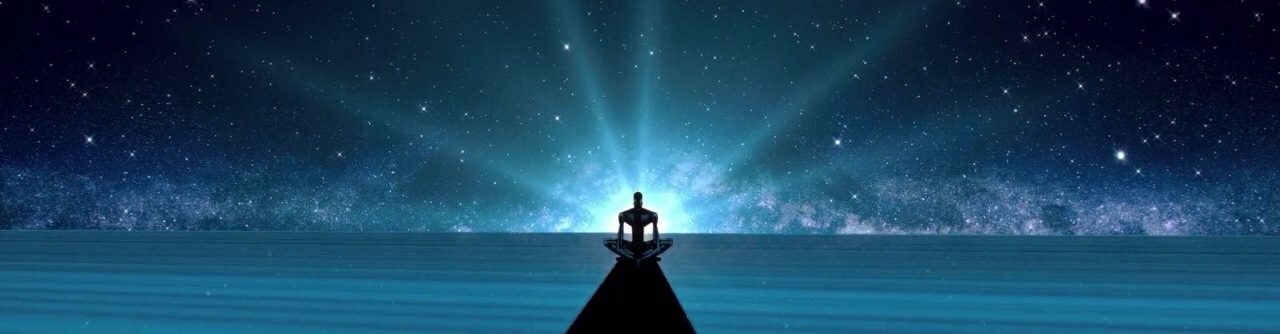
Radical hope is needed to create the change we need for the future. Solar punk brings back indigenous ways of living in balance with the land, while also acknowledging that technology is here to stay and can be used for good. 

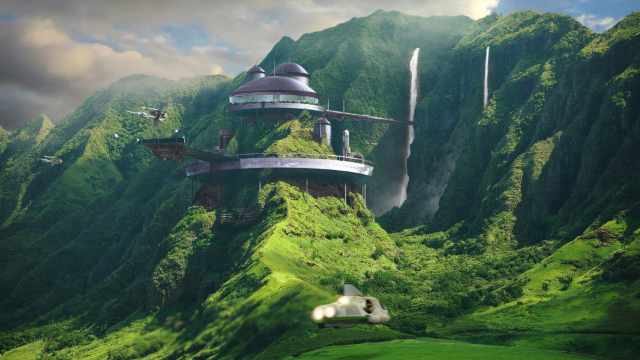
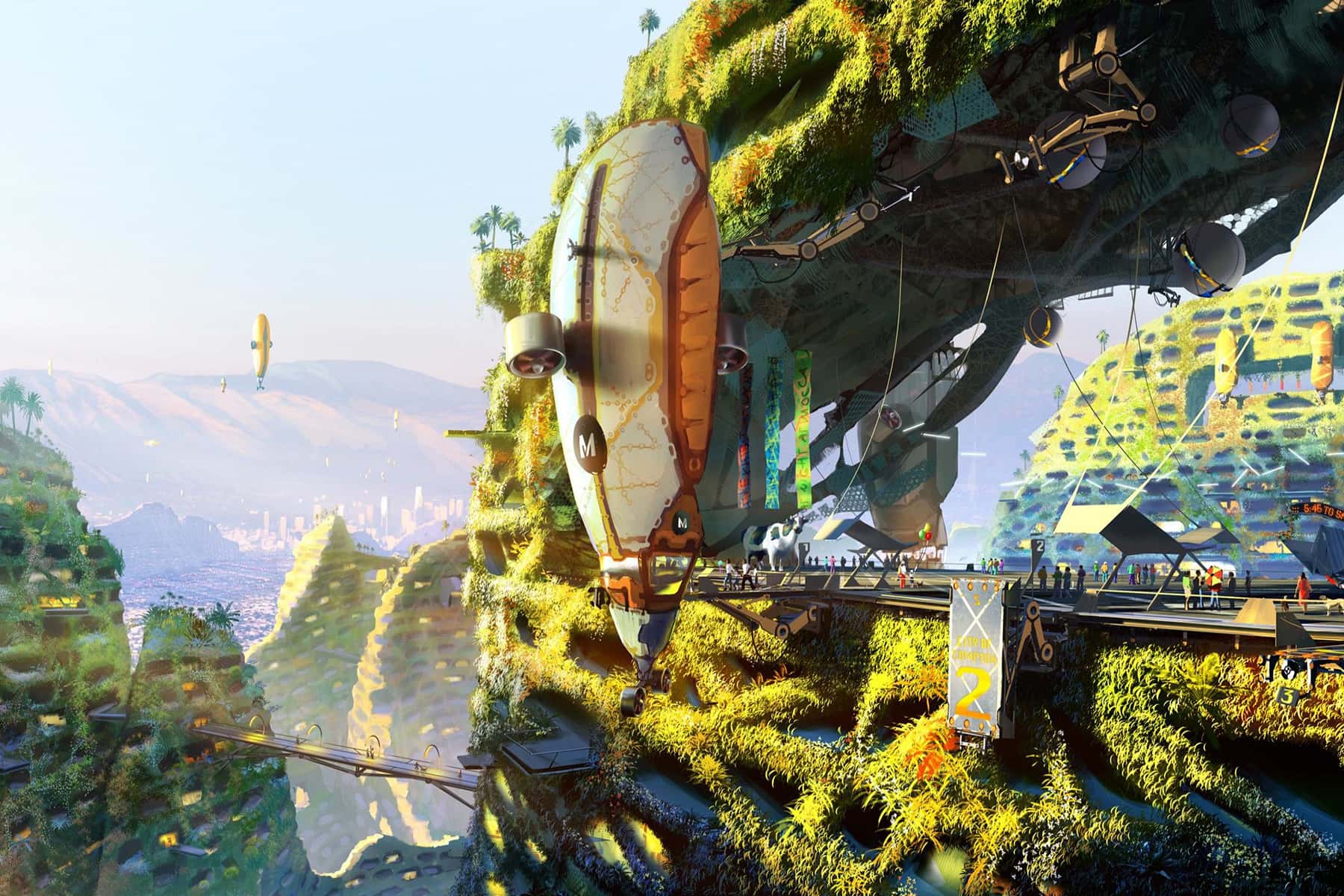
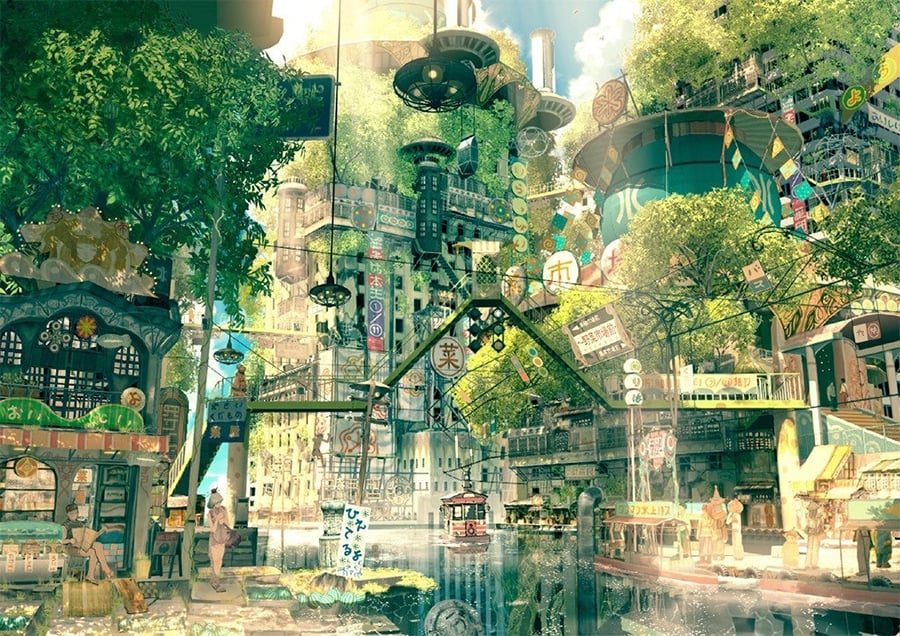
Linked are some depictions of a solar punk imagined world. 

Discovering the Rainbow: Solarpunk embodies an optimism towards the future that our society needs | The Milwaukee Independent

Why “Solarpunk” Gives Me Hope for a More Sustainable Future - YES! Magazine

While researching more about solar punk, I came across a Chobani yogurt ad that beautifully depicted an optimistic solar punk future, a future where people living in harmony with the land while also striking a balance between us and nature. 

This was particularly interesting because I have dislike for any corporation that could be greenwashing and trying to appeal to an audience that cares about the Earth just to make more money. Despite my qualms, this ad, without the company references, was beautiful done and represents solar punk pretty accurately. 

The future that I want the children of the future to have, is one like solar punk, where balance is stuck. I will try to fight back against the pressing feelings of helplessness, and turn that frustration into doing what I can, as soon as I can, for the future. To be a good ancestor… 


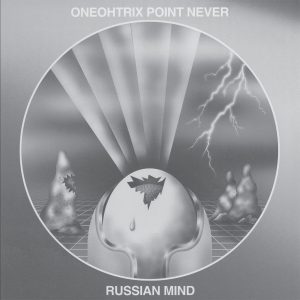
Oneohtrix Point Never – Rifts

0. Who is Daniel Lopatin? The composer of the soundtrack of what became everyone’s favorite Adam Sandler movie: Uncut Gems; a born-and-raised Masshole, like me(!); the director of The Weeknd’s 2021 Super Bowl halftime show; a wizard with a Roland Juno-60 synthesizer; an all-around great guy. 

1. Betrayed In The Octagon. Rifts evokes a narrative more than it could ever hope to present one. This is characteristic of any piece of music that’s almost entirely wordless. Musically speaking, however, it’s clearly indebted to the ambiance of soundtracks to SF films like Bladerunner, the synth work of new-age music of the 60s and 70s, and the experimental noise scene of New York City. That these influences range from music that was almost purely commercial to sounds that most people (myself included) have a hard time calling “music” is characteristic of the project as a whole, regardless of whether the influences in question are musical or literary.

2. Zones Without People. The titles of the songs on Rifts are full of references to technology (“Laser to Laser,” “Disconnecting Entirely,” “Computer Vision,”), the uncertain nature of time (“Months,” “Time Decanted,” “ Immanence”), and bastardized locations (“Terminator Lake,” “Behind The Bank,” “Melancholy Descriptions Of Simple 3D Environments”). Electronic music is already associated with notions of the future, technology, and the unreal. Add the fact that the album is already influenced by works of past science fiction, and there you have it: my yet-unshared theory that this album is about a(n) astronaut(s) traveling through/lost in space/time is clearly a great one. I win.

3. Russian Mind. I would also argue that this album is influenced by works of new wave SF and hard SF in the same way it’s influenced by new-age and noise. Starting with the former, we can see that Lopatin is interested in the mind and the surreal. Songs like “Grief and Repetition” and “Blue Drive” are as wandering and hypnotic as their titles suggest. It might not come as a surprise, then, that the only two countries referenced on the tracklist are the United States (“When I Get Back From New York”) and Russia (“KGB Nights”). Lopatin is the child of Russian-Jewish immigrants, and this is music inspired by the sounds and mindset of the 80s: it is, at times, very anxious and very lonely. 

4. Drawn And Quartered. Elements of hard sf are present as well. A title like “Lovergirls Precinct” feels like it could be ripped out of a pulp magazine, while one takes it a step further and references a real person: philosopher Emil Ciroan. Then there are songs like “Transmat Memories, “ “Sand Partina,” and “Hyperdawn,” which feel concerned with exploring the very specific discoveries of unnamed scientists and the brand new experiences of long-lost astronauts.

5. The Fall Into Time. Are our characters alone? “Learning to Control Myself” implies yes, while “A Pact Between Strangers” suggests otherwise. Are they lost in a Zone Without People or have they been Betrayed In The Octagon? My favorite song on this album answers none of these questions and poses at least three of its own: “I Know It’s Taking Pictures From Another Plane (Inside Your Sun).” If you’re not into electronic music, give this a shot. When I listen to it, I imagine the universe’s loneliest man sitting alone with his guitar at an abandoned bar on the moon of some unexplored planet. The contrast between the horror of the Lovecraftian title and the humanity of Lopatin’s voice is both grounding and disorienting, but altogether beautiful in its own way.

00. What is Rifts? One of the only albums I can comfortably call musical science fiction, and one of my favorite electronic albums of all time; the soundtrack to the greatest space epic never made; best heard when you’re on the edge of sleep in a dark room. Preferably alone.


Kurzgesagt: Emphasizing the S in SF

Hey folks.

I wanted to take a moment to share a Youtube channel that some of you may already know about. It’s called Kurzgesagt, and the work being produced by this animation studio in my opinion provides some of the best and most thought out explanations to theoretical science. Their videos cover a wide range of scientific and philosophical topics, such as the complexities of the immune system, realistic ways to combat climate change, and how to live your life with purpose. Often their videos focus on a central debate or topic relevant to present-day science to which they apply literature and expert opinions to formulate a set of answers to the video’s central question. But sometimes their topics get a bit more “what if”. For example, this channel exposed me to: the Fermi Paradox, the Dyson Sphere, uploaded consciousness, stellar engines, and other more SF-ey topics we’ve already talked about in this class.

To me, what is unique about this channel is rather than producing videos that simply outline ideas such as the Dyson Sphere, these people are like “no, what if humanity actually built a Dyson Sphere? How long would it take us? What resources would be necessary to construct such an engineering feat? When in the future could this idea actually become feasible?” Kurzgesagt takes far-fetched ideas and applies science, reason, and understanding to arrive at what they acknowledge is only Kurzgesagt’s answer to the question at hand. I wanted to share this with you all not only because they have some great videos explaining some pretty wild technological ideas (see links below), but their methodology behind video production is some of the most transparent I’ve seen on Youtube’s platform. They provide links to their papers, cite each one of their claims, and (in my opinion) are incredibly objective to the topic at hand. And when an opinion does arise, they are explicit in their video to say something like “based on what we’ve just shown you, this is what we think”. Kurzgesagt provides some of the best educational material regarding science on a platform that too often represents the epitome of misinformation. I encourage y’all to peruse their videos and find one that looks exciting. Oh, and their animation is likewise stellar.

Enjoy!


Dyson Sphere:


Fermi Paradox (there’s also a part 2):


Loneliness (one of their more holistic videos):


Alien Physiology and the Limits of Our Imagination

I would like to take a minute here to begin traveling down a line of reasoning that, I’m sure, will be a perennial one in this course; this being the ability of human beings to imagine what alien life would be like.

The nature of aliens is a question that appears all over science fiction literature, film, and television, with interpretations ranging from people in green body paint to giant pixelated amorphous blobs. The Kanamits of To Serve Man are – and I say this as somebody who thoroughly enjoyed the episode – a good example of a rather unimaginative take on alien life. They are simply tall humans with bulbous heads. Visual mediums like The Twilight Zoine seem to be more commonly guilty of such portrayals, partially because it is much easier to leave appearances up to the imagination in writing than it is in film or the visual arts.

I understand that, often, the physiological nature of the aliens is besides the point. For many works of science fiction, it is enough that they are signified as “other”, and that signifier can be as simple as a pair of antennae attached to a headband. This, paired with a narrative, is enough to let us know that, wherever the beings are from, it isn’t Earth. However, biologically speaking, I can think of no good reason that a species which developed on a planet other than ours should look too humanoid in nature. To me, visualizing aliens as such all to often reeks of an anthropocentric point of view that I find to be quite aggravating.

That, or a lower-than-optimal budget.

There are some exceptions to this viewpoint of mine. For example, it may be the case that an author wishes to explore the possibility that human life came from another planet. In which case, the inhabitants of that planet would likely look quite a bit like us. And yes, if aliens were to be subject to similar selective pressures as life on Earth, they could certainly evolve similar features to organisms on our planet. Fin-like organs, for example, would be useful in water on any planet. These are, however, specific exceptions and somewhat besides the point. Assuming that the alien life is truly alien and thus evolved on a planet far from Earth in response to a different set of selective pressures, to have them resemble life on Earth – especially human beings – too closely would be unrealistic and unimaginative.

Or would it? As I write this, I am reminded of the incredible diversity of life on this planet and the many and varied solutions that different species have developed to cope with many and varied selective pressures. The odds that some form of life on another planet might have evolved a similar solution to a similar challenge as has an Earth-creature are nonzero. So maybe it isn’t the plain fact of alien life being often portrayed as similar to life on Earth that’s getting to me, but the reasons for that trend. It often seems to occur due to a lack of interest in the nature of alien physiology and, though I am not at all saying that that is the most worthwhile question for science fiction to pursue, I do wish it were pursued more often.

This is why I am so excited by science fiction stories like Prott, which really take the time to delve into alien biology and to ask what alien physiology would really be like. Just how far from what we are used to would it be? Would we even recognize it as life? How would a human being react to the truly alien, to life different in every way to that which we are used to and understand? All these are wonderfully interesting questions that make for wonderfully interesting literature.