
[gview file=”https://courses.bowdoin.edu/digital-computational-studies-2430-fall-2014/wp-content/uploads/sites/52/2014/12/NDiaye_finalPaper_Part11.docx”] [gview file=”https://courses.bowdoin.edu/digital-computational-studies-2430-fall-2014/wp-content/uploads/sites/52/2014/12/NDiaye_FinalPaper_Part21.docx”] [gview file=”https://courses.bowdoin.edu/digital-computational-studies-2430-fall-2014/wp-content/uploads/sites/52/2014/12/NDiaye_FinalPaper_Part3.docx”] 

All posts by andiaye
Subpar Public Transportation System in Portland
I conducted my transect walk with Karl and Rachel and we decided to walk through the East end. As we are all in the infrastructure group, we chose to focus on public transportation, and for our route we elected to follow and observe the #1 bus route. As I mentioned in my #6 post, the people of Portland deeply want a better public transportation system, and after conducting this transect walk, I completely agree with the people I talked to about public transportation. Some important and practical changes that should be made our shelters at each bus stop ( this will become very important in the winter time). Currently most stops, except for the last stop, only have signs on post to indicate where the bus will stop such as this one:
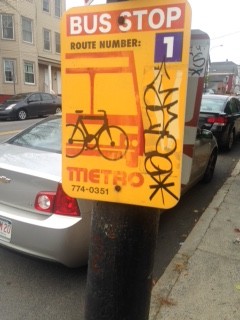
Additionally, a sign that contains the time in which the bus will come by is also necessary. This will aid in making the bus system seem much more reliable. The only shelter and bus schedule that Rachel, Karl and I found was on North Street in front of the East Community School.
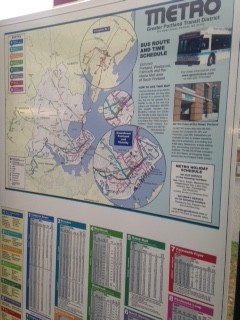

Further, a smart city suggestion for Portland public transportation is to create an app that contains stop information, maps and updates about the bus (such as whether or not the buses are running behind), similar to the NJ Transit Schedule or MTA map you can find in App form. This will be helpful as more and more people are relying on their smart devices to get them from location to the next.
On our walk around the East Promenade it was pretty residential and as we got closer and closer to the water, the view became more and more unreal. Creating a bike lane could help reduce car traffic and pollution. We did see one on Congress Street, however, it only went for a few blocks until we ran into St. Lawrence Street. City of Portland is very small and can be walked across in just few hours; the city should use this to their advantage and try to turn Portland in to a walking city. A reliable public transportation system is key, as are bike lanes.
After walking this path, I see why many people are frustrated with the public transportation system(or rather lack there of public transportation system). Along with the need for in public WiFi in cafés, free public WiFi in all public spaces would greatly help the bus system. Smart city recommendations along with more practical solutions would vastly improve the quality of life and economic sustainability.
Full Transect Walk:
206 Congress Street (43.663676, -70.250266)
Sheridan and Congress Street (43.664660, -70.249350)
Turned onto Atlantic : Next stop is at Atlantic and Monument Street (43.6653356,-70.2457624)Intersection of Atlantic and Wilson (43.6653512,-70.2453279)
27 Atlantic (43.664808, -70.244244)
Turned onto Eastern Promenade(43.664195, -70.243182): Next stop is at E. Promenade and Vesper (43.665382, -70.241702)
126 Wilson Street and E.Promenade (43.667571, -70.242227)
182 Congress Street and E.Promenade (43.668797, -70.244094)
Turner Street and E.Promenade (43.669604, -70.245639)
304 McAuthur Gardens and E.Promenade (43.670706, -70.249062)
Turned onto North Street: Next stop is at East End Community School on North Street (43.671226, -70.254072)
143 North Street(43.669674, -70.252495)
Intersection of Quebec Street and North Street (43.667417, -70.250051)
Intersection of Cumberland Street and North Street (43.666122, -70.248668)
Up Close and Personal View of Portland
Mental Maps and Café Ethnography Reflections
Gathering mental maps in Portland on a Sunday proved to be a very interesting (and often a bit tedious) time, given that fact that there were not many people out on the street, however, it was completed with success! All four people gave very different perceptions of the city and their data combined gives an insight into all different areas of Portland. In terms of their ideas about smart improvement to the city, all most everyone suggested a better green public transportation system, and interestingly one older man suggested that no changes be made to Portland. “Portland in my mind is one of the most progressive places in the United States and does not need any additions. Cities in the US need to catch up to us,” he said firmly.
As expected, no two maps were remotely the same. The maps ranged from looking into a particular neighborhood all the way to giving a over overview of the entire city…one person even added in Peaks Island, which is where they moved to over the summer. Participants that were older tended to provide less detail and decided to usually focus on landmarks that were around the neighborhood in which they lived and worked in. Younger participants included parks, shopping, and places that they enjoyed going out with friends.
For the café ethnography I went to Speckled Ax on Congress Street. Free public Wifi would be a great addition, due to the fact that almost 90% of the people in the café were always on a smart device and trying to use the internet. You have to ask the Barista for the password, which is okay, but free wifi would be so much more convenient. Interestingly, this café did not serve food… I cannot say I was pleased by the this but it created a very different atmosphere. Most people were doing work and drinking coffee–When people talked, they were either very quiet or did not talk at all.
After going to Portland to complete an ethnography and get four mental maps, I plan on focusing more the public transportation system. Every person I talked to expressed a concern and dislike over the current system that is in place. Tackling public transportation in Portland is going to be a very interesting task because of the city’s small size and current demographic. All of the people I interviewed said they only stayed in the area they lived in and did not stray far from there. In order to revamp the public transportation situation we are going to have to approach this task from a very creative angle. Solutions that work in a place such as New York City is not going to work in Portland.
Mental Maps
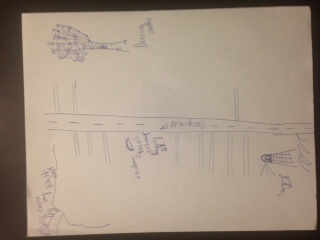
1. Female, 22 years old, Store Manager, moved to Portland 2 years ago
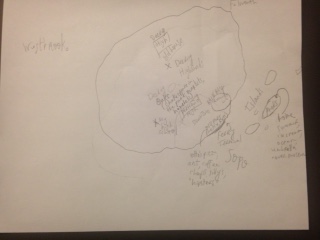
2. César, Kathleen, and Elena Britos, currently live on Peaks Island, but used to live in Portland and South Portland, have been in the area for 9 years.
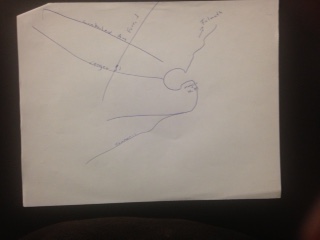
3. Male, 58 years old, Cashier at a convenient store, Playwright/Actor, lived in Portland for 21 years.
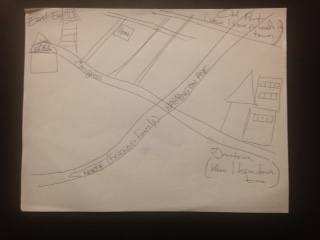
4. Female, 28 years old, Cook at a restaurant, likes to stay around the Eastern Promenade, lived in Portland for two years (was tired of “big” city life in Boston)
Complete Ethnography
1:00pm—arrived at speckled Ax with Rachel and Karl. For the most part everyone in the café is pretty young, and looks like they are students that go to maybe USM? 8 of the 12 people in the café are on laptops, 1 person on an ipad, 8 people are girls, 4 people are boys; there is a constant rate of people coming in an out.
1:17—same group of people…not much has changed. The scene is very “hipster”… Most people are still doing work or readings books. The café is a medium sized—has a warm feeling (chocolate colored walls) ambiance is very trendy.
1:27—the demographic is very white—I am the only black person in the café and there has not been a black visitor yet. A group of “trendy” boys just walked in that all kind of look like they walked out of portlandia. Not many couples—only two here right now. Most people seem to be of considerable wealth just from looking at the different brands and kinds of technology that people own. Very packed now. Not the kind of place where people just randomly sit at a table. The café has a small bar at the counter, 4 long tables on one side and 3 smaller round tables along —there is also a small seating area out front but today it kind of cold so no one is outside
1:37—most people are not talking they are either on their phone or doing work. Little spurts of noise come in and out. But for the most part it is a relatively quiet place. The staff that works here is pretty young, one boy and one girls—both are wearing black, are white…maybe they are college students?
1:47— across the street is not very busy—there is a vintage store that looks like it is not open. There aren’t many people on the street. Currently, I am drinking a café au laît but the smell of coffee beans in here is very strong. There are a lot of kinds of coffee that I haven’t heard of that they offer here—my knowledge of coffee is not as advanced
1:57—I am kind of hungry…. However, they do not offer here, just coffee. Not even like juice. Kind of a bummer. There is now an old man sitting next to me doing work. Currently hearing coffee brewing and beans roasting
2:07 –on the phone with my mom —not that many people came through the scene is pretty much the same scene.
2:17—I go to the bathroom and when I come back there seems to be a lot of people wanting to get coffee
2:27—There is a Hispanic woman crouched over her phone at the small table directly in front of me…not quite sure what she is doing because she has no wifi (she did not buy coffee). It’s kind of weird.
2:37—I am starving at this point. Contemplating going somewhere close to get food. Why do they not serve food? I see granola bars but I am allergic to most nuts and fruits and vegetables. Karl just asked the women in front to draw a map for him, smart idea. I am considering asking the man sitting in between Rachel and I to draw a map, but he seems a little busy (he is drawing a lot of measurements on quad paper)
2:47—kind of an older demographic but definitely the same kind people at the café. A lot of people wearing expensive outdoor gear, backpacks and flannels. Everyone is still pretty quiet and keeping to themselves (readings, laptop, work, on the phone). The music is alternative (eg. like the shins or )
2:57—there is no one on the street right now really. Someone walks by like every 3 mins. Not many people are stopping to look into store (it is kind of cold outside); just saw someone run by; this is the first time 2 men passed by who looked like they were more from a lower socio economic group. Mom just came is with her baby—there is like an equal distribution of men to women. The music is much more upbeat and loud than this morning.
3:07—Very chatty in here. Some one is on their phone, and both people on either side of me are talking. Someone is playing music on his or her phone. People are doing work, but it’s not as intense of a scene as earlier. Much more friendly environment I feel for people that are walking into the café or looking through the window. A lot of men are in here. Currently Rachel, me and another girl are the only women here. We are also clearly the youngest in here by maybe like 10/15 years.
3:17—Things on the street just got very busy. There is a large group of people standing in front of the store and looking in. Things have quieted down in the café. Just got an intense smell of coffee beans and the large group of people do not come in
3:27—not much has changed from the last 10 mins. The café is kind of empty right now and more people are beginning to leave. A lot more people at the bar
3:37—leaving. Feels much more like lively. More people are talking and the environment is more conducive for conversation. A lot of people are talking and it now smells like a mixture of cleaning products and coffee.
The Human Character of Infrastructure
Infrastructure constantly needs to be updated and kept up with the current standards of a city, however, more importantly a smart city needs to worry about the human character aspect of infrastructure. As Sorkin writes, “the human character of cities begins with face to face interaction”[1]. In other words, different types of human interactions shape the personality and style of a city. Additionally, through coming face to face with so many people, a city is creating a sense of social responsibility and an environment for its inhabitants to live in.
Open source technology aids in the idea of creating a social infrastructure and making it much more accessible, friendly, and representative, due its readily availability to the general public. The public receives real time and up to date services that any one can obtain or edit, thus aiding in human interacting, which is also displayed in the Jiménez reading [2]. An added plus is way in which the city will be represented, due to the fact that a little bit of everyone that contributed will be a part of the outcome, and not just the input or vision of a minority of people.
Similarly to Sorkin and Jiménez, Simone expresses the same ideals of infrastructure by taking a closer look into the structure of Johannesburg. He shows us that people can also serve as infrastructure. When infrastructure in not in place, people make do with their surroundings [3]. With this comes a strong sense of community, and ownership of a city. Simone shows us that it is important to not put too much stress on infrastructure because then cities will become too constricted. This is very important because a strong quality that a smart city needs to maintain is innovation and creativity.
For Portland, Jiménez’s idea of the “right to infrastructure” goes well with the idea of the common good [2]. Every inhabitant of the city has the basic right to claim ownership . The infrastructure should be set up in a way that it gives everyone the opportunity to freely shape his or her life around it. I think that Portland would greatly benefit from open-source data or crowd-sourcing. It allows for open communication and huge amounts of innovation. Crowd-sourcing could go towards some form of more efficient and sustainable public transportation system.
Works cited
[1] Michael Sorkin, “Traffic in Democracy,” in The People and Space Reader, ed. Jen Jack Gieseking, et al (New York: Routledge), 2014, 411-415.
[2] Alberto Cosin Jiménez, “The Right to Infrastructure: a Prototype for Open Source Urbanism,” Environment and Planning D: Society and Space 32 (2): 342-62, 2014.
[3] Abdul Maliq Simone, “People as Infrastructure: Intersecting Fragments in Johannesburg,” in People and Space Reader, ed. Jen Jack Gieseking, et al (New York: Routledge), 2014 (2004), 241-246.
Effcient and Affordiable Housing
Smart technology for houses needs to be something that people of all economic levels can afford to put into their home, however, currently these goods are considered “luxury”[1]. Smart technology may raise our efficiency rate, but the burden of the cost to take of the system in the home is much higher than without smart technology. Therefore, smart technology is currently not accessible for the majority of the population. In order to change this pattern, we often have to look into our behaviors of the past. Through techniques such as redlining, we have been able to see how difficult it would be to implement the same standard smart technology because of the wide range of socioeconomic status in different neighborhoods. Currently, possessing a smart device, or having a “smart” home signals to people a certain level of wealth or level of “success”, however, in a smart city every person needs to be able to live up to that standard.
The income gap in cities is very large and continues to expand as gentrification occurs. People that once inhabited certain neighborhoods can no longer afford to liver there because of the cost of living becoming too much. Smith argues, that with cities people become “urban pioneers” [2]. Essentially, the Frontier of the city is class conquest, which occurs when people go into areas of lower socioeconomic status and rebuild them to make them “better”. Scholars Uffer and Fields demonstrate to us that this problem is not just an issue that is affecting the US, but rather a worldwide problem. Property ownership is cities vary, between people renting, leasing to total ownership. However, due to such diversity in ownership, it is hard to keep individuals accountable for making sure their housing is in good condition [3]. In other words, the lack of communication between residents and tenants leads to housing statuses falling apart, which then continues to spiral out until something such as gentrification occurs. We need to create a smart housing option in which everyone can afford to live in and one in which everyone can be held accountable.
In Portland, the smart housing option should not just worry about costs, but also needs to be completed in a “smart way”. Along those lines, in order to create more open and equal housing, borders between neighborhoods and different socioeconomic classes need to broken down as well. So first, housing should be affordable for everyone. Secondly, another option that could be implemented in Portland is to set up a form of system of systems, as Uffer and Fields explain in their article [4]. However the system in place in Portland should use a means of communication that is accessible and readily available for everyone. Installing this sort of communication throughout the city would bring instant access to real time data, and to events (good or bad) when they occur, thus allowing everyone in the city to be on the same page.
Works cited
[1]Crowley, David N., Edward Curry, and John G. Breslin. “Leveraging Social Media and IoT to Bootstrap Smart Environments.” In Big Data and Internet of Things: A Roadmap for Smart Environments. Switzerland: Spring International Publishing, 2014. 379-399.
[2]Smith, Neil. “Class Struggle on Avenue B: The Lower East Side as Wild Wild West.” In The People, Place, and Space Reader, edited by Jen Jack Gieseking, et al, New York: Routledge, 2014. 314-319.
[3]Fields, Desiree, and Sabina Uffer. “The financialisation of rental housing: A comparative analysis of New York City and Berlin.” Urban Studies July (2014): 1-17. usj.sagepub.com (accessed October 3, 2014).
[4] Fields, Desiree, and Sabina Uffer. “The financialisation of rental housing: A comparative analysis of New York City and Berlin
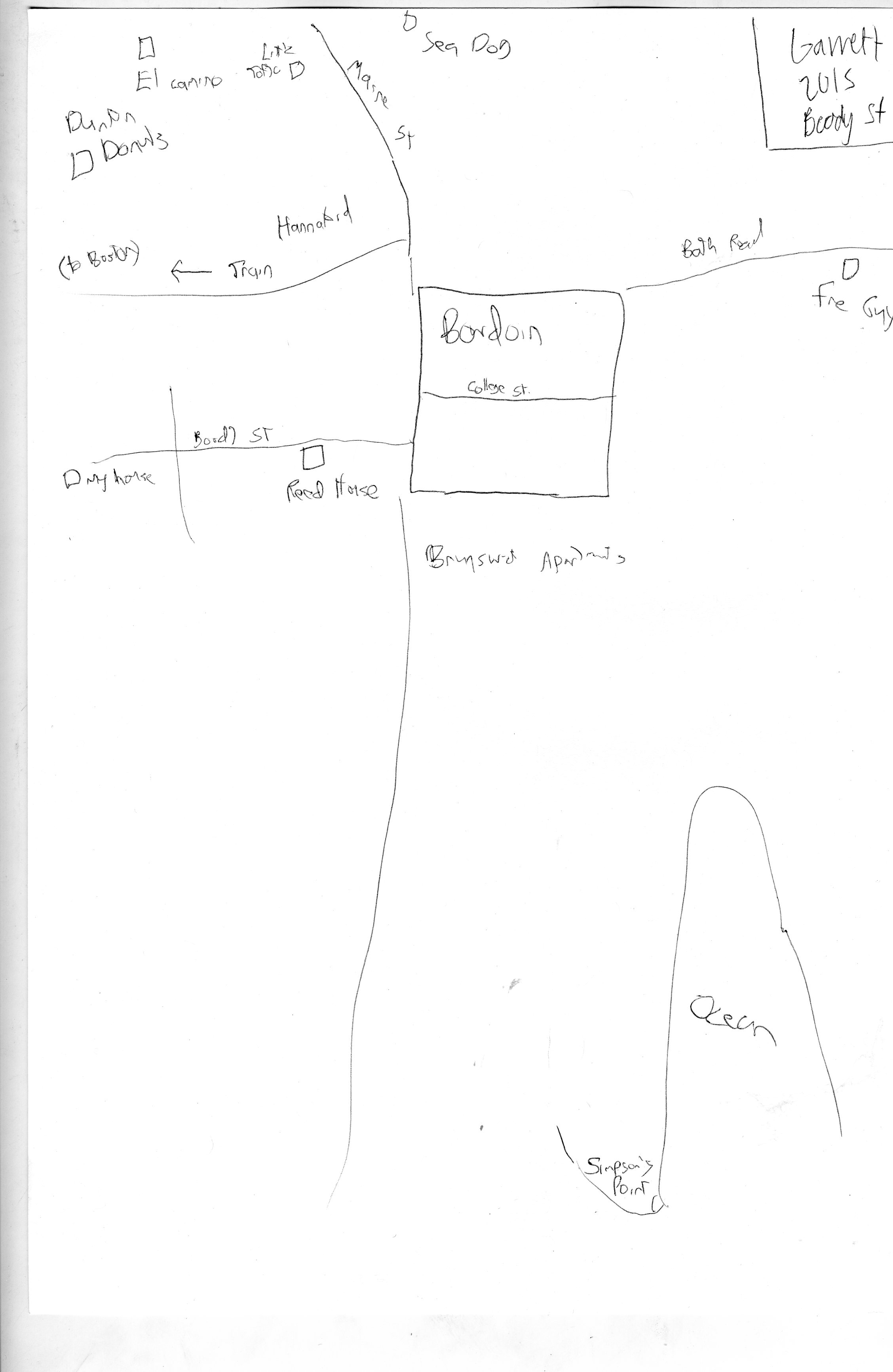
Brunswick Mental Map: Garrett Casey ’15
Mix of the Old and New in Public Spaces
Creating a public space in a smart city that appeases everyone is going to be hard, but is possible. However first and foremost, the most important thing is safety. No matter what gender, race or social class a person identifies with they need to feel okay in that space. They need to not worry about experiencing the fear of being attacked or tormented by a stranger. (1) “A new defensiveness has arisen since the September 11 terrorist attack,” writes Low. In other words, since the terrorist attack on 9/11 our society has been hypersensitive to whom we surround ourselves with. This in itself is troublesome because when is enough protection enough? Is the militarization of our public space good? Men and women in uniform are stationed throughout public spaces, such as Penn Station and Grand Central Station, just in case something arises. This has become the new normal. Commuters and residents of New York City do not live in fear of the men and women in suits, rather, they have grown accustomed to seeing them and do not think twice about them being there. Is it okay that the majority of people have now accepted the subtle and not so subtle cues of the government as a part of everyday life? Are smart cities just going to move these armed forces behind a computer or camera?
For a public space to be completely “open” to the public, everyone needs to feel at ease and not just the majority. The idea of a public space in a smart city in itself seems to contradict what society deems to be “smart”. Public spaces are caught at the intersection of old vs. new. Words such as sustainable, efficient, and control are associated with the future of smart cities. However, the connotation behind each word is very traditional. For this reason, it is even more crucial to build a successful public space that encompasses both traditional and nontraditional attributes. A public space in a smart city should display the effortless mold of the old and new, which leads to a space serving the common good. [2] As Don Mitchell writes, “The right to the city implies the right to the uses of city spaces, the right to inhabit,” thus, making it everyone’s basic right to be able to enjoy the space.
Portland often reminds me of Hoboken, NJ. Hoboken, which is often overlooked due to its proximity to New York City, has many great cool and exciting things going on. It is comparable in size to Portland, but Hoboken has done wonders to its waterfront. Along the waterfront there is a series of paths, which leads to parks and piers that overlook the Hudson and New York City. Additionally, New York City has also done similar things with its waterfront along the Hudson. Public spaces, such as paths around the waterfront that lead into other areas of social interaction, like a small park or an observatory, create a very fluid and open environment that people can come in and out of as the please. Finally, While creating a space like this Portland needs to take into consideration the five freedoms, which are: access, action, claim, change, and ownership. Moving forward as spaces produced, no matter how advanced or “smart” they become, they will not be totally public without these five basic freedoms in place.
Works cited
[1] Setha M. Low . 2002. “Spaces of Reflection, Recovery, and Resistance: Reimagining the Postindustrial Plaza.” In After the World Trade Center: Rethinking New York City, edited by Michael Sorkin and Sharon Zukin, 164. New York: Routledge,163.
[2] Don Mitchell . 2014 [2003]. “To Go Again to Hyde Park: Public Space, Rights, and Social Justice.” In The People, Place and Space Reader, edited by Jen Jack Gieseking, et al, 195. New York: Routledge, 2014, 193.
Smart Solutions for Infrastructure in Portland
Smart City Innovations (In regards to Infrastructure)
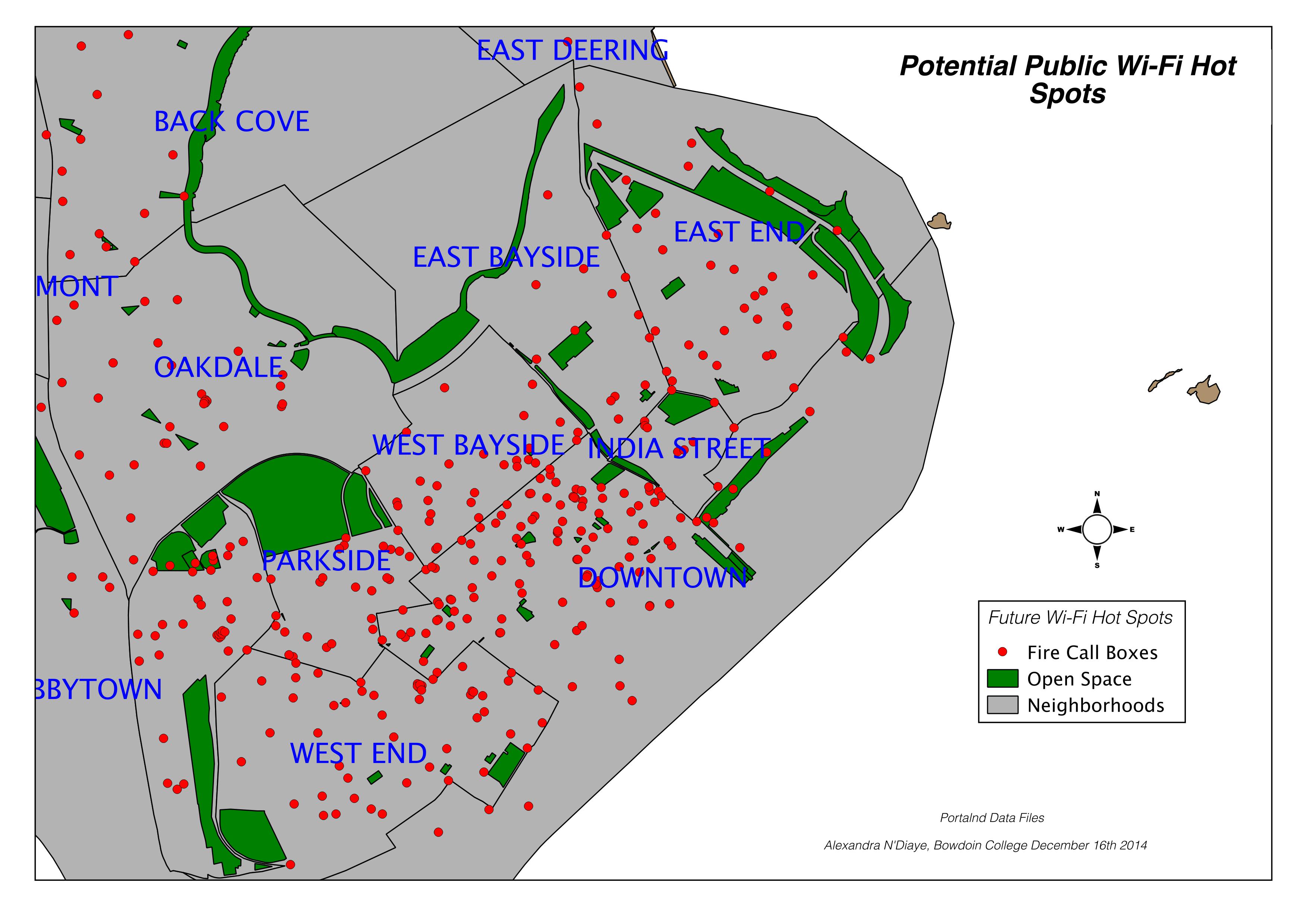
- Free Wifi Hot spots
- Smart devices/sensors spread throughout the city that acquire real time data, alerts and information processing
- App and online applications that tracking information such as: energy, parking meters, amount of parking spaces available
- Within 2 miles of a home there should be access to public transportation
- Public maps that are accessible online and in print
After reading portions from Adam Greenfield’s book and our field trip to Portland, I feel as if I learned a great deal about the city that I did not know before. Portland has so much potential and I agree with Greenfield on many aspects of the evolution into smart cities. Firstly, as a society we need to think beyond the norm. If we continue to structure a smart city with the current definition of what “smart” means, Portland will not become “smart”. We need to be looking to the future and try to be one step ahead of the evolution of technology. Looking at a smart city in a standardized way also helps to promote the connotation of the city, in the case Portland, becoming stagnated, and unoriginal and lacking character. However, in building a smart city creativity and digital intelligence advancement go hand in hand.
As someone who has not been to many places in Portland (excluding a select few restaurants), it was awesome to learn so much about Portland’s history and how the city became what it is today. Being that it is only about 3 miles long, I felt like I quickly gained a sense of the vibe of Portland. As the city continues to improve, it still manages to keep a very laid back, small New England feel, which I think is very important. The infrastructure I am proposing to add to the city of Portland should not disrupt its current happenings. Rather, it should exist in a way that it begins to become a major presence but in an intrusive way.
Smart devices, which would be placed throughout the city of Portland, would be a “smart” investment. This system would be made up of sensors that send back real time results of data, alerts, and information that city workers could instantly receive. Additionally, the presence of these devices would greatly improve efficiency and help intelligently run the community. Participants that are involved in bettering the city would now have the opportunity to minimize or maximize certain factors in that city that used to not be in their control. This form of Information Technology, would be become the foundation for the running of society.
Greenfield, Adam. 2013. Selections from Against the Smart City. 1.3 edition. Do projects.
Rapid Evolution of Information Technology and Infrastructure
This semester I am interested in focusing my research on infrastructure. More specifically in regards to infrastructure, information and the control of technology for the public are fascinating to me. As a society, we are constantly changing our behavior based off the exponential growth of technology. The evolution of smart cities is a prime example of how information and the control of technology for the public are beginning to dictate choices that are made in our lives. Infrastructure is the foundation and basic physical core, and organization of structures we need for our society to operate and develop.
While the Dolores Hayden reading did not affect my choice in choosing to want to look further into infrastructure, the scholarly work did challenge the way that I see and talk about cities. One of the biggest I took away was the idea of space. As space is produced, it is constantly changing. But with this change we get place. With place comes the association the personality, and social history of a given place. Hayden writes: “social relations are intertwined with spatial perception”(16). Thus, the power and reality of place is that is forms our view of the world around us. Memories come together in complex ways, and how people see the world politically, socially and economically begin to become intertwined. All of these ideas enhance our imagination and allow us to constantly improve our dream about what cities should look like and represent.
Throughout my life I have been fortunate to travel to many cities around the world. It has been exciting to explore very “developed” cities like Hong Kong, Berlin, and Budapest to more “up and coming cities” such as: Addis Ababa and Libreville. During my last visit in Addis Ababa in 2012, something that I found to be interesting was the influx of Asian businessmen. Specifically they were coming from China and Singapore. In China and to many countries around the world, Addis Ababa is the next Paris or London. Investors are buying land up at an insane rate. At first, I did not really see what many people saw in the city. It’s lack of any remote form of infrastructure, especially its IT platform, in this day and age is astonishing. However after spending a month there and then returning that following summer, I now get it. Around 80% of the population lives in or very close to the city, while the remaining 20% are either members of nomadic tribes or live in rural areas. Slowly but exponentially, the city is growing in scale and with advancement in functions. Their system, which is primarily government owned and run, is moving towards becoming more optimized and efficient. Investors are coming in and looking to lay down a solid foundation. The space is ready to be occupied and ready to not just be land, but a place. After coming back from visiting Addis Ababa or when I am off of Skype with my parents, I am consistently amazed to see and hear about so much progress in infrastructure in such little time.