Category Archives: Post #6: Individual Analysis of Ethnography & Mental Maps

CAFE ETHNOGRAPHY

Local Sprouts Cooperative

After doing some field work through Cafe Ethnography and collecting some mental maps, I have reaffirmed my original ideas about improving infrastructure in Portland, Maine (more development projects to attract investment and population, such as building a casino). I have reached this conclusion from the following insights drawn from my ethnography and mental maps, below.

1) Lack of population. There does not seem to be enough people to sustain Portland’s service industry. This would also explain the empty prime location retail spaces still looking for tenants. It is not that businesses are not attracting people, but the fact that even a major thruway looks relatively empty. This would also explain higher prices in the cafe to help compensate for high fixed operational costs.

2) Lack of businesses. More business mean more tax income, which could go to aiding the Preble St people, along with funding many other public space projects that would make everybody’s lives better. It would also mean more job opportunities.


3:00 pm – The cafe is mostly empty, with only 10 patrons including myself. The cafe seems to offer a lot of options in addition to coffee and tea, including beer and drink specials. The prices tend toward the higher end of the cafes I have been to in Maine.

3:10 pm – The place does not look like it is well attended to. There seems to be only 2 staff working. I spot patrons waiting at counter for somebody to help them.

3:25 pm – I spot a couple dating, a female student texting, another female student with headphones on doing work, a mid-aged woman doing work on her laptop (all electronics have an Apple logo on them).

3:30 pm – Talked to 2 people who identified as queers: they loved the character of Portland and the sense of community, stating that it is not overwhelming.

3:50 pm – Decorations and vibe in general feels very “Maine.”

4:03 pm – Music : Something in the way he moves – Bobbie Gentry.

Lighting and mood feels organic in a sense. I also spot artwork of plants and animals. There is even a food map of Maine, something which I feel is quite relevant to our class. I should have taken a picture of it. I guess the cafe is really capitalizing on Maine’s distinct personality and why people chose to come here. Most furniture are made of wood, and even the floor is wooden.

4:05 pm – Just noticed there’s free WiFi— not really obvious.

4:07 pm – Music: Fancy – Bobbie Gentry.

4:10pm – Looking out, I observe little car traffic on Congress St, which is quite shocking considering all mental maps contained the road in a central artery position. The couple dating just got served food and are now eating.

4:15 pm – There is nobody in the children area.

4:25 pm – Pretty much the same crowd at the cafe. A guy came in by himself, and is eating a meal. The woman who was working on her laptop is now cleaning up and getting ready to leave. And then I just noticed that even without much staff attention, the place still looks pretty neat and clean. This might be suggestive of Portland residents being really considerate of others.

4:30 pm – I see a guy standing along in a corner reading a book? Questionable what he is doing.

4:40 pm – I feel the lighting and vibe makes me become negligent of time, though I am not sure if time feels faster or slower. Or maybe it has something to do with the music — Amy Winehouse is playing at the moment.

4:50 pm – There is seemingly more traffic outside, though I see way more pedestrians.

4:55 pm – There is a giant “For Lease” sign outside at 648 Congress St. Its neighbor, 652, looks empty too. The retail situation on Congress St doesn’t seem so great.

5:00 pm – Traffic outside have started to die down.

5:10 pm – A couple of people are walking around while talking on their phones, though not disturbingly.

5:15 pm – I just noticed there are a lot of christmas lighting, a Social Justice board, and a giant wall outside of bathroom dedicated to ad and event posts. The information seem to be very diversified— I see events and opportunities catered to a variety of different interests.

5:20 pm – Most of the people in the cafe when I entered have already left, except for the female student working, and the couple on the date still dining.

5:24 pm – I observe many single males come in ordering meals at this point.

5:26 pm – I also just remembered that almost everybody I talked to in the cafe mentioned Preble St. as being the sketchy area that people have to detour around to get from Old Port to Whole Foods and other business on Marginal Way.

5:28 pm – I have seen a bus pass through Congress St. roughly every 10 min. All the buses look pretty empty. Directly across the street at 650 Congress, is a “she-bear” gallery?

5:30 pm – People outside don’t seem to be walking fast at all. Everybody looks like they are just casually taking a walk. Most passer-bys look young and hippy, or older and badly groomed.

5:32 pm – As I am leaving, I notice a piano that’s not being utilized (don’t know if you are allowed to). By the way, how does a cafe become emptier at 5:30 pm than at 3 pm??!!

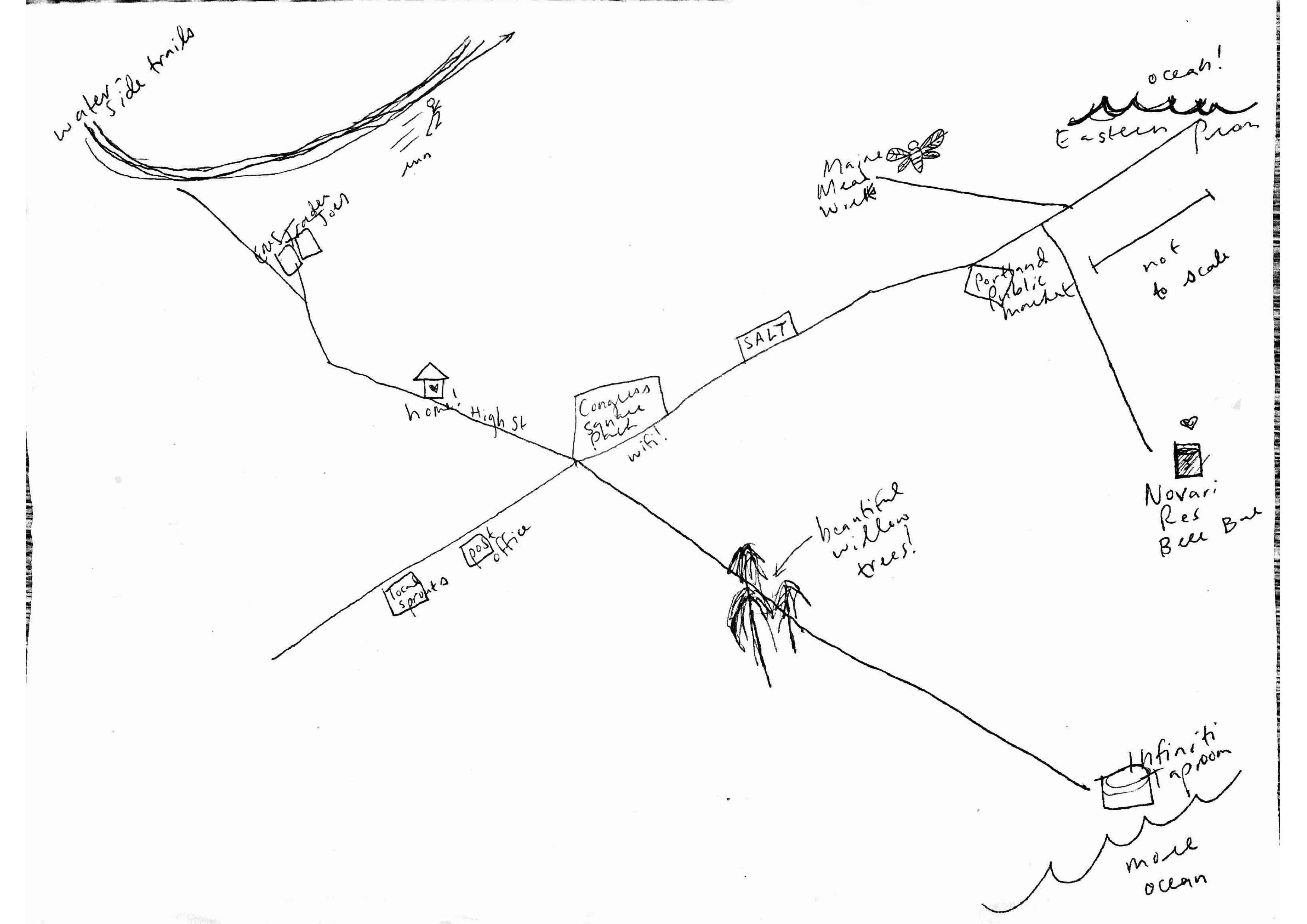
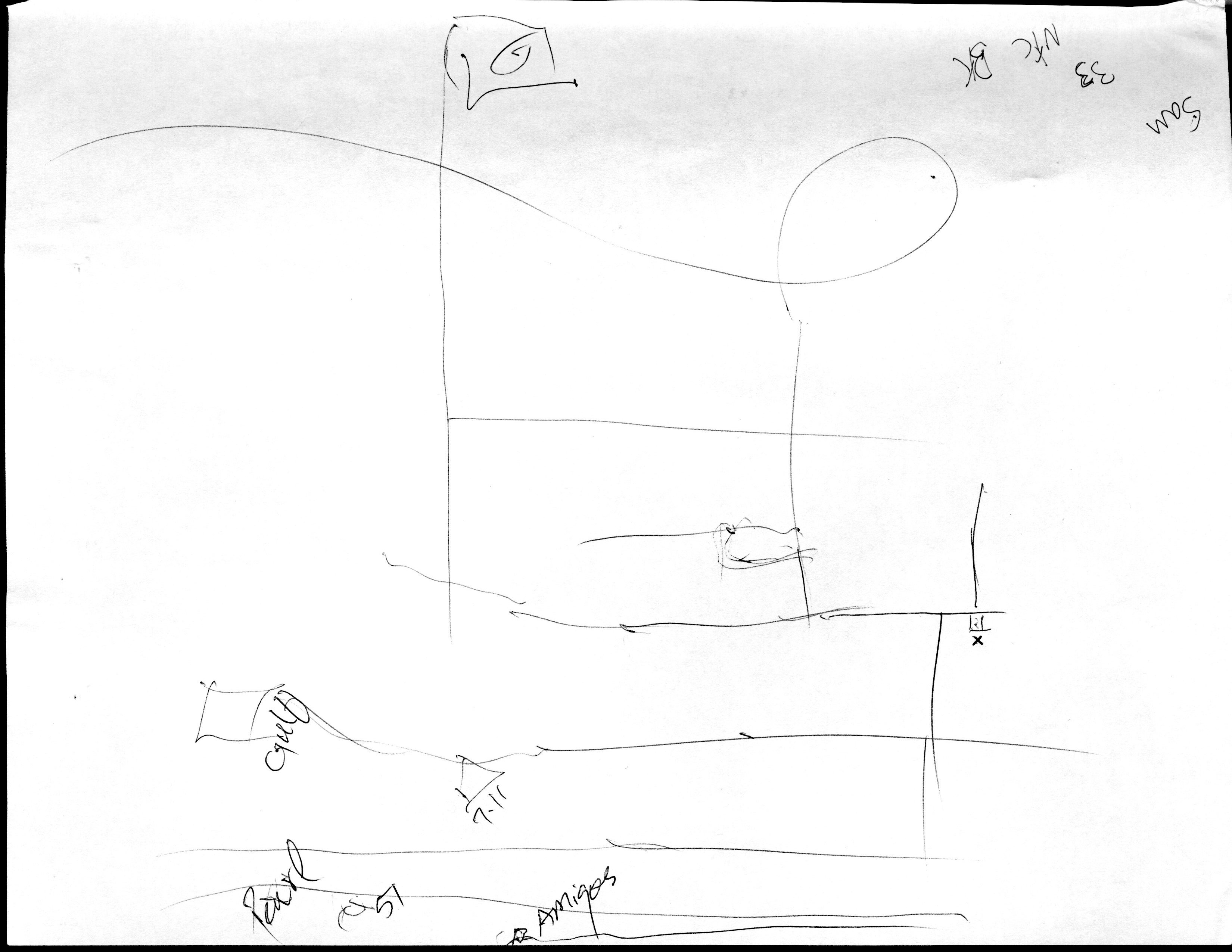
Map 1: Parker, 26, in Portland for 3 years, identifies as male, lives in South Portland, works in retail at the Maine Mall. [email protected]


Mental Map 1


Map 2: Lahana Palehcia, 19, Female, Housekeeper, in Portland for 1.5 years, lives on Congress St, [email protected]. Uses the Portland Bus System extensively.


Mental Map 4


Map 3: 24, female, student, in Portland for 3 months, lives on High Street, wishes there were more public shuttles to get to wilderness areas.

Mental Map 3

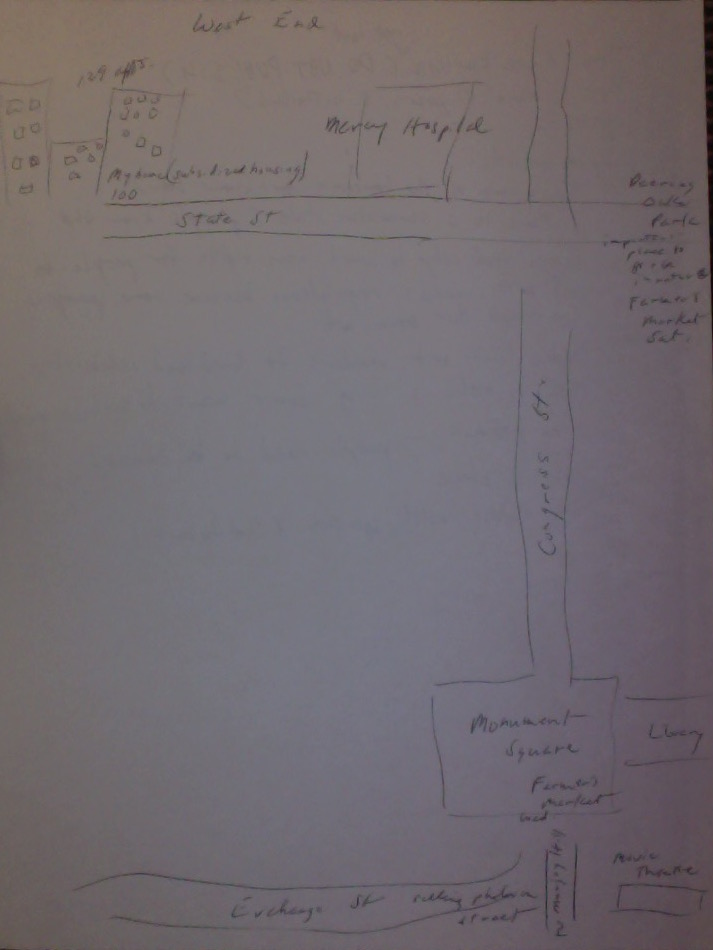
Map 4: Erneok Moreno, 32, male, in Portland for 2 months, lives in West End, [email protected].


Mental Map 2

Cafe Ethnography

Cafe Ethnography

Location: Crema Coffee

Time: 2:30pm to 5:00pm

Date: Tuesday, October 21, 2014

—————————————-

2:30

First Post. Initial reactions to location: large, can seat up to fifty people (more space than a typical cafe), and mostly filled.  Age groups represented are quite broad, with a large number of 18 to 25 year olds (20+ members) mixed with a large number of 50 to 65 year olds (also 20+ members). Must take into account that it is a Tuesday during a work week, as well as during the work day, so demographics may change over time.

2:40

The space is quite loud. This may be a result of the high ceilings, but people are not discouraged from talking to each other in this space. Cafes tend to have a library feel to them, as if conversations are expected to take place in a subdued voice out of respect for the people sitting alone. There are definitely people sitting alone in this space. There is a bar specifically dedicated to people who want to sit by themselves. However, many people are sitting in groups and are happy to talk in a normal tone. One might think that it would give the space a high school cafeteria feeling, but the essence of the cafe is not diminished by the lack of indie music playing in the background.

2:50

There’s a guy sitting next to me at the same table. He’s been sitting here for a while, not saying anything, looking out the window at the cruise ship in the harbor. In front of him sit a coffee and an iPhone—the typical mask of today’s city-goer.  That’s not what interests me, though. Its the fact that he sat at the same table as me—without needing to ask—and it was okay for both of us. It makes me question just how many people, that I would assume are in groups, are sitting independently of each other. There is minimal sense of ownership of individual spaces by their users. Why? There may be several reasons. I think its because there are so few spaces to sit inside, and there are SO MANY people here in terms of a typical cafe. Odds are, I will not speak to this guy (he doesn’t look like he wants to be disturbed—everyone has those days, I can empathize). However, there is no awkward tension between us, despite our shared space, our proximity, and our mutual identities as complete strangers. I’m a fan of that. More spaces should be this welcoming.

3:00

I am seeing a lot of runners go past the window. Its lightly misting outside, but that doesn’t seem to be deterring anyone. The runners are all in their 20s or 30s. This tells me a lot about the location of the cafe within the city fabric. Granted, Portland is not large, which mean a 3-mile run could most definitely include Exchange Street as a part of a runner’s route from anyone living on the peninsula. However, their age corresponds directly with the age of the people sitting in the cafe. What this tells me is that Crema Coffee is also within walking distance for many of these individuals, which means that Exchange Street on the north side of Franklin Street sits in a neighborhood that has a large young-person population. The success of this establishment is proof of that as well.

3:10

I spent $4.39 on a small maple latte. ALL THREE of those words, associated with the price, are evidence of (dare I say) gentrification.  As much as I hate the negative connotation associated with that word, I can’t deny its existence. I purchased twice the amount of liquid at Tim Horton’s in Topsham earlier, and it cost half as much. So why, oh WHY, was I willing to pay four times as much per unit of liquid for this beverage?? Well firstly, it was made with real maple sugar. That’s an added cost that is directly absorbed by the customer’s wallet. Secondly, the beverage, made with the same type of bean as my Tim Horton’s coffee, was called a latte. Marginally stronger, I’ll grant you, but no less similar. The name latte allows them to charge more because it is a specialty beverage. It is not the norm. Lastly, it was served to me with a fancy heart drawn in the steamed milk in the top. That’s the clincher. The effort to create that heart, however minimal, and the idea to add the superficial decoration (that adds nothing to the actual quality or flavor of the beverage) is reason enough to charge more than a standard coffee.

3:20

I just had a wonderful conversation with the elderly lady sitting adjacent to me at my table. This is another example of mutually shared space, but also a great example non-existent stranger anxiety within this space. We have never met, but we were more than willing to have a meaningful conversation following the simple question of connecting to the local WiFi. This probably would not have happened on the street, and it would definitely not have happened in a fancy restaurant. The cafe creates a sense of community. We are here for various reasons, but we are connected within the space by the welcoming aura .

3:30

I’ve seen many people walk in here, look around briefly, and then approach an individual who had been apparently waiting for them inside and proceed to sit down with them. This is important for the identity of the space. It has been recognized as a space of welcomed congregation. In doing so, it is creating repeat customers, who will frequent the space, spend their money here, and contribute to the success of the space. It also creates a node of the space within the fabric of the city.

3:40

The age group of the cafe has begun to shift. The younger people who were here in large numbers earlier have mostly departed. They’ve been replaced largely by members of the 50-65 year old age group—they represent about 75% of the people here right now. I’m sure this has to do with the cruise ship docked right across the street, but the number of flannel shirts I’m seeing suggests there are a good number of local users in here too.

3:50

The rain has been a big factor in the number of people here, I’m sure. However, I’m curious to see how the business is affected by nice weather. Obviously, people are staying inside because the rain keeps them off the streets. That would suggest there are people here that wouldn’t be here if there was nice weather. However, I would also speculate that the space benefits from nice weather too, because there are more people on the streets. Tourists definitely contribute to the business here, and they are probably deterred from venturing this far off the beaten path of the Old Port. I would venture to say there would be fewer locals in here if there were nicer weather, and MANY more tourists.

4:00

There are paintings periodically placed on the walls. They function as great decoration, off-setting the rustic brick of the walls and making the space feel a little more welcome. Each one also has a small, white square at its bottom-right. All of these paintings are for sale! This space isn’t just a cafe—its a functional gallery too. This cafe is the quintessential mixed-use space: it has so many varying functions that add to its usefulness, and also makes it a more attractive space. It is going to attract a wider variety of users, it will attract MORE users, and it will likely be more successful than a space that only offers coffee, only offers a place to sit, or only offers paintings for sale. All it needs is a performance stage in the corner…

4:10

The work day is nearing the end of completion, so new groups of people are beginning to pop up in the cafe. One of them is the casual business type. Pointed leather shoes, sports coats, and designer jeans are clear indications of someone with an “important job” and a very, very “disposable income.”  They come in, buy their grande mocha-choca decaf latte double-shot with pumpkin spice, and leave. Probably off to an “important business meeting.” This is countered by the other group: the college student, specifically the artsy type. This group has an affinity for facial piercings, loose black beanies, fantastic hair, and outfits purchased at Goodwill for under $10. These students probably don’t have disposable incomes, but are also staying in the space much longer. They know the people who work here, and while they can’t necessarily buy the most expensive item on the menu every time they visit, they are definitely far more of a staple to the environment. They are contributing to the success of the business by their mere presence.

4:20

There is a completely different group of people in the space now than was here when I first arrived. Even the barista positions have changed hands. There are fewer people here than there were earlier, but the space feels just as active. There may be fewer contributing members, but the people here are far more often in groups than they were before. There are fewer individual users in the space, who were more likely to be silent and less likely to interact with the people around him. The people now, however, are gathered in mutual groups. These people are not silent, and are contributing to the white noise of the space even more than they were before. A line has formed at the counter now, though. I have a feeling that the space will start to feel spatially full once again, as well as resonantly active.

4:30

For the first time since I arrived at the cafe, the couch in front of the bay window at the front of the space is open. It has been occupied by a group for the entirety of my time here. I’m going to keep an eye on this: I want to know just how valuable this space is to the users of the cafe, and I’ll judge that by how quickly the space is filled up. INSERT: It took 90 seconds. And that’s being generous; it probably took less time than that. I’m astounded. My guess was three times longer than the actual time it took. That makes it three times more valuable than I first considered it (in terms of usefulness and desirability, as the space really isn’t “worth” anything to use). Imagine if we charged the use of space in a cafe by how much people want to use it, like we do parking lots or apartments? That would be the definition of degenerative gentrification, if you ask me.

4:40

As I reach the tail-end of my observations, I continue to see the same patterns occurring as I did earlier: people coming in and meeting people who have been here already for some time; a majority of young people balanced by an equal majority of middle-age people; business types who enter and leave, and artsy people who come in and stay in. Something I haven’t before that I’ve begun to see: people are moving seats. If they were sitting towards the back of the cafe, they are moving positions toward the front of the store. If they are sitting at dining tables on wooden chairs, they are moving towards the plush lounge chairs and coffee tables. As vacancies in more valuable spaces are opening up, people are taking advantage of them to once again create a natural scarcity in valuable spaces. It seems to be the natural tendency to migrate towards the more valuable spaces in the cafe; such spaces will not simply be left open if the opportunity to “conquer” them arises. Human nature, at a microscopic level.

4:50

The space has quieted down in the past hour. I can hear the background music for the first time since I arrived—its indie music, just as I expected. The space has gained more of the typical cafe aura, but it has not lost its identity as a place of congregation. Demographics remain the same, even if the total numbers have gone down.

5:00

The cafe is going to close in an hour. As a result, the staff is beginning its pre-closing routine: emptying garbage cans, washing empty tables, cleaning dishes and equipment, etc. More people are leaving than are arriving, as would be expected. The weather hasn’t really changed during the entirety of my stay, so its safe to say that my observations can be used as a summary for the majority of rainy days in this establishment. Given its location, though, I would wager that this place could function as a very successful bar on the weekends. It has the space and the atmosphere that would welcome many of the same people, just at a different time. A suggestion I could bring up to the proprietors of this business at a later date, perhaps…

Hilltop Cafe’s Ethnography and Mental Mapping

Cafe Ethnography 

The setting is very mellow. The music is mostly indie melodies, but at the same time soothing sounds. The dim lighting and the hardwood creates a mood for peace and relaxation. The red walls and chairs creates a fiery atmosphere where it is meant to have an absence of mind.

.hilltop-coffee-by-bryan-bruchman

The numerous plants and flowers are very welcoming to the customers. The windows cover the whole front wall next to the entrance. There is beautiful light entering the “glass wall” created by the large windows in the front. The seating is arranged for larger groups, but can easily be manipulated for the purpose of a single person. Obviously the location/shop smells like coffee, but it also smells like a good fragrance, more likely coming from the numerous flowers and plants. Overall the sense of Hilltop Coffee Shop is amazing and comforting. I am excited and glad to spend the next 2.5 hours here.

People come in to look for jobs. The person is in college and loves the atmosphere of the place. He is available for some late shifts, but the coffee shop seems to have a full staff.

A couple sits next to each other to read their respective books while drinking their coffee.

Customers walk in and buy their regular items for the day and quickly leave.

Women came in with sporting clothes, probably went on a run, bought an iced drink and left.

The cashier seems to know some customers as “regulars.”

A customer compliments the nice flowers by the register.

People usually walk in two’s or alone outside chatting about their day and goofing off. The three men crew, whom I am referring to as goofing off, is laughing a lot, looks like they are having a good day.

Sounds like mild traffic, some beeping of larger vehicles and normal car sounds.

Kids are coming from a sport practice, looks like soccer due to their long socks.

An older couple walked by holding each other (pretty adorable).

Some people came in to buy tea or coffee and sat down while checking their smartphones.

A young woman sat around waiting for another man (waited for a period of 7 minutes and seemed frustrated)

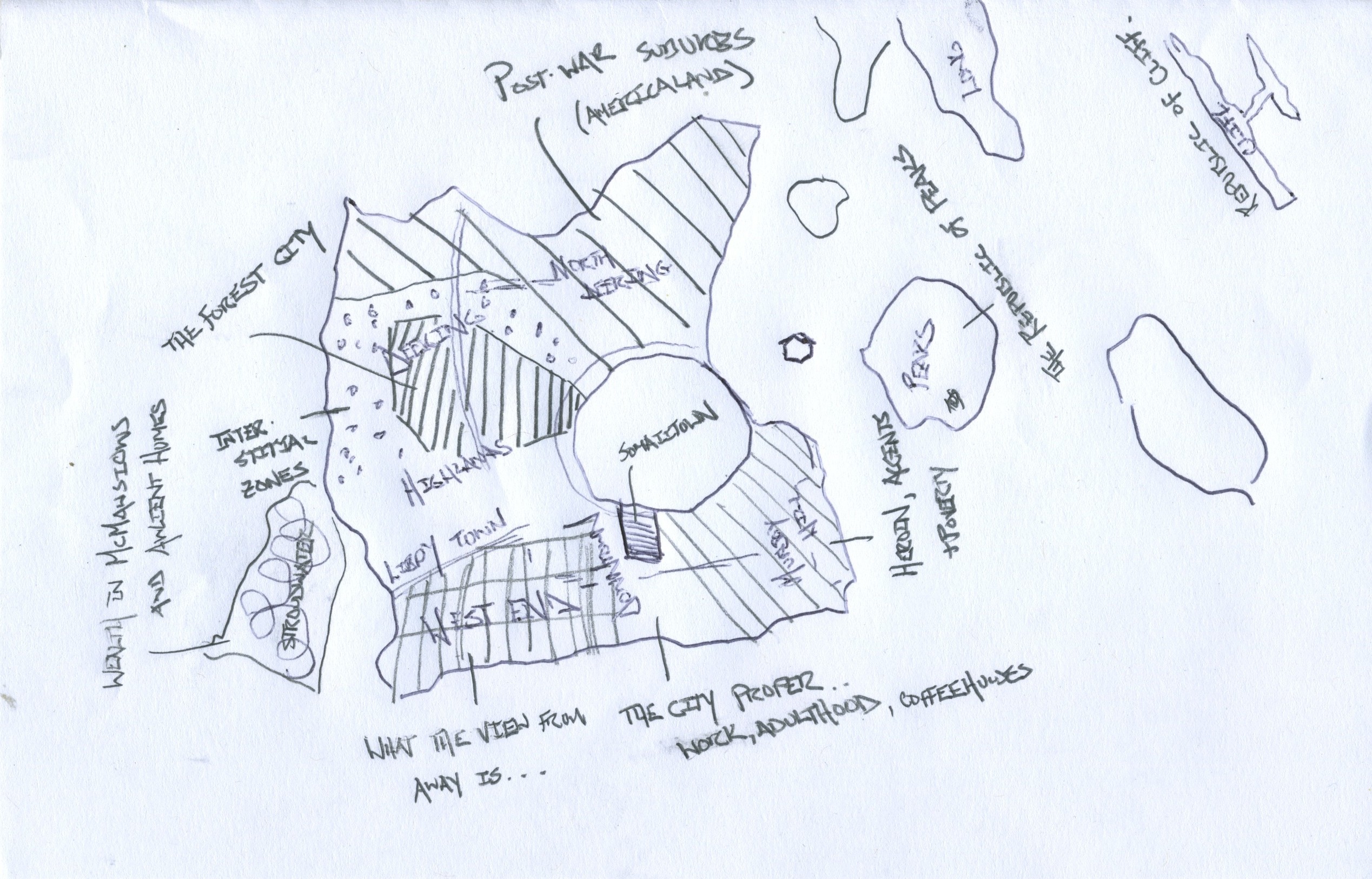
Met Professor O’Brien from the math department and got him to draw a mental map for me. Only thing he is not a resident, but he grew up in Portland, so I thought it would be interesting if he drew a mental map of Portland when he was growing up in the East Side. O'Brien's Mental Map(Extra Credit, am I right?)

I have seen many individuals, usually by themselves, walking and smoking a cigarette.

Younger folks with ear buds passed by listening to music.

Bicyclists pass by on the street, but sometimes went on the sidewalk.

Road worker came in and talked to the person attending the register and seem to know each other. I guess he came in earlier and had his coffee, and now he is just checking in and chatting.

Another male individual walked by while smoking, except he was using an E-Cig.

e-cigarette

Lastly, the shop was closing up, but lady at the front was very nice and generous and gave us the bagels and cookies that were going to be thrown out as well a free refill of coffee. What a lovely spot it has been; I am glad to have chosen the Hilltop Coffee Shop. The atmosphere is great to study or do work in, and the people running the shop are extremely nice.

Mental Maps

Scan


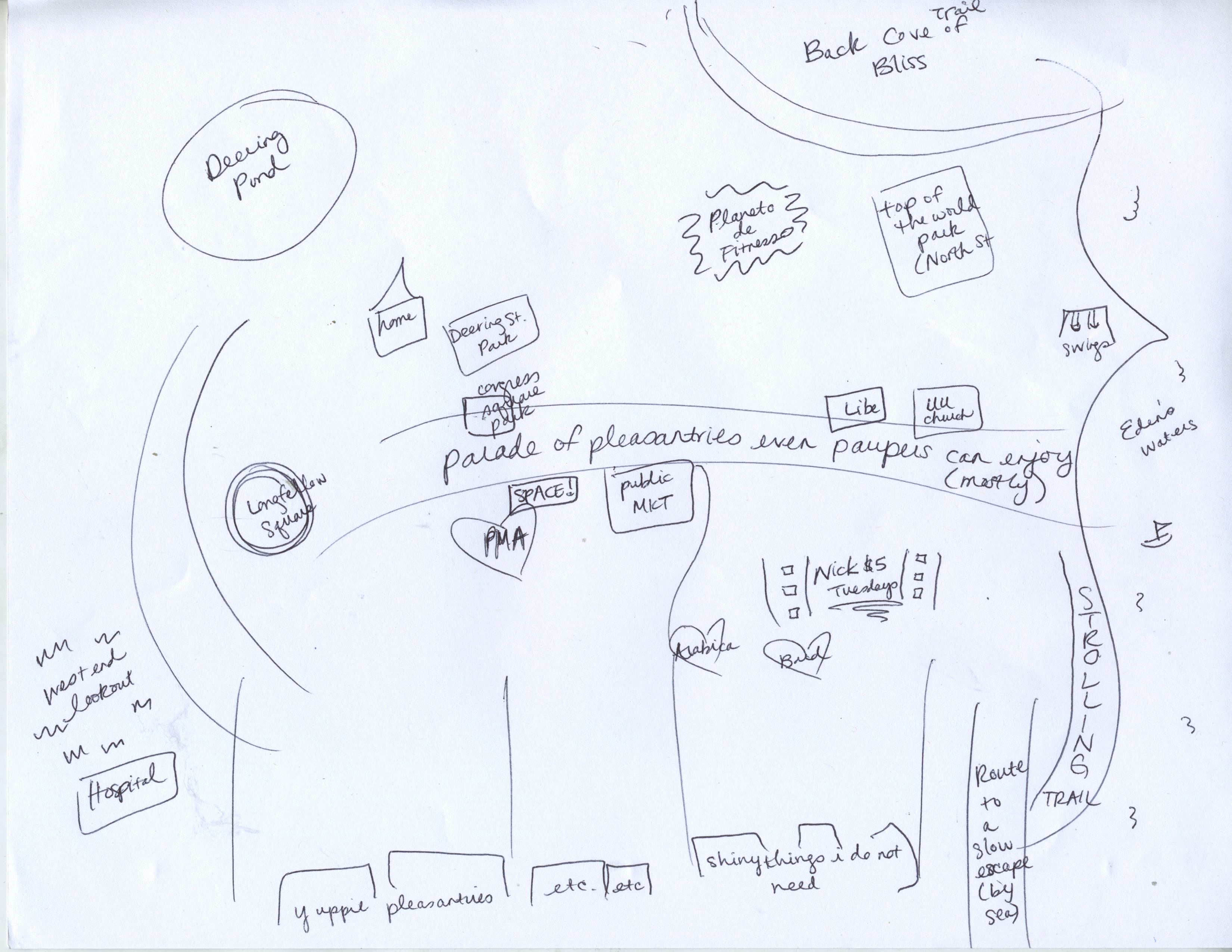
This map is very personal and the woman who drew this was very nice, but she did not want to give any information. Her map shows what she thinks of in different locations and the purpose of each location. I like her Old Port representation as”Shiny things I do not need.” She did draw on the map where she lives which is by the Deering St. Park. Her map showed me the importance of trails and paths I did not even know. Maybe these paths should be used when thinking of implementing pathways that create energy.  I am specifically talking about the “Strolling Trail”, “Back Cove Trail of Bliss”, and the “Route to a slow escape (by sea).” These are clearly important routes to this resident.


Scan%202


This map was drawn by a new resident; he actually moved to Portland a year and a month ago. He lives on Woodford and Forest and is 23 years old. He is from Utah and white. Most importantly he is “80% not sober.” I thought it would be interesting to see how his mental map would turn out. He had difficulty with the task, but I know he put his best effort. He labeled Blitliff’s Cafe and Preble Resource Center. I couldn’t really tell the rest, but I found it interesting overall.

Scan%203


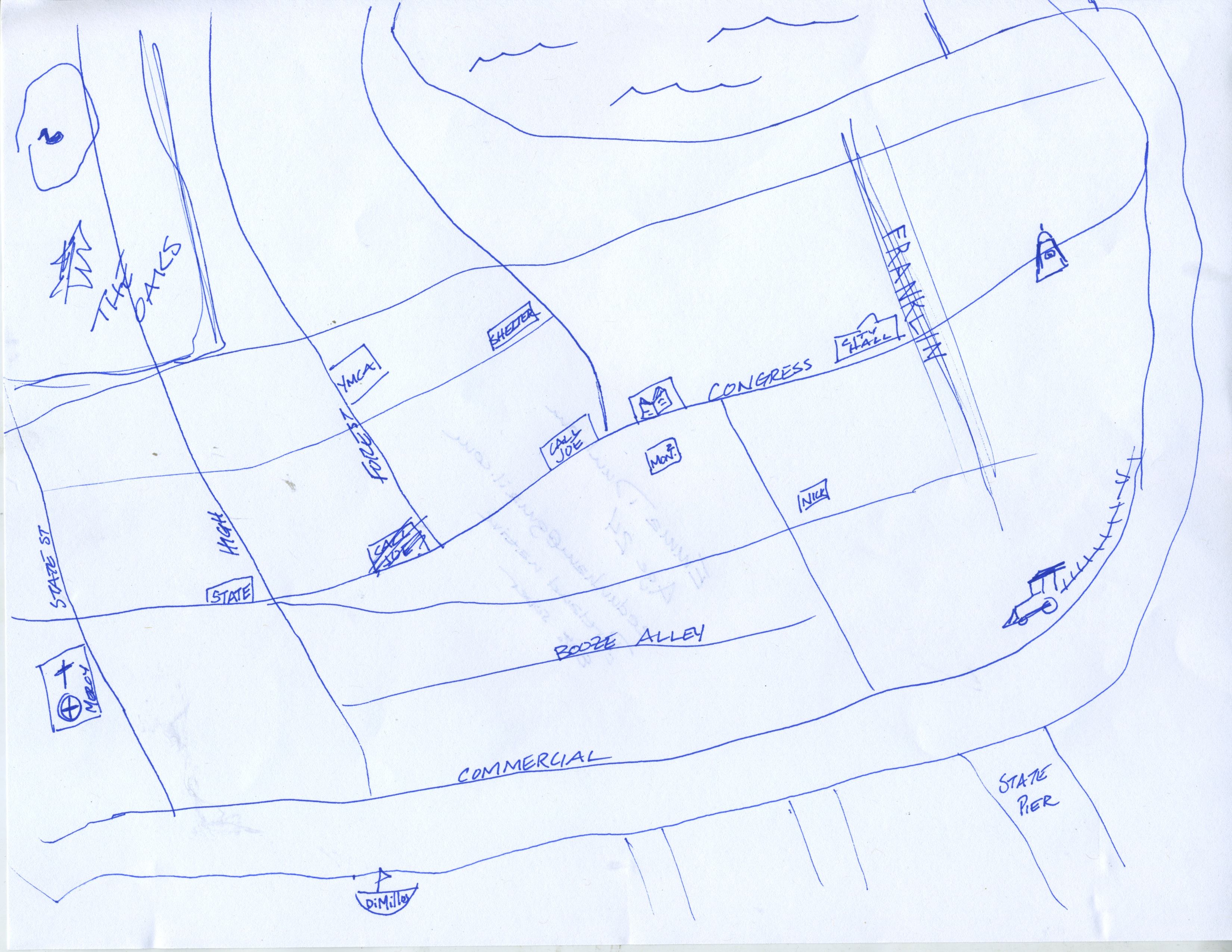
This map pertained to a  24 year old  female who has lived her whole life in Portland. She draws the “booze alley”, the shelter on Peble St, the library, and the YMCA. She on the other hand, is “80% sober.” She also notes where the train tracks are and the importance of the Nickelodeon theater. In addition, she told me she believes bicycle routes would benefit the city the most. The oaks is also an important space for her.

Scan%205


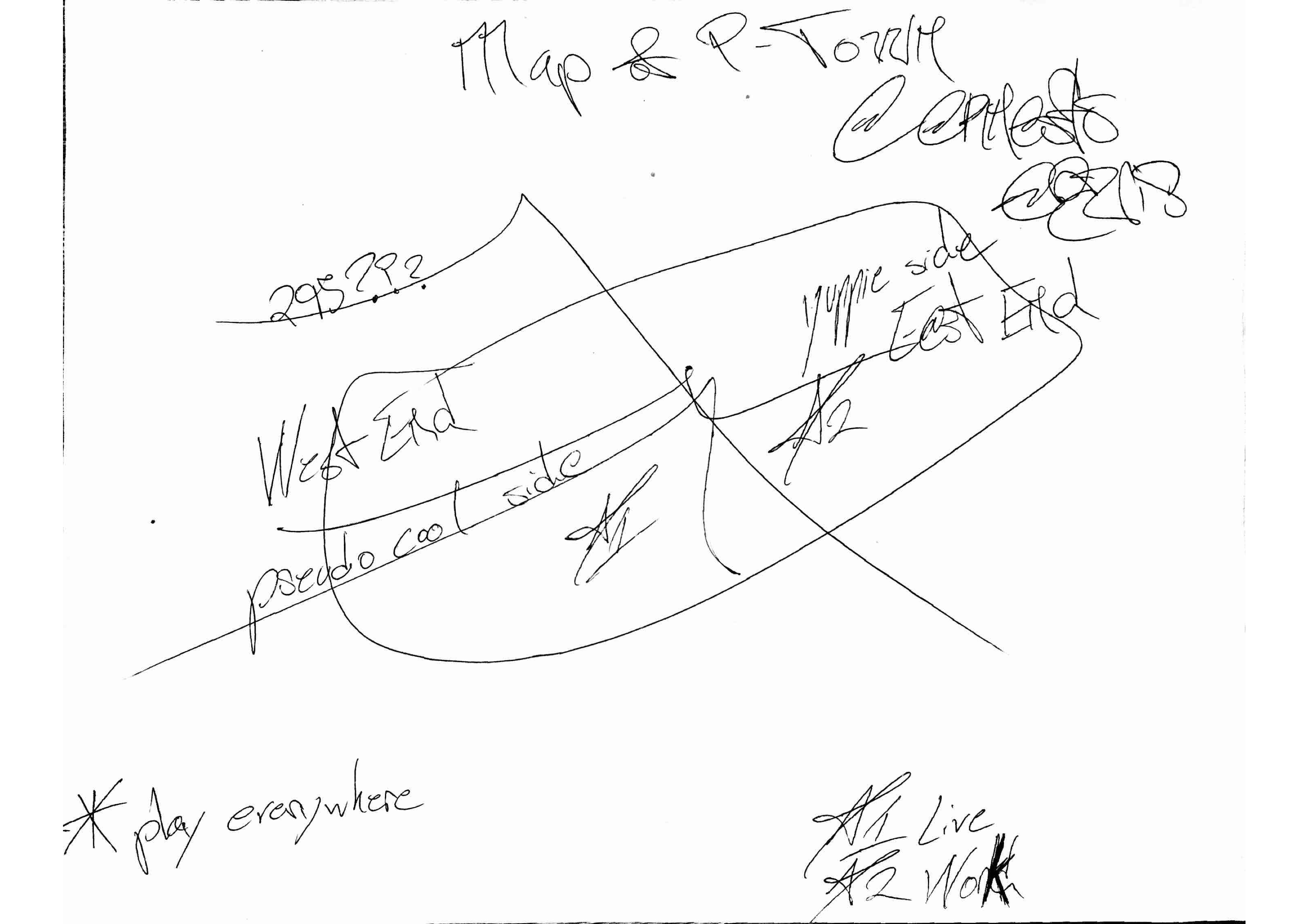
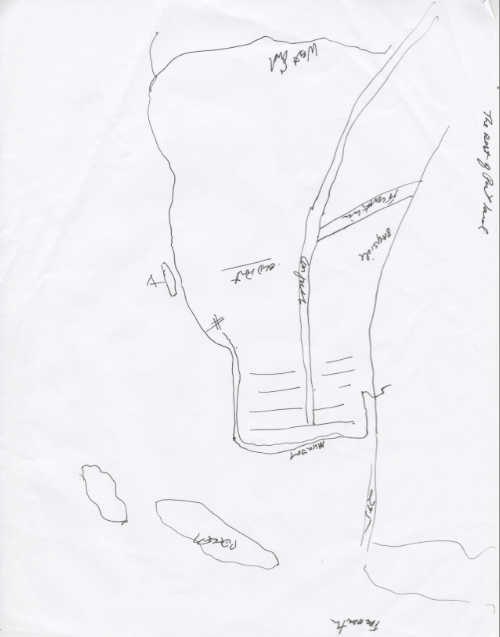
This guy was super interesting to talk to. He is the guitar player for his band Tumbling Bones. His band is actually really good if you are into folk music check them out on spotify, soundcloud, or their website at www.tumlingbones.com. He gave me a very simple map, because he told me “Portland was one for him”/he probably could have just been lazy to draw a map, but he does show the highway, where he lives (the star), the docks, and a very accurate shape of Portland. He pointed out that musicians in Portland try to find good places to play, and they adopt well, but it would be nice to have a bigger open space. That way even first friday could be less congested.


This assignment was great, because I met some rally cool people. They have given me a lot to think about. Does Portland even need new infrastructure? Many of the people I met never really thought about technology; they just want more efficient space which includes more bicycle routes and parking. Other than that they feel content. Again not the most diverse group of people, but they had important inputs. I still believe that Portland could benefit from some sort of technological innovation, like energy absorbing sidewalks.

Hilltop Coffe Cafe Ethnography and Maps

Female, age 24. 2 years a resident. Recommendation: Fix the potholes in the roads!
Male, 60 years old, 7 year resident of Portland. Recommendations: More reasonable housing rates, and better AT&T Service on the Hill.

Scan%202

Two things are particularly worth note: that the coffee shop was, on the whole, pretty busy all morning, and two, that it was busy with a rather specific population. I don’t know the demographics of Portland, but if this coffee shop had been taken as representative, it would be a city of under 30 year olds, all white and relatively well off. Perhaps this is the kind of crowd a coffee shop draws. But it is a curious thing to witness anyway. Where is everyone else? I think, to the extent that I can extrapolate, my mental maps confirmed this trend. Though they varied in age and gender, the mappers most frequently identified local eating establishments and upscale shops. Few people identified landmarks or museums or libraries—public or free spaces. It confirms my interest in a more inviting and economically mixed Portland.

10:00—Sitting facing the window, I notice that the streets are super busy. Lots of young, hip looking people in flannels and men with beards.

10:10—It’s pretty full in here, roughly 25 people. A few empty seats. People are encouraged to sit together, as there are lots of twotops.

10:20—Emptier now. Still, I’m noticing that it is very loud! The espresso machine or whatever is constantly buzzing, milk is being frothed. Nice indie rock drones. Conversation is quiet and minimal, a couple is sitting doing the crossword in one seat. Cute.

10:30—(I drew a map of the coffee shop, showing a variety of smaller seating around the perimeter—which, by the way, was a pretty small rectangle, roughly 20 by 25 feet—and a big long table for 8 or so in the middle of the place.)

10:40—Not very busy now. 2 conversations or so, I can hear the music pretty clearly. A man with a cowboy hat enters. 10 people total inside. 5 people at least are 25 or under, one is maybe over 60, all are white.

10:50—The guy sitting across from me is youngish, with a huge beard and tattoo sleeve, skinny. Another older man, maybe 60 walks in, but he is well in the minority.

11:00—A bus drove by with a big U.S. Cellular ad—is it a public bus? Someone enters with a stroller, maybe the first one I’ve seen? Also, just a note on the space, it’s pretty dimly lit, and as said before, pretty minimalist as a space. Small, cozy, not very much in the way of decoration except for some pumpkins. Big windows on the two street-facing sides. They don’t have much of a menu it seems.

11:10—Down to 6 people. 3 were here when I arrived. A biker has entered. I’ve seen lots of bikers ride by. Cars at this point seem pretty infrequent for a main thoroughfare (Congress). So are people on the street.

11:20—Ok, it’s gotten busier again. An elderly lady with a pushcart and a cool headscarf has struck up a seemingly spontaneous conversation with a younger woman.

11:30—Worth describing the general appearance of people—if I can take that liberty. First off, just about everybody is rather put together (cafes are great places to show off). Lots of boots, a few of which are bean boots. Still lots of facial hair amongst males. Patagonia and Northface abound.

11:40—Hats, lots of baseball caps! They are never fitted caps—that’s not how Mainers do it, it seems. They are faded, roughed up, blues and beiges. As if to say, “I don’t care too much…” It is very in line with the yuppie look.

11:50—Two guys walk in who seem to be in construction. They have on dark blue jeans with paint and grass and dirt stains. They have matching sweatshirts with a company’s name on it. They are the first people who seem to be working, and manual labor at that.

12:00—Lots of people are entering and taking coffee or food to go. People who sit down are here for the long haul. One is reading Frankenstein, another is reading The Odyssey. One does sudokus. Someone has the Wall Street Journal out—what?? 5 men, 6 women.

12:10—There is now one Asian person here—and he happens to be a former Bowdoin student.

12:20—I notice the bus again, and see that it is indeed a municipal bus. I can’t see if it’s crowded or not, but I would guess that it isn’t…

12:30—A trolley cruises by. Has to be tourists. The café is still pretty quiet. People on their Macs are still chugging away.

A Sunny Day on Congress Street and Alternative Living Situations

Simultaneous perception was a challenge in conducting my café ethnography. Instead of going about my business and taking notes every ten minutes, I found myself hyperaware of everything going on both inside the café and outside the gigantic window. In terms of housing, the location of Tandem brought up many questions about neighborhood, weekend wandering/flanerie, and demographics. Though I saw more racial diversity outside the window than I had expected, the clientele at Tandem were predictably homogeneous. Though I think Tandem is technically situated in the West End, its placement on a main artery made peoplewatching a more varied experience.

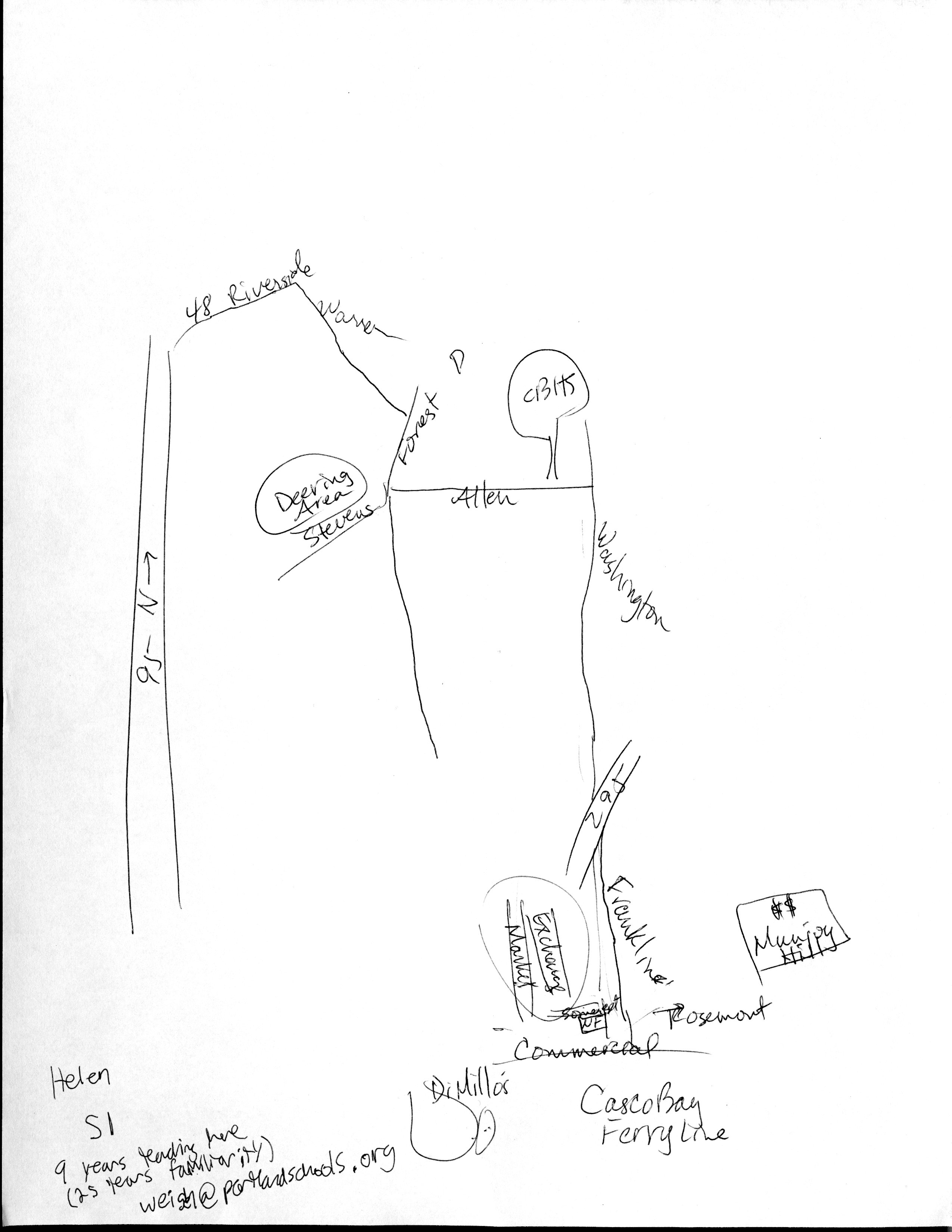
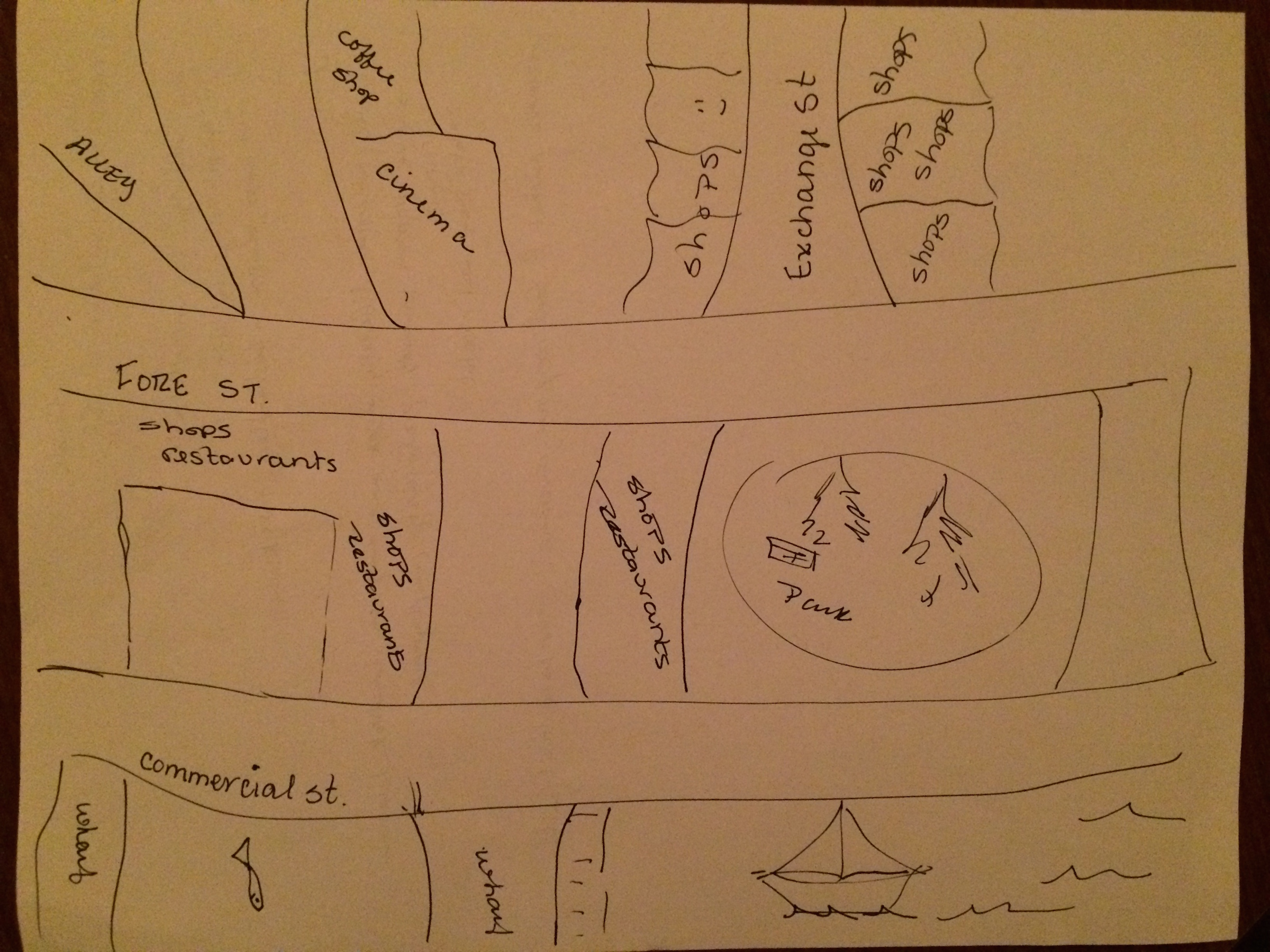
Mental map collection mostly yielded discoveries about the many living situations possible in Portland. Whereas I had expected to see several detailed maps that were telling in their inclusion and omission of certain neighborhoods and public areas, what I ended up gathering from my cartographers was more pertinent to housing than expected. For example, one can see below that Helen’s map is influenced heavily by the fact that she lives on a sailboat docked right outside DeMillo’s and once commuted further inland to CBHS via the highway. Sam lives and works at Bayside Variety Store, but a street of bars and clubs in Old Port were the first places he marked, and he marked no East Bayside locations at all. I was interested to see that living in Portland isn’t always a simple matter of finding an apartment in a shiny new condo, even though the future holds many new developments of that nature.

Café Ethnography: Tandem Bakery & Café (742 Congress St)

Saturday 9/27 @ 3:30PM

  • I almost walked straight past the whited-out gas station awning of Tandem Bakery
  • Walk in, immediately greeted with a friendly hello and enthusiastic conversation about their Malt Iced Coffee
  • I watch the guy make it with all these beautifully curated tools and cups
  • It’s really good coffee
  • After sitting down in the more interesting corner bench area with low marble tables (impossibly small), I decide to move to the window counter with tall stools. I realize the whole place has really nice natural light, and feel pretty cool sitting in a former gas station store that is all bleached out and minimalist and stuff.
  • A couple pulls up their car and leaves it unlocked, idling in a random spot in front of the awning, like we’re actually at a gas station. Nobody seems to mind at all. They come in, say some friendly hellos, and seem to order the usual. They are young, white, and clearly well off. They leave and get back in their little eco-friendly Toyota and zoom away happily
  • Somewhat hip guy rides bicycle past a big brick house that was clearly a mansion, but is now for sale by KW real estate
  • The music in here is solid and nostalgic
  • Woman in headscarf walks by, wearing very cool Nikes. If I were to make a snap judgment, I’d say she belongs to an African refugee population here in Portland, but she is clearly integrated in terms of fashion.
  • The baristas are talking about umami and something with a ragout…this town really cares about food.
  • The pastries are sitting behind me, pretty much staring at me. The sticky bun looks really good. Maine for real. Even though I feel like I’m in Brooklyn.
  • Apparently what I’m hearing are “records.” Of course
  • Longboarding is happening in front of me. It’s so nice out that I’m not really surprised. This just doesn’t happen in Brunswick so much.
  • I notice that the house across from me (that isn’t made of brick) is really intricate and somewhat Victorian/arts and crafts.
  • Portland police vehicles keep passing by
  • People really ride motorcycles on days like this too.
  • Wandering is a popular activity on a Saturday (for some)
  • Emily is sitting next to me. She has the impulse to write in this space. It is blank and therefore creatively open?
  • A blonde family on bikes stops by, boosting the Scandinavian quality of the space. Families happen in this neighborhood, and they hall have their own cute little bikes. Classically cute little girl says something about “a long bike ride.” Mainers take advantage of nice weather when they can.
  • Racial diversity out this window isn’t on par with NYC, but it’s noticeably better than Brunswick.
  • Barista checkup: . All hip. Having fun together.
  • Asian guy w/ glasses, top bun, blue running nikes.
  • White guy with Red Sox cap and scraggly chinstrap beard.
  • Black woman with big braids, lip piercing, big earrings
  • The people who come in here are willing to spend $4 on a coffee. The café is not always full, but they do have consistent business. Some people can afford this lifestyle. They are all seemingly under the age of 50, and are mostly white.People are jogging by occasionally.
  • The natural light is really doing its job.
  • Okay these buildings across the street from me are literally ivy-covered. Portland was/is fancy. People on the street don’t match the fanciness that much.
  • Portland seems very walkable, even though this street is clearly a feeder off some highway.
  • Baristas share a secret code of theirs about a “cappuccino knife.” You don’t ever need a knife to make cappuccino, but you ask a coworker to pass you a cap knife when you’re frustrated.
  • Like you are secretly pissed off and stabby
  • Good to know
  • Emily comes back from bathroom, comments on bathroom art and lemon verbena soap. Of course.
  • Bus passes by at 4:10. “Metro Runs on Maine Natural Gas” Holy frack.
  • It can get pretty calm in here. Just hearing the soundtrack and washing of dishes is kind of nice. I feel like I’m doing my homework in a restaurant kitchen.
  • I don’t see nearly as many elderly people walking on the street here as I do in Brunswick. This one I just saw has varicose veins like a lot. Poor guy. He’s wearing a button-down though…
  • Beginning to suspect that the African-American population here is more substantial than I thought before. Like just from who you see on the street.
  • A lot of kids skate on these cobblestone streets! That seems bumpy.
  • Some friends show up, as well as a carful of Bowdoin kids I didn’t expect to see. They are ecstatic. Coincidentally, the barista says to a member of the cast of Girls: Portland Edition that he is “very happy to be working here” as he caresses his La Marzocco machine.
  • The place just smells really clean. Like water, alternately colored by the smell of espresso coming out of the machines. This is a bourgeois side of Maine that emulates many other styles. Most notably Scandinavia. It’s all white, but in a warm way. White walls + wood + white tile + plants. Green still makes its way into here, but not the typical Maine green coniferous growth you’d expect.
  • Asked for a glass of water and the barista said “It looks like you guys are hangin’ out,” and handed me a whole nice bottle of cold water with one of those pop off caps. Maine manners are alive and well.
  • Beanies n’ bicycles outside. Fixies too.
  • Woman comes out of an apartment-looking building to smoke. What’s the housing makeup of this neighborhood (West End)? I see a lot of former mansions, but they no longer seem to be single-family homes. Tree lined streets and low buildings. Kind of like Brooklyn.
  • A family comes in and the little boy wants a soda. Unfortunately, we are in hip Scandanavia, so all that ole’ top bun can offer him is a sweetened sparkling water. Tandem. I really like you, but I can see how some local people would hate you; namely these grungy Dakine backpack skater looking kids walking by. They probably think your coffee shop/bakery is bullshit.
  • This location has been open for one month. Redheaded mom of white family (+ chacos & ankle tattoo) says “this place is so nice.” Barista says thanks, clearly having heard this sentiment all day.
  • J Crew catalog model walks by in his best photo shoot attire, aviators and all.
  • The bathroom has very interesting hanging practices. Portland strikes me as an aesthetically minded place, at least when people can afford to give a damn about that kind of stuff.
  • I feel the need to walk for two reasons. My parking meter is running out, and activity on the street and in the café is slowing down considerably. As I exit, a man in a Bruins shirt and Red Sox cap with an absurdly small dog walks by. “Keep Portland just slightly weird.”


Mental Maps

mentalmap002
Helen. Female, 51. Has taught Math at Casco Bay High School for 9 years as a commuter from York area. Lives on a sailboat, which she and her husband had just docked near Old Port. Living on the wharf, she wishes there were better waterfront access all over the city’s coastline.
mentalmap003
Sam. Male, Age 33. Moved to East Bayside from Brooklyn almost two years ago to take over Bayside Variety from previous owner who skipped town. When asked about improving Portland, responded that the area has “no manners, ethics, or beauty.” To combat this problem, he suggested education reform and a new school. The nodes marked at the bottom are clubs and bars in Old Port, and the x is where Sam lives and works.
mentalmap004
Kazeem. Male, 41. Owner of a high-end clothing store. Has lived in Portland for 6 years. Thinks that the city could improve multicultural life through public programs like movies in the parks (he started the Maine African Film Festival). Kazeem took a different big picture approach and marked a few Portland landmarks (like Whole Foods).
mentalmap001
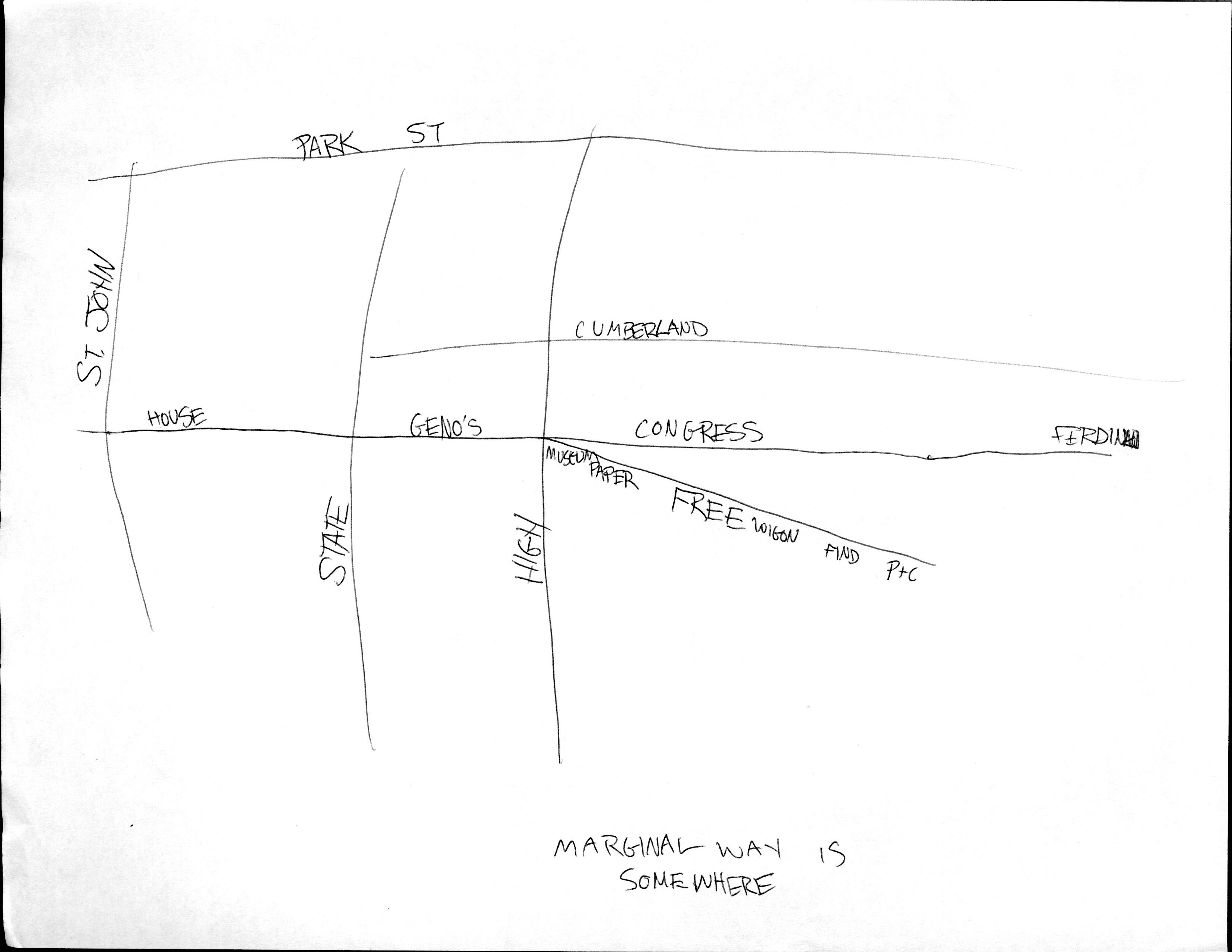
Sarah. Female, 34. Works at Find, a quirky clothing and trinkets store on Middle Street. Has another job near Marginal Way, but couldn’t situate it on her map. She thinks Portland could use better transportation options or parking; she lives kind of close to her job at Find, but would rather not have to drive in winter because parking is impossible in the Old Port area.

A Tale of Two Cafés, and a Funeral

It came recommended by not one, but two friends. It was built into an old gas station, but didn’t sell gas. It had a memorable logo that was at once cute and minimalistic. It was Tandem Coffee Roasters, and it was empty.

Of course I could not conduct an ethnography in an empty café, but, in Portland, such eateries have propagated like horny rabbits with extra sex organs – there would be another. The proximate sibling happened to be Speckled Ax. I ordered a cup of drip, sat down, and initiated that passive, temporary sort of stalking that we all now know and love: the ethnography.
4:10
Arrived at Speckled Ax Café on Congress Street
A generally young crowd, with the single exception of a middle aged woman discussing the prospects of graduate school with an enthusiastically gesticulating woman who is (you guessed it) young.
Young (half black?) man with a beautiful brown pitbull sits at the table across from mine talking with another young woman. A young woman with short blond hair sits behind them, working on her mac pro – engrossed and wearing a black hoodie.
I am sitting in the middle of them in a row of tables, aligned by a long bench that juts out from the brown walls. To my left is another young woman working quietly at her laptop, and to the left of her is a young woman who appears to be reading a book (but her back is to me).
There are a group of early 30s (?) white men beside me discussing a messy roommate and moving to one of their girlfriends’ places (hipsters).

4:20
Woman with the guy with the pitbull gets up to go to the bathroom. He takes pictures of his dog on his iphone. Another young man strolls quickly into the café – says hi to the pitbull guy, they appear to be friendly.

4:30
A couple shows up and walks to the counter to order. They stay standing there, and talk to each other until their coffee is ready and they leave. The group of hipster men beside me leave, but one has left their iphone and espresso on the table.

4:40
The hipster guys are back, minus one. Strong tobacco smell.
There is a young woman sitting at the table beside me also working on her laptop (not a mac!) The guy with the pitbull and friend discuss weed and alcohol. She doesn’t drink much and he doesn’t either, but he smokes “like, every day.”
young woman who was been working at the bar (not making coffee, on her laptop. there’s a small counter to work at) gets up to leave. Drinks water first.. I feel creepy watching all of this and writing it down. As she leaves, finally, she says hello to the hipster guy who also knew the pitbull guy. The hipster guys also leaves, but not with her.

4:50
Young woman sitting next to me packs up to leave, and the woman at the table across from me (black hoodie, engrossed in work) has also left. Meanwhile, the pair discussing grad school remain locked in conversation. It’s just me and these two talking pairs now. And the two employees chatting in the back.

5:00
Both pairs are still talking and no one has come in, though there is a lot of foot traffic outside. The pair across from me have their iphones out and are discussing them.

5:10
The pair across from me leave after friending each other on facebook. The pair to my right are still talking, but it’s just us three here now.

I needed paper and the Speckled Ax had emptied out. After grabbing a few sheets at Kinkos, I moved to Arabica café.

5:15
Much more diverse crowd. 14 people by my count.
In the front sections there is a middle aged woman reading the newspaper by the window, and a younger woman using a macbook air. There is a very stylish and tattoed man at the table beside her, also on a mac laptop. Then, at the table by him there are two women sitting quietly – one on a laptop, one reading. At the tably beside them there is a woman with over ear headphones and an IBM laptop working. Further down the cafe there is an older man in a tshirt tapping away at an ipad. A couple of seats down there is a small group of three skater-types, two guys and a girl (college age?). Towards the end of the cafe there are two couples quietly working.

5:25
One of the skater people leaves.
A group of three young women come in and head straight to the back of the café.
A middle aged woman enters and orders a drink – then sits on the couch behind the bar by herself, reading on her iPad mini.

5:35
The older woman by the door leaves, but the newspaper remains on the counter. Another middle aged couple come in and take her place. Two Bowdoin students show up and take a table in the back.

6:00
Café is closing; I have been asked to leave.

Mental Maps

Name: Savannah
Age: 20
Gender: Female
Occupation: N/A
– Grew up in Portland and lives on Munjoy Hill.
– Really likes Portland and didn’t have many problems or ideas.
– Thinks that humans shouldn’t have to work to have a home, and would like to have housing be free. Wants to see more community sharing of land.
– Wants trash bags to be cheaper
– Feels that she is approached by “narcs” a disproportionately large amount.

2014-10-26 23.28.34


Name: Tim Wilson
Age: 28
Gender: Male
Occupation: Painter
– Grew up further North and has lived in Portland for five years. Currently resides in West End.
– Likes the trails in and around Portland, and biking up and down its hills.
– Thinks parking is a big issue. Wants to revamp the buses. (“Who takes the bus?” he asked. “It’s a cultural issue.”)
– Likes the park, but events are few and do not appeal to his interests.
– Would like to see more going on than just restaurants and bars.

(Note: Tim’s drawing is really cool looking, and it turns out he is a very talented artist: http://www.timothypowerswilson.com)


2014-10-26 23.28.53

Name: Stella
Age: 55
Gender: Female
Occupation: Special Education Teacher
– Moved to Portland 22 years ago
– Panhandling is uncomfortable. She identifies as politically far left, but thinks that panhandlers are bad for tourism (take up benches, accost tourists), and make the city less welcoming.
Thinks that Prebble Street or other organization should focus on getting homeless people to work, possible in an agricultural setting. Thinks farming could be very therapeutic. Wants the homeless to feel useful.
– Loves famers’ market and food coop, wants more local food.

2014-10-26 23.28.10

Name: Laura
Age: 29
Gender: Female
Occupation: Marketing
– Grew up in Portland
– Wants better parking, affordable housing, and more sustainable development / sustainability projects in general.
– Thinks that homelessness is a big issue facing the city.
– Idea: bring back the train around the peninsula!

2014-10-26 23.29.12
My time in these Portland cafés, and my discussions with this small sampling of its inhabitants, suggest that these middle class citizens are generally very happy with Portland as it exists today. The most pressing issues of daily life in the city seem to be parking and homelessness. Of these, homelessness was very clearly more significant.

In my own evaluation, Tim’s desire for more cultural attractions that go beyond bars and restaurants was a subtle but important one. It seems that the restaurants in Portland have assumed the role of old Boston’s pubs, Paris’s cafés, and LA’s pool parties – stoking the flames of a burgeoning culture that will inevitably spill over to other arts and activities. It also struck a strong chord as San Francisco citizens currently face a similar issue, but from a very different angle. While SF has long been home to an impressive variety of cultures and attractions, the recent tech boom in the city has sparked a steep increase in swanky bars and dressed-down, but  still high end restaurants. The parallels don’t end there – San Francisco also faces a large and very present homeless population. Perhaps lessons learned in addressing cultural development and homelessness in Portland can be applied to San Francisco as well.

Crema Cafe Ethnography and Mental Maps

photo 1 photo 2 photo 3 photo 4

Saturday, October 4, 2014

Dreary day, misting/light dribble, temperature, 58 degrees

Crema Café/Arabica

2:30pm to 5


2:30

  • About forty-five people, half by themselves (working, reading), half with people (groups of 2-4)
  • Roughly an even split of genders
  • Activities seen: date, date, reading comics, on laptop, reading, reading, discussion/ hangout, on laptop, on laptop, date, on laptop, date, on laptop, three people at bar, listening to music, on phone, reading, talking, two kids playing
  • Big family just walked in
  • Pretty constant line of about 3-8 people
  • All ages (except maybe middle school, high school, college student)
  • About 70% occupancy but almost all tables have at least one person
  • Pretty constant flow of people, a “group” every five minutes?
  • Relatively lively
  • There’s a photographer
  • Casual place, most people in jeans and sweaters, no professionals
  • Not too many passerbys on street probably because of weather


3:00

  • About fifty people, about ten solos, a few families with small children, mostly groups of two
  • Smells like coffee
  • Street view is by waterfront but blocked off by construction
  • There was a coffee spill
  • Line is still consistently 3-8 people
  • More flow of people, a group every 3 or 4 minutes
  • Smells like sweet coffee
  • Man biked by with Roman soldier helmet
  • Lots of conversations
  • Almost everyone is getting drinks and sometimes something else
  • A lot of people just hanging


3:30

  • About forty people
  • Most people just get drinks but families get food for the kids
  • There aren’t a lot of food options
  • People by themselves have not really left but families with kids have high turnover rate
  • Horse drawn trolley just rolled by
  • They shout out orders
  • Line is averaging less people (maybe3-5?)
  • Less people at bar but most tables still have at least one person

4:00

  • About thirty-five people, almost no non-white
  • Line is averaging 0-3 (no one there now)
  • Family with three kids came in but left after getting food
  • Net negative flow of people
  • Fewer conversation, most people by themselves and doing work
  • About a quarter of tables are free
  • Started raining/heavier drizzle around 4:20 and temperature is getting chillier


4:30

  • About thirty people
  • Almost no non-white people still
  • Line staying relatively short
  • Quieter most people are just reading or on laptop
  • About a third of the tables are unoccupied
  • Pretty much same as last block but slightly smaller
  • About twenty-five people as I was leaving and the remaining people didn’t look like they were staying too much longer


My maps were mostly taken from people around Munjoy Hill. It was therefore unsurprising that the mental maps I collected focused on East Bayside and Old Port. One person even mentioned that she was only drawing “her part of Portland.” The West End was not labeled on any of the maps and the maps had very few landmarks from the West End area labeled. It seemed that most of the landmarks were nondescript shops and locations and there was not too much overlap between landmarks. The younger generation seemed to label more places and seemed more aware of the entirety of Portland.


Having talked with a few residents, I still think that Portland needs to prioritize working on its public transportation system. Many residents at least mentioned that it was difficult to commute around the city and that even with a car it is difficult to find parking. Although I was hesitant about increasing bike accessibility or a bike share system given the long winter in Portland, residents seemed to want more bike lanes and for Portland to be a more bike-friendly city. Therefore, I think bicycle lanes and bicycle racks would be a good way to encourage more bicycles in the city, especially for the younger age group that seems to be moving into the city. Additionally, the public bus system should be updated and integrated into the city so that the residents and commuters find it to be a more accessible and reliable form of transportation.


Holy Donut Ethnography and Mental Mapping – 10/13/14

My trip to Portland showed me just how divided the city is due to socioeconomic factors. The class-based segregation in the city became apparent to me during the first two and a half hours of my day at the Holy Donut on Exchange Street. During the entire time in which I was observing people in the donut shop, nearly every person I saw appeared to be middle-class or upper-class based on their clothing and topics of conversation. Similarly, almost everyone I saw in the Old Port area was either a tourist or a person who was middle-class or higher. This was definitely not the case as soon as I crossed into Bayside, where a large number of people appeared to be homeless or very poor.

It was very clear from my conversations with Portland residents as I was collecting mental maps that the city is separated along socioeconomic lines. The first woman I asked for a mental map (she did not end up making a map for me) was, until recently, homeless. When I explained to her that one of the reasons we were collecting mental maps was to make the city better, she voiced her concerns that we would only pay attention to what the “yuppies” had to say. Three homeless people I tried to interview in Monument Square did not want to speak with me, which I presume was at least in part because they were skeptical of my intentions as someone from a different socioeconomic group. Of the four people who ended up giving me mental maps, three spent a large amount of time discussing the problems of poverty and homelessness in the city.

Needless to say, the issue of class must be addressed when considering making any improvements to the city. Although I had initially proposed implementing a public Wi-Fi network in Portland, I now realize that in order for a system like that to benefit as many people as possible, there needs to be increased access to technology for people from all backgrounds. Internet access at the Portland Free Library is a great first step toward providing everyone with access to technology, but more needs to be done. At the moment, there appear to be almost no ways for people in Bayside to access the Internet without using their own devices and private networks. Perhaps the city could provide desktop computers and Wi-Fi routers to various organizations for low-income or homeless individuals, such as the Preble Street center or the Salvation Army Adult Rehab Center. This is not to say that Portland would not benefit from a public Wi-Fi network, but rather that providing Internet access to all people, regardless of socioeconomic status, should take priority.


Café Ethnography Field Notes (Holy Donut – 10/13/14):

  • 10:46: I just came into the shop. The line is very long.
  • 10:46: There are lots of people here. Based on clothing, most seem to be middle-class.
  • 10:48: No women are alone here. All women are with friends or other people. There was one man alone sitting at a table.
  • 10:50: Two young women ahead of me in line took one of the only tables. They seemed excited to find a table because of how busy it was.
  • 10:51: Employees behind the counter are talking about how busy today is.
  • 10:53: I’m sitting on the sofa facing the entire shop. There is no Wi-Fi here.
  • 10:57: Two couples, one with baby, are sitting at table next to me.
  • 11:06: The girls who were in front of me in line are talking about how busy it is today.
  • 11:08: Girls are talking about shopping and L.L. Bean.
  • 11:09: Couples at the table next to me are talking about good local restaurants.
  • 11:09: Now one woman at the table with the baby is talking about how hard it is to find non-domestic wines here.
  • 11:10: Lots of people are walking on Exchange Street. There isn’t a lot of traffic on Exchange Street, but a few cars have passed by on Fore Street.
  • 11:11: A woman just walked in with a fancy camera. She and her friend might be tourists.
  • 11:13: The people at the tables on the right side of the shop seem to leave pretty quickly. The same people have been sitting on the left side for almost half an hour.
  • 11:16: A group of four older (look like they’re in their 50s) women and two older men just sat down. They bought A LOT of donuts (it looks like there are two boxes).
  • 11:17: A woman just left the shop with a donut on a paper plate.
  • 11:19: A family with two boys in their teens to early twenties just sat down on the right side of the shop. They’re the first young men who have stayed instead of getting donuts to go.
  • 11:19: A man in a dress shirt and tie just walked in. Maybe he’s on his lunch break.
  • 11:20: The sun is shifting such that I am now sitting in the sunlight.
  • 11:21: Table of older people started talking to the younger couples at table next to me. The couple with a baby is visiting the other couple, who moved here from Rhode Island six months ago. Holy Donuts is a place that they frequent.
  • 11:22: The family that took two individual tables on the right-hand side of the shop has moved the two tables together to make a bigger table.
  • 11:23: Two nice people just sat next to me on the couch. They might come here often, since when the woman asked the man if he wanted coffee, he said, “You know what I like.” The woman has a slight Southern accent.
  • 11:26: The man commented on how they use potatoes in the donuts. They probably don’t frequent this place.
  • 11:28: Table of older people know people sitting next to me. They’re getting dinner tonight at 6:30.
  • 11:29: The older table is leaving and headed to Duck Fat for lunch. The people next to me aren’t joining them. When the man asked where the restaurant was, one of the women said, “You’re in America now, so you can Google it. This young man next to you (referring to me) can help you!”
  • 11:30: As the older people were leaving, one of the women at the table next to me said, “Enjoy your visit!” Some or all of them are probably visiting.
  • 11:34: The line got busy again. The family on the right side of the shop has left and a new one has taken their table.
  • 11:36: “Billie Jean” just started playing. It’s the first time I’ve noticed the music in the donut shop.
  • 11:37: The young couples (here for almost an hour now) are talking about good places to shop. They might go pumpkin picking later today.
  • 11:39: Young couples are leaving.
  • 11:40: The line was short, but just got very long again because eight people (three groups of two) just walked in.
  • 11:41: “Billie Jean” just finished playing. There is still music playing, but I don’t recognize the song. I wonder if there was music beforehand that I didn’t notice.
  • 11:43: A woman who was sitting by the window on the right side of the shop is leaving with a young girl (her daughter, I assume). I haven’t seen any young children with only men. All young children have been with at least one woman.
  • 11:45: One of the men who has been working the counter for a few minutes was not there when I came into the shop an hour ago.
  • 11:46: A man just walked in wearing a Bowdoin Preorentation 2010 T-shirt. He’s with a woman about his age.
  • 11:47: I just saw a car drive down Exchange Street for the first time since I got here. I’m facing away from the window, so it’s possible there have been others that I did not see.
  • 11:49: The man and woman who sat next to me are leaving. The man said to me, “Y’all have a nice day, now!” I didn’t notice at first, but he had a vaguely Southern accent as well.
  • 11:49: At the table closest to the counter on the left side of the shop, four young men (twenties or thirties) are talking about some website that is just like Facebook.
  • 11:51: The “Bowdoin Preorientation guy” and women with him left without sitting down. It looks like they only got coffee.
  • 11:51: Three men just walked in together. One has a camera without a strap or bag. Maybe they have a car nearby. It wouldn’t make sense to carry a camera around all day without a bag.
  • 11:52: A young man sitting at the table in front of me (where the younger couples were sitting) is playing games on his iPad.
  • 11:55: There have been very few people of color here. I’ve seen two Hispanic people, three black people, and one Asian woman. Everyone else I’ve seen here appears to have been white.
  • 11:55: An older couple wearing backpacks just walked in. There have been several people with backpacks (many holding shopping bags) and several people with cameras. I’m guessing those people are tourists.
  • 11:56: I noticed the woman who gave me my donuts over an hour ago looking at me. I wonder if it’s strange for people to stay here for a long period of time since this is not a typical café setting.
  • 11:58: For the first time since I got here, there is no line. It probably gets less busy here during lunchtime.
  • 11:59: The only other people sitting in the shop are a man sitting at a table in front of me (the one on the iPad) and two people sitting by the opposite window. Three older people are standing and talking in the center of the shop.
  • 12:00: Two Asian people walked into the shop and immediately left.
  • 12:05: Lots of people just walked in. An employee just started wiping the tables.
  • 12:06: A group of four people just left. One made a joke about how they could hang out here and listen to the music and eat great donuts.
  • 12:07: There are cars on Exchange Street. One that was parked in front of the donut shop just left.
  • 12:07: An employee just told a customer that all donuts here except the apple donut (which I bought) are made with potato. He said something about there already being too much starch in that one.
  • 12:11: The shop is nearly empty. Only two customers are at the counter. The man with the iPad and two people sitting by the other window are the only customers here besides myself.
  • 12:12: A new man is working at the counter with the other man. I don’t see the woman who served me at the counter; I think she’s in the back.
  • 12:13: An Asian girl just left. There still have been very few non-white people here.
  • 12:14: The first male employee at the counter remarked that he got here at 10 and it was a “madhouse.”
  • 12:15: The man who I noticed behind the counter three minutes ago is now sitting at a table on the left side of the shop with a laptop.
  • 12:16: There aren’t nearly as many people walking by on the street as there were an hour ago.
  • 12:20: I bought a bottle of water from the woman who sold me the donuts earlier. I told her I was doing work for a class, which was why I had been here for so long. She told me she didn’t mind.
  • 12:22: Now that it is much less busy here, the first man from the counter is taking lunch orders (I heard him mention hot dogs and hamburgers) from his coworkers.
  • 12:23: An entire group of tourists with a tour guide just walked in. So much for a break for these workers!
  • 12:25: These tourists are wearing nametags that say, “Tour guest.”
  • 12:25: The tourists are all older people. Only one is not white.
  • 12:28: Every order I’ve heard has been an even dollar amount (my donuts were $6 and my bottle of water was $2). I think they set their prices such that all items with tax are even dollar amounts.
  • 12:32: The first male employee just told someone the shop was out of something for the day. I didn’t catch what had run out.
  • 12:33: The second male employee (the one who took out the laptop for a little while) just propped the door open with a doorstop.
  • 12:34: A middle-aged woman at the table next to me is talking about the TV show “Shark Tank” with a teenage girl. They’re here with two other middle-aged women. They haven’t been to Holy Donuts before.
  • 12:36: These women all have a Southern accent. They’re amazed by the “Maine potatoes” that are used in the donuts here.
  • 12:37: One of the women is talking about places like the Dollar Store and Target with the teenager. Their conversation has something to do with Columbus Day.
  • 12:42: The line is starting to get long again.
  • 12:44: There are people sitting at all tables on the left side of the shop. One woman (an Asian woman) is here by herself.
  • 12:46: One of the women at the table next to me commented on how much she looks like “mom.” These women might all be sisters.
  • 12:47: After using an iPhone to take a picture of herself, one of the women at the table next to me jokingly said, “We’re all selling out!”
  • 12:48: The woman at the table next to me is talking about Girl Scout cookies and how she doesn’t like working the cash register. I just noticed that she is wearing pink Sperry’s. Sperry’s have a reputation for being a Maine thing or, at the very least, a Bowdoin thing. Maybe one or more of these women are from Maine.
  • 12:52: Three women, one from Nova Scotia just sat next to me and two from Yarmouth. The woman from Nova Scotia – sitting on the couch next to me – told me that it is Thanksgiving Day there. She was afraid she and her friends were intruding on “my space,” but I told her she was more than welcome to sit next to me.
  • 12:55: The woman from Nova Scotia asked me if I’ve ever been. I told her I hadn’t, but that I went to Montreal and Quebec a week before school started.
  • 12:56: The music playing right now is from a Spotify playlist. An ad just played and now “Gimme Shelter” by the Rolling Stones (one of my favorite songs!) is playing.
  • 12:58: The women next to me are barely talking to one another. Most of their meal so far has been in silence.
  • 1:00: There are more people coming into the shop alone now than there were earlier. I don’t know why this is.
  • 1:03: Almost no one has come in here wearing nice business clothes. Most businesspeople probably don’t come to Holy Donuts for their lunch break.
  • 1:04: The first man from the counter just congratulated two female customers on their upcoming wedding.
  • 1:05: I just heard an order that cost $1.75. That’s the first time I’ve noticed an order that didn’t cost an even number of dollars (although $0.25-cent increments are also convenient for customers).
  • 1:06: When a woman said she’d come back later for a particular type of donut, the man at the counter said they might be out later.
  • 1:07: I just noticed that the sign on the door says Holy Donuts is open until they sell out of donuts.
  • 1:11: There are 12 women here (all but one on the left side) and only two males other than myself.
  • 1:12: The women next to me have been gossiping for the past ten minutes or so. They are much more talkative now.
  • 1:14: Almost all the customers coming in here now are women. There have only been two men in the last several minutes.
  • 1:15: The Asian woman sitting here by herself is writing something on a notepad. She’s been here for over half an hour.
  • 1:16: A man in a suit and tie just walked by the shop. He’s the second person who looks like a businessman that I’ve seen today (the first one was the man in the dress shirt and tie who came into the shop earlier.
  • 1:19: A lot of younger people are walking by now.
  • 1:19: The women next to me are talking about how young people spend all of their time on their phones now.
  • 1:21: A group of three teenagers with bags from some shop just left.
  • 1:22: I’m leaving now.


Mental Maps:

Name: Bob Gender: Male Age: 70 Residence: Falmouth (7 years) Improvements for Portland: • The city needs to be more food truck friendly. Notes: • Bob put many restaurants on his map (he started labeling them with the letter "R"). • Bob is retired. • Portland is "packed," but young people do not have as many things to do in the city as older people do. • The city is great for biking. Because there is so little traffic, bike paths aren't really needed.
Name: Bob
Gender: Male
Age: 70
Residence: Falmouth (7 years)
Improvements for Portland:
• The city needs to be more food truck friendly.
Notes:
• Bob put many restaurants on his map (he started labeling them with the letter “R”).
• Bob is retired.
• Portland is “packed,” but young people do not have as many things to do in the city as older people do.
• The city is great for biking. Because there is so little traffic, bike paths aren’t really needed.


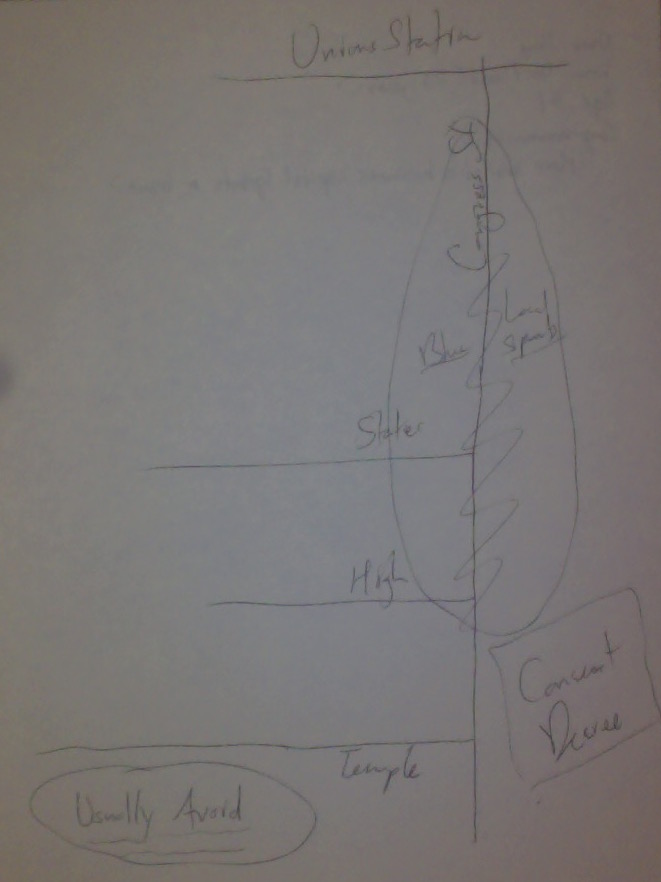
Name: Doug Gender: Male Age: 51 Residence: Portland (23 years) Improvements for Portland: • There needs to be more available business capital in the form of grants or loans. Notes: • Doug majored in sociology in college. • Doug's favorite area in the city (shaded on the map) is the "least likely to be gentrified." • The area labeled as "usually avoid" has lots of tourists and "rambunctious" people. • Consent Decree – 20 years ago, it was decided that people with mental illnesses couldn't be held against their will. Because of this, there are lots of "rambunctious" people on the streets.
Name: Doug
Gender: Male
Age: 51
Residence: Portland (23 years)
Improvements for Portland:
• There needs to be more available business capital in the form of grants or loans.
Notes:
• Doug majored in sociology in college.
• Doug’s favorite area in the city (shaded on the map) is the “least likely to be gentrified.”
• The area labeled as “usually avoid” has lots of tourists and “rambunctious” people.
• Consent Decree – 20 years ago, it was decided that people with mental illnesses couldn’t be held against their will. Because of this, there are lots of “rambunctious” people on the streets.


Name: Lisa Gender: Female Age: 50 Residence: Portland (2 years) Improvements for Portland: • There is an excessive amount of panhandling or begging, which looks bad to tourists. Laws would help. Notes: • Lisa is an artist who primarily sells on Commercial Street and at a weekly farmers' market in Deering Oaks Park. • Tourism is important for Lisa's business.
Name: Lisa
Gender: Female
Age: 50
Residence: Portland (2 years)
Improvements for Portland:
• There is an excessive amount of panhandling or begging, which looks bad to tourists. Laws would help.
Notes:
• Lisa is an artist who primarily sells on Commercial Street and at a weekly farmers’ market in Deering Oaks Park.
• Tourism is important for Lisa’s business.


Mingo - mental map 4.1

Name: The subject did not want her name to be publicized. Age: 68 Residence: Portland (8 of the past 10 years) Improvements for Portland: • Taking care of the homeless is important. • There needs to be more regulation for art vendors because some people don't sell their own art and some people who don't live in Portland come to the city just to sell their art. This makes competition much more difficult. Maybe art vendors would have to be Portland residents – this wouldn't be done with the intention of excluding people; it's simply very difficult to make a living as an artist in the city. • People need to be educated about drug problems and domestic abuse, both of which are issues relevant to Portland. • There should be more mental health agencies and institutions. Notes: • The subject is a photographer. • The subject loves nature and thinks preserving nature in Portland is important. • The subject lived in Thailand for 2 of the past 10 years. • The subject is dyslexic. • The subject said she "loves Portland." She wishes there were more regulation for artists because there need to be rules for everything to be fair.
Name: The subject did not want her name to be publicized.
Age: 68
Residence: Portland (8 of the past 10 years)
Improvements for Portland:
• Taking care of the homeless is important.
• There needs to be more regulation for art vendors because some people don’t sell their own art and some people who don’t live in Portland come to the city just to sell their art. This makes competition much more difficult. Maybe art vendors would have to be Portland residents – this wouldn’t be done with the intention of excluding people; it’s simply very difficult to make a living as an artist in the city.
• People need to be educated about drug problems and domestic abuse, both of which are issues relevant to Portland.
• There should be more mental health agencies and institutions.
Notes:
• The subject is a photographer.
• The subject loves nature and thinks preserving nature in Portland is important.
• The subject lived in Thailand for 2 of the past 10 years.
• The subject is dyslexic.
• The subject said she “loves Portland.” She wishes there were more regulation for artists because there need to be rules for everything to be fair.

Hill Top Coffee and Mental Maps


25 years old; teacher; lives in East End; lived here 3 years.

Scan2


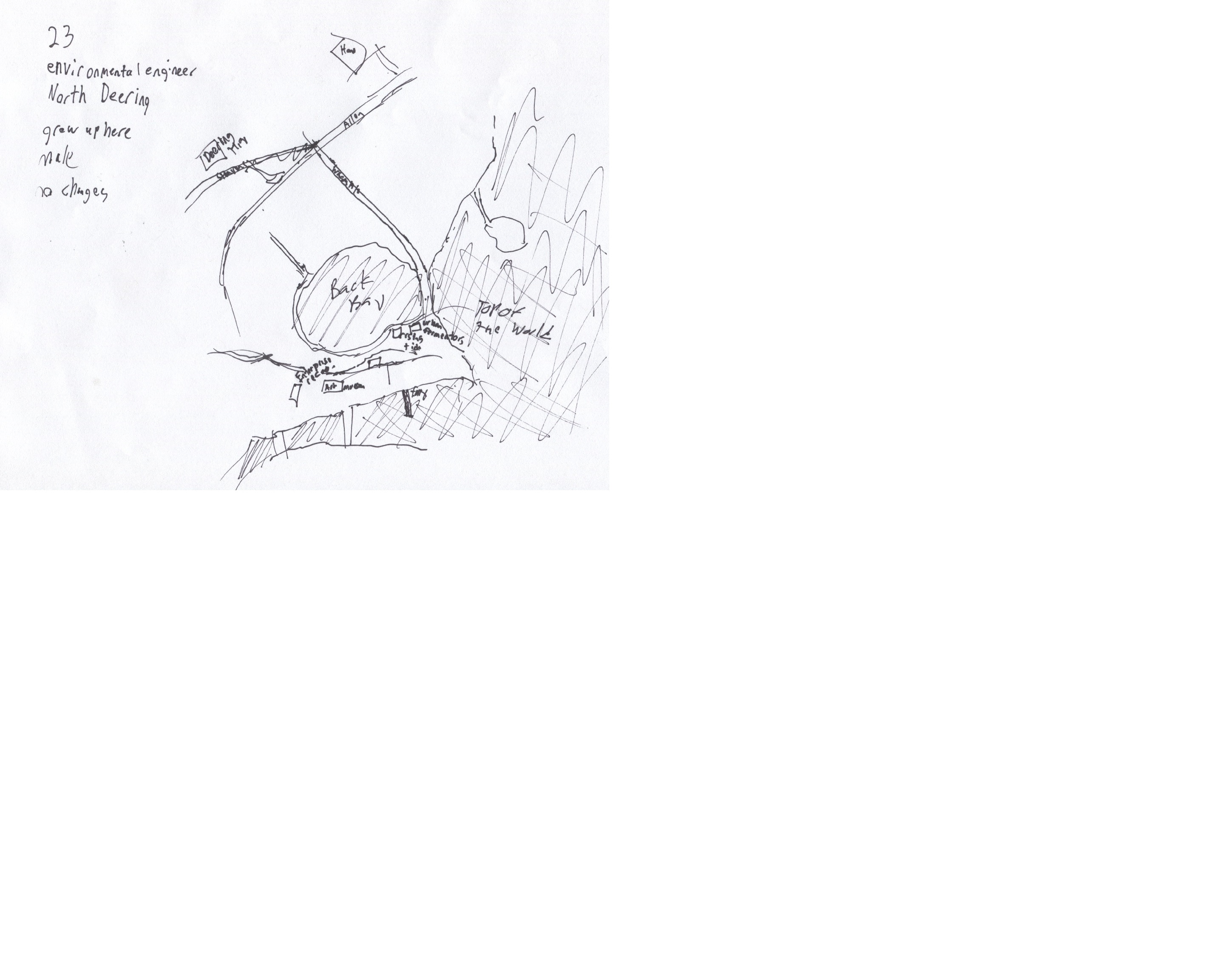
23 years old; environmental engineer; commutes from North Deering; grew up here.

Scan 8


24 years old; waste collector- compost; Pre-Eastend; 5 years here; This is where his projects are and his friends; Wishes that public consumption were legal

Scan

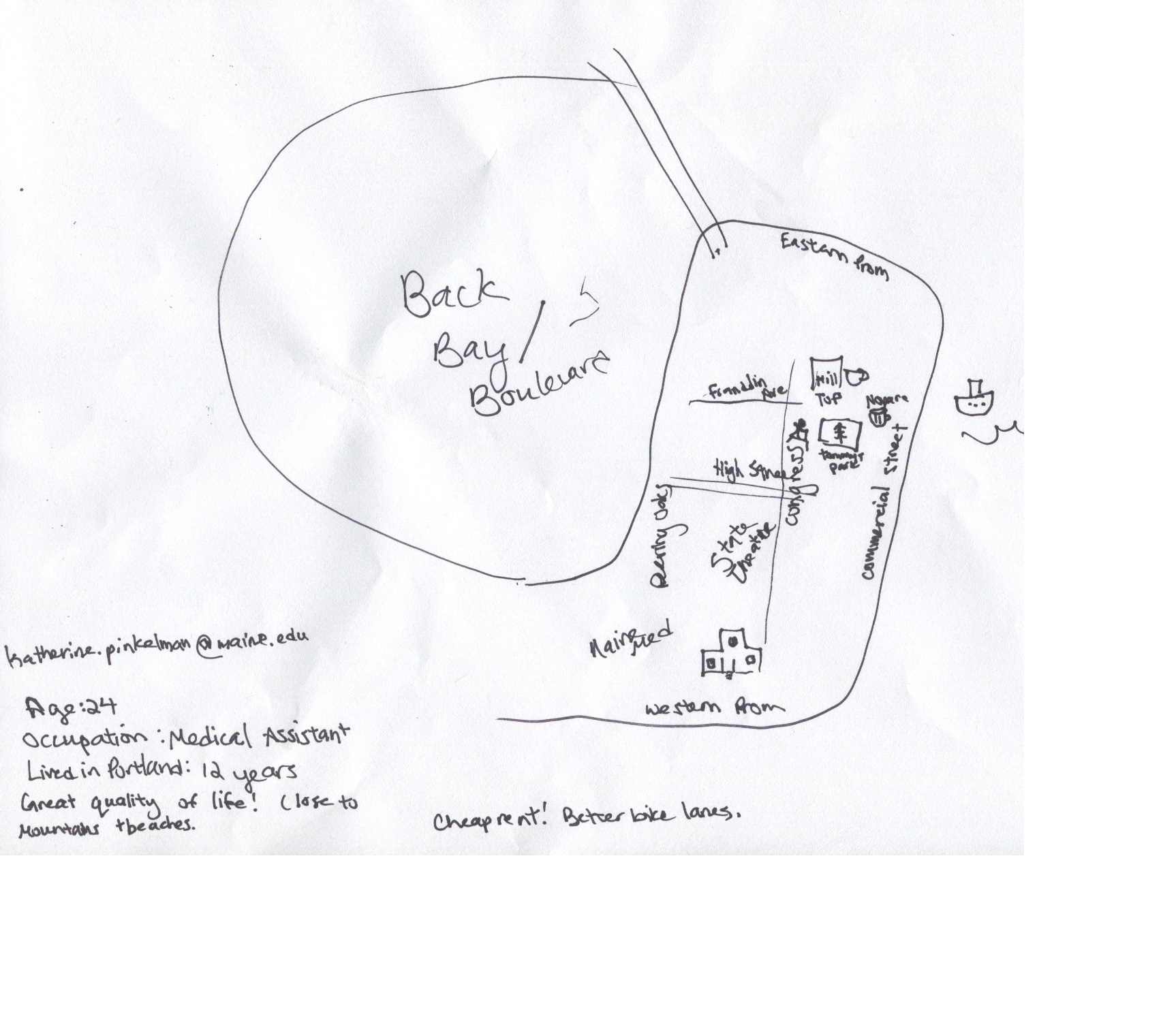
Age:24; Medical Assistant; lived in Portland 12 years for great quality of life; wants cheaper rent and better bike lanes.


Scan 3


So the first thing that I notice is that everyone is white and between the ages of 20 and 40. there is one older person who appears to be about 60. He is the only person who is overweight at all. The others are all very fit. About 80% of the people in here are women. about 15 people in the shop. A couple pairs of people are talking. the guy next to me is drawing. several people including the older man is reading. Most people have some kind of beverage in front of them. some do not though.

The first black lady just walked in. She ordered a coffee and sat down. She has some sizeable head wrap on. Demographics still very different than the city of Portland.

The lady next to me got up and left. she was a 25-30 year old fit white lady in a chic coat. She threw her cup in the trash can and walked out the door without saying anything. The guy next to me is still drawing in his little notebook. I think he is drawing someone on the other side of the room.

A middle aned white man walks in and orders a coffee. He stands and waits for it. So far it has been about 50/50 people waiting at the counter for their coffee and people sitting down and standing back up again to go get it. I have not noticed if there is some trend about the demeanor of the people waiting where.

The people who are talking over at the other table are talking about giving people leadership in an organization. One seems to be the other’s mentor or something. Certainly a position of authority within the same organization. Both are women and it is not clear what organization they are talking about.

One of the a baristas is going to town with that broom around the large coffee grinders. She has been sweeping everywhere, but they have not been using those grinders since I got in here a while ago at this point so I wonder what she is sweeping up.

I go inquire about the WIFI. One of the three baristas sitting behind the counter says that it does not work and that none of them no why. My efforts to do work while in the shop are foiled. I go ask the man next to me to draw a mental map. He takes about ten minutes to do so.

A pair just walked in presumably a man and his daughter. She appears to be about 12. She is the first child I have seen in this whole part of Portland. The man ordered a coffee and is now loitering around the counter. I could not tell if the girl got something to drink as well. It does not appear as though she did.

An older white lady just walked in. she ordered a coffee and left. A couple have done that. The older folks seem to prefer to take their coffee with them than sit around in the shop itself.

Someone has decided that it is acceptable to talk on the phone very loudly in the middle of a coffee shop as though there were no one else there. She will not get off.

A middle aged man walked in in a jacket. he ordered a large something or other and came and sat down next to me. I think he may see me writing this. Awkward.

Dude next to me just busted out a huge drawing pad and a macbook pro. Six pencils and an iphone6 maybe plus.

Next to me are two dudes drawing. one with a brand new iphone the other with a verizon flip phone. The younger one has the worse phone and looks like it is all he can afford. the other guy’s appearance fits his iphone.

He too seems to think it is ok to just gab away on the phone as though no one else cared to enjoy the serenity of a hot cup of coffee and hipster music.

Now three people are on the phone.

The first small child just entered the store with his parents presumably. They got a couple cups of coffee while he ran around and made faces at the patrons. They left.

Several more people are now drawing stuff. Lots of drawing in the cafe.

The older gentleman is now messing with stuff.He seems to have a box of altoids that is filled with something else.

A couple probably in their late 20s just came in. They did not order a drink. They just sat down.

The guy who was sitting next to me (both of them) got up and were replaced by women. They are writing things. One of them is on here black berry.

In addition to the environmental engineer i just talked to there are several other people talking about environmental issues. They also worked at planned parenthood. This is likely a left wing place.

The people next to me are now German speaking. They speak very quietly and are dressed as though they were still out doors. the man appears younger than the woman but i believe they are married. Both wear rings.

Professor Gieseking just arrived. She is now ordering coffee.

The older gentleman is now leaving. Gieseking is likely to take his seat.

She did.

The German speaking couple has now gotten up. They are vacating the seat next to me.

Another woman has entered. She is very short.

There is a discussion of Boston navigation and the Liberty hotel in Boston. Also, there is a discussion of politics. Maine in particular. Opinions are left of center though not wildly so.

At this point I got up to ask a few people to do their mental mapping. While I did this, I noticed that many people were actually meeting up outside of the cafe and then entering. I thought this was particularly interesting because I cannot see why anyone would not just go in and sit down and wait for their companion there.

The people who entered from here on continued to be white in general. They also continued to be in their 20s and 30s.

In the entire time I was in and watching the building I noticed only two children under the age of 18. The whole area seems to be pretty light on children.


New Perspectives on Preble St. and Housing Sustainability

After spending time in Portland, observing at the café, collecting maps, and doing the transect walk, I have a much more comprehensive view of the people and the issues of the city.

Personally, I find people-watching fascinating, so I really enjoyed doing so with a more critical eye at the café. Cafés are fascinating places to do this type of work because of how amorphous they are – they can be spaces for solitary work, spaces for socialization, spaces for reflection and spaces for relaxation. The patrons I observed utilized the space for all of those purposes and more, supported by the café’s supply of toys, books and a piano. As Arabica is located in an urban center separated from Portland residential life, and many residents I have spoken to tend to keep their distance from the Old Port, it is plausible that many customers were tourists or visitors. Demographically, the crowd was quite racially homogenous. Throughout the couple of hours I was there, it became a younger and hipper scene, aligning with the “hipster” vibe described on Yelp.

I was intrigued by the prominence of Apple logos, as well as the phenomenon of people sitting across from each other scrolling on their individual phones, even children. In my Interactive Resource Map App idea from Post #2, I suggested that businesses might post about particular services like free wi-fi or food. It would be fascinating to gauge Arabica’s (and other cafés’) interest in participating in this app. I would imagine that different neighborhoods would have different staked interests – business owners in Old Port, as a tourist center, might be less interested as the presence of homeless and at-risk citizens might drive visitors away.

Talking with the man who drew my fourth mental map was particularly interesting. I approached him outside of Preble Street, and he was very quick to comment that he was a full-time chef and was not homeless, though he had been previously. Describing Portland as a “cesspool,” he lamented the lack of affordable housing, which “makes it impossible for people to get on their feet.” He noted that he does not think he is “better than anybody else,” but he finds Preble Street’s housing first model unfair for people that are more committed and more likely to make positive change in their lives. Before chatting with him, I had only heard Preble Street’s housing first model discussed reverently. I never thought I would hear the accessibility of the organization criticized by somebody that uses its services. Hearing this perspective changed my understanding of the dynamics of homelessness and outreach programs – I had not fully considered the issue of stratified groups within shelters. Going forward, I definitely would like to hear more from viewpoints of people who use Preble Street’s services to get a fuller understanding of its workings and effectiveness.

My conversation with the woman who drew my third map confirmed my earlier concerns in Post #4 about climate change impacting a coastal port city. When asked if she had suggestions to better Portland, she commented that the city should work on developing infrastructure and housing in Back Cove in light of frequent flooding and rising sea level. These are incredibly important concerns that often get put on the back burner, so I was grateful to be reminded to acknowledge the role of climate change in Portland’s future.

Cafe Ethnography

Saturday October 4
Arabica Café (Formerly Café Crema…ambiance described as “hipster” on Yelp)
9 Commercial St., Portland

2:40 pm
-The café is on Commercial St, so we’re right on the water and there’s a lot of salt in the air. There is an enormous cruise ship looming over the docks, much larger than the buildings in my line of sight. Trolleys keep passing by, one of them sponsored by Whole Foods and another sponsored by Shipyard.
-The café is pretty crowded. There is an interesting age range – primarily babies and elderly people. There are a few people on laptops and on dates, some people at the bar on cell phones, some couples reading or chatting. There are a lot of paintings up on the walls – a bunch of trees and flowers, a butterfly, a fish. Pretty standard coffee shop stuff.
-The line is daunting. I’m waiting for it to die down before I get some much needed coffee but it seems to keep growing.
-People scatter around the spacious interior of the café after getting their beverage but almost everybody stops at the table stocked with sugar, milk, napkins, and stirrers.
-The apple logo is everywhere you look. My friend’s Dell stands out in the crowd.
-Children congregate around the gelato case.
2:50
-A girl with a stuffed animal monkey hangs on her mother’s arm and begs for gelato. A boy walks by with a couple of bike tires draped around his torso like a sash and opens the door for a stream of customers.
3:00
-The girl with the monkey got gelato after all – success.
-A mother with a large camera takes a photo of her son biting into a brownie. The boy’s sister plays with one of the toys provided by the café. Her brother joins her. Now they’re both clutching the same toy. A fight is brewing… “Daddy, he’s not sharing. I hate boys.”
-The workers here seem pretty scattered. They run around and deliver people’s orders.
-A woman walks in with a young girl on her shoulders. A boy in line with his mother swings her hand back and forth and laughs somewhat maniacally.
3:10
-A woman walks by and asks us what discipline we’re studying. She tells us that she teaches medicine.
-My friend Elisabeth is taking photos for her photography class. She takes a picture of the gelato. “That was fun,” she says. Word.
-There’s a small bookcase behind us next to an antique piano. The Hunger Games, Chuck Palahniuk, Agatha Christie. A kid screams about a puppy.
-My friend Sabrina got an enormous cappuccino and it’s making me rethink my apprehension about the line.
3:20
-I didn’t see it but apparently a man biked by the window wearing the hat of a “roman soldier.”
-A grey haired man with a rattail runs into a family he knows and everybody hugs.
3:30
-Time to brave the line. The crowd has thinned out a bit. Can’t tell if I should wait at my table or wait by up by the bar. Table.
3:40
-A woman wearing all red and many tattoos wipes off the central milk/sugar/spices table and retrieves stray mugs from around the room.
3:50
-Older friends meet up and exclaim, “They changed the name!”
-People walk by outside under umbrellas and wearing raincoats.
-The cruise ship is still hanging out (named Arcadia, like the Preble St. bar), the American flag is still waving on top. Is this a vacation cruise? Pretty dreary weather…I learned a bit about the social dynamics of Maine tourism this summer and I’m curious about the transition from summer to fall.
-Engaging in people-watching commentary and staring at this massive cruise ship is making me want to reread “A Supposedly Fun Thing I’ll Never Do Again.”
4:00
-We’re collectively unhappy about the outlet situation. (There are very few, and none of them close to us.) Sabrina is keeping tabs on the movements of the “two old men in back” sitting at the table with outlet access.
4:10
-The two old men have exited and I’ve snagged a prized outlet spot. Brightness is up, phone is charging. What luxury.
4:20
-My new vantage point now includes the rattail guy & family from earlier. The young girl in pink taps furiously on a phone screen, brow furrowed in concentration, as the adults around her chat. A woman in a flannel sits and reads at the bar.
-The ones who didn’t know the café changed its name stand up and exit.
-I think everybody who was in here when we arrived has left by now. Our crew has spread itself out around the café as if by osmosis.
4:30
-A guy just walked in in a bright yellow disposable plastic poncho. He’s owning it.
-The man behind him in line has the word ‘SUPERVISOR’ printed on his back. He’s glancing shiftily around the café, looking very alert. He’s doing a great job.
-An older couple to the left of me sits across from each other and scrolls through their individual phones, occasionally showing each other a photo and giggling.
-There is a minor kerfuffle at the register because they are out of caramel.
4:40
-Oh no, I smell a banana in the vicinity. I’m terrified of bananas.
-The young girl in pink has put the phone down and her chin is on the table in a display of boredom.
-Sabrina comes over to ask if I can hear the music, which she describes as weird and “whisper-y.” She suggests that I move over to join her at her table, from which I’d have a perfect line of vision to the rattail man, access to the sounds of the weird music, and – most importantly – distance from the banana. She is very convincing and I agree.
4:50
-The demographics have changed significantly since we first walked in. The scene is much younger and trendier, with almost no families or kids.
-A bald man behind me asks for the wifi password. It’s espresso.
-Sabrina asks me if I noted the floating door. I hadn’t. There’s a door about a story up the wall toward the back of the café, very much floating as described. She is very helpful. She shows me a video of thirteen dogs jump roping. It’s really worth a look. https://www.youtube.com/watch?v=YtwPzyppOyY
-The man and the family are leaving. He is welcome to visit them any time. Lots of smiles and good feeling and jokes about the weather. Haha, it snows a lot here.
5:00
-The music is decidedly weird – “It’s gotta chill,” says Sabrina. Lots of alternating growling and whispering.
-The cruise ship is moving now, trudging along parallel to the street as comparatively speedy cars zip by.
5:10
Heading out.

Mental Maps

MentalMap1

-25 year old male
-Works in freelance
-Has lived in Portland for five years
-Lives in Munjoy Hill
-Wants the results of our study to be communicated back to Portland residents as opposed to “sitting in a warehouse,” but doesn’t want to be contacted about the study

MentalMap2

-64 year old woman
-Gardens, cleans houses, helps with her husband’s carpentry business but is “semiretired”
-Has lived in Portland on and off since she was a kid, now commutes there for work. Lived in four different places in Munjoy Hill, one place in the West End, and one on Peak’s Island (now “Yuppie-ville)
-Her and her husband were “hippies” in conflict with the “greasers,” who threw beer cans at them. “When the greasers started doing drugs, everybody got along.”
-She lived in NYC out of high school, was “too stoned” to remember what part of the city though.
-On Portland gentrification, she commented that the city is “becoming an extension of Boston” and that Old Port, formerly dangerous, is now “money, money, money.”
-Emphasized walking, trees, and cemeteries (“Every cemetery is worth walking through.”)
-Expressed concern about the rising sea level, particularly in Back Cove, and suggested infrastructure to support flooding in that area
-Wants to be contacted about the study at [email protected]

MentalMap3

-Alex, 25-year-old man
-Drives the Portland water taxi
-Went to high school and worked in Portland, has been living there again for a month on Anderson St.
-Suggested an app for public transportation schedules

MentalMap4

-31 year old male
-Works as a chef
-Lives in the “western part down by Denny’s”
-Called Portland a “cesspool,” has lived in Burlington and believes it is an infinitely better city. Commenting on Portland’s skyrocketing homeless population, he noted that other cities are sending their homeless to Portland because of the city’s outreach programs
-I interviewed him outside of the Preble Street Resource Center. He said very quickly that he is not currently homeless, but was homeless in Burlington eight years ago.
-“I’m a chef, I work full time, and I can’t even afford to get an apartment.”
-The lack of affordable housing “makes it impossible for people to get on their feet.”
-Commenting on Portland’s skyrocketing homeless population: “All these other cities are sending these people here because Portland has outreach programs and stuff like that”
-He criticized Preble Street Resource Center’s housing first model. In a homeless shelter he stayed at in Burlington, “you had to show them some type of effort.” He commented that the Preble Street model “takes away” from “people who are capable of working,” from people who will be receptive to help and assistance. He also complained about the lack of follow up review.