
This, I must sat say, is a tough assignment. Picking five smart city infrastructure suggestions that specifically applies to Portland, ME is not an easy task. At the end, I chose these:
- Sidewalks and plazas that create energy as one walks by
- Industrial outdoor heaters
- Scenic public waterfront view
- Free public wifi
- Outdoor public theater
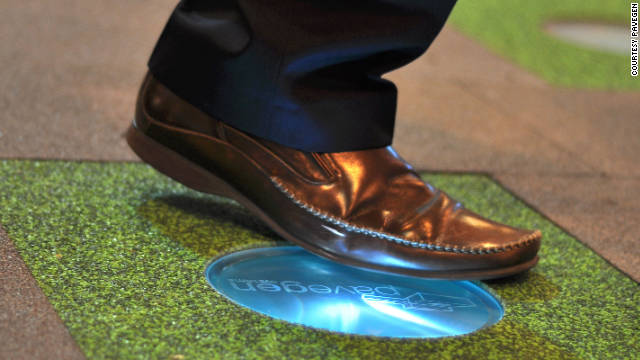
(Webster)
The infrastructure idea I will focus on is the kinetic energy absorbing pathways. The above picture is from a company called PaveGen™. These are grounds that would be implemented into popular high kinetic energy locations like roads, sidewalks, pathways, plazas, and even sport fields. Every foot step could produce “enough electricity to keep an LED-powered street lamp lit for 30 seconds.” (Webster) Greenfield would argue that because the technology is effortless “the behavior of a system offers users little insight into how it actually works. And this opacity leads to trouble when things breaks down. “(Greenfield 50) This technology is taking advantage of Human’s mindless acts and in return is creating electricity. People will not know how it works, but they would be able to understand they create energy from moving, and depending on the ground it can absorb it. On that note I suggest the service be handled by the public sector, because like Greenfield points out, “The notion that cities are machines with work-flows that can be optimized seems more clearly misguided.” (Greenfield 54) Meaning it can not be run like a business effectively. One can not privatize the energy to companies, because it makes no sense for companies to make a profit on what consumers generate, nor can the technology be fully optimized to cut costs.

(Webster)
During our field trip, we saw a lot of movement around old port and the by the shipping docks. According to the areavibes™ website, 10% of workers in Portland, ME walk or bike to work. That is at least 4,577 people who rely on Portland’s walkways to get to and from work. One of the most popular events in Portland is First Friday also known as the Portland Art Walk. The Portland Press Herald says, “Every month, more than 60 venues participate in the Art Walk, and as many as 3,000 people from Maine, New England and beyond experience the state’s largest monthly free cultural event.”(Letters to the Editor) These are the minimal numbers that will at least be constant through good days. Lets say every person takes at least 100 steps to get to and from work and enjoy first friday, that would be enough energy to charge 30,000 smartphones from every first Friday of the month.
The Portland City is funding two thirds of the renovation of Somerset St where they are elevating the street between Pearl and Elm Street and adjusting the utilities to support increase in pedestrians and vehicles due to new private development (City of Portland). It also addresses flooding issues in Bayside (City of Portland). These new development can include PaveGen™ technologies; the problem is that this project is increasing the city of Portland’s debt by 70,000 (City of Portland). Increasing their debt even more is another debate. I would propose the increase in sustainable energy is worth it and will pay off in the future.
Cit of Portland, ME. City Council. Agenda Regular City Council September 15, 2014. N.p.: n.p., n.d. Web. 25 Sept. 2014. <http://portlandmaine.gov/AgendaCenter/ViewFile/Agenda/09152014-605>.
Greenfield, Adam. 2013. Selections from Against the Smart City. 1.3 edition. Do projects.
“Letters to the Editor: Art Walk, a Beloved Tradition, Turns 13 – The Portland Press Herald / Maine Sunday Telegram.” The Portland Press Herald. Maine Today Media, 14 Oct. 2013. Web. 27 Sept. 2014.
Webster, George. “Green Sidewalk Makes Electricity — One Footstep at a Time.” CNN. Cable News Network, 13 Oct. 2011. Web. 25 Sept. 2014.
The idea of smart pathways really stood out to me, I think this technology would help cut down the costs of street lighting, while creating energy in an environmentally friendly, green way. Massive energy consumption is one of the most pressing issues today, smart cities should be implementing more ideas that would make it possible to utilize alternative energy sources.
I think that energy created by pathways could also be used to power wifi routers around the city. I think it is extremely important to make cities self-sustainable, at least in some way in order to promote green energy.
I’d never heard of pathways that can absorb kinetic energy before; it sounds like a really neat idea! These energy absorbing pathways would not be able to completely replace other energy sources, but if the costs of installing them are low enough, I could see them helping the city with at least some of its energy production. Are there other forms of producing energy that could be implemented in Portland as well? I imagine solar panels could also be a somewhat reliable source of energy.
The kinetic energy absorbing pathways is a very cool idea. It would be a great way to reduce energy consumption and make Portland a greener city. I’m surprised other cities have not started implementing these pathways, or at least I haven’t heard of them. I think the hardest part would be redoing the infrastructure of the sidewalks as well as finding initial investments. Do you know how much these PaveGen devices cost and how many would be needed to make a significant impact on energy consumption reduction?
I too included an energy absorbing pathway as part of one my ideas, but I haven’t seen anything suggesting that PaveGen is a better investment than other alternative energy technologies, namely solar panels.
30,000 smartphones sounds like a lot, but think about all of the energy (and money) it would take to tear up such a huge section of Portland, build the PaveGen pads, ship them, put them in the sidewalk, etc. I think the best thing about them as compared to solar is probably that they promote a sense of community as everyone works together to produce energy for their environment. It’s a bit gimmicky but definitely cool.
Also, I don’t think your arguments against the private sector hold up. It isn’t really electricity that people are already generating, it’s pressure. Converting that pressure to electricity is non-trivial, and would be a valuable service. Also, optimizing the technology to cut costs would just mean the device gets cheaper and/or better at producing electricity from the pressure of people’s footsteps.
You have not deviated from your (lighted) path and shouldn’t. In fact, bringing in bike paths to this idea is totally inspired and if you were to look at sewer paths and other undergrad electric lines in the Portland files, you may find a way to map on to a pre-existing heat source and do this at a much lower cost. I cannot wait to see how it turns out.