
[gview file=”https://courses.bowdoin.edu/digital-computational-studies-2430-fall-2014/wp-content/uploads/sites/52/2014/12/DIOTC-Final-Paper.docx”]
All posts by eszuflit
Small Changes Make Big Differences In Portland Parks
While I have been making more abstract smart city recommendations up to this point, the transect walk revealed specific ways in which small changes could greatly improve existing public space. As I mentioned in Post #6, there is a lot of existing green space in Portland, but its structure or lack of amenities make its use less appealing. Changes including more seating, more interesting or inviting landscaping, modifying the parks’ interaction with the surrounding environment, and introducing more cultural programming, will render more thoughtful and usable spaces. This is consistent with our findings from the mental maps and cafe ethnography exercise. More attention should be made to the type of amenities that are in demand. For example, the Western promenade was used almost exclusively by dog walkers and joggers during our transect walk. A dog park and more water fountains (we only saw one), would better serve these populations. Wifi would also be an amenity that could invite increased use. More specific recommendations are included in the notes below.
Transect Walk:
Jackie, Emma and I did a transect walk through the West End beginning on Pine Street. We were looking specifically at public seating, but came up with more recommendations along the way.
While walking down Pine Street, we saw very little public seating. There were however, features that could have been multi-use, doubling as seating. One being a collection of stone pillars that made up a fence:

We also noticed the interesting mixed-use of buildings. Many large mansions had been converted to multi-unit apartments or business spaces. It was unclear whether some of these spaces were public space or not.
When we arrived at the Western Promenade, we noted how its featurelessness made it an uninviting space to spend time in. Despite being surrounded by many attractive historic buildings in a residential neighborhood with few other park options, the strip seemed underutilized. The sidewalk was in great disrepair.
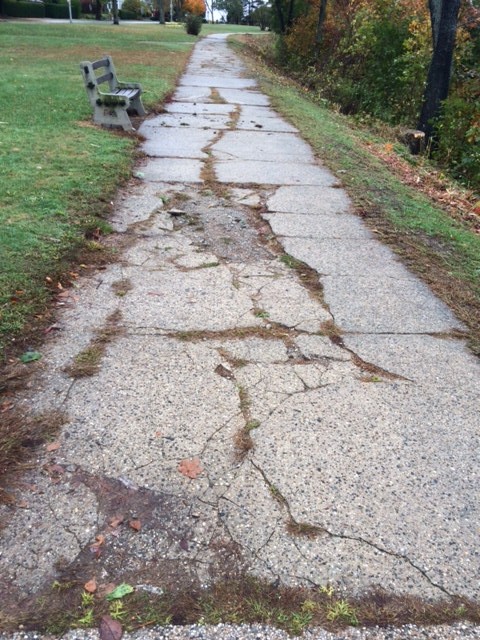
We saw six benches along the sidewalk, but they were also in poor condition. These were the only benches in the park, and they were facing away from the park into the overgrown slope leading from the promenade (see photo above). This was the least stimulating view in the whole park, as you could not see the bay or the park. The benches should be moved to face inward, or the overgrowth should be cut to reveal views of the bay. We also thought there should be more paths and benches and picnic tables in the green space, inviting more central use, as well as landscaping and attractive plantings. There was great potential in the space, but at the current moment, it was simply a buffer between houses and a walk to nowhere.

As we passed Maine Medical Center, we saw three blue benches in an ally leading to a back doorway. Signs above the benches said “No Smoking.” I do not mean to advocate for smoking, but that is the only thing I could imagine anyone ever wanting to use those benches for. They were outside a building in a back corner facing a wall.
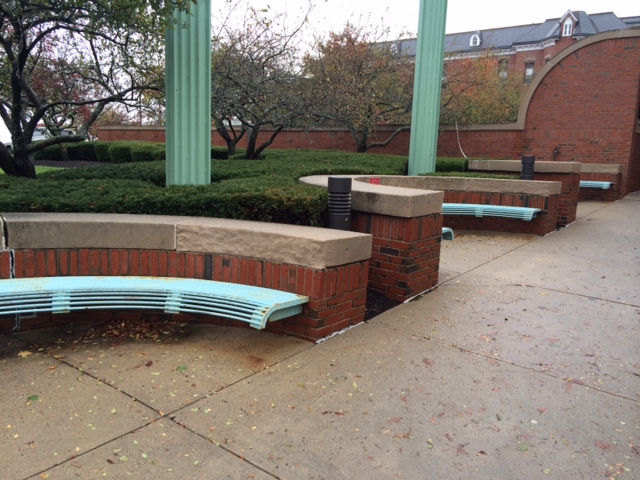
Seating would better serve the public inside of the hospital, in a courtyard, or facing the street, as it would be accessible and more visually stimulating. We found some good seating of this variety a couple steps further along Bramhall St. The low stonewall was a great height for sitting and accessible to the street. There were also benches in the bus stop shelter, though the area could have had more street lighting to ensure safety for bus passengers waiting at night.
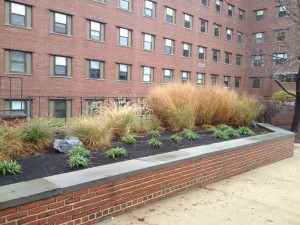
(Photo by Emma Chow)
We continued down Bramhall St. to Congress, where we saw little public seating or public space at all. At the intersection of Bramhall and Congress, there was a small greenspace with three benches. There was little space for large-scale activity in the greenspace, but the benches were well-placed for someone who wanted to take a moment to rest or watch activity on the street.
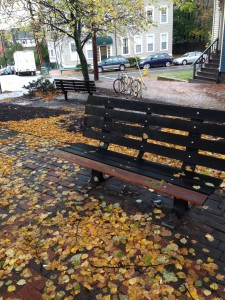
(Photo by Jackie Sullivan)
We went down Deering Avenue to Deering Oaks Park. The park has significant open grass for recreational and community activities, and a central pond. Similar to the Western Promenade however, it felt less a place to spend time, and more a nice place to “simply pass through.” A lot of this had to do with the physical features – or lack thereof. There were eight benches along the southern path of the park, but even this would only be enough to seat about 25 people – nothing near the desired demand for a large park on a nice day.
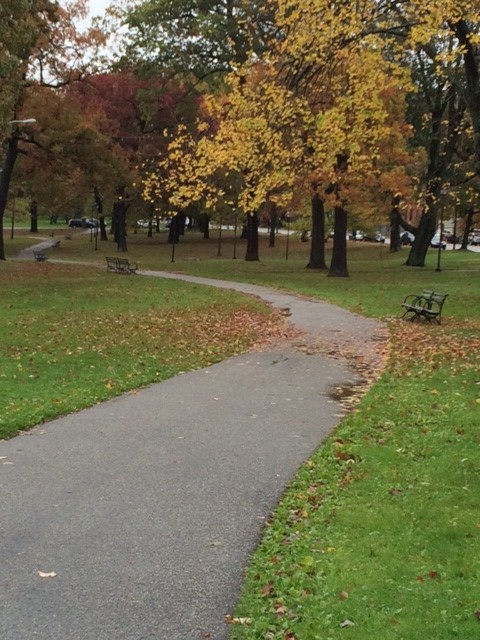
Surrounding the path were large open spaces of grass with scattered trees. To encourage greater use of the area, we thought there should either be a larger open grass space that could accommodate sports, or more intimate features like picnic tables, a gazebo, or small landscaping features. Otherwise, the area was too expansive and did not feel inviting.
In addition, the park should have a physical, or at least psychological, barrier between the park and the street. Park Avenue and State Street, the streets surrounding the portion of the park we walked, have heavy, noisy traffic. The park feels too exposed to these elements, making it feel simultaneously vulnerable to the dangers of traffic and an uninviting island. Hedges or a fence would make a large part of the periphery more inviting.
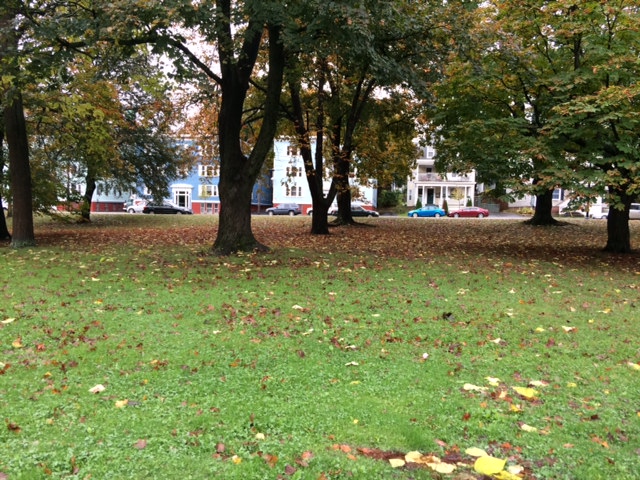
The areas between State Street and Forest Avenue do not even feel like a continuation of the park because they are so sectioned off by larger streets. There is some pleasant landscaping in the middle, but it has no seating, rendering it yet another park that is uninviting to lingerers. More seating, as well as varied, landscaping, would make an immense difference in this part of the park.
Portland does not suffer from a lack of public space or greenspace, but it could do a lot to improve the existing space and make it more appealing to visitors. Small changes could really get the city moving in the right direction – repaired sidewalks, improved landscaping, small amenity changes for the target audience of the park, and most importantly, improved seating, would make the Western Promenade and Deering Oaks Park much more enjoyable.
GPS Coordinates for Public Seating:
Pine Street Stone Blocks: 43o39’02.15″N; 70o16’09.10″W
Western Promenade Bench 1 (WPB1): 43o38’58.52″N; 70o16’34.65″W
WPB2: 43o38’57.33″N; 70o16’34.62″W
WPB3: 43o38’56.53″N; 70o16’34.73″W
WPB4: Missing coordinates (equidistant between 3 and 5).
WPB5: 43o38’54.50″N; 70o16’34.15″W
WPB6: 43o39’04.52″N; 70o16’34.98″W
Blue Hospital Benches: 43o39’07.83″N; 70o16’31.52″W
Stone Hospital Ledge: 43o39’08.62″N; 70o16’29.70″W
Hospital Bus Stop Bench: 43o39’08.95″N; 70o16’30.14″W
Congress St Bench 1: 43o39’14.78″N; 70o16’21.44″W
Congress St Bench 2: 43o39’14.44″N; 70o16’21.02″W
Congress St Bench 3: 43o39’15.00″N; 70o16’21.27″W
Deering Oaks Park Bench 1 (DOP1): 43o39’25.03″N; 70o16’20.17″W
DOP2: 43o39’25.32″N; 70o16’19.84″W
DOP3: Missing coordinate (equidistant between 2 and 4).
DOP4: 43o39’26.10″N; 70o16’15.64″W
DOP5: 43o39’26.22″N; 70o16’14.57″W
DOP6: 43p39’26.48″N; 70o16’12.78″W
DOP7: 43o39’26.84″N; 70o16’11.52″W
DOP8: 43o39’27.22″N; 70o16’10.67″W
Rethinking the Meaning of Public Space – Revitalizing Parks and Supporting Local Businesses
Two of my mental map-makers made recommendations specifically related to public space. One asked for more public parks, and the other for more paid street musicians. This demonstrates a demand for more culturally vibrant and engaging spaces. While there is a lot of green space in Portland, much of it is in inconvenient or uninviting places. One recommendation I am adamant about is modifying existing spaces to make them feel less desolate. There are many clear modes of improvement (more of which will be discussed in Post #7). There should also be more cultural programs in public spaces, promoting local business and the arts and engaging a diverse crowd. The Artwalk is a great example of how public space is already being utilized well for this purpose.
The café ethnography made me recognize the diverse patronage of a business that may appear to cater to only one type of person. Bard Coffee in itself acted as a semi-public space, inviting different groups for meetings and socializing. It served as a model for what a productive indoor public space in Portland would look like. It would be great to have an indoor lounge area with businesses like Bard Coffee surrounding it, but not necessarily requiring a purchase to spend time in it. The atrium could have public wifi and other amenities for people to work and meet. Indoor public spaces are important for continuing community engagement throughout the winter.
Cafe Ethnography:
Start: 4:20pm, Friday October 3rd. Bard Coffee.
- Two baristas and approximately 16 people in the café. The weather outside is sunny and cool. A barista, mid-20s male with moustache and red hat serves a drink in a white tea cup to a 20-something man with an afro, large glasses and a suit, the man then resumes using his iPhone. Two mid 30s women talk loudly by a column, presumably about money. The barista with the red hat carries a large canister from behind the bar. A man in a blue cycling uniform walks across the front.
- A man in a black long sleeve shirt sits on a couch, presumably doing nothing. Three blond women of varying ages stand by the water jug talking and leaning on the bar, presumably waiting for drinks. A woman in a blue rain jacket with a grey helmet waits at the counter. One of the middle-aged women is talking on the phone and reaching into her bag. A man in a striped button down shirt sits in a low chair and types on a mac laptop, writing emails, he has grey hair and appears to be about 40.
- Man in striped button down comments to us about how man in black long sleeve was creeping him out and trying to look at his computer. Man in red flannel with rolled sleeves and Macklemore haircut walks past. Old man with young man in blazer discuss drink options and order. Blazer man is very indecisive. Other barista, mid-20s woman with very short hair and large black glasses, is unexpressive. Red cap barista asks glasses barista to get the dishes in the back and she obliges. Older man with glasses and beard is talking with a young college aged woman, I suspect they are related.
- I just returned from a trip to the bathroom, there is a sign that says “If you don’t have the key someone will walk in on you and it will be awkward,” funny. Bathroom décor is an unusual juxtaposition between Starbucks-style stock photos of coffee and graffiti. A family of two grade school aged children and their mother walk in. The girl is in athletic clothes and the boy drinks water, the girl orders a hot chocolate for here. The mother pulls her wallet out of a tote bag. The old man and blazer man are now sitting at a table drinking coffee out of cups, the old man hands the younger man a small black book to look at.
- Potential father daughter pair hand the phone to each other to talk to a third party. A young man with headphones lounges on a chair, his headphones propped on his head to talk to a young woman with curly hair and glasses as she works on a laptop. The mother addresses the children by name and call them to the window. Two college-aged girls wait for the bathroom, they are both wearing tight pants under baggy sweaters and large bucket bags, they are typing on their phone. A middle-aged women in orange leaves the bathroom, hands them the key and smiles, they walk in together.
- One of the college aged girls leaves, while the blonde waits by the water jug, on her iPhone. Another bathroom key exchange between two older women wearing youthful clothing, one with polkadot blue pants, and the other with as shorter flowy skirt. Three 30 year olds discuss weekend plans, saying they always forget to make Friday plans, they laugh about something about a stripper. Young head phones man has taken off his headphones and resumes talking to the girl.
- Mother walks to bathroom with key, it’s attached to a whisk. Another mother, son and daughter group walk in, the girl is wearing a sparkly item from Pink, and the boy athletic clothes, the mother is wearing a jean jacket with a Coach bag. A headphones guy appears to be dancing around/stretching, unclear, while in line, and peers in the pastry case, red cap barista takes his order and counts change, flannel man inquires about what the different pastries are and buys one.
- A couple walks in, the woman is pregnant and the man is very beardy and has spiral gauge earrings, they have a child in a stroller, and wait for the drinks. A man with a backpack and sneakers, bald with sunglasses on his head, sits at the bar on a stool. A father has joined the first mother and children group and the daughter sits on his lap while the mother talks to her and she stretches around.
- Man at bar still sits, unmoved. Glasses barista talks to customer who is reading across the bar with a bun about the Artwalk. Bald 30-something man drinks iced coffee out of a tall mason jar while using a non-iPhone. The three 30 year olds, Suit guy with afro, woman with short hair and a bandana, and a beardy bald guy, are talking about watching Premiere League soccer.
- Old man in khakis and blue button down gets change. Two middle-aged women, one in scrubs pants and rain boots, the other with a striped sweater, approach the register and one orders a latte as the other gets water. Old man sits down on lounge chair. Glasses barista walks to the back, gets red cap barista to assist in making drinks. Three 30-somethings are still talking, about some man’s post about a man’s face, presumably an art piece.
- The three 30-somethings get up and leave. Man in red and black checkered jacket, ponytail and cap orders and sits at bar. Man with blond ponytail and gauges orders, woman in pink blazer and pencil skirt waits in line, woman in blue flannel and ripped jeans waits for drink, blond woman sits at table. The two ponytailed men sit next to each other at the bar, red flannel pulls out some photo prints, or possibly a vinyl.
- Pink blazer girl hugs a tattooed man with dreads that walks in and he asks about her day. They sit at a table and start leafing through big piles of yellow loose-leaf paper, he’s writing something and she’s typing what appears to be calculations into her phone. She says “for the 3rd, it’s $87.82” continues to rattle off calculations. Heart Skipped a Beat by the XX is playing on the speakers. It smells like coffee. There is a hiss, possibly from the speakers, possibly from a coffeemaker. A man in a poncho and a woman in camo enter.
- Really big family walks in, two young children, a tween boy, a blonde woman, a 30 something woman and a 50 something woman. I believe this is the second time Mouthful of Diamonds by Phantogram has played. Little boy sits on a stool, glasses barista pulls pastries out of the glass case for the big family. Blazer and dreads have put the papers back in a big accordion folder and are drinking coffee and talking.
- Man in pink t-shirt spills a lot of coffee and gets a napkin. Large family sits with pastries and teacups at a low table. The Dirty Projectors are playing again. Pink-tshirt waits in line. Middle-aged couple orders two large decafs. Ponytails are still talking at the bar. Old man is sitting with computer in chair next to big family.
- Middle-aged couple are now at the table next to us, man reads a newspaper the “Portland Phoenix.” Glasses barista pours hot water out of a shiny kettle into a shy tea cup, this may be a way of brewing the coffee? Older woman in the family shows photos on a camera to little girl and blonde woman, mother calls a place for reservations. Blue flannel leaves. Bun girl keeps talking to glasses barista.
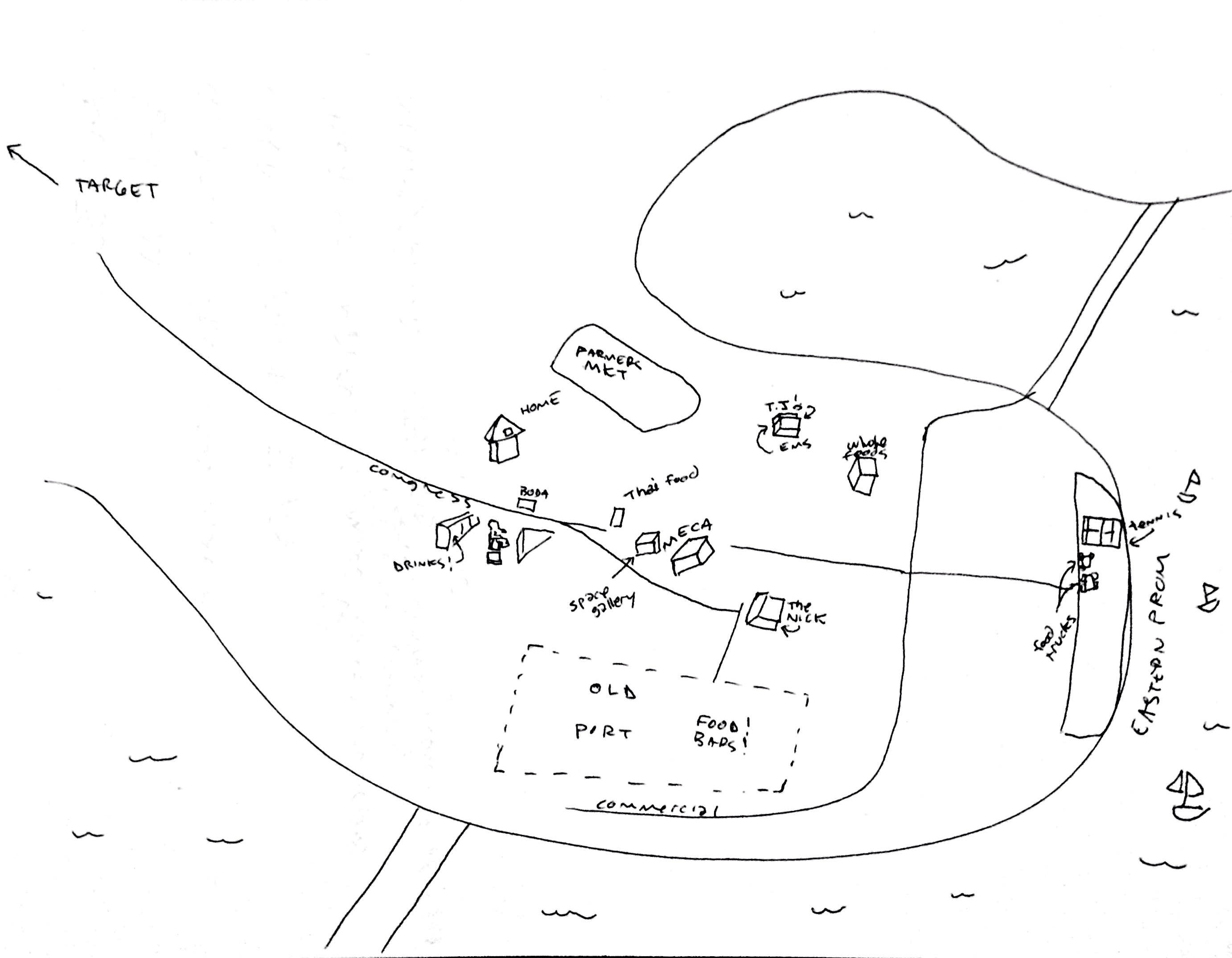
Mental Maps:
Map 1: Female, 21, Graphic Designer (MECA Student), lived in Portland 2 years, lives on Preble Streets, thing she would like to change about Portland is no more beggars.

Map 2: Female, 36, Artist, lived in Portland 2 years, lives in Arts District, wants more affordable rentals in Portland.
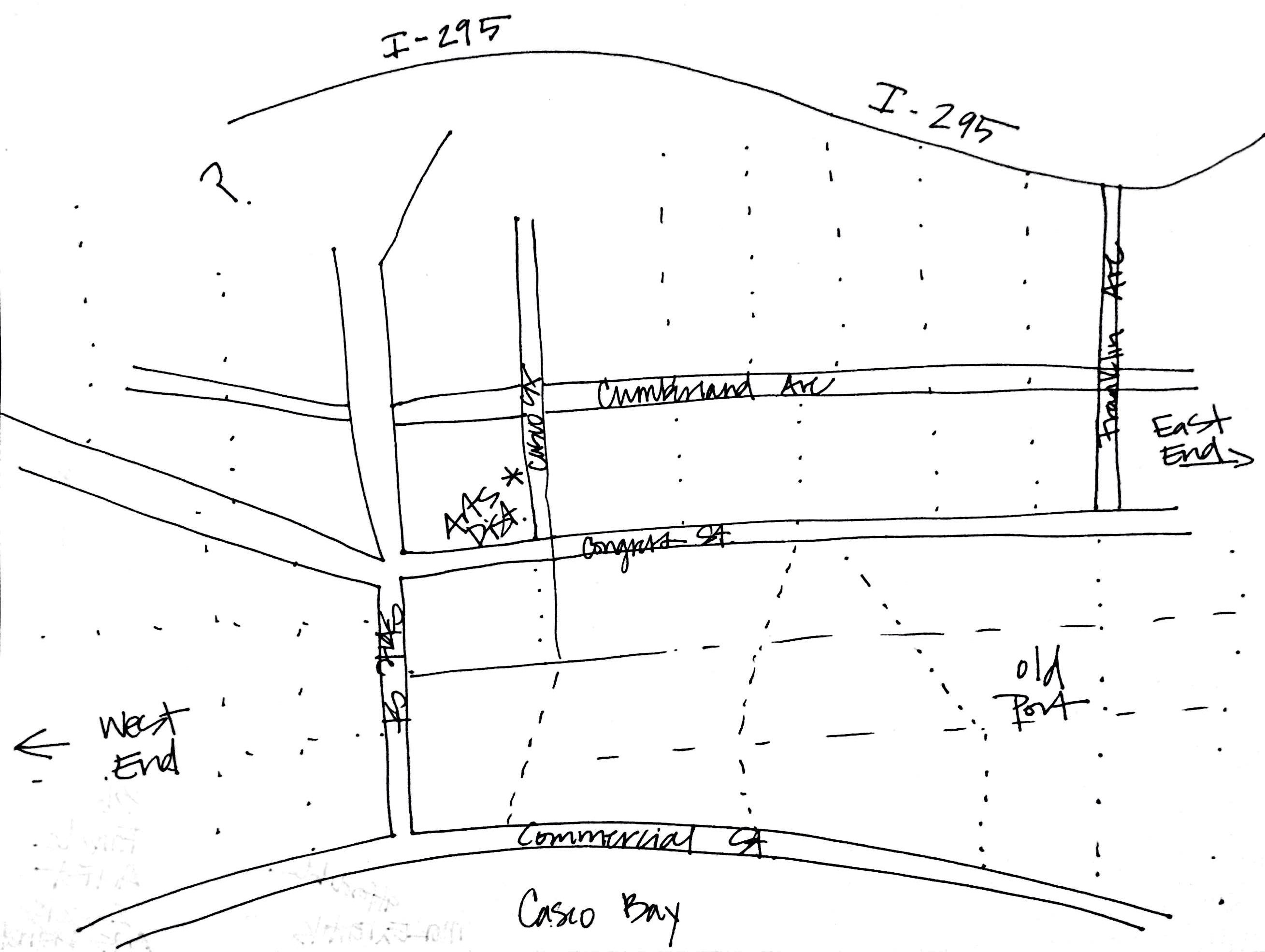
Map 3: Male, 26, Food Truck Server, lived in Maine 14 years, lives in Westbrook, ME (commuter), wishes Portland had more public parks.

Map 4: Male, 32, Admissions Counselor at MECA, lives in Portland 3 years, lives in West End (Parkside), wishes there were more paid street musicians (i.e. bucket drums) and better grocery stores closer to West End.
Democratic Participation in Smart Infrastructure
When I think of a smart city, I think of infrastructure that promotes well-coordinated and convenient movements of people, resources and ideas. This improved convenience, however, comes with decisions about what entities will be structurally (both literally and figuratively) supported. In “Traffic in Democracy,” Sorkin reveals the ways in which the city “organizes its prejudices and privileges physically,” namely by outlining how Giuliani’s New York was physically organized to prioritize the car.[1] This organization creates a social hierarchy that becomes imbedded in society. Sorkin describes the importance placed in “flow” in New York – increased speed to save time – and how this results on slower moving bodies deferring to faster ones.[2] This is not inherent, but rather structural. Denmark, for example, has infrastructure that heavily supports the bike as dominant. Bikes have their own lanes, traffic lights, and bridges. In Denmark, the car is the last priority, and their new “smart” technology is in accordance with this. They are developing what is known as a “green wave,” or traffic lights that will give cyclist continuous green lights during rush hour.[3] As Portland transforms into a “smart” city, it should consider updating existing technology to act in accordance with more pedestrian-friendly practices.
Unfortunately, many decisions about physical infrastructures – such as size of roads, capacity for public transportation, etc. – have already been made. Luckily, the advent of “smart” infrastructure, principally virtual infrastructure, has the opportunity to develop and organize itself more democratically. Jiminez discusses the potential for democratization of cities through “open technology,” with equal opportunity to access data and recreate the urban landscape.[4] We must be wary however, of how democratic they may prove to be. Individuals with no access to technology will be entirely isolated from this new form of infrastructure.
While this may seem to be an unusual parallel, “People as Infrastructure” made me think of ways in which people can serve as a different type of infrastructure in a “smart” city. In Johannesburg, interconnected networks of individuals acting as special economic and social links make difficult urban conditions more manageable.[5] The “smart” city also presents opportunities for increasingly large social networks that rely on collaboration and specialized knowledge. While an app may be the medium for information sharing, it is the individual’s initiative to, for example, report the location of a traffic jam, that makes up the content of the new technology. People will, in a virtual world, become a much larger participant in infrastructure than they were in the age when infrastructure was purely the sidewalks and power lines.
[1] Sorkin, Michael. “Introduction: Traffic in Democracy.” In The People, Place and Space Reader, edited by Jen Jack Gieseking, et al, New York: Routledge, 2014. 413.
[2] Sorkin, Michael. “Introduction: Traffic in Democracy.” In The People, Place and Space Reader, edited by Jen Jack Gieseking, et al, New York: Routledge, 2014. 411.
[3] “The Green Wave Spreads,” Copenhaganize.com, October 6th, 2008, http://www.copenhagenize.com/2008/10/green-wave-spreads.html.
[4] Jiménez, Alberto Corsín. “The right to infrastructure: a prototype for open source urbanism.” Environment and Planning: Society and Space 32 (2014): 342-362.
[5] Simone, AbdouMaliq. “People as Infrastructure.” In The People, Place, and Space Reader, edited by Jen Jack Gieseking, et al, New York: Routledge, 2014. 241-246.
“Smart” Housing and Social Inequality
When thinking about options for “smart” housing, my mind immediately jumps to the Crowley’s “system of systems.”[1] The house would be designed to be extremely energy, time and ideally cost, efficient. In some ways, this could also be linked with the common good, namely a more environmentally friendly lifestyle. When I was in Denmark, I visited the headquarters of the Danish national energy transmission operator, Energinet. Their latest innovation was the “Smart Grid” – a house that was wired to reach maximum energy efficiency. The house would have solar panels that would contribute energy to the grid. All the appliances would have monitors that would run them at the most efficient time of day. For example, your laundry would begin at the time of day that had the lowest overall energy demand on the grid, and this would correspond to the times when the most energy going towards your task came from renewable energies. The incentive would be cost – the device told you the savings you would have if you waited to run the appliance. The difference between the “Smart Grid” and Crowley’s system however, is the social media element. Like we had discussed in class, the utilization of Twitter has both the potential for shaming, and the gathering of personal information for targeted marketing. Seeing as the home is often valued as a private space, the possibility of enabling public data collection to come out of the home itself can be jarring. It places the private space of the home in the virtual public space of the internet.
Returning to the idea of the Danish “Smart Grid,” it is important to note that it is made possible because all Danish energy comes from a single, public supplier. This makes it advantageous for everyone to contribute to a central grid, with the aim of reducing overall costs. In a capitalist society, particularly one that is moving towards privatizing housing, this would be much harder to enable. I fear that as houses get “smarter,” there will be an even larger gap between housing quality and availability among different classes. As we read in Fields and Uffer, the privatization of rental housing can lead to rent hikes, neglect for lower-rent housing, and the pushing of maintenance costs on to renters.[2] These factors contribute to the eviction of lower-income families to make way for people who can afford the units, and this leads to gentrification. We learned from Smith’s piece that the idea of moving into a previously low-income neighborhood is seen as romantic and appealing, analogous with the taming of the “Wild West.”[3] Smart housing is at risk of becoming another mechanism in which to structurally limit opportunities for the poor, as housing not only becomes more costly for as a result of its location, it also becomes more costly for its infrastructure.
So what would be a useful form of smart city housing? I believe one that has a monitoring system that helps the inhabitant live more efficiently, particularly energy efficiently. It should not however, use social media as an alert mechanism, and should not collect personal information about the user. Unfortunately, I cannot think of a smart housing suggestion that contributes to the common good apart from environmental consciousness – at least not until this infrastructure can be made available in all housing regardless of class.
[1] Crowley, David N., Edward Curry, and John G. Breslin. 2014. “Leveraging Social Media and IoT to Bootstrap Smart Environments.” InBig Data and Internet of Things: A Roadmap for Smart Environments, edited by Nik Bessis and Ciprian Dobre, 379-99. Springer.http://link.springer.com/chapter/10.1007/978-3-319-05029-4_16.
[2] Fields, Desiree, and Sabina Uffer. 2014. “The Financialisation of Rental Housing: A Comparative Analysis of New York City and Berlin.”Urban Studies, July. 13.
[3] Smith, Neil. 2014 [1996]. “‘Class Struggle on Avenue B’: The Lower East Side as the Wild Wild West.” In The People, Place, and Space Reader, edited by Jen Jack Gieseking, et al, 314-319. New York: Routledge, 2014.
Brunswick Mental Map: Matt ’15

The Problem with “Smart” Monitoring Systems in Public Spaces
While a “smart” public space may foster unprecedented opportunities for entertainment, efficiency and convenience, we have to look at the ways in which universal access may be structurally limited by these improvements. Low describes contemporary examples of the ways public spaces are not inherently “open”: “many of these civic spaces are no longer democratic places where all people are embraced and tolerated, but instead centers of commerce and consumption.”[1] These spaces are designed for use by one portion of the population in preconceived ways, limiting freedom. A “smart” square could tend towards – if not necessitate – advanced surveillance mechanisms that would be beneficial for only a margin of the population. A space that could monitor movements and process information about individuals could lead to discriminatory mechanisms imbedded in the square itself. Squares that could track movements, for example, could send reports about squares most frequently used by homeless people, and lead to subsequent police monitoring. This would defeat the purpose of a public space.
A “smart” monitoring system would not only be potentially discriminatory, it could also reduce the quality of life in a city. One thing I have always valued about New York City is the ability to occupy your own bubble of “private sphere” in a public space. Given that your actions are for the most part safe and legal, no one will have a problem with anything you are doing. You have the benefit of being anonymous while experiencing the public life of the city. The prospect of a larger “smart” mechanism that makes the movements of your private life publicly documented takes some of the charm out of city living.
Given these arguments, I believe the best “smart” public space for Portland would have to use technology for the increased independence of the people, and not top-down monitoring. Both Low and Mitchell make the importance of liberated and unmonitored use of spaces known in their discussions. Low notes that it was the “spontaneous, less-regulated spaces” of New York City that were the most vibrant and healing memorials after 9/11. She goes on to say that, particularly spaces as emotionally-charged as Ground Zero “must respond to the different experiences and reactions of people throughout the city, divided as they are by age, generation, location, ethnicity, and class.” [2] A public space cannot be statically created to serve one purpose, but must be versatile to serve many different groups. Mitchell goes on to say that a public space cannot just be deemed “public, but “rather, it is when, to fulfill a pressing need, some group or another takes space and through its actions makes it public… The very act of representing one’s group… to a larger public creates a space for representation.” [3] A public space needs to be constantly taken up and transformed by different groups. It must include accessible, free technology that can be used productively by the public.
[1] Low, Setha M. 2002. “Spaces of Reflection, Recovery, and Resistance: Reimagining the Postindustrial Plaza.” In After the World Trade Center: Rethinking New York City, edited by Michael Sorkin and Sharon Zukin, 164. New York: Routledge.
[2] Ibid., 166.
[3] Mitchell, Don. 2014 [2003]. “To Go Again to Hyde Park: Public Space, Rights, and Social Justice.” In The People, Place and Space Reader, edited by Jen Jack Gieseking, et al, 195. New York: Routledge, 2014.
Public Space Suggestions: Interactive Walking Tours
Smart City Suggestions:
- Reconfiguring traffic space as public space: Using longitudinal data about traffic patterns (I don’t know if this exists yet), the city could open and close streets to allow for more public space. If certain streets get very little traffic, they could be repurposed as plazas. I know they did this in many major squares in Manhattan and it really improved both traffic and the quality of the area. The September 15th City Council Meeting made reference to the opening and closing of streets temporarily for festivals, it would be cool to seem them do this full time (City of Portland, 24).
- Interactive public art: It would be really interesting to see Portland’s public spaces integrate more public art, particularly interactive or “smart” art. We all remember the sad little fountain on our walking tour, wouldn’t it be great if the fountain could sense movement and put on special shows as people walked by? Or a sidewalk that played music to the beat you were walking?
- Indoor public spaces: Portland needs more indoor public spaces and atriums that would give a place for people to relax and socialize in the winter months. Thinking of a “smart” indoor public space made me think of Songdo’s smart buildings. These buildings could be designed as low environmental impact, with special temperature control mechanisms (maybe even those fancy shades). It could also be a central information hub, with screens giving information on the weather, transportation, traffic and world news.
- Interactive history tours: Many students suggested that they wanted more information about the history of the city and historic landmarks. Similar to the interactive public art idea, it would be great to have interactive history tours. Screens dispersed throughout the city could give you information about the site, show historical pictures, and tell stories. This could be similar to the bricks project we saw during the walking tour, except they could constantly update, with people submitting their own stories.
- A public space events app: An app advertising events could make public spaces less of a placeholder and more of a destination. Public spaces could host concerts, public theater, children’s workshops, and sponsored events from local organizations. This would help these spaces gain a reputation as vibrant locales. The app could also feature more day-to-day information, like which food trucks will be in which square when.
I think the most exciting suggestion would be the interactive history tours. The kiosks could support of a host of activities – facts, photos, and serve as a platform to share stories and experiences. It gives Portland a sense of places, teaching residents and tourists about the history of the area. It fosters a sense of community and acts as a virtual artwork through the sharing of stories. It would also help brand Portland as a cutting edge “smart” city. In relation to public space, it incentivizes spending time on the sidewalks, and treats the street as not just a thoroughfare to walk but a place to spend time in, appreciate and interact with.
Greenfield’s notion that the smart city is built in generic space and time made me realize how important the location and history of a city really is (Greenfield*). While a new smart city may be placed anywhere, generic versatility would totally neglect Portland’s unique charm. That is why I think learning about the constantly-updating history of the city is so important when experiencing it. Greenfield’s critique of smart cities as “pretending” to “perfect knowledge that are nowhere achievable” made my shy away from suggestions that were too far reaching. Greenfield states: that algorithms used to design smart cities suggest “there is one and only one universal and transcendently correct solution to each identified individual or collective human need,” and that this can stifle diversity or malfunction (Greenfield). The kiosks don’t carry this risk because they are about fostering the creative and human aspects of the city. The September 15th City Council Meeting did not address any creative aspects of the city – it was only concerned with permits, development and maintenance of infrastructure. I would be nice to change this.
On a completely unrelated note, why/how are they able to publically publish the criminal records of a man trying to get a liquor license for his restaurant? (City of Portland, 49)
Sources:
- Greenfield, Adam. 2013. Against the Smart City. 1.3 edition. Do projects.
* I couldn’t get page numbers on the Kindle. - City of Portland. Regular City Council Meeting: September 15th, 2014. Portland, ME: September 15th, 2014.
Community Support of Public Spaces
The research aspect I would like to focus on is public space. I recently read “The Death and Life of Great American Cities” by Jane Jacobs and was really intrigued by her claims on what makes a vibrant park. She said that public spaces needed to be surrounded by neighborhoods of diverse use to support a constant flow of different types of people throughout the day. A solely business district, for example, would be totally vacated by the evening, increasing likelihood of crime and eventually gaining a reputation as a dangerous area. I started to notice these trends as I was walking around New York City. The “ideal” public spaces that I passed, Washington Square Park for example, are surrounded by offices, schools, shopping and nightlife, and is always crowded. Cadmen Plaza in Brooklyn however, is surrounded by offices, tall apartment buildings, and major roadways, and is vacant at many points in the day. Many of the green spaces we saw on the field trip today followed similar trends — while they are well-kept in themselves, they are surrounded by major roads that make them inconvenient. Looking at the amenities and activity introduced into the public space, like we saw at Congress Square, is also interesting. What makes people want to use a space? It’s easy to get a vibe that a public space is underutilized or even hostile, but what generates that impression? It seems Congress Square’s level of use turned around in a few months, does that indicate that popularity is based more on physical characteristics than reputation?
The Townsend lecture got me thinking about the best way to develop and implement the improvements to public space. He kept returning to a central theme of grassroots, bottom up development in terms of smart city information sharing. This summer, I got the chance to speak with a Bowdoin alum who works at Project for Public Spaces, a non-profit that works on urban grassroots “placemaking” (I believe they worked with Congress Square, as a matter of fact). Their approach is to educate and support communities and make recommendations about the best ways to transform their spaces, but leaving the direction and implementation to the local community. I believe this a fascinating and vital approach. I have yet to think of any local applications for smart city technology for public spaces, but I’d been interested in exploring that further.