
[gview file=”https://courses.bowdoin.edu/digital-computational-studies-2430-fall-2014/wp-content/uploads/sites/52/2014/12/Paper-Proposal-copy.docx”]
All posts by jibsen
Views of Portland from a Firsthand Perspective
For my mental maps, I interviewed two middle aged males (around 50 years old), one 30 year old male, and a woman in her early 20s. They all lived and worked in Portland, though the two older males lived on the border of Portland.
It was interesting to find exactly how much one can tell about people and a city from their mental maps. For example, the two older men both included University of Southern Maine (where they were taking classes), Starbucks (a frequented café), and Hannaford (where they buy cat food and groceries). These landmarks suggest a typical student or settled down family in an urban area. Compared to this, the notable landmarks of the 30-year-old barista at Coffee by Design were good bars, gentrified areas, and coffee shops. And, the woman who worked at Love Cupcakes (a cupcake truck) drew at the places the truck travels to, along with a map that focused more on the streets of Portland (probably because she drives through the areas for work).
I interviewed three of these people at Coffee By Design on India Street, where I did my ethnography. Though the neighborhood did not seem very touristy, the people coming to the café seemed like affluent people with low diversity. Since it was raining for the majority of my time at the café, most of the people who came inside were meeting people, or they at least stayed for a while.
The people I spoke to all seemed to agree on one thing: Portland has a lot of areas that need work. The three men I interviewed stressed the pros and cons of the gentrifying neighborhoods to the extent that Sean drew them on his map and Peter made pretty clear distinctions between the neighborhoods. It was really interesting to see how the residents (of 20 to 30 years) perceived the changes in Portland and how the changing city affected their lives.
However, the technological suggestions did not reflect on the gentrification, but more at the infrastructure of the city. Public transportation was mentioned every time and overall, the request that Portland become a more accessible city. Whether the suggestions were adding a more functional bus line, rebuilding a trolley system, or creating parking apps that list free spots around the city, it was agreed that Portland needed to improve its accessibility.
Another improvement was free public Wi-Fi. With a growing need to always be connected, public Wi-Fi would definitely be a realistic addition to the city. Portland is large enough that there is a demand for public Wi-Fi, yet it is small enough that this suggestion is manageable. Additionally, a few people suggested creating better parks and overall, more green spaces in Portland. All the suggestions from the people I interviewed would be good ideas to help improve the city of Portland, though many of them are more basic suggestions that do not actually involve technology. However, they provide the necessary structure for a growing city, which would then allow for more technological improvement afterward.

Hannah:
Age 23, white female, lives on High and Sherman for over a year
Technology Improvements: Free public Wi-Fi, all 2-way streets, some sort of parking map that shows occupied spots (apparently, it already exists for certain cities)

Sean:
Age 30, white male, lives in the East End, has lived in Portland ~30 years total.
Problems with Portland: There is no outreach of what people want in the city, unaffordable condo, Portland is using money on arts to amp East Bay Side, but displacing middle class because housing is becoming unaffordable
Technology Improvements: Public transportation, some sort of rail line, public Wi-Fi

Peter:
Age 49, white male, lives in Rivertown for 26 years
Problems with Portland: Unaffordable for working class, condos are too expensive
Good things about Portland: Green space → lots of trees, green areas (compared to other cities), the ocean and islands nearby

James:
Age 54, white male, lives in Rivertown for 33 years
Problems with Portland: Bigger companies are coming in and taking out independent business, there is a sense of false diversity (pockets of immigrants), unaffordable housing
Technology Improvements: Better public transport system → more times, more reliable, restrictions on amount of bars in city at a given time (changed nature of Old Port and downtown Congress St), nothing privileged in parks (Woonerf system), bike friendly streets
Café Ethnography (10/4/14) Coffee By Design, India Street
Cloudy, rainy
4:00pm
I first went to Bard Coffee—very hip and located in a central place
Now on India street: much more empty–maybe that means less tourist filled?
Raining outside…not many people walking around
Seen a few people in groups with umbrellas
16 people inside café
many apple products → ipad, iphone, laptops
people sit on the outside of the café first (chairs near front window, tables along walls, in back)
one man walking, couple walking
signs outside have small graffiti
horse carriage passed
three friends just met up → two women, one man (white)
man stays in café for a while…talking about hybrid cars
4:10
18 people in cafe
many people in line to order food
people are sitting in the middle of the table row (because place is more full)
couple closest to windows individually reading newspapers
man alone with headphones writing in a journal
three friends that met up earlier talking
man sitting alone on computer with headphones
gets up with empty coffee mug to order more
couple walking outside (white; male and female)
they parked across street → walked in, tried to use bathroom (locked)
slowly walk in and stay close together as read the menu out loud
ask for bathroom key
father and son sitting outside at restaurant across the street
4:20
couple still reading newspaper
group of three left
two women talking at middle table
lonely man w headphones went outside to smoke cigarette
16 people inside cafe
a few cars driving past
some people walking on street
couple looking at bathroom (following map to get key for door)
no one really staying outside → mostly in transit
bob marley playing
man walked up to man smoking → looking through window at people inside café
4:30
I’m definitely the youngest person here
Only people here alone have headphones in and on computer
A lot of people still wearing jackets → either cold or not too comfortable?
4:40
Everyone is doing something → reading newspaper/magazine, working on computer, talking
Most people here are in conversation of two people rather than doing work
14 people and a baby!! (which is included in the person count—I just wanted to emphasize its presence)
baby/child and father are playing on the ground in back of store
Man walked in and then left
Family walked in and looked at bathroom
Man walking dog outside
Though not a very touristy area, still affluent seeming people in coffee shop
Well dressed, using technology, people leave stuff at table when getting refills
INTERVIEWED BARISTA
4:50
15 people in cafe
many people in line (barista paused interview)
two younger (mid teens?) girls (white) alternating turns and holding possessions in bathroom
5:00
two women still talking
16 people here
two men sitting at table – one writing, one reading newspaper
lone man still writing book
waves of people (many people at once, then empty)
when people order, standing around counter
man sitting, using phone
5:15
most people here for conversation (meeting up other people)
some people doing work
INTERVIEWED 2 MEN (the ones sitting at the table)
(yes, it took 45 minutes –they had a lot to say)
6:00
no one here (7 people including 2 baristas)
employees cleaning → sweeping, vacuuming
very friendly bartenders (I got a chai latte on the house)
female barista wanted people to leave so she can sweep
couple sitting together secluded in window area
man reading map alone by window
6:30
8 people here (and another baby!)
Asks barista a question about the map
Barista sweeping → Closing/cleaning up/winding down
Man drinking tea with baby (sits in comfortable chairs by window)
Waiting to meet someone at cafe
Shrek music playing (Accidentally in Love)
6:40
Since it’s later in the night, more people here individually
7 people here (including baristas)
Not as many cars outside
People walking by alone
Man with baby is looking at the products for sale (and singing with the baby)
Blink-182 playing
6:50
Middle aged people left
Mostly younger people still here – 30s?
Low diversity
middle aged
Sustainable Aspects (and Parks) of Portland
The data I collected during my transect walks reflects the sustainable aspects of Munjoy Hill and Deering Oaks Park. I paid attention to gardens, composting bins, recycle bins, trash bins, and solar panels (along with some other observations). Though, it was interesting to see that a few buildings actually did have solar panels, overall there were not many “green” indicators throughout Munjoy Hill. In fact, I did not see one recycle bin anywhere in Portland!
When I interviewed for mental maps, the barista at Coffee By Design mentioned Portland’s composting system and while I was visiting a bakery, there was publicity for the composting system as well. However, it was challenging to note which houses actually recycled or composted since I walked around on a Sunday and both are collected on Tuesdays. It would be interesting to see how many people actually compost since my data does not accurately reflect the people.
While walking, I passed one park (Fort Sumner Park), which was overgrown and not particularly cared for. It was hidden in a residential area, but had a GREAT view of the city (see picture below)! The bottom half of the park did not have much, but once walking up the staircase, there were four benches overlooking the city. Another noteworthy green space I saw was the East Promenade, which is one large park along the shore of the eastern side of Portland. It did a good job of providing enough seats for visitors, the history of the area (such as at the Fort Allen Rehabilitation Park ), and attractions that appeal to a wide range of people. There was a playground, a baseball field, picnic tables and benches, and spaces to walk along near the shoreline.

Fort Sumner Park on Sheridan (Taken by Jenny Ibsen)

The View from Fort Sumner Park (Taken by Jenny Ibsen)
When I walked around on my second visit, I went to Deering Oaks Park, which had an interesting use of space because there was a large central fountain and pond, yet there was no seating around it.
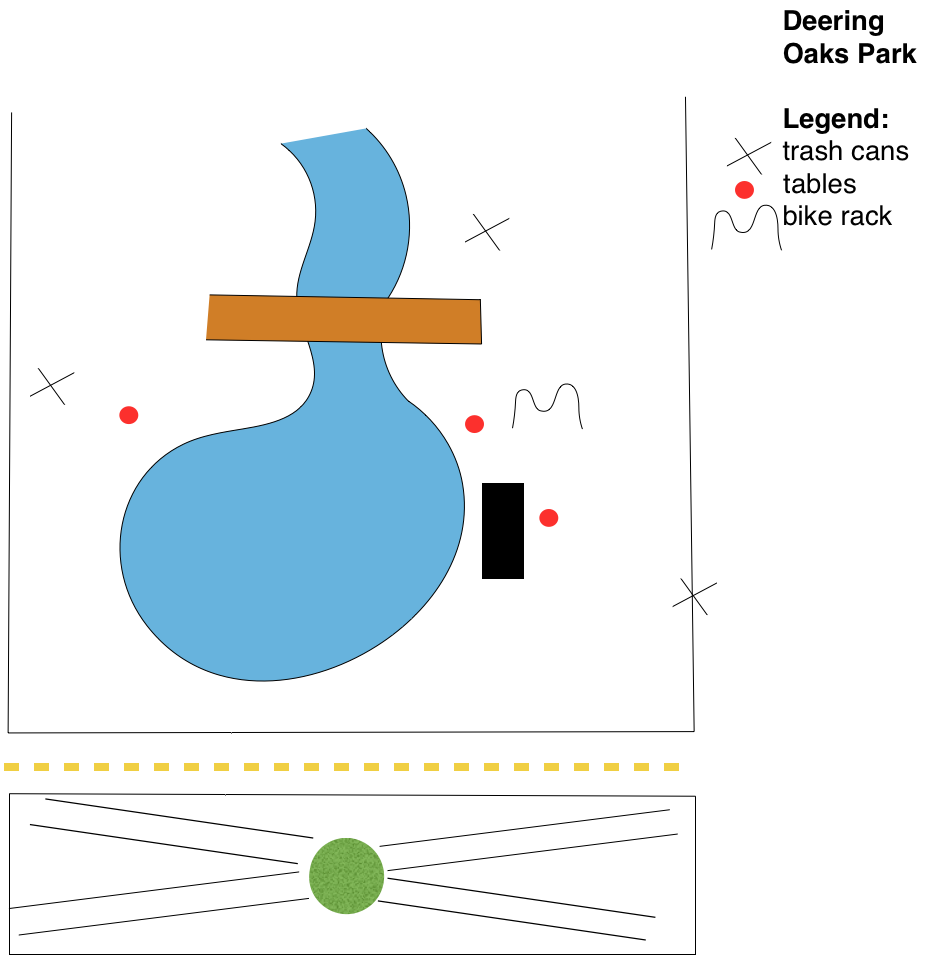
Deering Oaks Park Map (Drawn by Jenny Ibsen) – My extremely rough sketch of the park, including all the trash cans and picnic tables that I saw during my 30 minutes there. The black rectangle is a stage and the green circle is a plot of plants.
The park had several awkwardly spaced benches in an abundance of purposely uncared for grass. There was a sign posted nearby stating, “Sections are purposely left unmowed in order to return to a more natural and healthy woodland.” This was extremely interesting because though naturally maintained gardens are more sustainable, I have never actually seen this in practice. This could be more effective in the park if there were more attractive aspects to the park. There were not enough seating options to attract a large amount of people, and aside from the stage, there were not many other reasons for people to visit the park in general. This, in addition to the uncared for grass, gave the park an overall average feel (though, it did look nicer than other parks in Portland).
Overall, Portland has a few impressive aspects of green technology, but could use some work for the basic framework of the city. There were solar panels a few buildings and there were plans for them on a newly constructed building. I was also surprised by the abundance of Hybrid cars, mopeds, and Partial Zero Emission Vehicles (PZEV). Yet, the city definitely needs to work on its public green spaces and frequency of recycling bins.
Transect Walk
Started: Eastern Promenade (10/19/14)
- Lots of plants at houses
- Garden (corner of E. Promenade and Turner)
- Hybrid car—236 E. Prom, corner of Quebec and E. Prom, 304 E. Prom, corner of Melbourne and E. Prom
- I don’t know why I kept track of this—they just seemed really abundant
- Solar compacting trash – 288 Eastern Promenade
Walked to Walnut, then Willis
- Hybrid—23 Willis
Montreal St
- Corner of Willis and Montreal—first graffiti sign
- Garden: 41 Montreal, 46 Montreal
North St
- Newly developed houses
- Multiple family buildings (condos)
- School located at 129 North St
Walnut, Sheridan
- Green Clean building (local company?) —179 Sheridan
- Organic waste container (curb to garden program)
- Hybrid car
- Area feels empty
- Developing? House under construction across the street
- Solar panels on picture
- Graffiti and overgrown garden
- Fort Sumner Park (hidden view of Portland)
- 107 Sheridan – laundry line in backyard
- 106 Sheridan – recycling bin outside house
- 99 Sheridan – Moped
Cumberland
- 62 Cumberland – solar panels on roof
Sheridan, Congress
- 159 Congress – garden
- 127 Congress – partial 0 emission Subaru
St. Lawrence, Monument
- many front yard gardens
- 53 Monument – garden
Waterville, Sherbrook, St. Lawrence
- garden – 70 Waterville
- recycling bin – 72 St. Lawrence
- Moped – 61, 52 St. Lawrence
Fore St, Eastern Promenade
- Many decks on first and second floors of houses
- Large windows
O’Brien
- 4 O’Brien – organic waste, kWh usage outside house, recycle bin
Eastern Promenade
- 64 E. Promenade –recycle bin
- Fort Allen Rehabilitation Project
- Bollard lighting (instead of over head street lamps)
- Solar compacting trash (no recycling)
- 64, 84 (around corner) E. Promenade
- empty green space
- recycling bin—168 E. Promenade
- roads close to shore, green grass, randomly placed benches facing water
- few trash cans, but no litter??
- Solar compacting trash
- corner of E. Promenade and Congress, Turner and E. Promenade
- First water fountain!! (corner of E. Promenade and Congress)
- Playground (few trash bins where expected (around edges of playground area)
- Many houses have roof windows or natural lighting
- Corner of Congress and E. Promenade
- 222 E. Promenade – garden
Other places (drive back to 295)
- Solar panels — Washington and Cumberland
- School and Solar panels, community garden (North St)
- Pick up to 295 – solar powered signs
Deering Oaks Park (10/21/14)
- No seating near fountain/pond
- Benches along paths and borders
- Only saw 3 trash cans
- Some lampposts located near paths
- Trees near bridges are abundant
- Grass is naturally kept
- What is under the bridge?? Looks like it should be the pond but actually dried up… L
- Stairs leading down to the pond on northern side of bridge
- Park continues across street…no benches, no trash
- Outside park: some houses, commercial, industrial area, near highway
**Added November 3, 2014:

Transect Walk: Above is a map of my transect walk (the red point mark indicates my start and stop location).
Creating a People Friendly Street
Jiménez describes and defines what he believes to be the right to infrastructure. He claims that, “The infrastructure is not something that is ‘added’ to the social…but, rather, something that becomes reinscribed as a constitutive ‘right’—the right to define and redefine one’s infrastructural being.” [1] Whereas some aspects of a city are additional, such as aquariums, galleries, or museums, infrastructure is a key component to the structural existence of a city. It is a right, not only for the city, but also for the people.
Useful kinds of infrastructure include physical, such as highways, electric power; social, such as police and hospitals; and data, such as the underlying codes that run the city. Simone reinforced this idea of infrastructure by taking it to the next level, claiming that not only are the physical elements of a city essential to the infrastructure, but also the people living within the city can form their own infrastructure. [2]
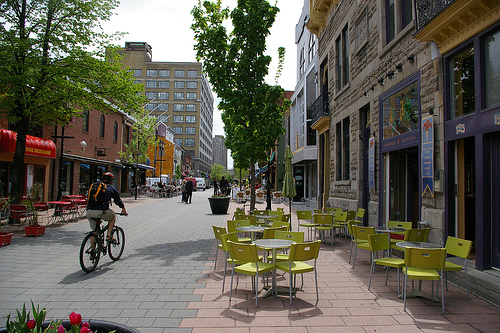
In Sorkin’s essay, he describes an essential element of infrastructure is the flow, which is directly related to conflict avoidance. [3] This means, the flow of traffic and how efficiently things run. When I interviewed a man in Portland for the mental maps, he mentioned that Portland should import the Woonerf sidewalk and public space system, which would help the neighborhoods flow. It is a system based on the concept of shared space that encourages interaction between all forms of transportation (i.e. bikes, pedestrians, and motor vehicles). This includes the idea that the sidewalks are at the same level as the roads on which vehicles drive, and in fact, sidewalks and bike lanes are not even labeled separately. This allows for travelers to be conscious of their surroundings, which creates a more equal system of travel, along with a more people friendly environment.
Another idea that would help advance the infrastructure in a city would be putting the electrical systems and telephone lines underground. This is helpful in the case of a storm, so the power is less likely to go out, and it makes the streets safer, and more aesthetically pleasing. Though these are not necessarily the “smartest” ideas, they are the beginning to creating a more friendly and clean space for the people who live there.
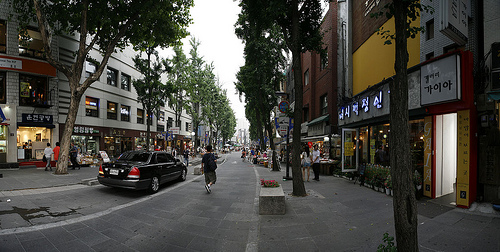
[4][5] These pictures are examples of the Woonerf system.
1. Jiménez, Alberto Corsín. 2014. “The Right to Infrastructure: a Prototype for Open Source Urbanism.” Environment and Planning D: Society and Space 32 (2): 348.
2. Simone, AbdulMaliq. 2014 [2004]. “People as Infrastructure: Intersecting Fragments in Johannesburg.” In The People, Place and Space Reader, edited by Jen Jack Gieseking, et al, 241–46. New York: Routledge.
3. Sorkin, Michael. 2014 [1999]. “Traffic in Democracy.” In The People, Place and Space Reader, edited by Jen Jack Gieseking, et al, 411-415. New York: Routledge, 2014.
4. Woonerf. Digital image. Web. 8 Oct. 2014. http://www.livingstreetsalliance.org/wp-content/uploads/2012/01/Woonerf.jpg
5. Insa-Dong Woonerf. Digital Image. Web. 8 Oct. 2014. https://c1.staticflickr.com/5/4117/4775157676_38b75188d7.jpg
Implementing Smart Technology With Regard to the Audience
With a growing ease of accessible technology available at our hands, it is only expected that “smart” housing will soon become normative. Crowley suggests in his essay that, “The vision of a Smart Building is of one that optimises its internal environment for the comfort and usability of its occupants while minimising the resources required to run and maintain the building.” [1] One of the suggestions to implement this is running a house entirely on one system: controlling the heat and electricity through the same means. This smart design is furthered with an experiment to test how users can become engaged with the system through Twitter. This involves posting requests such as, “Could you turn off the lights?” publically on Twitter for the user to be tagged in and to respond to. Though this is an efficient method to keep energy usage low and to keep the user in-tune with the house elements, it is definitely concerning. There’s a point at which being too connected is not necessarily the best solution. It is effective, but how much more effective? Is it actually worth doing? Another way to ensure the same energy is saved is automatic lights…Do we actually have to take this to the next level of technological advancement? This system has elements that help the house run efficiently in terms of energy usage, which is useful in promoting the common good. However, there are definitely other smart systems that provide the same benefits.
A few effective forms of energy efficient solutions that could be implemented in Portland include the use of solar power or automatic electrical audits. The use of solar power energy is increasing for not only large companies, but also individual houses, and even parking lots. Though expensive to implement, solar powered energy can be useful in the future because it is a form of “green” energy and will eventually be cost effective. Certain large parking lots can also implement solar powered canopies, which serve as a roof to shade the cars, while also collecting sunlight to power a nearby building. Inside a house, instead of having the system publically tweet the user to conserve energy, it could complete an automatic audit on electrical consumption within the household. Audits can be beneficial in identifying the main contributing factors to energy waste in a private household or a larger company. With the audit, the informed user can then respond with the proper means to reduce electrical consumption.
In general, smart housing is an efficient and beneficial way to promote energy sustainability using technology. But, there is a line at which becoming too dependent on technology is probably not as effective as a less technologically involved solution. Once again, the Twitter solution, as mentioned above, is probably an excessive attempt to create smart housing. However, another caveat of smart housing is the audience to which smart houses appeal. Yes, smart housing is beneficial, but it is also expensive. Since smart technology is not as frequent as it could be, it is more likely that, at the present time, smart technology would be used in a gentrifying neighborhood. Smith states in gentrifying areas, “Hostile landscapes are regenerated, cleansed, reinfused with middle-class sensibility; real estate values soar.” [2] Smart technology is often though of as a clean, regenerating form of efficiency, yet it comes at a price. The problem with creating a smart neighborhood with more economic value is that it then becomes unaffordable for those previously living there. So, how can a smart neighborhood that does not only serve the elite form? The usage of smart technology should be dispersed throughout the city so that technological pockets do not form. An effective way to incorporate smart buildings into a city would be for companies to implement them first so that they ideally, would become more normalized. Additionally, the city could provide subsidies on purchasing smart technology, or incentivize the usage of smart technology through decreased housing taxes. Smart technology is definitely growing in popularity and appeal in cities, especially with an increasing desire for cities to become smart, yet the audience of smart technology must also be considered.
- Crowley, David N., Edward Curry, and John G. Breslin. 2014. “Leveraging Social Media and IoT to Bootstrap Smart Environments.” In Big Data and Internet of Things: A Roadmap for Smart Environments, edited by Nik Bessis and Ciprian Dobre, 381. Springer.
- Smith, Neil. 2014 [1996]. “‘Class Struggle on Avenue B’: The Lower East Side as the Wild Wild West.” In The People, Place and Space Reader, edited by Jen Jack Gieseking, et al, 316. New York: Routledge, 2014.
Brunswick Mental Map: Maya ’16

Successful Public Spaces (Jenny Ibsen)
Public space is a defining characteristic of a city. Whether it is in the form of a stationary location, such as a park or plaza, or a mobile space, such as the subway or a sidewalk, public space is a social area that is open to the general public. As Low described in After the World Trade Center, useful public spaces are areas that utilize the five characteristics of public space: accessibility, action, claim, change, and ownership. (1) This means that the spaces are accessible to the general public, they are good spaces to do a variation of activities, they provide areas that individuals can claim, they are malleable, and they are dependent on ownership. A good example of public space is Central Park in New York City. It is large enough for individuals to have their own niche and to host a wide variety of events, yet it still remains completely accessible to all kinds of people. During the summer, the park is bustling with festivals and rentable paddleboats, while in the winter the park hosts ice skating rinks and winter festivals, along with several visitors’ centers scattered throughout. All these events hosted at Central Park help contribute to a safe feeling environment, friendly to a wide variety of ages.
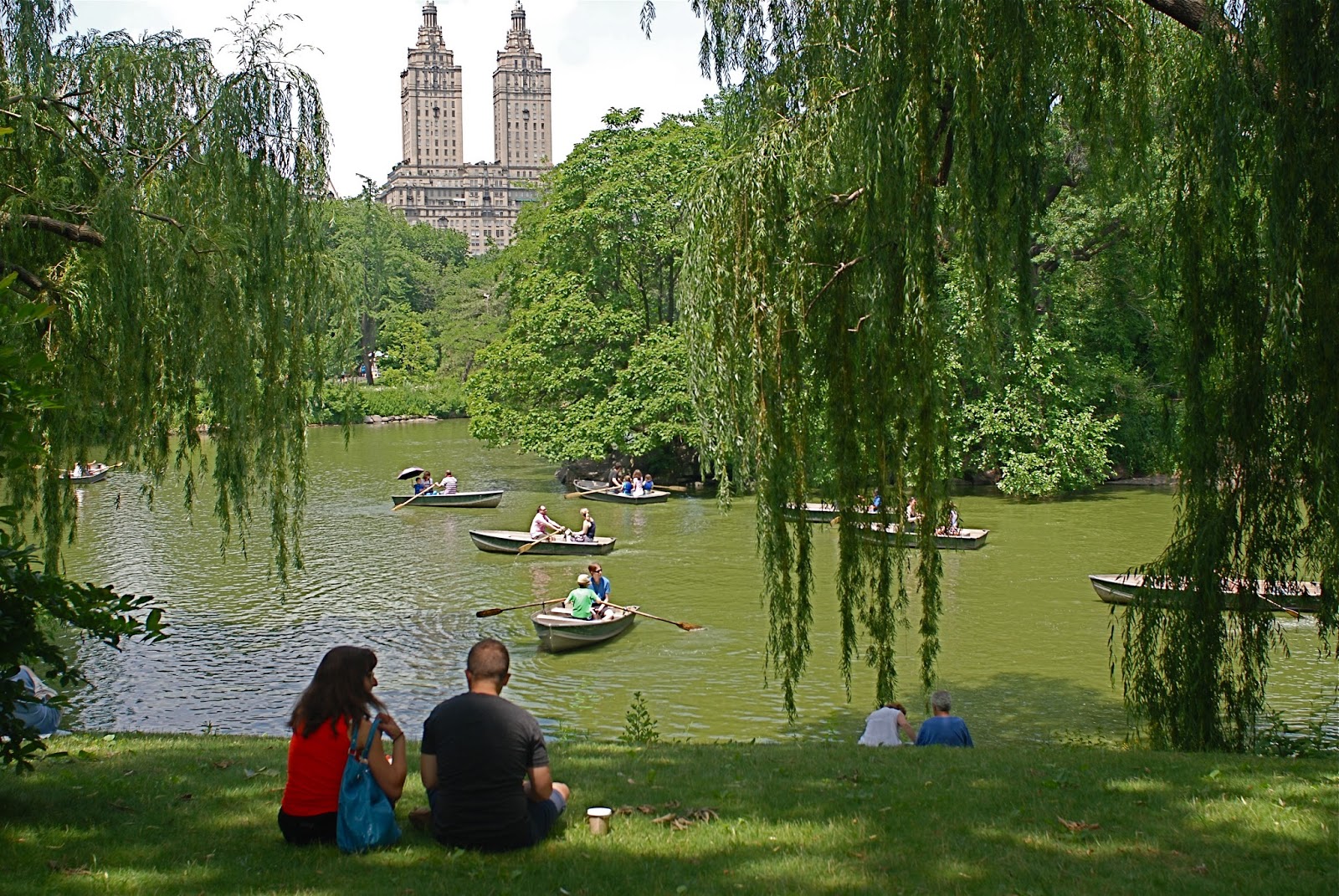
Central Park in Summer (2)
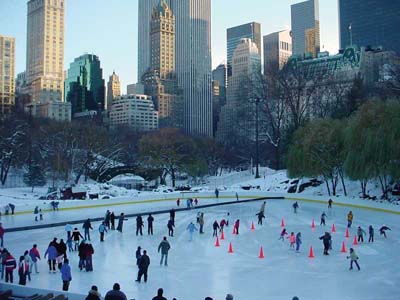
Central Park in Winter (3)
Smart public spaces would only vary in that they are “smart.” A smart city should be very accessible to various forms of transportation (such as walking, biking, buses). It should have seating! (Benches, chairs, places to eat, grass to lie down on, etc.). People should want to go there: whether this means a destination or a necessary path taken as travel. Features that would attract people would be the accessibility of Wi-Fi, seating, and other enticing activities. If a public space were geared towards promoting the common good, it would display aspects that correspond with those of the common good. There are several sub-categories of “common good” that could be appealing in form of public space. There are environmental concerns: the availability of recycling and composting bins, a community garden, solar powered lighting, and a variety of flora and fauna. Then there are qualities that provide people with necessities: the availability of free water, provision of shelters for rain coverage, seats and tables, lighting for night. Lastly, there are areas of comfort: space for activities (fields, bike paths, playgrounds, etc.), proximity of food (food stands, food trucks, cafes), display of art (sculptures, demos, displays).
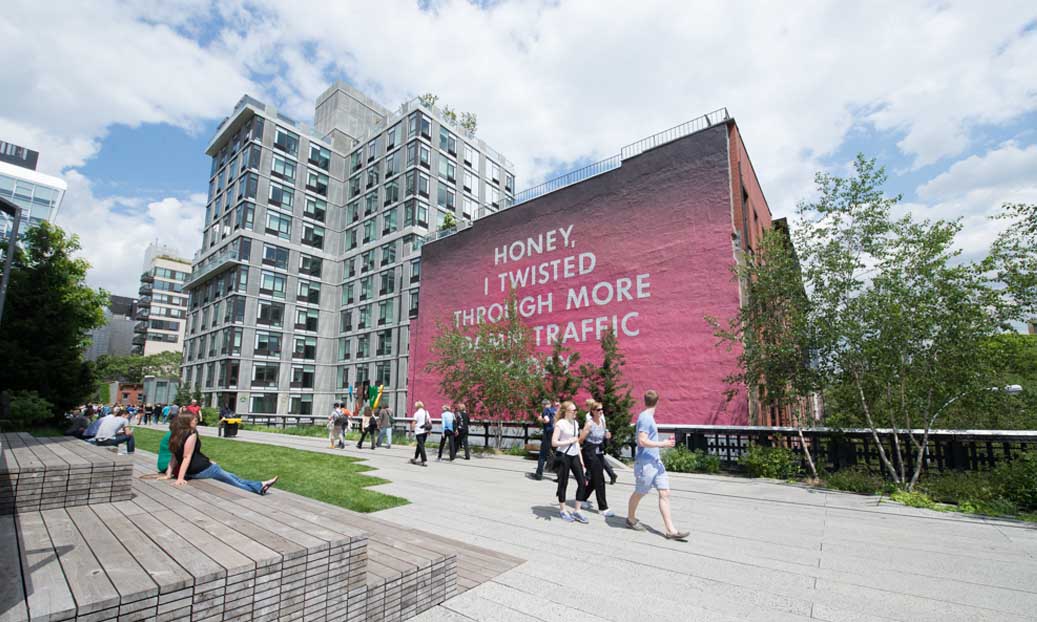
The High Line in New York City does a good job incorporating artwork into the public space. (4) (http://art.thehighline.org)
To truly be accessible and public, as Mitchell stressed, the area would need to feel safe: this includes being functional in both day and night, which would be possible through lighting and a strong sense of community. (5) If parks in Portland supported the qualities listed above, they would be a step closer to further developing their public spaces. The key aspects to making a successful public space are comfort, safety, and community.
Sources:
1. Low, Setha M. 2002. “Spaces of Reflection, Recovery, and Resistance: Reimagining the Postindustrial Plaza.” In After the World Trade Center: Rethinking New York City, edited by Michael Sorkin and Sharon Zukin, 163–72. New York: Routledge.
2. http://2.bp.blogspot.com/-fXbN0JdE4gA/UdtmPUGNxWI/AAAAAAAAb5w/LoeyR-cZnlc/s1600/DSC_0293.JPG
3. http://s.hswstatic.com/gif/family-vacations-central-park.jpg
4. http://art.thehighline.org/project/honey-i-twisted-through-more-damn-traffic-today/
5. Mitchell, Don. 2014 [2003]. “To Go Again to Hyde Park: Public Space, Rights, and Social Justice.” In The People, Place and Space Reader, edited by Jen Jack Gieseking, et al, 192-196. New York: Routledge, 2014.
Creating a Smarter City Through Parks
Smart City Suggestions:
1. Rain water pond used for irrigation
2. Solar powered lights in park spaces
3. App for monitoring traffic in Portland (provides best routes for walking, driving, biking, etc. taking into account events, closed roads, and rush hour traffic)
4. App for Parking (Tells available parking times, locations, and cost)
5. App for Festivals, Concerts, etc schedule (what events are occurring and the details about each event)
Portland, Maine already has the necessary urban infrastructure to build a stronger, more networked system, which will help the transformation into a “smarter” city. In Greenfield’s Against the Smart City, he states that the typical “smart city” can refer to a “far more consequential drive to retrofit networked information technologies into existing urban places” [1], though this is not always the case. In fact, Greenfield argues that a city that relies too heavily on technology is unrealistic. Instead, when building smart cities, one should take into account the unpredictable and flawed nature of cities and their efficiency.
Listed above are five ideas that would help create a “better” Portland. I am defining a “better” city as one that would provide an efficiently running, more connected, people-friendly cultural setting. The majority of these ideas rely on the technology of some sort of smart phone, such as the apps that can connect and update people with events occurring in Portland. However, the suggestion I am going to focus on in detail is the addition of a rain water pond used for irrigation [2].
When visiting Portland, I noticed a fountain located in a park that was lacking in both aesthetics and functionality. A solution to this would be creating a pond that could support aquatic life, while also naturally filtering and collecting water to reuse for irrigation for other plants in the park. This would be aesthetically pleasing for visitors of the park because it can host plants and provide the same satisfaction as viewing a water fountain. Additionally, in the September 3, 2014 Portland Council Meeting, the members discussed repairing the current water treatment system of the Stormwater Outfall at Capisic Pond Park [3], which could also benefit from a water collection pond. This addition could be routed to collect small amounts of run-off from areas in the park, which would help reduce the amount of run-off left at Capisic Pond Park in an environmentally friendly way. Although this pond is not “smart” in a typical technological manner, it is smart in that it runs efficiently in an innovative way. The pond not only contributes to the beautification of the park, but also provides an efficient solution to controlling water run-off and supporting the irrigation system in a park.
1. Greenfield, Adam (2013-12-20). Against the smart city (The city is here for you to use) (Kindle Locations 119-120).
2. This idea was actually inspired by the Aquatic Pond and Rainwater Harvesting System at Yale University’s Environmental Studies building.
3. Portland Regular City Council Meeting (September 3, 2014). http://portlandmaine.gov/AgendaCenter/ViewFile/Agenda/09032014-583 (Accessed 9/25/14).
Greening Public Spaces in Cities
I would like to take part in the research group about public space. Public space plays an essential role in defining a city: it forms social and cultural connections, while it also creates a personal history of the area in relation to the individuals living there, as Hayden described [1]. More specifically, I would like to research the various designs and methods of creating green public space. In a time in which people are becoming more cognizant of their environmental impact, public green space provides that personal connection between a person and the environment while also shaping an aesthetically pleasing and purposeful space, beneficial to the environment.
In Hayden’s The Power of Place, she emphasizes the idea that a space can be shaped and characterized by the qualities within it and its relations with the people using the space. She believes that through public space, people can “use the social history of places to make more resonant connections to public memory” [2]. This highlights the importance of public space in a city because it can form the cultural identity of a location, which affects both the present state of the city and the future. Similarly, in Townsend’s lecture concerning his novel Smart Cities, he focuses on the individualized experience of the citizen through public accessibility. He states that cities should be constructed “bottom up”, meaning that the people should be empowered to design the city rather than a “top down” approach facilitated by big companies. [3] Public space directly affects the people using them and can be used to create a more personal location and a deeper cultural identity.
Part of my interest in green public space stemmed from one of my trips to New York City to the High Line, which is a public park built on top of an old train line that is no longer in use. It beautifully recreated the space on the elevated tracks into a public walkway for people of all kinds to use. It is free to the public, home to many forms of vegetation, and has art displayed throughout the park. The entire park is creatively built so that it incorporates the natural beauty of the vegetation, while also emphasizing the beauty of the city itself through various architectural structures, such as a glass wall overlooking the streets of Lower Manhattan. This park made me more interested in the balance of creating an environmentally friendly public space that connects the cultural environment of the city.
1. Dolores Hayden, The Power of Place (Cambridge, Massachusetts: The MIT Press, 1995), 14-43.
2. Dolores Hayden, The Power of Place (Cambridge, Massachusetts: The MIT Press, 1995), 43.
3. Smart Cities: Big Data, Civic Hackers, and the Quest for a New Utopia [Anthony Townsend]. 2013. http://www.youtube.com/watch?v=z1evCV6_e8Q&feature=youtube_gdata_player.