All posts by cvillarl

HOUSEportland

HOUSEportland: Smart distribution of shelter and employment information for Portland’s homeless

           Homelessness is a problem on the rise in Portland, Maine. According to federal data cited by the Portland Press Herald, the number of homeless people in Maine rose 14.6% from 2010 to 2014, despite a 10% drop in homelessness nation wide.1 In Portland, that means an ever-increasing number of adults, youths and families staying in homeless shelters or out on the streets without a place to sleep. While about 500 individuals were identified as homeless in the 2014 annual point-in-time count,2 only about 460 individuals were residing in a homeless shelter in Portland each night in the month of September 2014.3 Though holistic policy reform is clearly needed to ensure sufficient space at homeless shelters and the availability of low-income affordable housing, in the mean time, we can use smart solutions to assist individuals without a home in getting back on their feet.

A method to efficiently deliver real-time information about homeless shelters and temporary employment would be dramatically useful to Portland’s homeless population. Research has shown that homeless individuals are sleep deprived and that lack of sleep is inextricably tied to poor health and depression.4 The goal of this project is to newly empower homeless people by delivering critical information allowing them to: (a) better plan where they will stay each night, thereby increasing sleep hours and reducing stress, (b) avoid wasting time and energy making trips to shelters that are already full, (c) take advantage of temporary employment opportunities, and (d) to have more awareness of the options available to them. I propose a three-pronged smart solution: the creation of “HOUSEportland,” a system comprised of a linked webpage, smartphone app, and automated text-messaging program.

The webpage and smartphone app would show the real-time number of bed openings in each homeless shelter in Portland. This would require all shelters to link their registration database with the webpage in order to keep information in real-time. Users would have the option of creating a username and password to which they could link a cell phone number. A “Favorites” option on the webpage and smartphone app would allow users to receive push notifications and text messages when shelters put in the Favorites category are nearing capacity. The webpage and smartphone app would include embedded maps with personalized directions to the shelters with open beds nearest to the user. (Proximity to the user could be optionally determined by inputting address or by allowing the application to access the GPS location of the computer or smartphone.) An option for temporary employment notifications would allow users to receive push notifications and/or text messages with critical information about temporary employment opportunities in Portland (e.g. “CONSTRUCTION LABOR NEEDED: Tmr, Wed Nov 12; be @ Oxford & Elm @ 7AM”). Employers would be able to register on the website and send alerts about their labor needs without having direct access to user information and phone numbers.

The HOUSEportland webpage, smartphone and text-messaging system should increase the accessibility of information regarding shelter and temporary employment that is available to individuals without a home. As a result, I hope it increases their sleeping hours, reduces stress, speeds re-employment and/or re-housing, and ameliorates some part of the pain involved in homelessness.


Work Cited

1 Miller, Kevin. “Count of Maine homeless dropped this year, but rises over long term.” Portland Press Herald, October 30 2014, accessed November 10, 2014, http://www.pressherald.com/2014/10/30/count-of-maine-homeless-dropped-this-year-but-rises-over-long-term-survey-finds/.

2 Maine State Housing Authority. Annual Point in Time Survey (Portland, ME: January 2014), accessed November 10, 2014, http://www.portlandmaine.gov/DocumentCenter/Home/View/5035.

3 Social Services Division, City of Portland Health & Human Services Department.
Portland Homeless Shelters (Portland, ME: September 2014), accessed November 10, 2014, http://www.portlandmaine.gov/DocumentCenter/Home/View/7006.

4 Chang, Hui-Ling, Felicia D. Fisher, Lorraine R. Reitzel, Darla E. Kendzor, Minh Anh H. Nguyen, and Michael S. Businelle. “Subjective Sleep Inadequacy and Self-rated Health among Homeless Adults.” American journal of health behavior 39, no. 1 (2015): 14-21.

Construction and Destruction in Portland: East End Transect Walk

My transect walk in the East End.

IMG_2060

[gview file=”https://courses.bowdoin.edu/digital-computational-studies-2430-fall-2014/wp-content/uploads/sites/52/2014/10/IMG_2053.compressed.pdf”]

[gview file=”https://courses.bowdoin.edu/digital-computational-studies-2430-fall-2014/wp-content/uploads/sites/52/2014/10/IMG_2061.compressed.pdf”]

[gview file=”https://courses.bowdoin.edu/digital-computational-studies-2430-fall-2014/wp-content/uploads/sites/52/2014/10/IMG_2062.compressed.pdf”]

[gview file=”https://courses.bowdoin.edu/digital-computational-studies-2430-fall-2014/wp-content/uploads/sites/52/2014/10/IMG_2079.compressed.pdf”]


My transect walk focused on new building construction and broken down buildings in the East End. Though most houses were quanit and in relatively good shape on Congress street and along the smaller, more suburban streets, there were several very dilapidated houses along Washington street. Some buildings just needed a new paint job but others such as  31 Washington street (see photo) were completely boarded up. The new constructions included 118 Munjoy Hill apartment high-rise, 77 Walnut apartment complex, and near 165 Sheridian street (back visible from Washington street). None of the new constructions appeared to be affordable housing, but were instead luxury living options.

These data suggest the influence of gentrification and the catering of Portland to new, higher-class residents. The juxtaposition of boarded up houses across the street from the construction of a fancy new apartment high-rise emphasized the lack of liveable housing opportunities for the lower class. Newly opened cafés and pottery shops in these areas suggest increasing price of living in these areas. These observations suggest that citizens with lower incomes are being pushed out of these “up-and-coming” neighborhoods. City-wide regulations protecting affordable housing and limiting the negative consequences of gentrification are clearly crucial in the future development of Portland, though how to do this most effectively remains in question.

Café Arabica (Crema) Ethnography

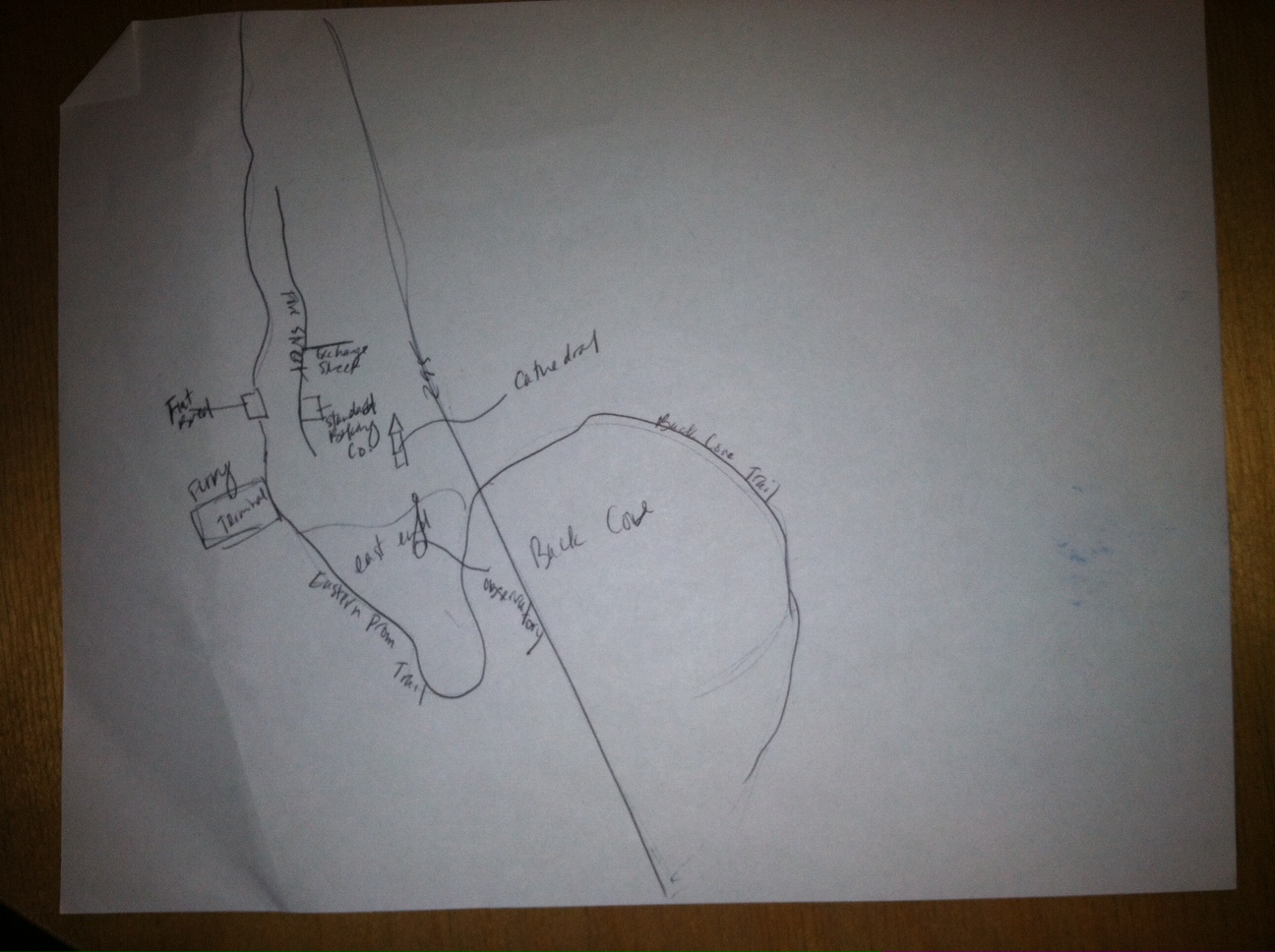
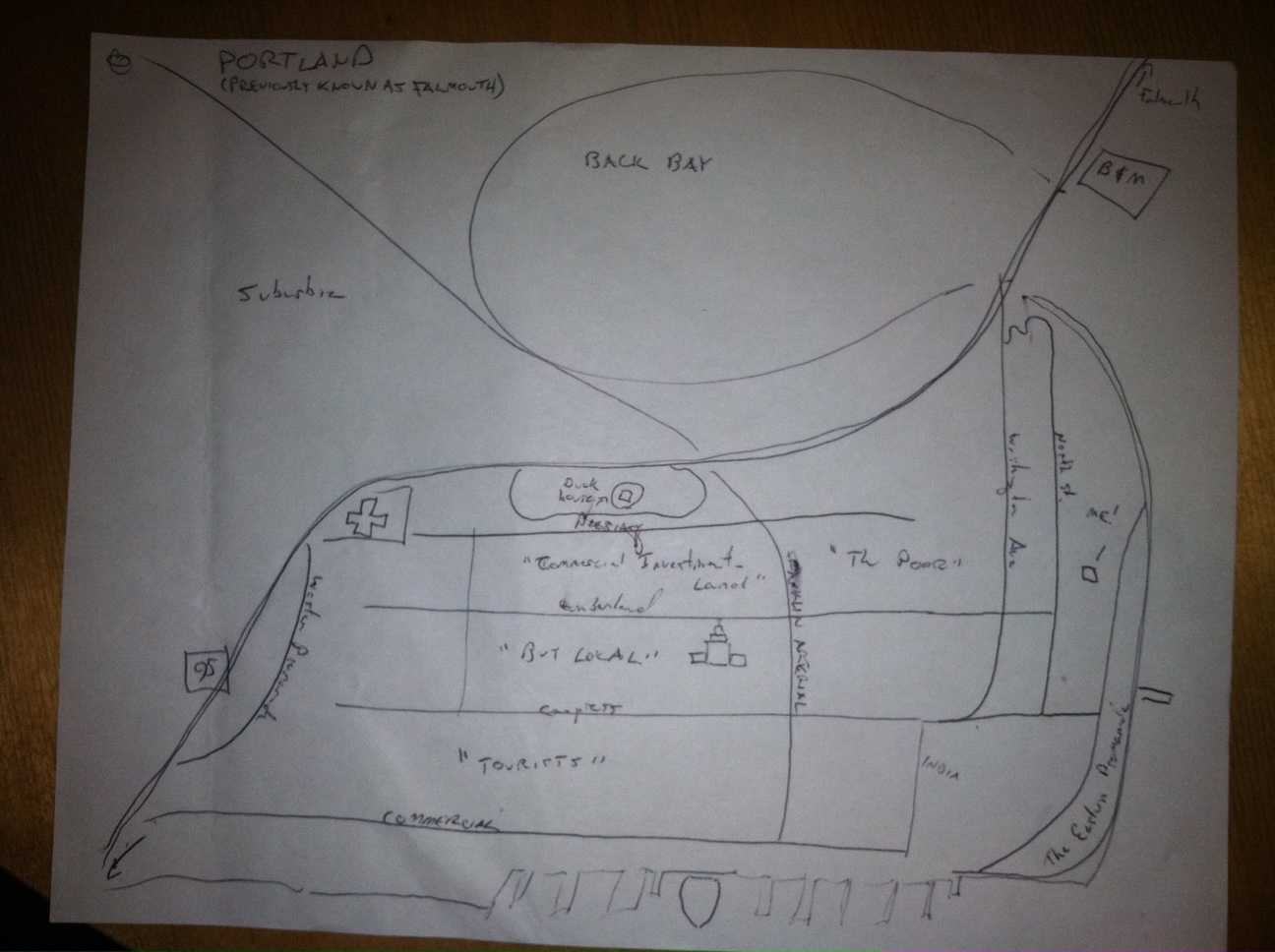
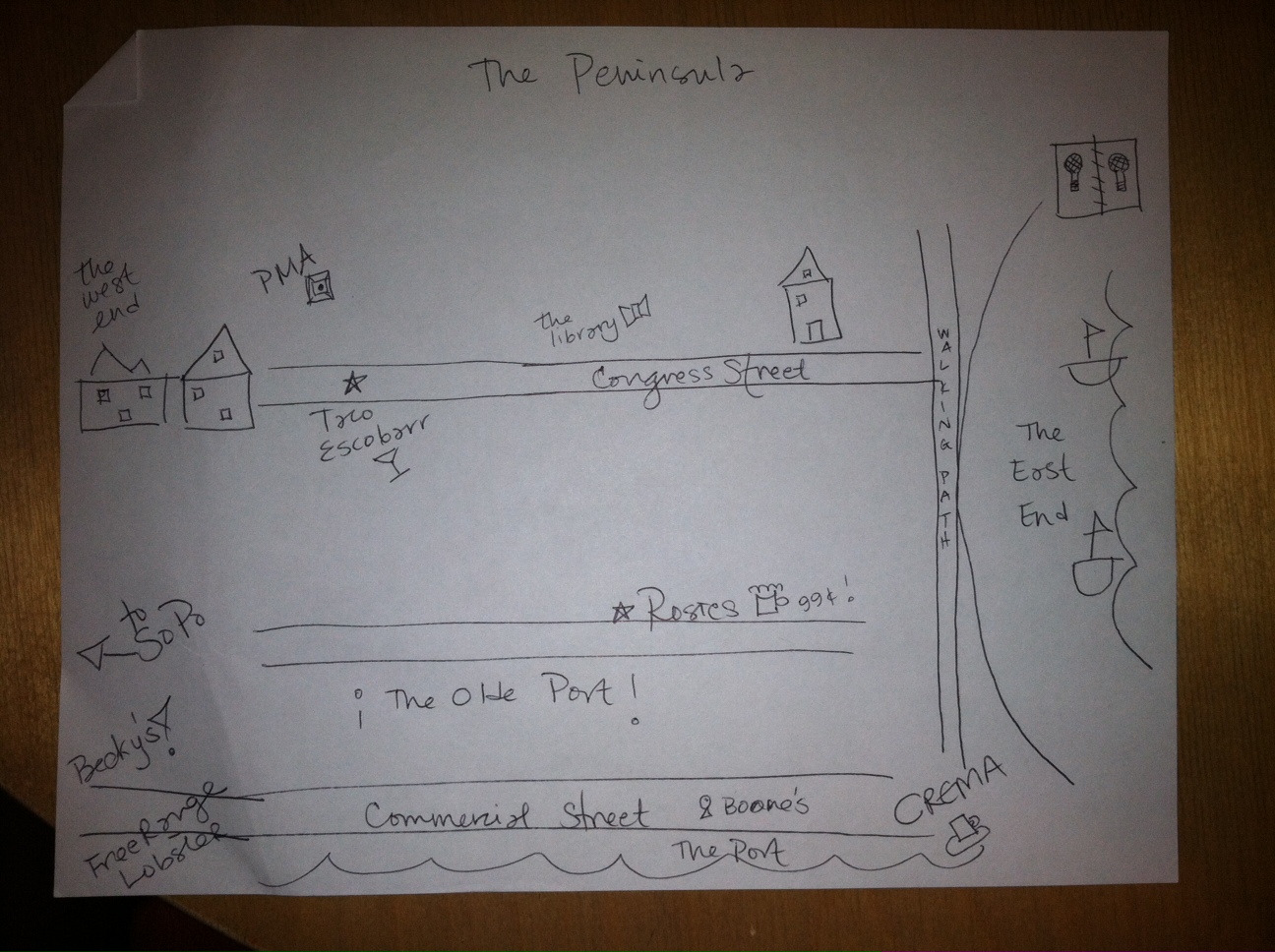
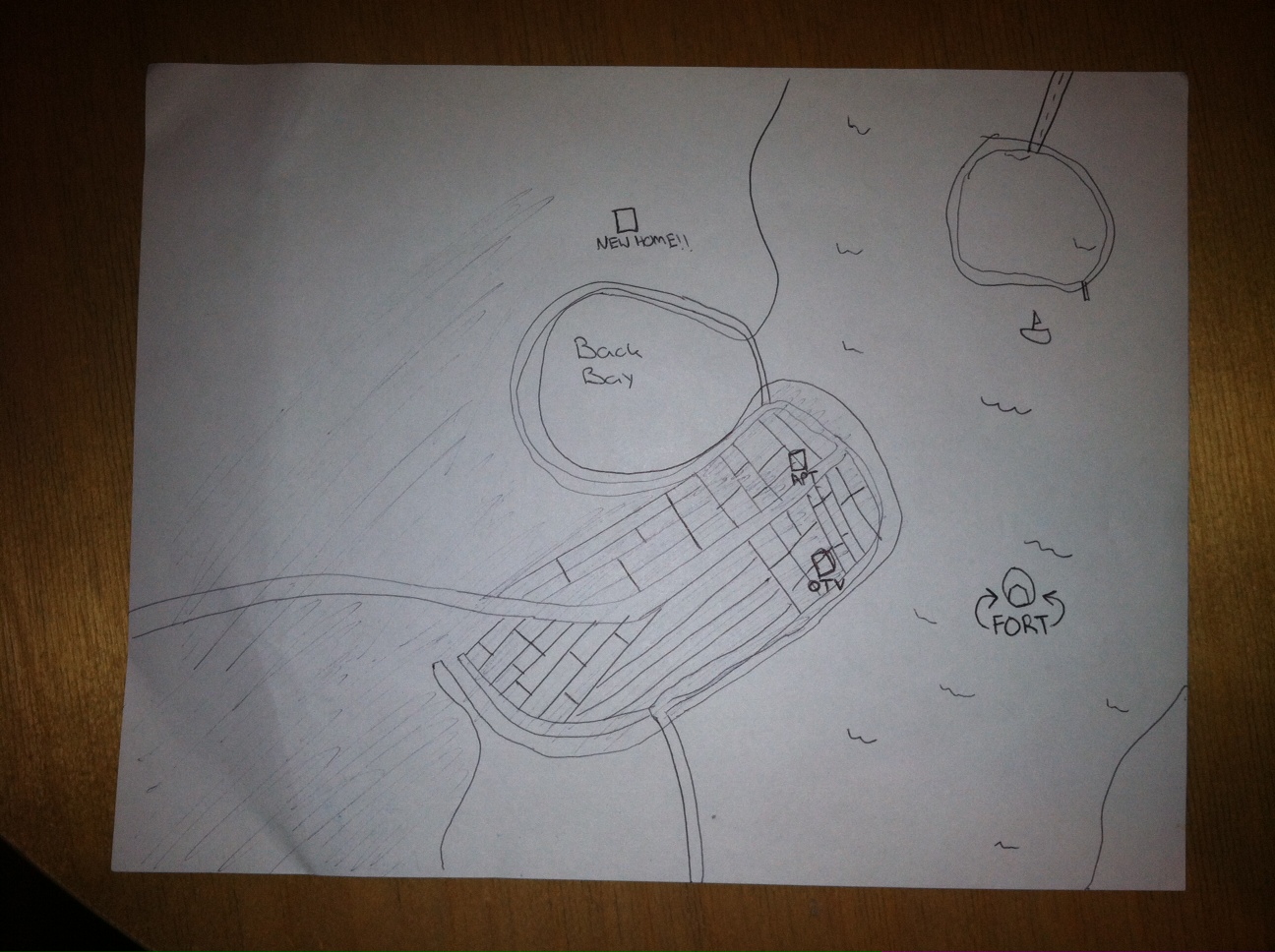
Mental Map 3
Middle-aged white female, resident for 9 years, director of an architecture organization. Drew the peninsula outline first. Suggestion: fewer hotel constructions.
Young white male, residents for 6 years, working in marketing for a research NGO. Drew the water line first. Suggestion: bring back the trolley line!
Young white male, resident for 6 years, working in marketing for a research NGO. Drew the water line first. Suggestion: bring back the trolley line!
Mental Map 1
Middle-aged white woman, resident for 2 years, self-employed in real estate design. First drew big streets. Suggestion: better maintain green spaces between houses and sidewalk on Congress st. (Is this public space?)
Young white male, resident for 9 years, works at OTV. Drew peninsula outline first. Suggestion: offer public municipal broadband for internet and TV at rates that aren’t marked up.

Arabica Ethnography Notes


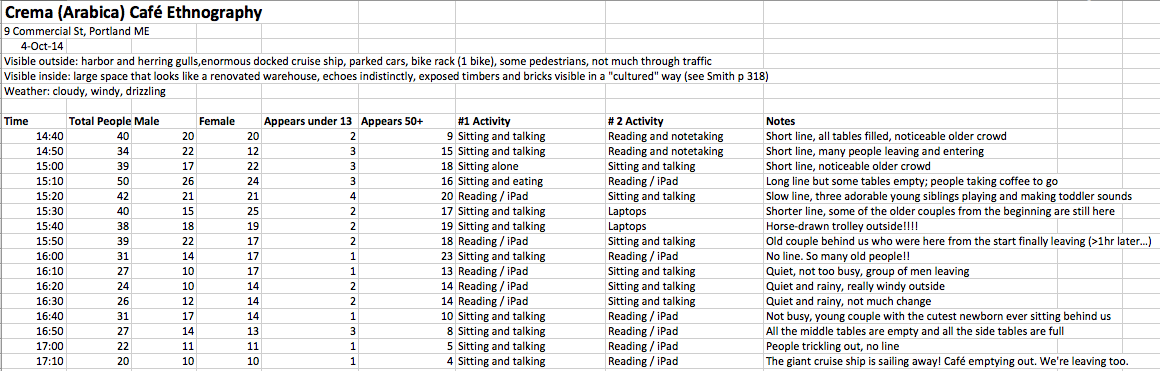
[gview file=”https://courses.bowdoin.edu/digital-computational-studies-2430-fall-2014/wp-content/uploads/sites/52/2014/10/Café-Ethnography.xlsx”]

The café ethnography was  skewed towards those who appeared to be middle- and upper-class white Portland residents. Males and females seemed to be relatively equally present. There was a noticeable tendency towards older customers, who seemed to be more likely to sit and talk for several hours at a time, while younger customers tended to come in and out more regularly. There were some students studying at tables near the walls, but scarcity of outlets may have discouraged them from coming and/or staying long.

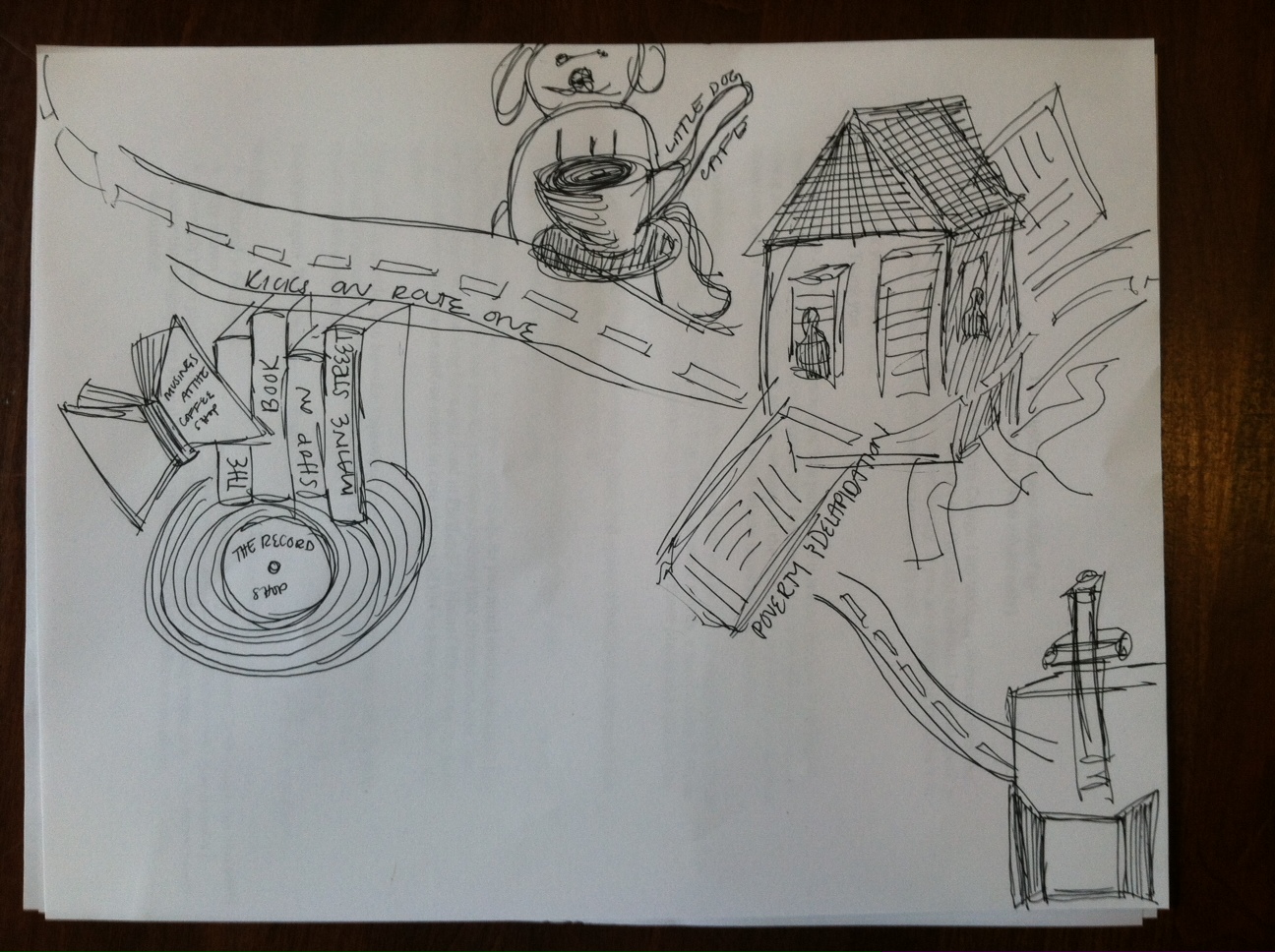
My mental map participants were similarly skewed towards white participants who appeared relatively privileged. It was difficult to find a diverse group of participants who were willing to participate; I got turned down by people I asked who appeared to be working-class, either because they seemed busy, mistrusting, or did not speak English. I was able to get mental maps from only two people outside; the other two I had to get from a café where (as noted in the ethnography) my selection of people was more limited. Still, the four maps differ in interesting ways: each of the four mental maps  strongly reflected individual preferences through their inclusion of particular bars, restaurants, running trails and hang-out spots. The two younger participants both drew outlines of Portland very much in accordance with Google Maps, suggesting their geographical image may have been shaped by their relationship with their smart phone.

The four recommendations given by participants suggest Portland needs better public transportation, more effective ways of integrating tourism into its economic plan without upsetting or alienating long-time residents, and cheaper ways to access internet and TV broadband. Both the implementation of better mass transit and the creation of a public, non-marked up option for broadband seem like great, straightforward ideas for a smarter, more inclusive city. Juggling the interests of long-time residents on one hand, and the economic needs of a growing, tourism-dependent city on the other, appears to be a more complex task with less clear solutions. Still, this tension is important to keep in mind while making decisions about Portland’s development.

The Welcoming City Revisited: Open-access Infrastructure

I have focused my last two posts on how urban planning can and should help create a welcoming city. Perhaps beyond ensuring affordable housing and temporary shelter options, or designing recreational public areas appealing to residents of all socioeconomic classes, we need to rethink the process by which we produce urban space. After all, a city will not feel welcoming to all sectors if those designing it are only representative of a single demographic. This highlights the need to create new pathways influencing political decision-making and governance. In his article, “The right to infrastructure: a prototype for open source urbanism,”1 Alberto Corsín Jiménez presents a revolutionary idea about how to do this: through open-source/open-access infrastructure. Jiménez notes that open prototypes are at their core a symbol of what the production of cities should look like: they are an ongoing discussion, trial, and revision, and a process anyone can participate in. Allowing open-source infrastructure is, in Jiménez’s words, an “investigation into the very nature of the city as an open educational frontier.” By implementing open-source infrastructure in New York City or Portland, we would transform the way the city is produced by bringing previously disregarded voices, speaking about how they envision the future of their city, to the forefront of the conversation.

One of the first days of class, we reflected on whether a resident could feel as important to the production of New York as they could to the production of Bowdoin. We came to the conclusion: “We, the students, are Bowdoin, we make Bowdoin; in New York City, each person is only one peon among millions.” Upon further reflection, I disagree. The identity of New York City is no less dependent on the wonderful contributions of its myriad residents than is the identity of Bowdoin dependent on the contributions of its students.

http://vimeo.com/85667490

Humans of New York founder Brandon Stanton has, through photography, found a way to highlight the paramount contribution of the individual New Yorker to the vibrant mosaic of the New York identity. He would not have been successful without the open-access online platform, Facebook.

Bowdoin feels more inclusive because the way it is structured allow students to play a bigger role in deciding how the college functions. Some would argue New York has too many residents to allow each to play a bigger decision-making role, but with the advent of technology, this is no longer the case. In cities including Portland and New York, with an open-access internet-based platform as well as more powerful and efficient ways of screening data (a la “How to Read a Million Books” seminar), crowdsourcing for infrastructure is not only a viable way to incorporate city voices in a completely new way, but also economically favorable.

Open-access infrastructure platforms would echo AbdouMaliq Simone’s notion of people as infrastructure.2 Given the Mirriam-Webster definition of the term infrastructure, “the basic equipment and structures; the system of public works; the resources (as personnel, buildings, or equipment)… needed for a country, region, or organization to function properly,”3 Simone goes one step further by thinking about ordinary residents––innovate, determined and unyielding––as the “resources” needed for the city to survive. In Portland, implementing Jiménez’s open-access platform would amplify residents’ ability to shape the culture and experience of the city, while simultaneously saving the city from paying over-charged design fees and patents. I strongly advocate that Portland implement open-access infrastructure; doing so would be a step towards simultaneously creating a Smart City and one concerned with the common good.


References Cited

1 Jiménez, Alberto Corsín. 2014. “The Right to Infrastructure: a Prototype for Open Source Urbanism.” Environment and Planning D: Society and Space 32 (2): 342–62.

2 Simone, AbdulMaliq. 2014 [2004]. “People as Infrastructure: Intersecting Fragments in Johannesburg.” In The People, Place and Space Reader, edited by Jen Jack Gieseking, et al, 241–46. New York: Routledge.

3 “Infrastructure.” Miriam-Webster Online Dictionary. Accessed October 6, 2014. http://www.merriam-webster.com/dictionary/infrastructure.

Ensuring the availability of affordable housing and protecting the welcoming city

I grew up in Washington Heights, a Dominican, mostly low-income neighborhood that is becoming increasingly gentrified. My parents moved to the neighborhood as low-income recent college graduates in the 1980s. Over the course of the last three decades, they (and many of their neighbors) have successfully landed high-paying jobs, attracting high-end restaurants and businesses that the original residents of the neighborhood largely cannot afford. Real estate agencies have renamed the section of the neighborhood now occupied by upper-middle class residents like my family “Hudson Heights,” outlining an area mostly located west of Fort Washington Avenue along the river.

Screen Shot 2014-10-05 at 12.50.27 PM
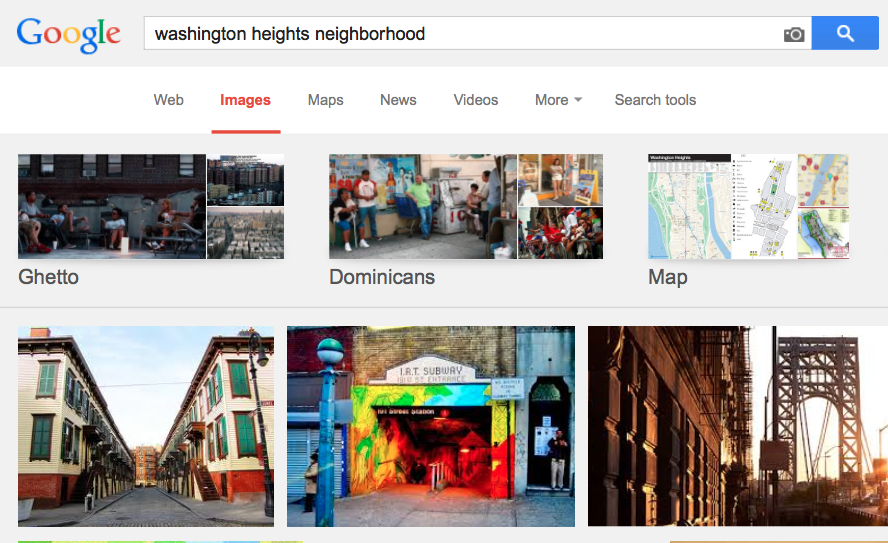
Google Image comes up with categories “Ghetto” and “Dominican” when searching “Washington Heights,” but yields friendlier and greener images when searching “Hudson Heights.”

Screen Shot 2014-10-05 at 12.50.01 PM


Like other examples we discussed in class, this name-change distinguishes the gentrified area of Washington Heights from the rest of the neighborhood, encouraging the sale of more property to middle-class families and up-scale businesses, leading to further gentrification. This has transformed the feel of the neighborhood: while the park across the street from me used to be filled with Dominican teenagers playing music on their boomboxes and Dominican men playing dominoes, now the park has been renovated and is mostly populated by white toddlers and their Dominican nannies. The effects of gentrification are most visible in so-called Hudson Heights, where I live, but they are not limited to this area. Even in the most eastern part of Washington Heights, the presence of the private Yeshiva University is slowly but consistently applying real-estate pressure toward middle-class redevelopment. Just this summer, an expensive-looking, glass-plated residential building, dwarfing the worn-out low-income apartment buildings surrounding it, popped up on 181st street and Audubon, directly across from the Goodwill.

As described by Desiree Fields and Sabina Uffer in their 2014 article, “The Financialization of Rental Housing,”1 investment and financialization (specifically, transforming expected future earnings into concrete currency, making possible mortgages or deficit spending) have led to heightened inequality throughout New York City. They argue that previously low-class neighborhoods can be transformed by investment and financialization only at the expense of the original residents. This argument aligns with that of Neil Smith in his article “Class Struggle on Avenue B”2: namely, that the gentrification of neighborhoods such as Washington Heights can be described as a sort of frontier struggle, where more powerful sectors of society are called upon to “tame” the overly romanticized low-class neighborhoods. Smith points out that gentrification leads to an increase in official crime rates, police racism and assaults on the “natives,” or the people who were there first. Washington Heights is a prime example; throughout my life, these consequences have been evident. In high school, if my male black or Latino friends were visiting my apartment, dressed in baggy jeans and fitteds, they were questioned about their motives by police guards on my block, while my white male friends wearing skinny jeans and button downs were never stopped. Fort Tryon Park, just north of me, was never heavily regulated while I was growing up; now it is crawling with cop cars ready to hand out court summons to anyone in the park after 1am, echoing the harsh voice of Mayor Dinkins in 1991: “The park is a park. It is not a place to live.”2

It frustrates me that the nature of gentrification is so segregationist. Not only do the gentrifiers express, often subconsciously, intense racist fear towards original residents, but original residents often understandably intensely resent the gentrifiers. I have felt embarrassed to tell my neighborhood friends exactly which building I live in because, in their eyes, it would jeopardize my ability to say that I am “really” from Washington Heights, or worse, that I am “really” Latina. More interaction between newcomers and original residents is critical to bridging this divide. I believe that every new residential building in Washington Heights should include an equal number of units designed for tenants of low- and middle-income economic brackets. I would recommend similar regulation for Portland. Allowing for the displacement of low-class and immigrant communities due to gentrification is unacceptable. The most beautiful aspect of urban areas is the intense confluence of diverse cultures and varied heritages; only through strict housing regulation that prevents the displacement of low-income communities can we support such a confluence and nurture the growth of a vibrant and welcoming city.

Work Cited

1 Fields, Desiree, and Sabina Uffer. 2014. “The Financialisation of Rental Housing: A Comparative Analysis of New York City and Berlin.” Urban Studies, July.

2 Smith, Neil. 2014 [1996]. “‘Class Struggle on Avenue B’: The Lower East Side as the Wild Wild West.” In The People, Place and Space Reader, edited by Jen Jack Gieseking, et al, 314-319. New York: Routledge, 2014.

First-Year’s Artsy Brunswick Mental Map

mental map

This map was drawn by a 19-year old first-year female living in Hyde. Originally from Delaware, she had never been to Brunswick before enrolling at Bowdoin about a month ago. She recommends that Brunswick and Bowdoin team up to design a learning project which would bring students into local businesses in order to help them better understand the town’s needs.

Rethinking Portland’s Public Spaces for a More Integrated City

Conceptualizing, designing and creating “successful” urban public spaces, ones that contribute holistically and inclusively to the identity of entire communities, seems to be one of the most daunting challenges faced by urban planners today. How can we create public space that is structured enough to be enticing and attractive, yet malleable enough to allow itself to be molded representatively by the diverse residents of the city? As Professor of Cultural and Urban Geography Don Mitchell writes, “In a world defined by public property…public space (as the space for representation) takes on exceptional importance.” [194]1 It is clear that creating space that welcomes all sectors of the city, including those traditionally marginalized, is of utmost importance. It is less clear, however, how to accomplish such a feat.

One of the greatest challenges to creating representative public spaces is balancing calls for increased liberties with those for increased safety. As Mitchell points out, fear has been, is, and will continue to be a limiting factor in the design of public space. The terrorism attacks of September 11th and their aftermath, of course, provide a dramatic example of how fear can change the experience of public space. In 2002, less than a year after the incursion, Professor of Anthropology Setha M. Low observed, “Fear now pervades the postindustrial plazas of New York City,” citing that increased surveillance and the redesign of bench and ledge architecture both manifest the push to curtail the “publicness” of spaces. [165]2 In the thirteen years that have passed since the attacks, it is unclear whether the fear driving this push has dramatically faded. Camouflage-clad, machine-gun-armed intimidating men are still dispatched to “watch over” public New York City hubs such as Penn Station and Grand Central Terminal, and NYPD officers still patrol central subway stations, instructing loitering teenagers and homeless people to move along. The fear of public space as a no-man’s land in which passerby are vulnerable to violence or aggression has thus pushed cities to more strictly regulate activities in public spaces. This probes at the central questions of democracy: to what extent do we value safety, order, and protection over our freedoms of speech, expression and movement? Where do we draw the line between security and liberty?

In Portland, with an influx of low-income and racially diverse refugees and immigrants, and an ever increasing number of homeless residents (hitting an all-time high in 2013)3, tensions over how to design and regulate current and future public spaces are likely to intensify. Privileged residents may feel anxious or fearful in public spaces that force them to interact with homeless people, gathering youth, or people of a different race (particularly given Portland is over 80% white). They may therefore be more likely to avoid such public spaces, and/or advocate, whether consciously or subconsciously, public spaces designed to discourage the appearance of such socially marginalized groups. This need not solely be via police surveillance; as Low points out, this can often be accomplished via partial privatization of public space. She writes, “Commercialization and privatization…limit participation to those who can afford it and conform to middle-class rules of appearance and conduct.” [164]2 Still, public-private partnership can enliven public spaces and create incentives for residents to gather and interact, providing a basis for social integration.

Portland is thus facing a crucial turning point in how it wishes to think about public space. Just this summer, NPR reported a significant increase in laws restricting sleeping, loitering and begging in public, effectively criminalizing homelessness.4 Portland has begun to hire security officials to shoo traditionally marginalized people, including the homeless, the young, and the socioeconomically disenfranchised, away from parks in which they are not welcome. Instead, the city must design safe and comfortable places for these people to gather, such as larger public shelters and showers, and sports and recreation areas. Portland should make use of public-private partnerships to create spaces that welcome residents of all demographic sectors. Encouraging the development of affordable, diverse and inclusive privatized establishments and events in public spaces, such as ethnic food trucks, festivals and events celebrating various world cultures, and seasonally-dependent low-cost community recreation spaces (e.g. summer outdoor movies, autumn apple-picking orchards, winter ice rinks), should be at the top of Portland’s urban planning to-do list. I strongly believe that the creation of public zones where traditionally segregated sectors of society can come together in a positive and constructive way is crucial to the healthy development of this increasingly diverse and vibrant city.


References Cited

1 Mitchell, Don. 2014 [2003]. “To Go Again to Hyde Park: Public Space, Rights, and Social Justice.” In The People, Place and Space Reader, edited by Jen Jack Gieseking, et al, 192-196. New York: Routledge, 2014.

2 Low, Setha M. 2002. “Spaces of Reflection, Recovery, and Resistance: Reimagining the Postindustrial Plaza.” In After the World Trade Center: Rethinking New York City, edited by Micheal Sorkin and Sharon Zukin, 163-72. New York: Routledge, 2014.

3 Billings, Randy. “Homelessness hits record high in Portland,” Portland Press Herald, October 27, 2013, accessed September 29, 2014, http://www.pressherald.com/2013/10/27/homelessness_hits_record_high_in_portland_/

4 Fessler, Pam. “With a series of small bans, cities turn homelessness into a crime,” National Public Radio, July 16, 2014, accessed September 29, 2014, http://www.npr.org/2014/07/16/332050463/with-a-series-of-small-bans-cities-turn-homelessness-into-a-crime

SMART HOUSING: PORTLAND

My suggestions are a series of five related Website/SmartPhone App initiatives:

  1. PORTLAND HOUSING PROJECT
    1. Users can search options for Portland housing on three tabs: affordable housing, transitional housing and shelters.
    2. Postings are in real-time: shelters, for example, should update number of open beds available for each particular night.
    3. Listings should include address, contact information, and an inlaid Google maps diagram to find housing quickly and easily.
  2. RENT PORTLAND
    1. Landlords can post listings to rent residential units not listed as “affordable housing”; should be aimed at housing rentals for minimum two months.
    2. Includes information about the place, location (with map), information about amenities, and contact information for landlord.
    3. City officials can screen asking price to make sure landlords ask for reasonable rent prices (?)
    4. Similar to other rental platforms such as airbnb.com, renters can write reviews and post praises/complaints for landlords and vise versa. (Reviews should only be posted once the lease contract has been terminated.)
  3. ENSURE QUALITY OF LIFE
    1. Involves the production and distribution of free home sensors to monitor air and water quality in your home.
    2. App/website should include:

i.     Information about the importance of clean air and water

ii.     A way to mail-order a free household sensor, and/or information about where to pick one up

iii.     A way to schedule an appointment for a city health official to come in person to evaluate air and water quality in your home, should the sensor indicate an unhealthy environment

  1. GREEN HOUSING
    1. Involves the production and distribution of (a) subsidized home sensors to monitor energy efficiency in your home, and (b) subsidize energy efficient light bulbs, home appliances, products/services for improving insulation, etc.
    2. App/website should include:

i.     Information about the importance of conserving energy, and steps you can take to reduce your own consumption

ii.     A way to mail-order a subsidized household sensor or energy-efficient products, and/or information about where to pick one up

iii.     A way to schedule an appointment to have a city-approved official come to insulate your home

  1. CROWDSOURCING FOR AN INTEGRATED HOUSING SYSTEM
    1. Ask the public to contribute to city initiatives to design affordable housing units and to plan their neighborhood location so as to best integrate them into the rest of the Portland community.
    2. Create a website with:

i.     A place to submit your design

ii.     A place to see other people’s submissions and comment on them

iii.     Forums for discussion

In his book Against the Smart City, Adam Greenfield reminds us that smart cities assume an objectivity and unity that is impossible in a real city. He argues that smart cities do not support diversity, but instead assume a singular definition of what is “good.”1 In accordance with his ideas, I propose that Portland move towards a Smart City model that does not reduce the number of choices people have, but instead enhances their ability to access these choices. The best Smart City technology will therefore provide people access to more autonomy and human support, rather than replace social interactions with detached digital ones. Greenfield also points out that technical systems are destined to break, and that no algorithm will ever allow a city to run perfectly. The best Smart City technology will therefore facilitate a checks-and-balances system where human users can continuously assess and adjust city systems.

My first two suggestions involve the creation of linked website/apps to allow people to more easily find housing options in Portland. The first app would be aimed at low-income users looking for shelters or affordable or transitional housing; the second would be aimed at newcomers looking to settle in Portland who do not need subsidized housing. It was evident during our field trip that Portland is an up-and-coming city; places to live are in high demand. It is important to protect both low-income residents and newcomers, as these social groups are likely the most vulnerable to be taken advantage of by dishonest or irresponsible landlords. These apps/websites will allow users to access more housing choices, and the public nature of the information will ensure that the landlord-renter relationship is maintained in a fair and professional way.

Low-income housing is critical for any diverse and vibrant city. According to the India Street Sustainable Neighborhood Plan (Order 43-14/15),2 reviewed by the Portland City Council on September 3, 2014, housing diversity is crucial to maintaining the population diversity that it so prides itself on. The Plan states, “The India Street neighborhood has always hosted a diverse resident population. The neighborhood plan should encourage and maintain that diversity of residents (age, race, ethnicity, gender, family size, income, etc) [19].” As the city contemplates the construction of new affordable housing units in the area (for example, on the corner of Franklin and Middle Streets), they also consider destroying old ones: “Munjoy South Townhouses is a low-income housing development…[that] may be redeveloped in the future. It is not known whether future development on this site will remain affordable housing and what form and density it will take. [11]” These are decisions that will greatly affect Portland residents; in order to more directly involve the residents, I suggest a Crowdsourcing webpage in which users can discuss the best affordable housing plans and the best way to maintaining a vibrant community through housing diversity.


References Cited

1 Greenfield, Adam. 2013. Selections from Against the Smart City. 1.3 edition.

2 Portand City Council. 2014. India Street Sustainable Neighborhood Plan. Final Draft, August 2014. Accessed on Sept 24, 2014 at http://www.portlandmaine.gov/DocumentCenter/Home/View/6471.

Fair Housing for a Welcoming City

Having a place to call one’s home is critical to one’s happiness, comfort and grounding; having the opportunity to create a home in which one feels welcome and safe is a right of every citizen. Unfortunately, this is not the case in many cities, including New York. Too many city streets ––too many subway cars, too many park benches–– are the faux-homes of unlucky people. Without a home, they are marginalized, assumed to be drug users, irresponsible, incapable of contributing to society. To be homeless is to be a failure.

Well-kept shelters, transitional housing, just tenants’ rights and access to affordable housing are inalienable aspects of a healthy city. As Dolores Hayden illustrates in her essay, “Urban Landscapes as Public History,”1 the crowded, disgusting housing tenements on the Lower East Side of NYC at the turn of the 20th century were not only violating human rights, but also creating a highly stratified city by marginalizing low-income people. Though we have preserved such tenements in museums to supposedly remind us of how far we have come, much remains to be done. In the words of my city councilmember Ydanis Rodriguez, “We must continue to fight discrimination at every turn and ensure our city is a welcoming place for all who choose to reside here.”2

I spent a good part of the spring semester of my sophomore year of college interning for Ydanis, the council representative of Washington Heights, Inwood and Marble Hill. During my time there, a resident of Washington Heights named Octavio Estevez was diagnosed with a potentially deadly illness and was forced to leave his job.3 Unable to afford his apartment in an increasingly gentrified neighborhood, he and his family relocated to a homeless shelter in the Bronx. While there, he was told he could not receive the kidney transplant he needed until he found more stable housing. Octavio is not the only one suffering from the shortage of affordable housing in Northern Manhattan; an ever-increasing cost of living is pushing more and more residents to leave their homes and seek housing elsewhere. Ydanis worked with community members such as Octavio to organize rallies demanding the construction of more affordable housing north of 155th street. His passion for affordable housing helped me understand the importance of ensuring that all who live in NYC, regardless of heritage or socioeconomic background, can find a welcoming home in NYC.

This semester, I would like to focus on how we can bring technology into the bottom-up fight for housing rights in Portland or NYC. Anthony Townsend’s lecture4 helped me to think about the advantages technology may afford us ––whether through city-funded household water and air quality monitors, or a CouchSurf / Air B’n’B – style alternative for temporary housing–– in the fight for urban housing rights in the 21st century.


Hayden, Dolores. 1997. “Urban Landscape History: The Sense of Place and Politics of Space.” In The Power of Place: Urban Landscapes as Public History, 14-43. Cambridge, MA: The MIT Press.

2 Feeney, Micheal J. “Report: Councilman Ydanis Rodriguez and City Council Speaker Melissa Mark-Viverito earn top scores on human rights,” New York Daily News, March 25, 2014, accessed September 12, 2014, http://www.nydailynews.com/new-york/report-uptown-leaders-earn-human-rights-article-1.1734621.

3 Rodriguez, Ydanis. “Northern Manhattan’s population is shrinking; we need more affordable housing,” New York Daily News, March 19, 2012, accessed September 12, 2014, http://www.nydailynews.com/new-york/councilman-ydanis-rodriguez-northern-manhattan-population-shrinking-affordable-housing-article-1.1041765.

4 Smart Cities: Big Data, Civic Hackers, and the Quest for a New Utopia [Anthony Townsend]. 2013. http://www.youtube.com/watch?v=z1evCV6_e8Q.