All posts by Professor Jack Gieseking

Mental Mapping Script & Sample Requirements

In class, we agreed that all of our research participants must meet the following requirements:

  • Be age 18 or over
  • Max 1-2 are not from City of Portland
  • Min 1 year residence (not address) in Maine
  • Half female and half male (appearing)
  • Seek out diversity

Gather information after the interview by asking about:

  • Occupation
  • Length of residency
  • Neighborhood
  • Age
  • Gender
  • Why in Portland
  • Recommendation for the city

 Script for interviewing:

Hi, I’m ___________________, a student at Bowdoin College. I am taking a course entitled The Digital Image of the City and I need to speak to a few Portland residents. I need to speak to a few people and have them draw their map of the city. If you are a Portland resident and this interests you, do you have 15 or so minutes to chat with me?

IF NO:: Thank you for your time.

IF YES:: Great. Thank you.

Here is a piece of paper and some pencils and pens. The purpose of this exercise is to elicit how residents of Portland see and experience the city.

I will ask you to label this map as we go along and I will take notes as well for my memory. I will also ask you some basic questions about yourself to help us understand whose maps we are collecting.

Please sketch your map of Portland. We do not expect an accurate drawing, just a rough sketch; in other words, a mental map. Include the places and spaces you go on an everyday basis as well as those places and spaces that you think define the city.

[As person draws, student records order of places and spaces drawn and continues to ask research participant what they are drawing.]

WHEN MAP IS COMPLETE TO PARTICIPANT’S LIKING:: Thank you again for taking part in our study.

In order to help us keep track of who made which map, do you mind sharing the following information with us? Age? Race? Gender? Class? Occupation?

Thank you again. This concludes our study.
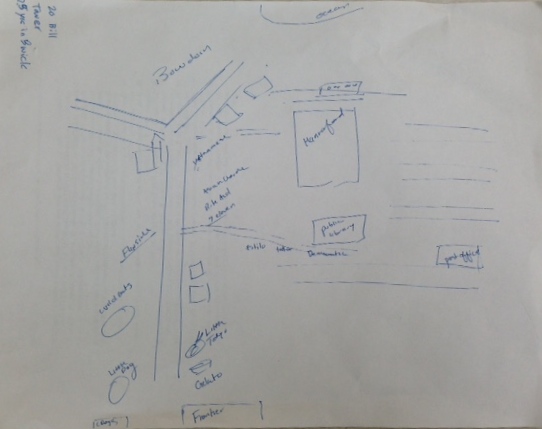
 

HOW TO: Brunswick Mental Map: Bill ’16

To post your mental map from our pilot data collection exercise on Wednesday, just include the following information and embed your map. You can add the image by clicking the Add Media button above, and then embed your map in a post. You can add the image by clicking the Add Media button, and then Upload Files, select the file, and Insert into Post (medium or large size). For the title, simply make a title with the words “Brunswick Mental Map: (NAME) (YEAR or POSITION).” Use the category “Pilot Mental Map.”

We will discuss these first thing on Monday. Have a great weekend!

IMG_0783

Blog Post #8: Policy Recommendations 2.0

Blog Post #8 – November 5th – due November 6th by 5 p.m.

For this post, imagine that your audience is the citizenry of Portland, including politicos, policymakers, stakeholders, business owners, and everyone else you can think up. It is time to turn to policy. In class on November 5th, we read NYC Digital: NYC Mayor’s Office of Media and Entertainment. Now that you had the opportunity to think through and critique the ideas in this document together in class, you will need to find a policy document from Portland related to your research area. (NOTE: Prof. Gieseking will help narrow your search with links to Portland policy documents). First, link the policy document and describe what you found therein. Then, drawing from at least two of the October and November readings and the NYC Digital report, where can the ideas you have been developing throughout the class fit into the policy as it now stands for Portland? Convince the people of Portland of your ideas.

Blog Post #7 & Comment #3: Transect Walk Data Sharing

Blog Post #7 – October 27th

Place the details from your transect walk into your post with exact notes of addresses or latitude and longitude. At the top of the post, reflect on what this data tells you about your research area, and how this data repeats or diverges what you found in your ethnography and mental maps. Are you swayed to consider different smart city recommendations to improve the quality of life and economic sustainability of Portland? Or have you different ideas in mind?

Comments #3 on Blog Post #7 – November 3rd

Continuing our work to produce knowledge as a group, look at each of Blog Post #7 for your research group. In a paragraph (or two maximum), respond to your colleague’s ideas and describe how this may or may not shift the ideas you have been thinking about. What else should your colleague consider? Draw on evidence from any of the class readings in October to back up your ideas.

Blog Post #6 & Comment #2: Ethnography & Mental Map Data Sharing

Blog Post #6 – October 27th

Carefully scan or photograph your mental maps (300dpi) and submit the originals to Prof. Gieseking’s box on the 2nd floor of the VAC in Martie Janeway’s office (under our classroom). Post your full ethnography and load and embed your mental maps into a post. At the top of the post, reflect on what this data tells you about your research area. Are you swayed to consider different smart city recommendations to improve the quality of life and economic sustainability of Portland? Or have you different ideas in mind?

Comments #2 on Blog Post #6 – November 3rd

It is now time to build on the knowledge you individually created and produce shared knowledge. Look at each of Blog Post #6 for your research group. In a paragraph (or two maximum), respond to your colleague’s ideas and describe how this may or may not shift the ideas you have been thinking about. What else should your colleague consider? Draw on evidence from any of the class readings in October to back up your ideas.

Research Groups: Housing, Infrastructure, Public Space

Our distinct but overlapping research groups allow you to hone your expertise in a certain area while working with others who share a passion for the same topic. Each of you bring different skills to the table. The list below explains who is in which group:

HOUSING
  • Peter
  • Ben
  • Jonah
  • Claudia
  • Hannah
INFRASTRUCTURE A
  • Rachel
  • Kote
  • Mingo
  • Vivian
  • Luis
  • Ezra
  • Ike
INFRASTRUCTURE B
  • Karl
  • Alexi
  • Max
  • Alex
  • Roya
  • James
PUBLIC SPACE
  • Emma
  • Libby
  • Jackie
  • Eva
  • Annie
  • Jenny

Our First Round of Ideas for a Better Portland

The first round of ideas for a better Portland, Maine, gathered on September 22nd, 2014:

  • statuesque icon
  • catwalks
  • tunnel
  • connection between Back Cove and Old Port
  • green roofs
  • urban farming
  • community gardens
  • playgrounds
  • splash fountain
  • alleys
  • more-than-a-plaque plaques
  • public history
  • outdoor performances
  • outdoor performance spaces
  • dog parks
  • festivals
  • more greenery
  • recycling bins
  • less decrepit parks
  • green along waterfronts
  • more food trucks
  • food diversity
  • multi-trick city
  • more sports spaces
  • public sports spaces
  • waterfront access
  • more scenic overlooks
  • more public parking in city center / vertical garages
  • integrated local transport to nearby suburbs
  • street lamps with fire
  • seasonal attractions
  • graffiti
  • bike paths
  • signage
  • obvious transport stops
  • public maps
  • lobster drnes
  • integration
  • murals
  • public art
  • mice lighting
  • bold illumination
  • weather dependent public space
  • winter gathering spaces
  • free public wifi