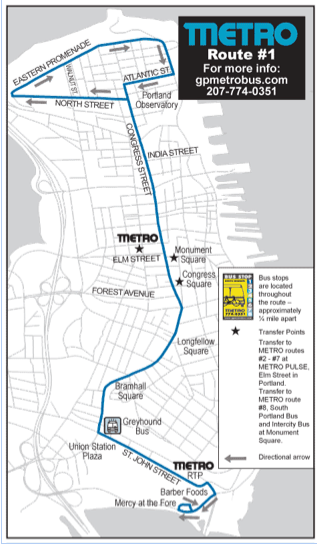
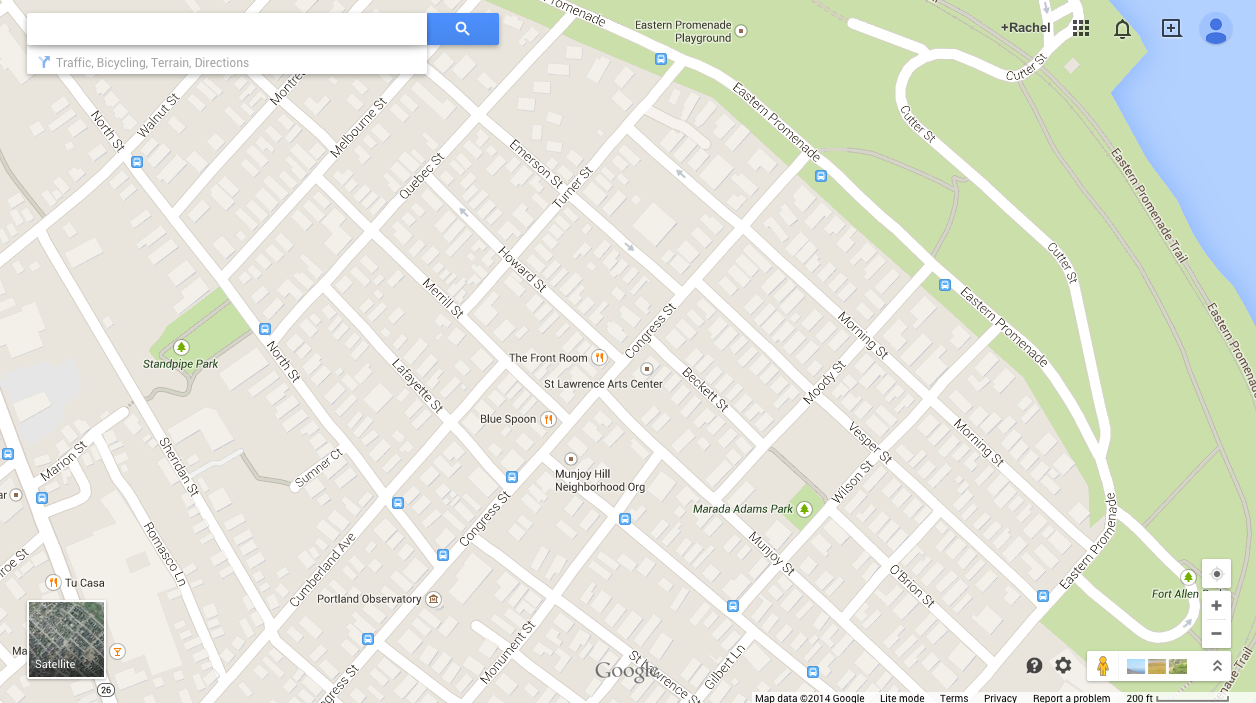
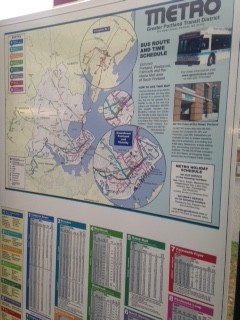
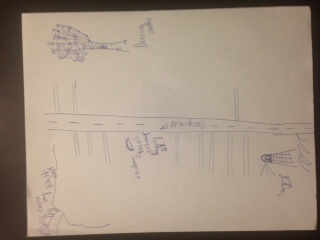
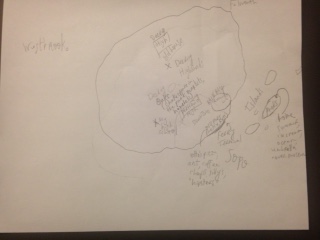
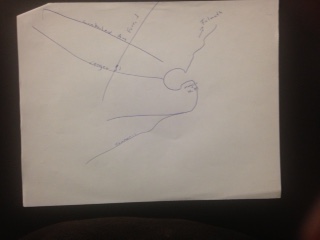
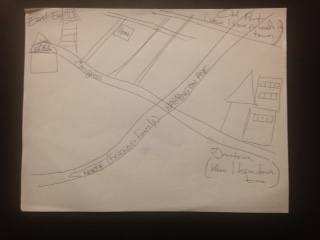
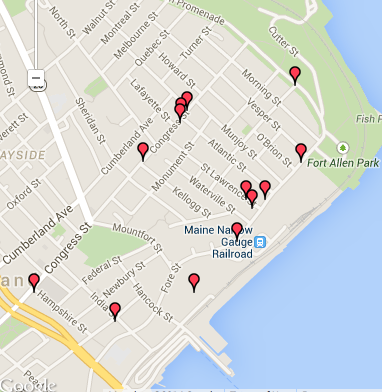
For my group’s transect walk, we decided to follow Bus Route 1 in the East End to get a better sense of the public bus system in practice. Starting along Congress Street and walking up Munjoy Hill to the East End, we followed the route counter-clockwise eventually returning to our original position at the bottom of Munjoy Hill on Congress Street. This direction is important to note because I believe we went in the opposite direction of the buses. Because we did not follow the same direction and also were only one particular side of the street during the walk, I do wonder how many bus stops we may have missed on our transect walk. This is something to consider when analyzing our observations in the future. The details of the walk are posted below.
Transect Walk
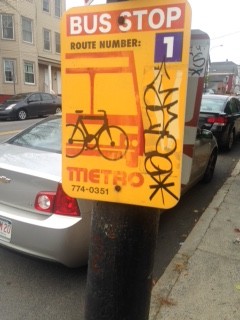
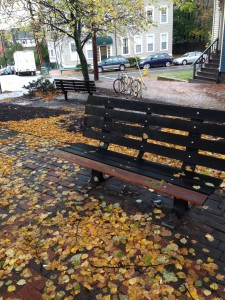
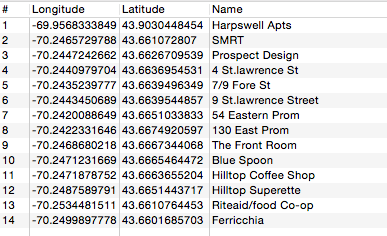
We began at the intersection of Congress and Mountfort heading east on Congress. I noticed that this portion of Congress has a bike lane heading out of Downtown Portland into the East End. The first bus stop we encounter is in front of 206 Congress Street and is displayed with the following sign:

All but one of the other bus stops we encounter are represented simply by this sign. (The two white lines in the image also make up the bike lane I mentioned). The next bus stop is at the intersection of Sheridan and Congress (and is not shown in Google Maps – see the next image where there is no bus icon indicating a stop at this intersection).

The divergence between our observations and some of the stops that are shown on Google Maps already makes me questions Google Maps’ accuracy (or perhaps my own ability to record the location of bus stops).
Anyway, the next stop we observed was on Atlantic Street (the bus route turns to the right on this street) at the corner of Atlantic and Monument. I notice that there is no one else walking on the street with us while we are on Atlantic and the street is lined with parked cars. The next bus stop is at 27 Atlantic Street. We then turn left on the Eastern Promenade and see a bus heading opposite our direction and on to Atlantic Street confirming that these buses do in fact exist. The next bus stop is at the corner of Vesper and the Eastern Promenade. And the next two are at 126 Eastern Promenade and 182 Eastern Promenade. We all notice how beautiful the houses are in this area and how most have an ocean view.

Many of them appear to be broken down into apartments. The next bus stop we see is at Turner and Eastern Promenade and then at 310 Eastern Promenade. We eventually get to the part of the promenade that leads up to the East End Community School. After passing tennis courts to our right, we reach a baseball field and the area unfortunately smells like sewage. We round the corner to the left and circle the school and come to a bus stop in front of the school.


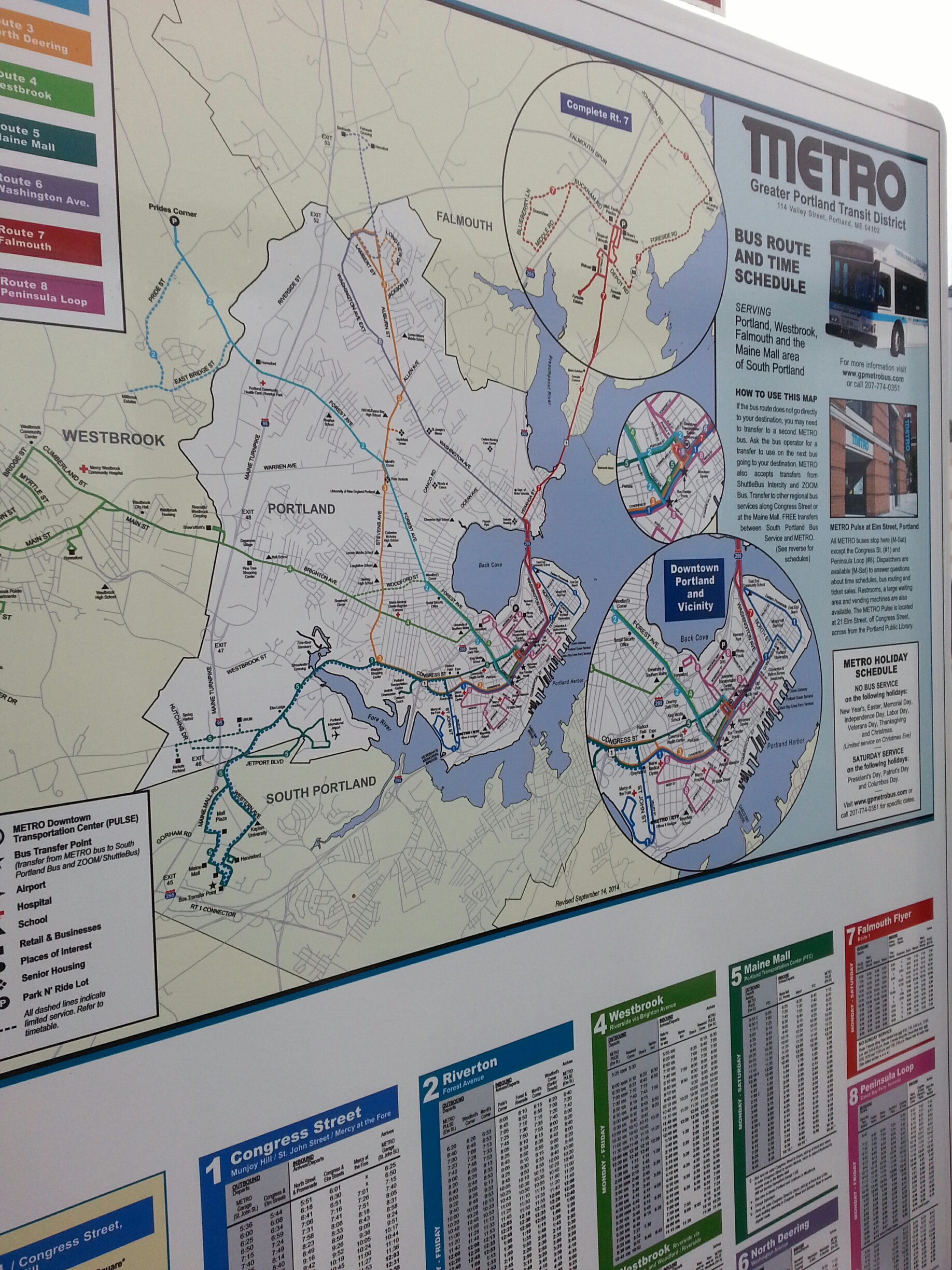
It is the only bus stop we encounter that has a small shelter and map of the bus system. We continue down North Street and encounter bus stops at 143 North Street, Quebec and North, and Cumberland and North. We finish our transect walk when North Street intersects with Congress and we reach area that we have already covered.
Reflection
Admittedly, nothing too paramount devolved from my transect walk, but I did have notice a few important things. I did not expect the bus stop signs to be too significantly obvious on the street, but I was surprised that only one stop had a shelter. It was also comforting to indeed see a bus while on our transect walk. Stops were so frequent that I don’t actually think they are an issue at all. I actually think they are spread too thin and that there should be another major bus stop somewhere at the top of Munjoy Hill or near the Eastern Promenade (like the structure in front of the school) and that would suffice for the entire East End community. This could streamline the bus routes and allow for buses to more frequently come to the area. And following upon my maps and café ethnography, adding GPS and Wi-Fi to the buses could vastly increase ridership as well and is another way the bus system could be improved. Finally, one last impression I had was the lack of bikes or bike racks I noticed in the area. The only evidence of cycling was the one bike lane on Congress Street. It seems like Portland is not much of a bike city at all. Thus, I should also carefully consider the bike sharing ideas I was told by one of my mental mappers as another way to improve transportation as well.