Category Archives: Post #4: Housing Reflections

The Holistic View: Keep People from Being Locked out of Housing

One thing Desiree Fields and Sabine Uffer make abundantly clear: treating housing as a liquefied asset with no conception of it as a place where people live is sure to lead to trouble. Common welfare is quickly left by the wayside, people are forced out of their homes, housing and neighborhoods become socioeconomically stratified. Housing is intimately tied to people’s lives and livelihoods, and the two cannot be separated. However, ignoring the broader market in which housing can be a form of capital is not a viable solution. [1]

In terms of promoting the common good, we have not only to consider the prosperity and diversity of a neighborhood, but also its history. Neil Smith says that the new pioneers of gentrification “seek to scrub the city clean of its working-class geography and history,” and in doing so erase and edit parts of the city’s social history. [2] This is not to say that dilapidated buildings must be carefully upheld in their state of deterioration, but that as the city changes it respects and acknowledges what is being left behind temporally. Both Fields and Smith call for a more holistic view to urban housing developments. All parties must be accounted for.

It is in the “holistic view” concept that I begin to doubt the realistic execution of David Crowley’s vision of the smart city. A space that “maximizes the requirements of the users” is not one destined for 100% success in any public setting. [3] The holistic view includes those who do not believe that people’s actions have a measurable effect on climate change. These people have significantly less incentive to change their behavior and act as sensors in smart buildings. Realistically, it seems that if the system relies on maximum participation, it should be paired with a system of incentive or penalty to stimulate usage.

Control of housing should come at a state level, and not be left open enough for profiteers to have access to existing communities. In Portland, the holistic view means taking into account not only the tourist industry that helps the city to thrive in the summer months, but the city’s year round residents. The holistic view means working actively to provide housing to people who come to Portland seeking it— even if they really don’t look like “Mainers.”


[1] Fields, Desiree, and Sabina Uffer. 2014. “The Financialisation of Rental Housing: A Comparative Analysis of New York City and Berlin.” Urban Studies, July.

[2] Smith, Neil. 2014 [1996]. “‘Class Struggle on Avenue B’: The Lower East Side as the Wild Wild West.” In The People, Place and Space Reader, edited by Jen Jack Gieseking, et al, 318. New York: Routledge, 2014.

[3] Crowley, David N., Edward Curry, and John G. Breslin. 2014. “Leveraging Social Media and IoT to Bootstrap Smart Environments.” In Big Data and Internet of Things: A Roadmap for Smart Environments, edited by Nik Bessis and Ciprian Dobre, 379. Springer. http://link.springer.com/chapter/10.1007/978-3-319-05029-4_16.

Housing in the Smart City and Beyond

There is perhaps nothing in the city of greater importance to the individual than housing. Housing is the foundation upon which every society is based: without living space, there would be no people, no infrastructure, and no city. That being said, different environments demand different types of living spaces. As such, we must consider a variety of factors when determining how to create the best possible housing system for any particular city.

Smart cities all over the world are constantly experimenting with new housing ideas. In Songdo, for example, video conferencing has been built into every apartment. [1]  This telepresence has fundamentally changed how the city operates, such as by allowing children to have classes from the comforts of their homes. [2] As we discussed in class, however, technologies like this discourage face-to-fact interactions that are so characteristic of the quintessential urban experience. This is not to say that all “smart” technologies have to fundamentally change the ways in which we live. Crowley et al. describe their study in which sensors and social media are used in workplace environments to reduce energy usage. If implemented into living spaces, technologies such as this could certainly make our living environments more cost-effective and eco-friendly. Technologies should not necessarily change how housing works on a foundational level. Rather, technologies should be used to preserve and enhance those aspects of housing essential to people’s day-to-day lives.

While “smart” technologies can certainly be used to improve housing in cities, there are even more basic steps that can be taken to promote the common good. First and foremost, housing should be considered a necessary service and not solely a means of making money. As Neil Smith says in his article about the Lower East Side of New York, “The perverse rationality of real estate capitalism means that building owners and developers garner a double reward for milking properties and destroying buildings.” [4] The treatment of housing as a financial asset and nothing more leads to poor living conditions and financial disaster, as we saw firsthand during the housing crisis of 2008. [5] This crisis affected the entire country (and the rest of the world, to a certain extent), not just lower income families who were victims of predatory loaning. Everyone in society benefits from affordable housing for all. This was a fundamental assumption in Germany for a long time, as Fields and Uffer explain: “Under the principle of the ‘common public interest’ (Geminnützigkeit), companies limited their profit orientation in exchange for tax exemption.” [5] Affordable housing does not need to come at the expense of landlords, however; the co-op system of housing places the burden of upkeep on all residents in the building, thereby minimizing the financial burdens on any one person. In short, the best ways to serve the common good with housing are to make housing about people rather than money and to hold society as a whole, not just one individual, responsible for providing and maintaining living spaces for everyone.

How can these ideas be applied to Portland? Considering that as of 2012 58 percent of people living in Portland are renters and the average household income is less than $43,000, lower cost housing would certainly help people with smaller incomes living in the city. [6] The median cost to rent in Portland in 2012 was almost $900 a month, meaning rental costs were about 25% of the median household income. [6] Increased adoption of the co-op housing model would also relieve a great deal of financial stress on lower income families, since these families would be more able to deal with unforeseen housing problems. Portland renters could also benefit greatly from stabilized rental costs, seeing as the price of living is constantly rising in the city.

[1] Maija Palmer, “Screen Time: How Video Conferencing is Gaining Ground,” Financial Times (London, UK), September 11, 2011.

[2] “Songdo, South Korea — The Forefront of Education,” YouTube video, 3:25, posted by “Cisco,” April 11, 2012, http://www.youtube.com/watch?v=5YLsmSvVpO0

[3] David Crowley, Edward Curry, and John Breslin, “Leveraging Social Media and IoT to Bootstrap Smart Environments,” in Big Data and the Internet of Things: A Roadmap for Smart Environments, ed. Nick Bessis and Ciprian Dobre, Springer, http://link.springer.com/chapter/10.1007/978-3-319-05029-4_16.

[4] Neil Smith, “Class Struggle on Avenue B: The Lower East Side sat he Wild Wild West,” in The People, Place, and Space Reader, ed. Jen Jack Gieseking et al. (New York: Routledge), 314–319.

[5] Desiree Fields and Sabina Uffer, “The Financialisation of Rental Housing: A Comparative Analysis of New York City and Berlin,” in Urban Studies, July.

[6] “Portland, Maine,” City-Data.com, accessed October 6, 2014, http://www.city-data.com/city/Portland-Maine.html

Smart Technology in Housing and Gentrification

Housing cannot be discussed without gentrification and that is exactly the issue that looms over the advent of the smart city. Gentrification as a term was first coined by Ruth Glass in 1964 to describe the process of middle class residents moving into lower class neighborhoods and subsequently driving up property values. The causes for gentrification vary by case, but real estate investment is certainly an important factor. Further, private equity real estate investment is exactly what Fields and Uffer identify as an important factor that causes financialization, which ultimately leads to “higher inequalities in housing affordability and stability and rearranged spaces of abandonment and gentrification.” [1] Therefore, we can expect that the investment needed to build the smart city should have similar results to the effects of financializtion in Berlin in New York described by Fields and Uffer. As global financial integration transformed the political economy of housing in both cities, it either furthered gentrification or deterioration depending on the area. In New York, private equity firms “repurposed informality as a leverage to evict ‘illegal subletters’” [1] forcing out lower-income residents who could not afford legal representation in court. In Berlin, a similar process occurred as well, which was that in neighborhoods where housing investors tried to minimize costs and did not focus in housing maintenance, people would often abandon the deteriorating housing: “Households with the resources to secure better housing often left, concentrating low-income households without other options.” [1] I fear that it is likely that smart technology will be only installed in the areas of the city that investors would deem “appropriate” for the technology and thus this would further marginalize or gentrify certain areas.

The technology necessary to making housing smarter also has its pro and cons as well. A smart city requires housing that is integrated community-wide, or at least all updated with current technology. And Greenfield criticizes the smart city in the way that “it pretends to be an objectivity, a unity and a perfect knowledge that are nowhere achievable, even in principle.” [2] This is certainly the case for smart technology that requires citizen actuation, as it may not always be correctly sensing an issue in the grid and requires anthropogenic maintenance. This kind of intermediate technology, though certainly not objective, does seem to be the most affordable and easy to install. Crowley demonstrated how such technology could reduce energy usage in an office building by up to 26% by notifying workers via twitter of items using energy that were not being used by anyone. [3] Further, this technology may be of minimal cost and this easy to implement in a variety of public and private buildings. Thus, use of smaller scale and less expensive technologies could lessen the probability that energy and technology companies would first begin this program in higher income homes and organizations, subsequently expanding differences between income classes. Therefore, this kind of smart city may actually be very useful in promoting the common good in the way that it uses simple measure to reduce energy costs in buildings.

The reason why we must very strongly consider how investment in smart technology in housing could gentrify areas and exacerbate class differences is because this has proven to be a significant issue in the past. Smith highlights how the transformation of the lower east side into the “East Village” is a perfect example of how gentrification created class conflict. Hundreds of homeless people were evicted from Tompkins Square Park in the dead of winter in December 1989 following riots in August the year before as many were angered about the rampant gentrification of the area. [4] This site and area became a symbol of new urbanism being categorized as the urban “frontier”. [4] It would appear that the American tradiation with manifest destiny continued as “real-estate cowboys” sought to take control of the “uncivil” working class and take over this “new” territory from marginalized communities in a romantic, yet dangerous way. [4] It is very easy to see how this could similarly happen in the future as smart city technology becomes increasingly available. “Software Cowboys” could bring forth sensor technology to “civilize” the lack of smart technology in marginalized neighborhoods.

Overall, Portland will need to both take ideas from the smart city and preexisting housing institutions and structures currently available. Use of human actuation systems in building energy use over the high cost of actuation systems can both easily reduce energy usage and thus costs and also help to develop more of a sense of community in these building through the human actuation process. Therefore, implementation of such housing technology seems pragmatic for the community of Portland (especially for a city that spends much money on the heating of buildings during the cold winter). However, these technologies should be implemented in a cautious manner as to not allow already privileged communities develop more advantages and cause oppressed communities to be more at a disadvantage. Specifically, perhaps it would be wise to install such technology in a non-profit like Preble Street that is already looking for easy ways to reduce energy cost.

Ultimately, as smart technology is likely more frequently used in cities around the world, we must carefully consider how these implementations may worsen preexisting social inequalities. If we look at what real estate investment has done to many communities in the past, we need to carefully consider what smart technology may do to these same and similar communities in the future.

References

[1] Fields, Desiree, and Sabina Uffer. “The financialisation of rental housing: A comparative analysis of New York City and Berlin.” Urban Studies July (2014): 1-17.

[2] Greenfield, A. Against the Smart City. 2013.

[3] Crowley, David N., Edward Curry, and John G. Breslin. “Leveraging Social Media and IoT to Bootstrap Smart Environments.” In Big Data and Internet of Things: A Roadmap for Smart Environments. Switzerland: Spring International Publishing, 2014. 379-399.

[4] Smith, Neil. “Class Struggle on Avenue B: The Lower East Side as Wild Wild West.” In The People, Place, and Space Reader, edited by Jen Jack Gieseking, et al, New York: Routledge, 2014. 314-319.

Effcient and Affordiable Housing

Smart technology for houses needs to be something that people of all economic levels can afford to put into their home, however, currently these goods are considered “luxury”[1]. Smart technology may raise our efficiency rate, but the burden of the cost to take of the system in the home is much higher than without smart technology. Therefore, smart technology is currently not accessible for the majority of the population. In order to change this pattern, we often have to look into our behaviors of the past. Through techniques such as redlining, we have been able to see how difficult it would be to implement the same standard smart technology because of the wide range of socioeconomic status in different neighborhoods. Currently, possessing a smart device, or having a “smart” home signals to people a certain level of wealth or level of “success”, however, in a smart city every person needs to be able to live up to that standard.

The income gap in cities is very large and continues to expand as gentrification occurs. People that once inhabited certain neighborhoods can no longer afford to liver there because of the cost of living becoming too much. Smith argues, that with cities people become “urban pioneers” [2]. Essentially, the Frontier of the city is class conquest, which occurs when people go into areas of lower socioeconomic status and rebuild them to make them “better”. Scholars Uffer and Fields demonstrate to us that this problem is not just an issue that is affecting the US, but rather a worldwide problem. Property ownership is cities vary, between people renting, leasing to total ownership. However, due to such diversity in ownership, it is hard to keep individuals accountable for making sure their housing is in good condition [3]. In other words, the lack of communication between residents and tenants leads to housing statuses falling apart, which then continues to spiral out until something such as gentrification occurs. We need to create a smart housing option in which everyone can afford to live in and one in which everyone can be held accountable.

In Portland, the smart housing option should not just worry about costs, but also needs to be completed in a “smart way”. Along those lines, in order to create more open and equal housing, borders between neighborhoods and different socioeconomic classes need to broken down as well. So first, housing should be affordable for everyone. Secondly, another option that could be implemented in Portland is to set up a form of system of systems, as Uffer and Fields explain in their article [4]. However the system in place in Portland should use a means of communication that is accessible and readily available for everyone. Installing this sort of communication throughout the city would bring instant access to real time data, and to events (good or bad) when they occur, thus allowing everyone in the city to be on the same page.


Works cited

[1]Crowley, David N., Edward Curry, and John G. Breslin. “Leveraging Social Media and IoT to Bootstrap Smart Environments.” In Big Data and Internet of Things: A Roadmap for Smart Environments. Switzerland: Spring International Publishing, 2014. 379-399.

[2]Smith, Neil. “Class Struggle on Avenue B: The Lower East Side as Wild Wild West.” In The People, Place, and Space Reader, edited by Jen Jack Gieseking, et al, New York: Routledge, 2014. 314-319.

[3]Fields, Desiree, and Sabina Uffer. “The financialisation of rental housing: A comparative analysis of New York City and Berlin.” Urban Studies July (2014): 1-17. usj.sagepub.com (accessed October 3, 2014).

[4] Fields, Desiree, and Sabina Uffer. “The financialisation of rental housing: A comparative analysis of New York City and Berlin

Visibility for the Preservation of Urban Identity

In terms of housing on the scale of neighborhoods, Smith’s ideas on gentrification paints a simultaneous mental renovation of a given area (Lower East Side being transformed into East Village) and marginalization of a disadvantaged group. The urban frontier mentality is driven by the greed of the real estate industry as they “smooth [the city] of its class and race contours” [1]. But when something is smoothed over, the excess needs to go somewhere. Robert Moses has demonstrated the ways in which the city is a shapeshifting microcosm, a place of accelerated evolution. The destructibility of physical structures is common and often necessary from at least one person’s point of view, but emotional geography and spatial-cultural history is an intangible beast to plow over.

I think there is a new mental mobility developing in urban folk — the nature of attachment is shifting along with its context. While it may be inevitable that neighborhoods will change, to promote the common good there must be a new space constructed for the displaced, and not space that is worse off or marginalized. Smith describes how the “terrain of inner city is valuable again, perversely profitable” [1] Smarting housing policy should be applied to the processes of reorganisation, in providing deserved compensation to those people. The difficulty here is that no one subtracts social costs from their profits. It is difficult and inevitably biased to quantify these costs, but the best basis to attempt it is the voice of the displaced. They may be offered money, but they are not offered the options, security and guidance they need if they are to be uprooted. Money can often be a bandage applied to a wound someone does not want to see.

In the first place, no, the Lower East Side should not have been subjected to gentrification that eventually wiped the neighborhood name off the map. They have their right to place. The juxtaposition of the Lower East Side to Greenwich Village — the edge between them acting as a source of friction — helped to preserve their history, visibility and identity by maintaining a geographic contrast.


Munjoy Hill was described in a Washington Post article as formerly “a onetime tent city” when Portland burned down in 1866, and a “blue-collar enclave” [2]. Now it is a neighborhood dotted with venues and coffeehouses, lavishly described in the article as a base for accessing the foodie thrills and homeware shops of Old Port and the Eastern Promenade — a clear advertisement for attracting young professionals to Portland. Avesta Housing, the developers responsible for building the new condominiums in Munjoy Hill are “pushing the boundaries of affordability” [3]. However one might want to take this, what sorts of options are left to the working class? I found a list of subsidized housing in Portland, and Avesta Housing has also worked to create spaces such as Bayside East (rent restricted housing for 55+ citizens), Butler Payson (income based rent for 62+ and disabled), Deering Place (rent restricted for families), Munjoy Commons (rent restricted), etc. [4]

See the list here: http://www.mainehousing.org/programs-services/rental/subsidized-housing

There is more research to be done on my part in terms of the economic side of things, but perhaps these projects can funnel more money into providing housing and programs for those who cannot even afford income based rent, and strengthening the projects already in place. The Portland Housing Authority offers Housing Choice Vouchers, which allow the disadvantaged choice in where they would like to live, and not just in subsidized housing projects [5]. At Logan House and Florence House, “Preble Street provides 24-hour support services to monitor the stability of residents, provide crisis intervention and conflict management as needed, and to assist residents in developing and enhancing life skills necessary to succeed in permanent housing” [6]. Florence House is a $7.9 million haven built through a collaboration between Preble Street and Avesta Housing to house up to fifty homeless women [7] .

[7] Avesta’s Florence House for Homeless Women
It seems that Portland has great initiatives that are providing flexible options for people, dispersed throughout the city. Yet there are still so many homeless people. I hope that the “excess” maintain their visibility, or else they will be forgotten as people skim over the presence of homeless people in Portland. Over the process of housing being leveled and rebuilt, the goal of depolarization should always be kept in mind.


[1] Smith, Neil. 2014 [1996]. “‘Class Struggle on Avenue B’: The Lower East Side as the Wild Wild West.” In The People, Place and Space Reader, edited by Jen Jack Gieseking, et al, 314-319. New York: Routledge, 2014.

[2] Talcott, Christina. “In Portland’s Munjoy Hill, Do as the Mainers Do.” Washington Post. The Washington Post, 29 Mar. 2009. Web. 06 Oct. 2014.

[3] “Portland Housing Developers Struggle to Meet Market Needs.” Mainebiz. Mainebiz, 20 Feb. 2012. Web. 6 Oct. 2014.

[4] “Subsidized Housing.” Subsidized Housing. Maine State Housing Authority, n.d. Web. 06 Oct. 2014. <http://www.mainehousing.org/programs-services/rental/subsidized-housing>.

[5] “Housing Choice Voucher.” Portland Housing Authority, n.d. Web. 06 Oct. 2014. <http://porthouse.org/section8/housing_choice_voucher.html>.

[6] “Welcome to the Portland Housing Authority.” Portland Housing Authority, n.d. Web. 06 Oct. 2014. <http://porthouse.org/section8/project_based_vouchers_proj.html>.

[7] Richardson, John. “Florence House to Open Doors for Homeless Women – The Portland Press Herald / Maine Sunday Telegram.” The Portland Press Herald Maine Sunday Telegram Florence House to Open Doors for Homeless Women Comments. Portland Press Herald, 05 Apr. 2010. Web. 06 Oct. 2014.

Visibility of Portland’s Identities

In terms of housing on the scale of neighborhoods, Smith’s ideas on gentrification paints a simultaneous mental renovation of a given area (Lower East Side being transformed into East Village) and marginalization of a disadvantaged group. The urban frontier mentality is driven by the greed of the real estate industry as they “smooth [the city] of its class and race contours” [1]. But when something is smoothed over, the excess needs to go somewhere. Robert Moses has demonstrated the ways in which the city is a shapeshifting microcosm, a place of accelerated evolution. The destructibility of physical structures is common and often necessary from at least one person’s point of view, but emotional geography and spatial-cultural history is an intangible beast to plow over.

I think there is a new mental mobility developing in urban folk — the nature of attachment is shifting along with the context. While it may be inevitable that neighborhoods will change, to promote the common good there must be a new space constructed for the displaced, and not space that is worse off or marginalized. Smith describes how the “terrain of inner city is valuable again, perversely profitable” [1] Smarting housing policy should be applied to the processes of reorganisation, in providing deserved compensation to those people. The difficulty here is that no one subtracts social costs from their profits. It is difficult and inevitably biased to quantify these costs, but the best basis to attempt it is the voice of the displaced. They may be offered money, but they are not offered the options, security and guidance they need if they are to be uprooted. Money can often be a bandage applied to a wound someone does not want to see.

In the first place, no, the Lower East Side should not have been subjected to gentrification that eventually wiped the neighborhood name off the map. They have their right to place. The juxtaposition of the Lower East Side to Greenwich Village — the edge between them acting as a source of friction — helped to preserve their history, visibility and identity by maintaining a geographic contrast.

Munjoy Hill was described in a Washington Post article as formerly “a onetime tent city” when Portland burned down in 1866, and a “blue-collar enclave” [2]. Now it is a neighborhood dotted with venues and coffeehouses, lavishly described in the article as a base for accessing the foodie thrills and homeware shops of Old Port and the Eastern Promenade — a clear advertisement for attracting young professionals to Portland. Avesta Housing, the developers responsible for building the new condominiums in Munjoy Hill are “pushing the boundaries of affordability” [3]. However one might want to take this, what sorts of options are left to the working class? I found a list of subsidized housing in Portland, and Avesta Housing has also worked to create spaces such as Bayside East (rent restricted housing for 55+ citizens), Butler Payson (income based rent for 62+ and disabled), Deering Place (rent restricted for families), Munjoy Commons (rent restricted), etc. [4]

See the list here:

http://www.mainehousing.org/programs-services/rental/subsidized-housing

There is more research to be done on my part in terms of the economic side of things, but perhaps these projects can funnel more money into providing housing and programs for those who cannot even afford income based rent, and strengthening the projects already in place. The Portland Housing Authority offers Housing Choice Vouchers, which allow the disadvantaged choice in where they would like to live, and not just in subsidized housing projects [5]. At Logan House and Florence Street, “Preble Street provides 24-hour support services to monitor the stability of residents, provide crisis intervention and conflict management as needed, and to assist residents in developing and enhancing life skills necessary to succeed in permanent housing” [6].

It seems that Portland has great initiatives that are providing flexible options for people, dispersed throughout the city. Yet there are still so many homeless people. I hope that the “excess” maintain their visibility, or else they will be forgotten as people skim over the presence of homeless people in Portland. Over the process of housing being levelled and rebuilt, the goal of depolarization should always be kept in mind.


[1] Smith, Neil. 2014 [1996]. “‘Class Struggle on Avenue B’: The Lower East Side as the Wild Wild West.” In The People, Place and Space Reader, edited by Jen Jack Gieseking, et al, 314-319. New York: Routledge, 2014.

[2] Talcott, Christina. “In Portland’s Munjoy Hill, Do as the Mainers Do.” Washington Post. The Washington Post, 29 Mar. 2009. Web. 06 Oct. 2014.

[3] “Portland Housing Developers Struggle to Meet Market Needs.” Mainebiz. Mainebiz, 20 Feb. 2012. Web. 6 Oct. 2014.

[4] “Subsidized Housing.” Subsidized Housing. Maine State Housing Authority, n.d. Web. 06 Oct. 2014. <http://www.mainehousing.org/programs-services/rental/subsidized-housing>.

[5] “Housing Choice Voucher.” Portland Housing Authority, n.d. Web. 06 Oct. 2014. <http://porthouse.org/section8/housing_choice_voucher.html>.

[6] “Welcome to the Portland Housing Authority.” Portland Housing Authority, n.d. Web. 06 Oct. 2014. <http://porthouse.org/section8/project_based_vouchers_proj.html>.


Smart Housing and Sustainability in the Urbanizing City

Throughout our study of the smart city, it has become evident that smart technology can and should be applicable to all aspects of modern urban life, from how we navigate our sidewalks to when our window shades close. Urbanized and thickly settled cities like New York lend themselves well to smart changes, as do cities such as Songdo which are being built from the ground up without any preexisting society to contend with. Portland, with one foot marching into the modern city and the other firmly planted in its traditional fishing harbor, challenges us to intermingle smart technology while preserving the city’s character and industry. As it undergoes a housing revolution with increased demand and new, hip neighborhoods, the ideal housing in Portland is one that capitalizes on the charm and beauty of the city while also helping the city advance through the implantation of smart technology.

In all cities, both smart and not-so-smart, sustainability is a key component of housing. Appliances and windows are high efficiency, building materials are recyclable, and much of a housing unit’s energy comes from solar panels mounted on its roof. The ideal housing is an “intelligently managed space that maximizes the requirement of the users…while minimizing resources required.” [1] In other words, modern housing seeks to provide all that homeowners need using as little energy and as few resources as possible.

The study completed in the Crowley reading analyzes the effects of citizen actuation on energy reduction in an office space. This idea can be translated to housing where smart technology tracks the average consumption by room in a house and sends alerts to homeowners with abnormalities or energy saving recommendations. As we discussed in class, Twitter may not be the most appropriate media to send these alerts; energy consumption data can instead be displayed in small monitors in houses (think thermostat sized) or could even be sent to the landlord or board of a co-op housing unit. As the Crowley reading mentions, “while embedding sensors into an environment can be relatively cost-effective, the cost of installing actuation systems can be prohibitive.” [2] For this reason, it could be more efficient to install monitors to track energy consumption rather than smart technology that automatically closes your shades or dims lights in a room.

Energy consumption infographs through HP Labs' "energy-smart home."
Energy consumption infographs through HP Labs’ “energy-smart home.” [3]
Another way to increase sustainability and promote interaction within a housing complex is through the use of garden terraces. In this new Portland complex, rooftop terraces provide a location for solar panels and seating with bay views. Rooftop terraces also serve as a substitute for Portland’s lacking public spaces. Residents can share a communal space with a vegetable garden, for example, a perfect promotion of the common good.

terrace
An example of a rooftop terrace at new construction at 152-156 Sheridan St, Portland, ME. [4]
Portland’s high homeless population and the turnover and construction of new housing creates a housing disparity. With the continuous gentrification of neighborhoods in Portland, mixed income housing would benefit the common good of Portland. Exploring the Munjoy Hill neighborhood on Zillow (http://www.zillow.com/homes/Munjoy-Hill-Portland-ME_rb/), you can see the real estate gaps; new housing in the $900,000 range abuts housing in the neighborhood’s average of around $200,000-$400,000. Of course, while many houses and apartments on the market can be found within the neighborhood’s average, swanky new complexes tend to be much higher. A solution to this problem could be public policy that mandates that a certain quota of new housing serve low-income families or individuals. Thus we could begin to reverse “the frontier ideology [that] rationalizes social differentiation and exclusion as natural, inevitable,” [5] the mentality that gentrification leads to a natural social division, instead promoting the common good and integrating the city’s socioeconomic classes.


[1] Crowley, David N., Edward  Curry, and John G. Breslin. 2014. “Leveraging Social Media and IoT to Bootstrap Smart Environments.” In Big Data and Internet of Things: A Roadmap for Smart Environments, edited by Nik Bessis and Ciprian Dobre, 379-380. Springer.

[2] Crowley, David N., Edward  Curry, and John G. Breslin. 2014. “Leveraging Social Media and IoT to Bootstrap Smart Environments.” In Big Data and Internet of Things: A Roadmap for Smart Environments, edited by Nik Bessis and Ciprian Dobre, 383. Springer.

[3] Simon Firth, “Building the Energy-Smart Home,” Hewlett Packard Development Co, accessed October 6, 2014, http://www.hpl.hp.com/news/2011/apr-jun/home_energy_manager.html.

[4] “152-156 Sheridan St #1B, Portland, ME 04101,” Zillow, accessed October 6, 2014, http://www.zillow.com/homedetails/152-156-Sheridan-St-1B-Portland-ME-04101/2105266144_zpid/.

[5] Smith, Neil. 2014 [1996]. “‘Class Struggle on Avenue B’: The Lower East Side as the Wild Wild West.” In The People, Place and Space Reader, edited by Jen Jack Gieseking, et al, 316. New York: Routledge, 2014.

The Utilization of Sensors, Data, and Computing in Housing

As we discussed in class, I believe sensors should be an early logical step towards a smart city for the Common Good. Sensors and networks of sensors are a “key requirement for the delivery of Smart Environments” according to Crowley, Curry, and Breslin, but they are disruptive to install on existing systems/buildings.2 I have a family friend who co-founded a company, Powerwise Systems, specifically to produce these types of sensors and monitoring equipment. A Powerwise System can be installed into pre-existing housing for “circuit-level electrical monitoring; remote HVAC and lighting controls; building environment monitoring; performance measurement for PV, solar thermal, heat pumps, energy-recovery ventilators (ERV/HRV); and a variety of flow, fluid level, water, and gas monitoring.”1  Access to this knowledge would encourage less wasteful behavior, thereby creating a healthier environment and Common Good.

A Powerwise System flow chart

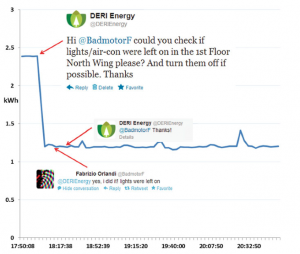
It seems obvious that, with these systems already designed and installable, the City of Portland could invest in one for its larger public buildings; businesses can nail down machines, practices, or groups that are particularly inefficient; landlords can pinpoint wasteful renters, and even specific rooms that need work; and individual homeowners can control their living spaces from-away to minimize their effect on the environment and the strain on their wallet. The rapid progression of technology is now also making it possible to control and monitor these systems from a mobile device, encouraging around-the-clock watchfulness and accountability. That progression is also leading to new methods of encouragement for environmental-minded behavior. One such example is “calling out” or in some views “public shaming” via social media. (See image from Crowley, Curry, Breslin)6. This strategy has the benefit of actually getting results, with the distinct disadvantage of causing uncomfortable public situations. My understanding of this tactic suggests that people would be unlikely to install such a system in a place that would affect them personally. Conversely, businesses, landlords, and cities would be very excited to use the tactic for monetary and environmental savings.

Notification system through Twitter

A parallel problem we also should deal with sooner than later is large-scale data collection and analysis. According to Crowley, Curry, and Breslin, data aggregation from separate existing public systems is a logistical nightmare.3 From a scientific background, I completely understand this complication. Transferring data from a machine to a computing system, then to a data visualization software, then to a publication source is even a computer savvy teenager’s most frustrating nightmare, as I found out the summer after my first year at Bowdoin. My project was to calibrate an x-ray fluorescent spectroscopy machine and I struggled even with very specialized software to transfer my data within the computing system. Trying to send my data to another program would have been maddening, and now, even after four years of experiments, the amount of data aggregation is nowhere near the volume of data immediately available in our environments. Yet, people are obsessed with the idea of data aggregation because of its vast potential. Therefore, I propose (and this may have already unknowingly happened) that all cellular devices act as data collection devices. They already relay vast quantities of data to users, and apparently to the NSA, so why not the Transportation Administration for traffic analysis, the National Weather Authority for precise and accurate temperature and humidity, etc? Again, this brings up the issue of how to effectively analyze this data. As I learned from two books, Big Data: A Revolution That Will Transform How We Live, Work, and Think and The Signal and the Noise: Why so Many Predictions Fail–but Some Don’t, data analysis of city-wide, national, international, or global data sets is a monumental task requiring lots of time on specialized high-computing systems run by data and statistical specialists.4,5 Both books also realize the importance of this new discipline. Ultimately, this ties back to using sensors in housing with the caveat that much of the possible data from these sensors will go unused for years before computing power rises to levels able to handle current and past data simultaneously.

Citations:

1) “InView Building Monitoring and Energy Management Solutions.” Energy Management and Building Intelligence Monitoring Technologies from PowerWise. PowerWise, 2014. Web. 03 Oct. 2014. <http://www.powerwisesystems.com/>.

2) Crowley, David N., Edward Curry, and John G. Breslin. 2014. “Leveraging Social Media and IoT to Bootstrap Smart Environments.” In Big Data and Internet of Things: A Roadmap for Smart Environments, edited by Nik Bessis and Ciprian Dobre, 380. Springer.

3) Crowley, David N., Edward Curry, and John G. Breslin. 2014. “Leveraging Social Media and IoT to Bootstrap Smart Environments.” In Big Data and Internet of Things: A Roadmap for Smart Environments, edited by Nik Bessis and Ciprian Dobre, 382. Springer.

4) Mayer-Schönberger, Viktor, and Kenneth Cukier. Big Data: A Revolution That Will Transform How We Live, Work, and Think. Boston: Houghton Mifflin Harcourt, 2013. Print.

5) Silver, Nate. The Signal and the Noise: Why so Many Predictions Fail–but Some Don’t. New York: Penguin, 2012. Print.

6) Crowley, David N., Edward Curry, and John G. Breslin. 2014. “Leveraging Social Media and IoT to Bootstrap Smart Environments.” In Big Data and Internet of Things: A Roadmap for Smart Environments, edited by Nik Bessis and Ciprian Dobre, 391. Springer.


Homelessness and Tourism in the Smart City of Portland

The technical innovations suggested in “Leveraging Social Media and IoT to Bootstrap Smart Environments” by David Crowley, Edward Curry and John Breslin are undoubtedly exciting, albeit concerning. The proposal for reduction in energy usage is appealing, but the notion of “Everything [becoming] a sensor” has the potential to verge into Big Brother territory (Crowley, 380). [1] It is essential that these burgeoning urban technological advances be “situated in a specific locale and human context” (Greenfield, Kindle Location 291). [2] In the specific locale and human context of Portland, Maine, there is a more pressing, rudimental, and fundamentally ‘smart’ need than the implementation of “sensors, actuators, displays and computational elements” in homes: ensuring the citizens’ access to shelter (Crowley, 380). [1]

This poses challenges in a city increasingly attractive to tourist populations and summer vacationers. A 2012 Bangor Daily News article poses a controversial and concerning question: “Is Portland too attractive to the homeless?” [3] A Portland Community Chamber of Commerce document discussed in the article quotes a homeless person describing Portland as a place where “‘nobody hassles you’ when in search of public assistance.” [3] The Chamber expressed concern that “the number of shoppers and visitors in Portland is bound to decline” as the city becomes “a disgusting filthy mess,” and seeks to make the city less appealing to the homeless, despite other efforts to increase shelter space. [3] This mentality of the Chamber of Commerce is reminiscent of the police evictions of homeless people and protestors from New York City’s Tompkins Square Park in 1988. Protestors were enraged at the impacts of gentrification on their community – the Mayor accused the homeless of “[stealing]” the park from the community, yet “the city shelter system had beds for only a quarter of the city’s homeless people,” (Smith, 313-314). [4]  Portland’s housing first model, by contrast, is a uniquely progressive system in which “chronically homeless individuals battling the most severe substance abuse and mental health problems are provided small apartments in buildings staffed with specialists at little or no cost, and with no initial demand that they change their lifestyles.” [3] This is a great start to getting Portland’s homeless on their feet, and could be augmented with technological and developmental advances to the city’s housing.

As we learned during our tours of the city, Portland has changed frequently and drastically over the years. It continues to do so today with the rise of tourism and the development of pricey condos, which hugely impact the experience of the city community. A comprehensive and interactive housing map, delineating changes in cost, development, and ownership over Portland’s history, would help to trace that change and understand forthcoming trends. Visualizing and studying this data would allow for greater understanding the dynamics and patterns of gentrification, homelessness and real estate in Portland. It would also – hopefully – generate motivation to eradicate the city’s homelessness and eliminate the attitudes expressed in the Chamber of Commerce document.

Portland’s location on the water, in conjunction with chronic climate change and Maine’s brutal winters, makes its buildings especially susceptible to physical damage. Looking to the future, developing low- and mixed-income coop housing ensures that individuals who obtain housing are able to keep it. In the case of a natural disaster or structural damage, the costs would be distributed across all residents instead of one unlucky inhabitant bearing the brunt.

Lastly, Preble Street login accounts (private, of course) would help individualize support and streamline communication. Users could sign up online for particular events, delineate specific needs, exchange online resources, and discuss sensitive issues with a little more remove.

[1] Crowley, David N., Edward Curry, and John G. Breslin. 2014. “Leveraging Social Media and IoT to Bootstrap Smart Environments.” In Big Data and Internet of Things: A Roadmap for Smart Environments, edited by Nik Bessis and Ciprian Dobre, 379–99. Springer.

[2] Greenfield, Adam. 2013. Against the Smart City. 1.3 edition.

[3] Koenig, Seth. “Is Portland ‘too attractive’ to homeless people?.” Bangor Daily News. N.p., 21 Dec. 2012. Web. 6 Oct. 2014. http://bangordailynews.com/2012/12/21/news/portland/are-cities-like-portland-too-attractive-to-homeless-people

[4] Smith, Neil. 2014 [1996]. “‘Class Struggle on Avenue B’: The Lower East Side as the Wild Wild West.” In The People, Place and Space Reader, edited by Jen Jack Gieseking, et al, 314-319. New York: Routledge, 2014.


Centralized, Energy Efficient Housing for Portland – Emma Chow

Housing is most useful in the smart city when it employs technology to increase the structural energy efficiency and is well-integrated with the city’s other systems. Crowley [1] discusses the possibilities of using Twitter as a means for directing people’s actions to be more energy efficient, but a system of systems does not necessarily need to be established in order to best leverage the power of technology. For instance, installing systems that allow residents to control their home’s temperature remotely using a smartphone app helps residents waste less electricity. Housing should not be planned according to low-density suburb design. By creating high-density residential areas, it makes it easier to design more accessible public transportation networks.

Ensuring housing is built within the city, instead of outside the city, brings people closer together and helps cultivate community. Smith [2] discusses the issue of gentrification in New York’s Lower East Side. He explains how developers promoted the Lower East Side’s new housing by convincing potential buyers they could conquer the “Frontier”, and in doing so, would capture the American Dream. Higher income residents gentrify a neighborhood by moving in, driving up housing prices, and often claiming it as their own by re-naming the area. “Village”, “Heights”, “Hill”, “Green”, “Gardens” – these are all common names assigned to neighborhoods to give them a more “sophisticated” image and sense of place. Housing for the common good is accessible. The financialization of the housing market over the past few decades has made housing in cities increasingly inaccessible. [3] Financialization has increased inequality and worsened housing conditions in cities by making it harder for low-income residents to move to better housing. [3] Housing for the common good may include co-op buildings where residents own shares and share the responsibility of maintaining the building. Housing should also be built using eco-friendly or recycled materials, in a manner that maximizes energy efficiency (i.e. weatherizing, high-efficiency appliances), to minimize negative environmental impacts.

Portland can take several steps to better develop its housing. The city should implement building height restrictions to ensure residential condo buildings do not concentrate people in too small of an area. A sudden influx of many residents can have unplanned negative impacts on a community. Portland should carefully manage areas that are attracting the “Creative Class”, to ensure they do not become too gentrified and exaggerate the divide between the poor and wealthy neighborhoods. Additionally, neighborhoods should be restricted from being renamed to sound more “sophisticated”. Housing developments should be integrated in the city as much as possible, while subdivisions or condos outside the city should be avoided. Distancing housing from the city’s core increases the need for car commuting, and makes it difficult to foster a sense of community. The city can also implement a housing weatherization project to ensure homes are more energy efficient; this will cut residents’ electricity costs and reduce climate-change-inducing emissions.

[1] David Crowley et al, “Leveraging Social Media and IoT to Bootstrap Smart Environments,” in Big Data and Internet of Things: A Roadmap for Smart Environments, ed. Nik Bessis and Ciprian Dobre (Springer), 379-99.

[2] Neil Smith, “’Class Struggle on Avenue B’: The Lower East Side as the Wild Wild West,” in The People, Place and Space Reader, ed. Jen Jack Gieseking, et al, (New York: Routledge, 2014), 314-319.

[3] Desiree Fields and Sabina Uffer, “The Finacialisation of Rental Housing: A Comparative Analysis of New York City and Berlin,” Urban Studies, July.