Category Archives: Post #4: Housing Reflections

Depolarizing Cities

Before I start writing about the present condition of public housing and ways of its improvement in the future, I’d like to go over the history of public housing system in the Unites States.

US Public Housing system was created as part of the New Deal, Franklin Delano Roosevelt’s economic recovery plan carried out between 1933 and 1936 in an attempt to restart the US economy after the disastrous effects of the Great Depression. The National Housing Act of 1934, also known as the Capehart Act, led to the creation of the Federal Housing Administration which  sets standards for construction and underwriting and insures loans made by banks and other private lenders for home building. The National Housing Act gave people an opportunity of a fresh start by providing affordable housing as they tried to escape poverty brought around by the economic recession.

The purpose of the housing bill was to provide low-cost housing for struggling citizens; however, as some people got richer than others, they started moving away from the neighborhoods associated with poverty and dirt. At about the same time banks realized that they could make money off urban migration and this brings us to 1960s.

Gentrification, one of the most important events in the history of urban studies, started in 1960s, the term itself was coined in 1964 by British sociologist Ruth Glass to describe the process of poorer residents being displaced by wealthier newcomers. Urban migration based exclusively on economic status resulted in redlining, a practice  followed by banks for categorizing neighborhoods. Gentrification and redlining resulted in the deterioration of disinvested neighborhoods, entire districts starting falling apart causing the decrease of property value. Banks would later acquire this property, fix it and raise the rental price – first, they would pocket the money that should have gone to repairs and upkeep; second, having effectively destroyed the building and established a rent gap, they have produced for themselves the conditions and opportunity for a whole new round of capital reinvestment.[1] People who lived there before were no longer able to afford the rent and they had to move. These processes caused widespread and drastic repolarization of the city along political, economic, cultural and geographic lines since the 1970s.[2]

I have mentioned in my previous posts that smart city is not just a city stuffed with sensors and CCTV cameras; smart city is smart because it approaches issues in novel, smarter ways. Desiree Fields and Sabina Uffer describe the strategies used by investors for promoting turnover rates that include harassing tenants, ignoring their requests and etc. I think that the first thing that needs to be changed is policy. Banks and large corporations should no longer be able to manipulate property prices; cities need policies that will provide tighter control over large property sales and regulate rent. Fields and Uffer describe the  principle of common public interest in their paper – under the principle of the ‘common public interest’ companies limited their profit orientation in exchange for tax exemption, which meant that units were often offered at below marker levels.[3] I think this is something that Portland could benefit from. Implementing this approach will contribute to the promotion of the common good by encouraging private companies to build more housing while keeping it affordable. In this way, we will create “nice” neighborhoods without weeding tenants out and building the frontier myth.

As property ownership transferred from local landlords to globalized investors, the issue of accountability emerged. It is much harder to hold distant investor-landlords socially, legally and politically accountable at the local level.[4] The lack of communication between tenants and people responsible for property maintenance causes the deterioration of existing housing which in turn creates basis for turnover of units and deregulation of rent-stabilised apartments.[5]

Accountability problem can be solved by a creating an open platform where citizens will be able to report issues to globalized investor-landlords. Requests will have to be routed through appropriate government agencies that will ensure their completion by private owners. Policies obliging private companies to complete the requests should also be created; this will add another layer of security for tenants and decrease the chance of real estate market manipulations.

We need to create public housing that will be affordable and secure.  This can be done by creating policies and fostering communication between single tenants and entities responsible for housing. Cities should no longer be artificially polarized, but should act as communities united under the goal of common good to create decent living conditions for every citizen.

————–

Citations

1. Smith, Neil. The People, Place, and Space Reader. Taylor & Francis, 2014. 317. Print.

2.  Smith, Neil. The People, Place, and Space Reader. Taylor & Francis, 2014. 315. Print.

3. Fields, Desiree, and Sabina Uffer. The Financialisation of Rental Housing: A Comparative Analysis of New York City and Berlin. Urban Studies, July. 3. Print.

4. Fields, Desiree, and Sabina Uffer. The Financialisation of Rental Housing: A Comparative Analysis of New York City and Berlin. Urban Studies, July. 4. Print.

5. Fields, Desiree, and Sabina Uffer. The Financialisation of Rental Housing: A Comparative Analysis of New York City and Berlin. Urban Studies, July. 13. Print.
Affordable Smart Housing

In a smart city, housing needs to be designed in a way so that it is affordable and inclusive. Currently, smart technology is not available in most places because of the costs of implementation and the difficulties in adding the technology into older buildings. {1} We have discussed in class how smart technology is not accessible for the vast majority of people, but if we want people of all socioeconomic classes to be able to have access to smart technology or even live in prototypes of smart cities, then they need to be able to afford the technology or housing itself. Looking back at history of housing in the cities, things like redlining and blockbusting were exploitative and led to larger issues of segregation in cities. When cities are highly racially or socioeconomically segregated, it is difficult to implement things like smart technology into them, as certain neighborhoods can financially support the technology and certain cannot.

In cities, there is an incredibly large gap between housing for the rich and housing for the poor. While a large portion of this is due to practices that have now been deemed illegal, the real estate market accounts for a lot of it as well. The practices of rental housing and the manipulation of markets for financial benefit discussed in the Fields and Uffer reading are simply not beneficial on a large scale. {2} For example, the ways in which landlords will not always renovate apartments in rent-stabilized units because it is not financially beneficial to them is something that prevents a neighborhood from revitalization. This goes against the 1991 Tompkins Square Park concert and then riot/movement idea that “housing is a human right,” as it not only prevents residents from living in appropriate housing, but also devalues neighborhoods. {3} Smart technology needs to be implemented in housing of all kinds so that neighborhoods do not become even more socioeconomically stratified than they already are today.

One way in which smart technology could be implemented into housing in all cities as well as in Portland is through more affordable smart housing. Lower socioeconomic neighborhoods are the major barrier to technology changes in cities, so implementing technology into affordable housing would not only make smart housing more accessible, but would also rejuvenate neighborhoods that are currently thought of as dangerous or more generally “bad” because of their residents. One way in which I think this could be implemented in Portland is through foundations that provide low-income or homeless housing. One of the programs that Preble Street runs is a program called Logan Place. Logan Place is a housing complex that houses 30 continuously homeless adults with 24-hour onsite help to assist them in the transition back to more conventional lives. {4} I believe that this program can already be considered a program with some sort of smart technology, as the 24-hour assistance allows residents to get help in whatever ways they need. This reminds me of the way in which the experiment in “Leveraging Social Media and IoT to Bootstrap Smart Environments” used Twitter as a means to communicate with people to have them perform tasks such as turning off the lights to conserve energy. {5} Having 24-hour on-call support is similar to this, as it allows residents to learn or relearn how to live stable lives through communication and aid.


{1} Crowley, David N., Edward Curry, and John G. Breslin. “Leveraging Social Media and IoT to Bootstrap Smart Environments.” In Big Data and Internet of Things: A Roadmap for Smart Environments. Switzerland: Spring International Publishing, 2014. 379-399.

{2} Fields, Desiree, and Sabina Uffer. “The financialisation of rental housing: A comparative analysis of New York City and Berlin.” Urban Studies July (2014): 1-17. usj.sagepub.com (accessed October 3, 2014).

{3} Smith, Neil. “Class Struggle on Avenue B: The Lower East Side as Wild Wild West.” In The People, Place, and Space Reader, edited by Jen Jack Gieseking, et al, New York: Routledge, 2014. 314-319.

{4} “Logan Place.” Preble Street. http://www.preblestreet.org/logan_place.php (accessed October 5, 2014).

{5} Crowley.

Ensuring the availability of affordable housing and protecting the welcoming city

I grew up in Washington Heights, a Dominican, mostly low-income neighborhood that is becoming increasingly gentrified. My parents moved to the neighborhood as low-income recent college graduates in the 1980s. Over the course of the last three decades, they (and many of their neighbors) have successfully landed high-paying jobs, attracting high-end restaurants and businesses that the original residents of the neighborhood largely cannot afford. Real estate agencies have renamed the section of the neighborhood now occupied by upper-middle class residents like my family “Hudson Heights,” outlining an area mostly located west of Fort Washington Avenue along the river.

Screen Shot 2014-10-05 at 12.50.27 PM
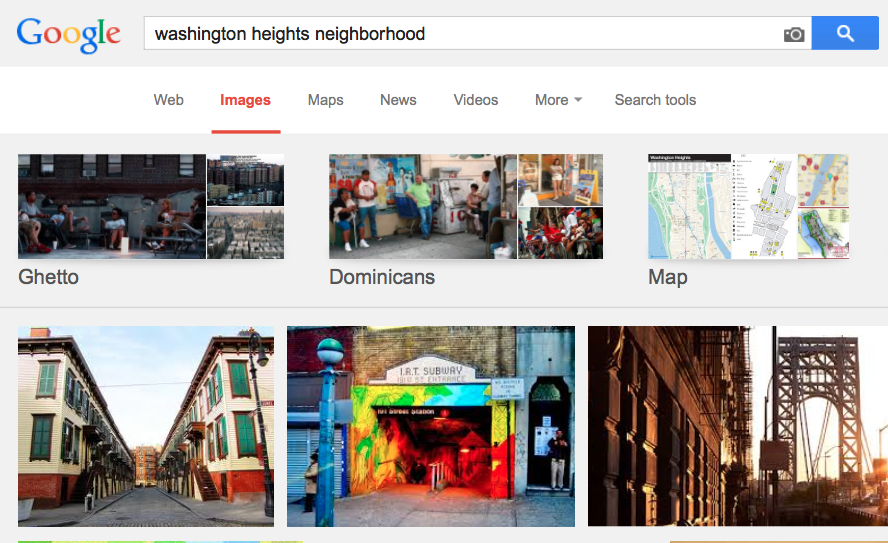
Google Image comes up with categories “Ghetto” and “Dominican” when searching “Washington Heights,” but yields friendlier and greener images when searching “Hudson Heights.”

Screen Shot 2014-10-05 at 12.50.01 PM


Like other examples we discussed in class, this name-change distinguishes the gentrified area of Washington Heights from the rest of the neighborhood, encouraging the sale of more property to middle-class families and up-scale businesses, leading to further gentrification. This has transformed the feel of the neighborhood: while the park across the street from me used to be filled with Dominican teenagers playing music on their boomboxes and Dominican men playing dominoes, now the park has been renovated and is mostly populated by white toddlers and their Dominican nannies. The effects of gentrification are most visible in so-called Hudson Heights, where I live, but they are not limited to this area. Even in the most eastern part of Washington Heights, the presence of the private Yeshiva University is slowly but consistently applying real-estate pressure toward middle-class redevelopment. Just this summer, an expensive-looking, glass-plated residential building, dwarfing the worn-out low-income apartment buildings surrounding it, popped up on 181st street and Audubon, directly across from the Goodwill.

As described by Desiree Fields and Sabina Uffer in their 2014 article, “The Financialization of Rental Housing,”1 investment and financialization (specifically, transforming expected future earnings into concrete currency, making possible mortgages or deficit spending) have led to heightened inequality throughout New York City. They argue that previously low-class neighborhoods can be transformed by investment and financialization only at the expense of the original residents. This argument aligns with that of Neil Smith in his article “Class Struggle on Avenue B”2: namely, that the gentrification of neighborhoods such as Washington Heights can be described as a sort of frontier struggle, where more powerful sectors of society are called upon to “tame” the overly romanticized low-class neighborhoods. Smith points out that gentrification leads to an increase in official crime rates, police racism and assaults on the “natives,” or the people who were there first. Washington Heights is a prime example; throughout my life, these consequences have been evident. In high school, if my male black or Latino friends were visiting my apartment, dressed in baggy jeans and fitteds, they were questioned about their motives by police guards on my block, while my white male friends wearing skinny jeans and button downs were never stopped. Fort Tryon Park, just north of me, was never heavily regulated while I was growing up; now it is crawling with cop cars ready to hand out court summons to anyone in the park after 1am, echoing the harsh voice of Mayor Dinkins in 1991: “The park is a park. It is not a place to live.”2

It frustrates me that the nature of gentrification is so segregationist. Not only do the gentrifiers express, often subconsciously, intense racist fear towards original residents, but original residents often understandably intensely resent the gentrifiers. I have felt embarrassed to tell my neighborhood friends exactly which building I live in because, in their eyes, it would jeopardize my ability to say that I am “really” from Washington Heights, or worse, that I am “really” Latina. More interaction between newcomers and original residents is critical to bridging this divide. I believe that every new residential building in Washington Heights should include an equal number of units designed for tenants of low- and middle-income economic brackets. I would recommend similar regulation for Portland. Allowing for the displacement of low-class and immigrant communities due to gentrification is unacceptable. The most beautiful aspect of urban areas is the intense confluence of diverse cultures and varied heritages; only through strict housing regulation that prevents the displacement of low-income communities can we support such a confluence and nurture the growth of a vibrant and welcoming city.

Work Cited

1 Fields, Desiree, and Sabina Uffer. 2014. “The Financialisation of Rental Housing: A Comparative Analysis of New York City and Berlin.” Urban Studies, July.

2 Smith, Neil. 2014 [1996]. “‘Class Struggle on Avenue B’: The Lower East Side as the Wild Wild West.” In The People, Place and Space Reader, edited by Jen Jack Gieseking, et al, 314-319. New York: Routledge, 2014.

Blog Post #4: Housing Reflections

Blog Post #4 – due Oct. 6 at 8pm

Reflecting closely on the arguments from the Smith, Fields and Uffer, and Crowley et al., readings and our class discussion, what sort of housing is most useful in the smart city? What sort of housing may be most useful in promoting the common good? Given the examples we discussed in regards to New York City and your reflections on housing  for a smart city and the common good, what may be of use to Portland in developing their housing?

Feel free to continue to build on ideas from previous posts, but be sure to also take them to the next level. You can do this by expanding, concretizing, or focusing your idea through research into city’s with similar ideas. You could also find readings on your topic that help you think through the idea in different and new ways.  Finally, you could draw on media such as (cited) images, videos, music, and other forms of art to support your arguments.