

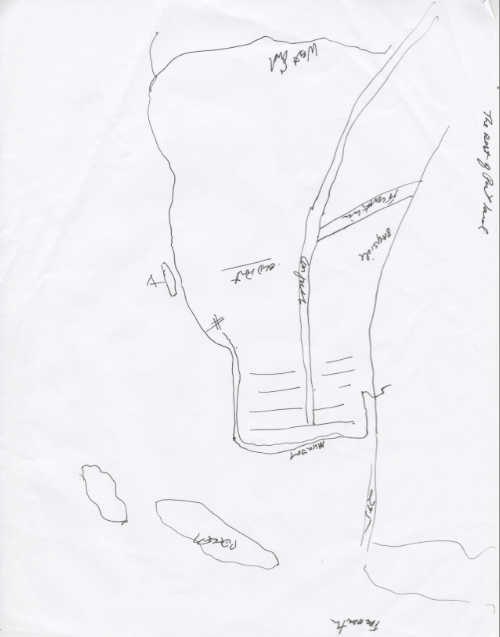

Two things are particularly worth note: that the coffee shop was, on the whole, pretty busy all morning, and two, that it was busy with a rather specific population. I don’t know the demographics of Portland, but if this coffee shop had been taken as representative, it would be a city of under 30 year olds, all white and relatively well off. Perhaps this is the kind of crowd a coffee shop draws. But it is a curious thing to witness anyway. Where is everyone else? I think, to the extent that I can extrapolate, my mental maps confirmed this trend. Though they varied in age and gender, the mappers most frequently identified local eating establishments and upscale shops. Few people identified landmarks or museums or libraries—public or free spaces. It confirms my interest in a more inviting and economically mixed Portland.
10:00—Sitting facing the window, I notice that the streets are super busy. Lots of young, hip looking people in flannels and men with beards.
10:10—It’s pretty full in here, roughly 25 people. A few empty seats. People are encouraged to sit together, as there are lots of twotops.
10:20—Emptier now. Still, I’m noticing that it is very loud! The espresso machine or whatever is constantly buzzing, milk is being frothed. Nice indie rock drones. Conversation is quiet and minimal, a couple is sitting doing the crossword in one seat. Cute.
10:30—(I drew a map of the coffee shop, showing a variety of smaller seating around the perimeter—which, by the way, was a pretty small rectangle, roughly 20 by 25 feet—and a big long table for 8 or so in the middle of the place.)
10:40—Not very busy now. 2 conversations or so, I can hear the music pretty clearly. A man with a cowboy hat enters. 10 people total inside. 5 people at least are 25 or under, one is maybe over 60, all are white.
10:50—The guy sitting across from me is youngish, with a huge beard and tattoo sleeve, skinny. Another older man, maybe 60 walks in, but he is well in the minority.
11:00—A bus drove by with a big U.S. Cellular ad—is it a public bus? Someone enters with a stroller, maybe the first one I’ve seen? Also, just a note on the space, it’s pretty dimly lit, and as said before, pretty minimalist as a space. Small, cozy, not very much in the way of decoration except for some pumpkins. Big windows on the two street-facing sides. They don’t have much of a menu it seems.
11:10—Down to 6 people. 3 were here when I arrived. A biker has entered. I’ve seen lots of bikers ride by. Cars at this point seem pretty infrequent for a main thoroughfare (Congress). So are people on the street.
11:20—Ok, it’s gotten busier again. An elderly lady with a pushcart and a cool headscarf has struck up a seemingly spontaneous conversation with a younger woman.
11:30—Worth describing the general appearance of people—if I can take that liberty. First off, just about everybody is rather put together (cafes are great places to show off). Lots of boots, a few of which are bean boots. Still lots of facial hair amongst males. Patagonia and Northface abound.
11:40—Hats, lots of baseball caps! They are never fitted caps—that’s not how Mainers do it, it seems. They are faded, roughed up, blues and beiges. As if to say, “I don’t care too much…” It is very in line with the yuppie look.
11:50—Two guys walk in who seem to be in construction. They have on dark blue jeans with paint and grass and dirt stains. They have matching sweatshirts with a company’s name on it. They are the first people who seem to be working, and manual labor at that.
12:00—Lots of people are entering and taking coffee or food to go. People who sit down are here for the long haul. One is reading Frankenstein, another is reading The Odyssey. One does sudokus. Someone has the Wall Street Journal out—what?? 5 men, 6 women.
12:10—There is now one Asian person here—and he happens to be a former Bowdoin student.
12:20—I notice the bus again, and see that it is indeed a municipal bus. I can’t see if it’s crowded or not, but I would guess that it isn’t…
12:30—A trolley cruises by. Has to be tourists. The café is still pretty quiet. People on their Macs are still chugging away.
I like how you note the specifics of what people are reading and doing. It’s so true that people who hang out in cafés are definitely not representative of Portland at large. I’m interested in the two construction men you saw. It would’ve been cool to know where they were coming from and why they saw fit to spend money on an overly priced coffee if they didn’t stay to enjoy the space. It’s funny to me that the outdoorsy look (faded caps, beards, flannels) has become a sign of class rather than of labor.
I also conducted my cafe at Hilltop and share many of the same observations as you do. Everyone in the cafe during my time was white, although I did notice a little more age variation, maybe because of the time of day. I think your maps, and most of the other upscale, cafe-centric maps, are asking for a more diverse city, both economically and socially. It would be interesting to see how many maps were collected in cafes and compare those collected in and out of cafes to see how the landmarks or other points of interests differ. I would think that those maps collected in cafes would reflect a higher, mostly white class, but it would be interesting to see if we could back that up with our research.
Like Jonah and Claudia, I agree that cutesy Portland coffee shops are unlikely to represent the range of residents’ lifestyles.
Despite the apparent collective resentment of coffee chains like Starbucks and Dunkin Donuts, their customers tend to be diverse than those at smaller cutesy coffee shops, at least in my experience. Perhaps their status as a chain makes them more socially accessible – they are less likely to develop a unique and exclusive ‘scene’ – and their lower prices (probably not in the case of Starbucks) make them more financially accessible. It would be interesting to perform a comparative study in a Portland coffee chain to assess the differences of demographics, ambiance and culture.
I agree with everyone that you make a good point about coffeeshops being an inadequate microcosm for Portland in general. Even without an extensive of knowledge of Portland’s demographic breakdown, it seems that we all know from statistics and a few sights around town that Portland’s coffeeshops are socioeconomically rarified air. Nevertheless, I find that your mental map subjects gave suggestions that could represent a majority in Portland, especially the specific complaint about housing rates. Given this problem, how could neighborhoods and communal gathering spaces be more mixed in the way you mentioned? Would rezoning help, or could a more inviting retail establishment fix the problem of cafe homogeneity?