
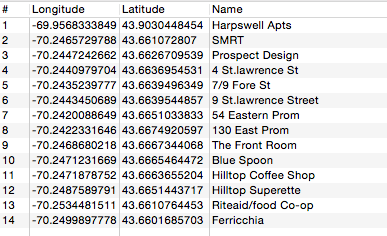
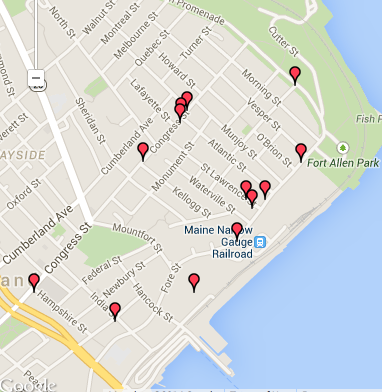
I looked into the revitalization of old buildings. Any structure that appeared to have an authentic skeleton or base, but with obviously new construction or renovations was marked on the map. I found that most of the spaces I saw on my transect walk were restaurants and businesses that necessitated redesigned spaces. I chose not to walk in the commercial section of the Old Port because this type of building structure (store at ground level with apartments above) is very common, but difficult to distinguish between new and original construction. I came upon this idea originally because of a real estate office off of Forest Street that had new construction within the original building. I think this is a fantastic and fascinating use of existing infrastructure because it requires less materials and waste, while revitalizing the look (and often purpose) of the building. I also found that many houses on the Eastern Prom have undergone repairs to make the expensive houses worth more. There was one in-progress right now at 130 Eastern Prom – a mere shell of the former structure, ready to be retrofit with new siding, insulation, etc. Although the direct purpose of the building as housing has not changed, many of the houses on the Eastern Prom have been split into multiple units. I foresee great possibilities for this repurposing and revitalizing in Portland, a city that tries to stick with its heritage, but yearns to progress into the future. I see parallels to many cities, my hometown of Moline, IL included, because of space limitations. In NYC we saw how space limitations drove development up; but NYC was obsessed with NEW, BETTER, DIFFERENT! Portland and many other cities don’t have the capital, capabilities, or desire to follow that building plan, and should think instead about how to reuse existing infrastructure. This idea is being used in a different context in NYC with the free Wi-Fi stemming from existing phone booths. The next step is larger infrastructure. Bowdoin College, in fact, has been following this plan for years; Studzinski Hall is repurposed from the old swimming pool, Smith Union is repurposed from the old track, the side of the Chapel houses the McKeen Center for the Common Good. From a purely financial view, repurposing old buildings costs less; but more than that it preserves the history of the space (a key reason Bowdoin likes the practice).
I think the idea of preserving the history of buildings is crucial in a city like Portland. When I went on my transect walk, I noticed that due to the New England style in which houses were built, I was not necessarily able to tell the difference between new and old, rich and poor, etc. The New England style is almost equalizing in that it can prevent people from directly telling the differences in socioeconomic class of houses. I think that Portland has a specific charm and elegance to it due to the New England style. If Portland tried to do smart technology in a NYC kind of “everything must look new and improved” way then Portland would not have the same charm and appeal that it does as a coastal New England city.
Your strong concern and wanting to preserve the current architecture of Portland is very important. Through the history of the buildings we are able to gain an intangible spirit and quality of the city. While walking around the east end, I loved seeing the old houses situated in modern day. Portland needs to keep this spirit as it goes through changes because its small New England town feel is what attracts so many people to the city. When thinking about smart technologies for the city of Portland, it is important to not consider it the next New York. We need to innovatively think of original ideas that are going to work Portland because it demographic and structure is so different from many other cities.
Your argument that repurposing/restructuring of building both preserves cultural and historical heritage and is also practical financially is strong. I totally agree with it and it is a way that Portland could improve its infrastructure at a low cost, while also maintaining much of its charm. Many of the repurposing you mapped was of restaurants and cafes and represents an important way through which older building can be revitalized into new businesses. I like that you also noted many of the large houses that had been split into smaller apartment units. I suspect that there are many more than the ones you mapped and I think this transition from large townhouse to apartment complex will be a way for Portland could create more housing for more people. The real question is what kind of people will these new apartments attract? Since Munjoy Hill is known to be experiencing a degree of gentrification, it seems to be attracting younger and wealthier residents with this kind of housing at this time.
Great observations. I am curious about how market needs/demand influence the decision process of how much of a building stays besides historical and cost concerns. To a certain extent, I am thinking about competing influences here. So if a developer is trying to execute its new building project either through demolishing and then building from scratch or remodeling the existing, how would competing influences be balanced? For example, a rising need for housing, which means to develop more units within a limited space, the building structure has to go up, which means historical buildings might not have the capacity to accommodate today’s and tomorrow’s needs.