
While I have been making more abstract smart city recommendations up to this point, the transect walk revealed specific ways in which small changes could greatly improve existing public space. As I mentioned in Post #6, there is a lot of existing green space in Portland, but its structure or lack of amenities make its use less appealing. Changes including more seating, more interesting or inviting landscaping, modifying the parks’ interaction with the surrounding environment, and introducing more cultural programming, will render more thoughtful and usable spaces. This is consistent with our findings from the mental maps and cafe ethnography exercise. More attention should be made to the type of amenities that are in demand. For example, the Western promenade was used almost exclusively by dog walkers and joggers during our transect walk. A dog park and more water fountains (we only saw one), would better serve these populations. Wifi would also be an amenity that could invite increased use. More specific recommendations are included in the notes below.
Transect Walk:
Jackie, Emma and I did a transect walk through the West End beginning on Pine Street. We were looking specifically at public seating, but came up with more recommendations along the way.
While walking down Pine Street, we saw very little public seating. There were however, features that could have been multi-use, doubling as seating. One being a collection of stone pillars that made up a fence:

We also noticed the interesting mixed-use of buildings. Many large mansions had been converted to multi-unit apartments or business spaces. It was unclear whether some of these spaces were public space or not.
When we arrived at the Western Promenade, we noted how its featurelessness made it an uninviting space to spend time in. Despite being surrounded by many attractive historic buildings in a residential neighborhood with few other park options, the strip seemed underutilized. The sidewalk was in great disrepair.
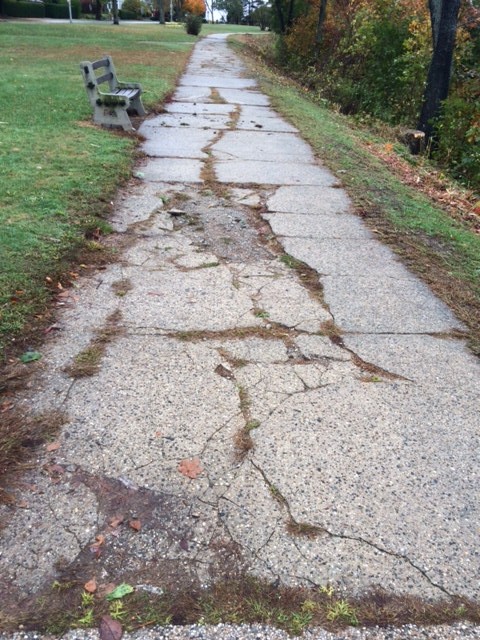
We saw six benches along the sidewalk, but they were also in poor condition. These were the only benches in the park, and they were facing away from the park into the overgrown slope leading from the promenade (see photo above). This was the least stimulating view in the whole park, as you could not see the bay or the park. The benches should be moved to face inward, or the overgrowth should be cut to reveal views of the bay. We also thought there should be more paths and benches and picnic tables in the green space, inviting more central use, as well as landscaping and attractive plantings. There was great potential in the space, but at the current moment, it was simply a buffer between houses and a walk to nowhere.

As we passed Maine Medical Center, we saw three blue benches in an ally leading to a back doorway. Signs above the benches said “No Smoking.” I do not mean to advocate for smoking, but that is the only thing I could imagine anyone ever wanting to use those benches for. They were outside a building in a back corner facing a wall.
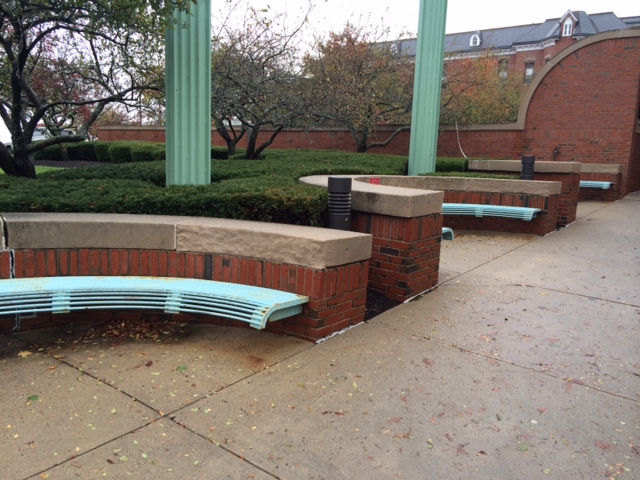
Seating would better serve the public inside of the hospital, in a courtyard, or facing the street, as it would be accessible and more visually stimulating. We found some good seating of this variety a couple steps further along Bramhall St. The low stonewall was a great height for sitting and accessible to the street. There were also benches in the bus stop shelter, though the area could have had more street lighting to ensure safety for bus passengers waiting at night.
(Photo by Emma Chow)
We continued down Bramhall St. to Congress, where we saw little public seating or public space at all. At the intersection of Bramhall and Congress, there was a small greenspace with three benches. There was little space for large-scale activity in the greenspace, but the benches were well-placed for someone who wanted to take a moment to rest or watch activity on the street.
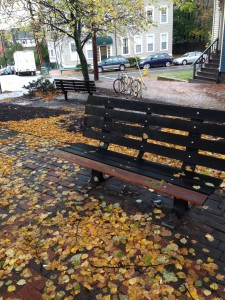
(Photo by Jackie Sullivan)
We went down Deering Avenue to Deering Oaks Park. The park has significant open grass for recreational and community activities, and a central pond. Similar to the Western Promenade however, it felt less a place to spend time, and more a nice place to “simply pass through.” A lot of this had to do with the physical features – or lack thereof. There were eight benches along the southern path of the park, but even this would only be enough to seat about 25 people – nothing near the desired demand for a large park on a nice day.
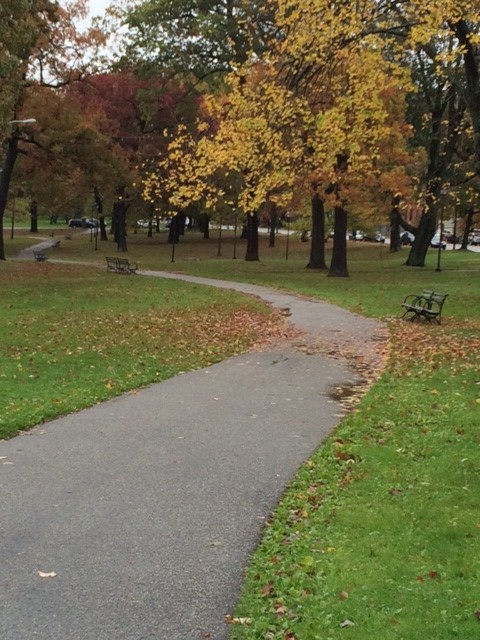
Surrounding the path were large open spaces of grass with scattered trees. To encourage greater use of the area, we thought there should either be a larger open grass space that could accommodate sports, or more intimate features like picnic tables, a gazebo, or small landscaping features. Otherwise, the area was too expansive and did not feel inviting.
In addition, the park should have a physical, or at least psychological, barrier between the park and the street. Park Avenue and State Street, the streets surrounding the portion of the park we walked, have heavy, noisy traffic. The park feels too exposed to these elements, making it feel simultaneously vulnerable to the dangers of traffic and an uninviting island. Hedges or a fence would make a large part of the periphery more inviting.
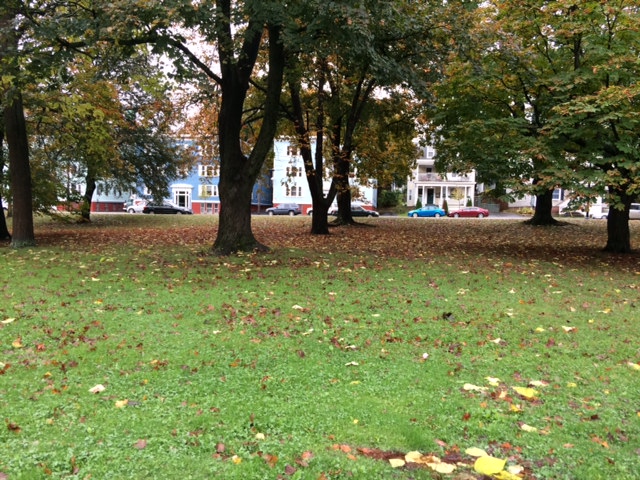
The areas between State Street and Forest Avenue do not even feel like a continuation of the park because they are so sectioned off by larger streets. There is some pleasant landscaping in the middle, but it has no seating, rendering it yet another park that is uninviting to lingerers. More seating, as well as varied, landscaping, would make an immense difference in this part of the park.
Portland does not suffer from a lack of public space or greenspace, but it could do a lot to improve the existing space and make it more appealing to visitors. Small changes could really get the city moving in the right direction – repaired sidewalks, improved landscaping, small amenity changes for the target audience of the park, and most importantly, improved seating, would make the Western Promenade and Deering Oaks Park much more enjoyable.
GPS Coordinates for Public Seating:
It is very true that during our transect walk we realized how many small, quick fixes could be made to dramatically improve public space in Portland, parks in particular. Benches need to be replaced or repainted, sidewalks need repair, and trees or bushes need to be planted. Portland has already invested a lot of time and money into creating green space, so it should capitalize on this investment by dedicating resources to making improvements rather than try to create brand new space.
Another common theme we noted along our walk was the need to have things to “do” in the existing parks. We need a space that is leveled out to play soccer, facilities that make dog walking more accessible, and children’s playgrounds to keep kids active. Cultural events, such as outdoor movies in the summer or big picnics, could also help develop connections between Portland residents and their parks. People need a reason to go to the parks, it cannot be expected that everyone will simply go walk through a park everyday. Let us make their experience in the park exciting and varied.
Libby,
I am glad that you made the distinction between putting in more public greenspace and just improving what is already there. Obviously the latter option will be much easier to accomplish, in terms of cost and zoning. The picture of the Deering Oaks Park path makes the park appear to be in quite bad shape. It seems worth it to me on an aesthetic level to ditch that ugly concrete path and find another solution that might look better and not crack so badly. Paths with more give, or with a small amount of space between pavers, would be less susceptible to temperature cracks. If the path were being redone, this would also be an opportunity involve local artists in making the infrastructure of the park into a piece of public art. A brick path would not crack, and some bricks could be decorative. Or, if a brick path were not practical, perhaps the path could be decorated concrete. (Can you do frescos in concrete…? Definitely not, I think.) There is certainly a solution that is practical and beautiful, and most things would be an improvement on the existing path.
Eva
I am glad you highlighted the condition, particularly the poor condition, of many areas of public space that we encountered. Even if those 6 benches in the western promenade were multiplied and placed in the perfect spots, they would still remain uninviting in their current condition. Nobody wants to sit on a run-down, moldy bench that looks as though it could fall apart. This does not positively contribute to the aspect of public space which we are trying to improve. More so, the sidewalks are extremely overgrown and not appropriately matching throughout the park. These are simple aspects that can make public space much more inviting and welcoming to more than just passer-bys, but maybe it could even be used for long periods of time. I also like your suggestions about additional amenities such as public wifi, which could introduce a whole new source of activities in public spaces. This is much harder to implement, although it should be easy to fix up the public spaces to make them look appealing.
It seems that the lack of features in parks such as tables, chairs and gazebos makes passerby’s see green space as in-between space, and therefore the park is not being used efficiently because there is not much to keep people there. You are right, it just seems like a buffer. Interestingly, I saw one of these “green buffers” in between the road leading towards 295 that was turned into a community garden!
For landscaping, I like the idea of hedges making the green space feel more enclosed, a bit more distanced from urban noise. Perhaps artificial hills could make flat green spaces more dynamic and variable. Remember when we read about how Central Park was designed so that the hills and paths keep people inside the park?
Portland has a lot of green space, as you said above, but all places seem to cry for improvement. Whether it’s turning around the benches so they face something scenic, improving the bench and path quality by using more weather resistant materials, or adding more attractions to the spaces themselves. Portland could hire local artists and architects to design practical benches that would add to the aesthetics of the city. As Eva suggested, paths could become frescos or places for murals. I agree with you that there are some very simple and specific additions that Portland could implement that would benefit the overall vibe of the parks, and therefore the usage of the spaces.