
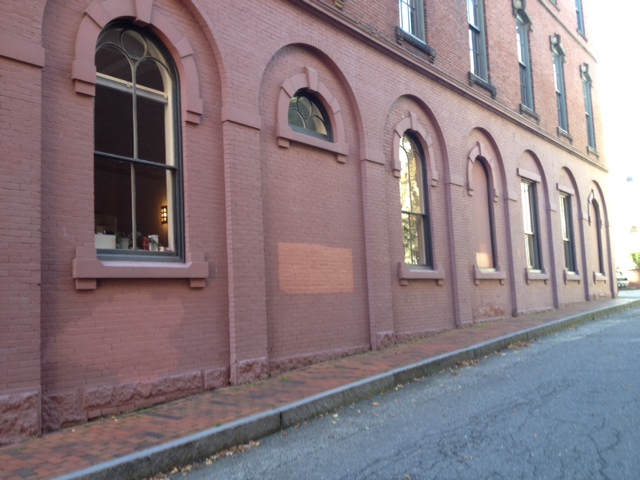
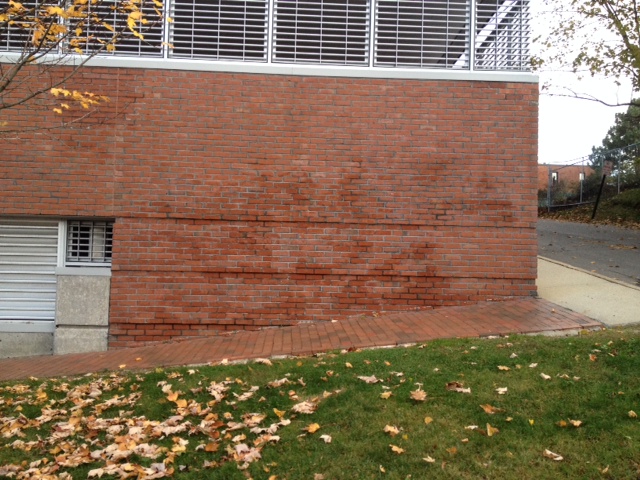
Saturday afternoon, brisk sun. We embark on a tireless adventure of trekking through Portland. We “derive” without even realizing it, letting our conversations and instincts guide us through the entire peninsula as we searched for graffiti. I notice, however, that as we dig our ways through the back streets and barren Scandinavian-style architecture of Bayside, that there is nearly no graffiti. As we found ourselves further from places where we could easily identify that we were in Portland, we thought that we could have been just about anywhere. It was quite bleak, and the tags we did find were confined to the backs of crosswalk lights and signs. All were mere outlines of graffiti, quite inconspicuous and diminished in presence. I wondered whether this fact says anything about Portland’s identity — whether it is nebulous, minimal due in part to lack of racial diversity, or in transition. We speak to a woman with her bike who curiously asks about my research, and she confirms that there is nearly no graffiti in Portland. In certain places I see where larger graffiti has been painted over with brick-colored paint, or walls with mottled scars where it has been scrubbed off.
We continue our walk. Approaching the West End, the landscape transforms. We confront a pocket of strip mall, fast food joints, and ethnic markets. Here I find perhaps the best “graffiti” in Portland: an undersea mural across the walls of the Dogfish Cafe. It had the clash of three dimensional graffiti fonts, a crab against tendrils of kelp, and an unidentifiable sea creature against a gradient of blues and drowned clouds.
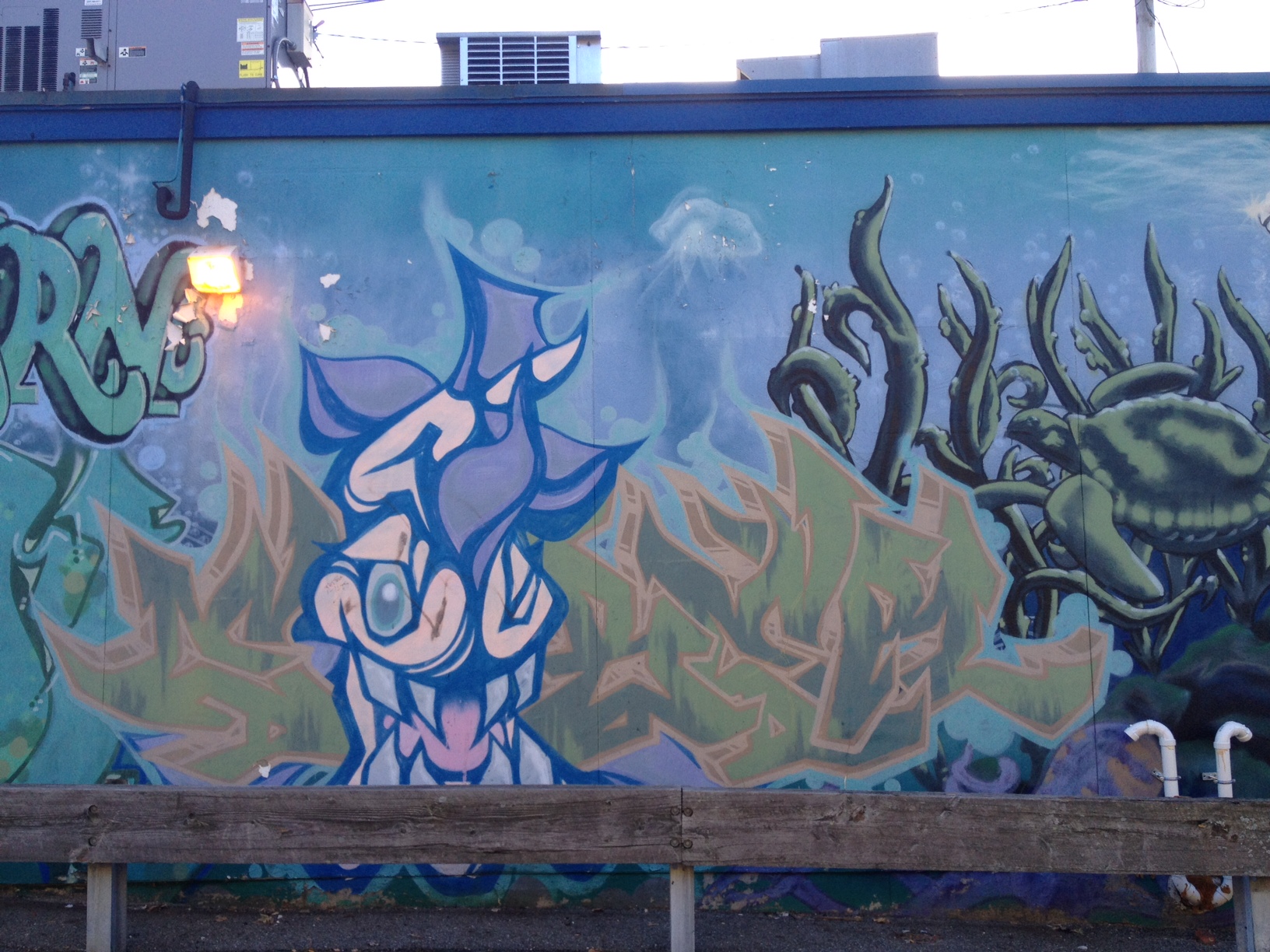
This was such a rarity that I thought it was imported.
We head up the hill back around to Congress Street, the new arts district that had encroached on one of my mappers’ (Tom; Map #2) fond memories of the street ten years ago, when Strange Maine had just opened. Congress had been lined with pawn and junk shops, and places like Paul’s convenient store and Joe’s smoke shop. Ten years later, my eyes are meeting beautiful examples of graffiti, the kind better defined as street art. There is a red, distorted “Nosh” dripping with blue splayed against the black facade of NOSH restaurant. Where Congress and High streets intersect, there is a curved wall of plywood with maze-like clouds, black “windows” looking into an sunset, and a crab battling a transformer atop a burning city.
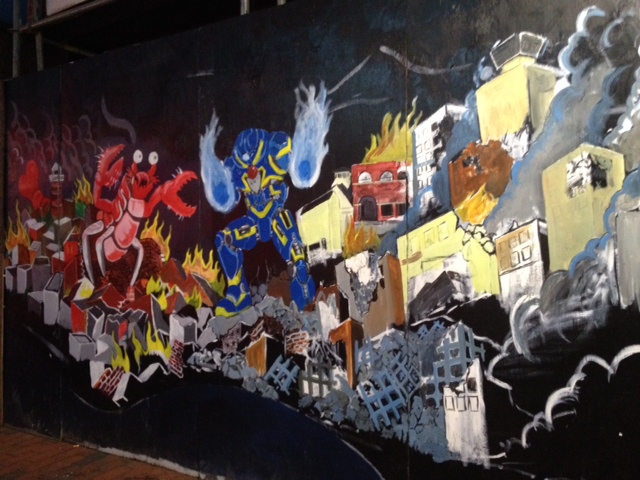
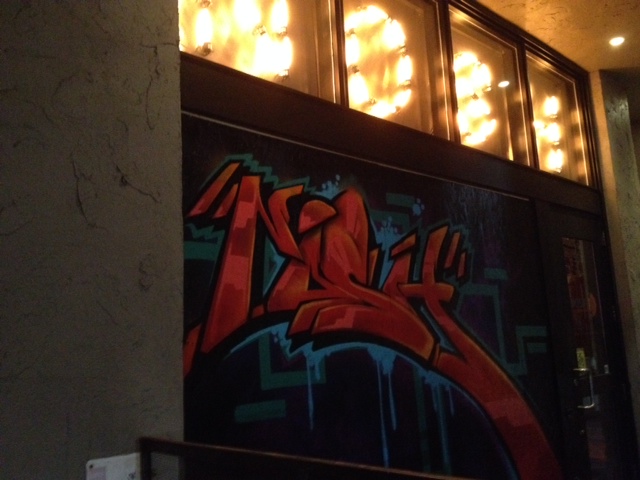

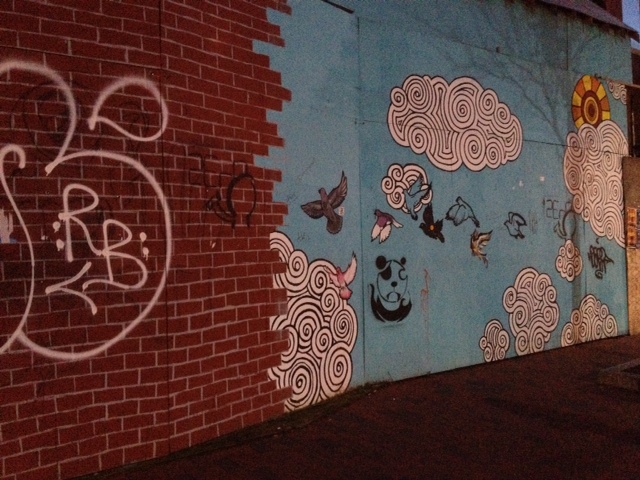
Perhaps this is why none of it was removed; it gives Congress vibrancy. In all the places where I found minimal graffiti, it had been removed because it must have detracted from the image of the neighborhood. An already run-down looking gas station does not need graffiti to further depreciate or strengthen its image. Here is Lynch’s idea of imageability. Assuming that graffiti is the product of an urge to express, and having found evidence of Portland’s attempts to erase tags, the illegible signatures are sliced off the end of the spectrum (among the ranks of careless tagging and vandalism) of what can be considered graffiti to push Portland’s image to the more “refined” end. Hailing from the suburbs of Philadelphia, I know that graffiti may be considered street art, but street art is not graffiti. Original graffiti is saturated with the punk DIY attitude, a rebellion carried out by unschooled artists against blank walls to establish an invasion of their presence. Portland is too small for pockets of these rebels to be visible. If the visible art mostly exists behind the glossy windows of MECA and within the numerous galleries, I would say that there is a noticeable polarization in Portland in terms of what visible art gets to stay and what is erased.
Who gets to decide what graffiti counts as art and what does not? The people with the brick-colored paint.
Who do they think they are? Portland’s image purification and editing team.
Who are the creators of the graffiti that was erased?
Based on definition, public art is a reflection of those whose expression gets sanctioned, and graffiti is very much a reflection of those who does not get sanctioned. Though I could suggest that the city of Portland could use more aesthetic vibrance beyond the “bougie” areas, I think I would rather recommend Portland to find a way to attract more cultural diversity to Portland. Seeing how small this city is, in the next decade the outfluxes of people like Tom who have been “classed” out will leave Portland distilled with a narrow socioeconomic identity, to which Portland already seems en route.
When I asked Tom about his favorite towns in Maine, he noted Saco as one of them, where there is a significant Somalian community. This is a change he likes. I think Portland must also diversify its definition of culture. There is culture tied to money, and there is culture steeped in tradition. With this goal in mind, I would like to see an expansion of schools such as Portland High School, which boasts students from 41 countries speaking 26 different languages. If any public art project is conducted, it should be by the diverse students at this school. Their creations could even be a force of attraction for drawing even more diversity into Portland. In addition, if the city could also make an effort to create an area of the city in which a more “down to earth” arts culture can flourish, where people do not feel threatened by an elite, bourgeois vision of culture, and provide incentives for a diverse set of people to move there, the identity of Portland could expand instead of becoming polarized.
I was inspired by this post – I too am a big believer that Portland needs more public art. During my visits to Portland, I noted just how many buildings are blank canvases, ready to be painted into masterpieces. I would love to see some public mural projects become engage the community. I remember when I was in elementary school, a group of about twenty students had the opportunity to paint the floor of a wading pool. It was such a great activity for all of us to spend a day working on. We were able to transform a drab, grey concrete surface into a vision of the ocean and all its creatures in just one day. The painting still remains. Wall art does not necessarily have to be confined to what is traditionally thought of as “graffiti”, because not everyone likes that aesthetic. It can take on any kind of aesthetic, suited to what the local residents prefer.
I am very interested to see how your map of the transect walk turns out. It seems like there were pretty strict borders between areas with graffiti, street art, or without, and I wonder what this distinction says about these neighborhoods. I thought it was interesting that Bayside had very little graffiti, but Congress Street and the West End had noticeable amounts. If my memory is correct, Bayside is lower income than Congress St and the West End, so this follows a trend opposite of what would typically be assumed. I wonder if this has to do at all with a “broken window theory” mentality — where vandalism attracts crime, and repairing damages is a way to prevent crime. On the other hand, places like Nosh, with its $15 sandwiches, likes to suggest a grittier vibe while appealing to the higher classes.
Annie,
I am glad that you found examples of such vibrant and creative street art that were not covered up. I think the fact that a few of these murals have been left uncovered speaks well for Portland, especially in terms of Lynch’s imageability. It seems like this is the start of the “down to earth” arts community you would like to see. Where do you want that community to be, Annie? I think that people like you, who care about seeing Portland change aesthetically, are the start of this movement; street art is a constant struggle between those who put images over brick and those who paint bricks over images, and the people who stand up for street art are, it seems, the ones who will define where the “down to earth” arts community can be found and what it will look like.
Eva
Grafitti and public art occupy such a central part in the personality of the city, I am glad you looked into this in Portland. It is interesting that there are extremely strict borders between areas where graffiti is accepted and areas where it is like vandalism and painted over. Why do areas like Bayside paint over graffiti when everyone can still tell that there used to be graffiti in that place? There is no perfect match for the brick color so instead of making this area look nicer, it has a vibe of temporary bandaids not permanent fixability. In areas where graffiti is left alone, there are beautiful murals which reflect a sort of community in Portland. The murals along Congress Street give this area of Portland a personality which would be lacking much vibrancy without the street art. It amazes me how segmented graffiti/public art is throughout Portland.
This is a really interesting facet of Portland to focus on. As I was walking around the East side, I too realized that much of the graffiti was confined to small street signs at intersections. However, there was this one (more famous) graffiti (public art?) spot on Free Street. The entire wall is vibrantly painted to read “Greetings from Portland, Maine”. Yet this spot seems to be celebrated throughout the city rather than painted over and condemned–what exactly constitutes this as public art rather than graffiti? Does it have to do with the location? Or the message?
Additionally, when I spoke with Professor Gieseking, she mentioned that there was a great graffiti spot along the Eastern Promenade Trail near the water treatment plant. If you plan to further explore the graffiti culture, maybe this would be cool to check out.