
The data I collected during my transect walks reflects the sustainable aspects of Munjoy Hill and Deering Oaks Park. I paid attention to gardens, composting bins, recycle bins, trash bins, and solar panels (along with some other observations). Though, it was interesting to see that a few buildings actually did have solar panels, overall there were not many “green” indicators throughout Munjoy Hill. In fact, I did not see one recycle bin anywhere in Portland!
When I interviewed for mental maps, the barista at Coffee By Design mentioned Portland’s composting system and while I was visiting a bakery, there was publicity for the composting system as well. However, it was challenging to note which houses actually recycled or composted since I walked around on a Sunday and both are collected on Tuesdays. It would be interesting to see how many people actually compost since my data does not accurately reflect the people.
While walking, I passed one park (Fort Sumner Park), which was overgrown and not particularly cared for. It was hidden in a residential area, but had a GREAT view of the city (see picture below)! The bottom half of the park did not have much, but once walking up the staircase, there were four benches overlooking the city. Another noteworthy green space I saw was the East Promenade, which is one large park along the shore of the eastern side of Portland. It did a good job of providing enough seats for visitors, the history of the area (such as at the Fort Allen Rehabilitation Park ), and attractions that appeal to a wide range of people. There was a playground, a baseball field, picnic tables and benches, and spaces to walk along near the shoreline.

Fort Sumner Park on Sheridan (Taken by Jenny Ibsen)

The View from Fort Sumner Park (Taken by Jenny Ibsen)
When I walked around on my second visit, I went to Deering Oaks Park, which had an interesting use of space because there was a large central fountain and pond, yet there was no seating around it.
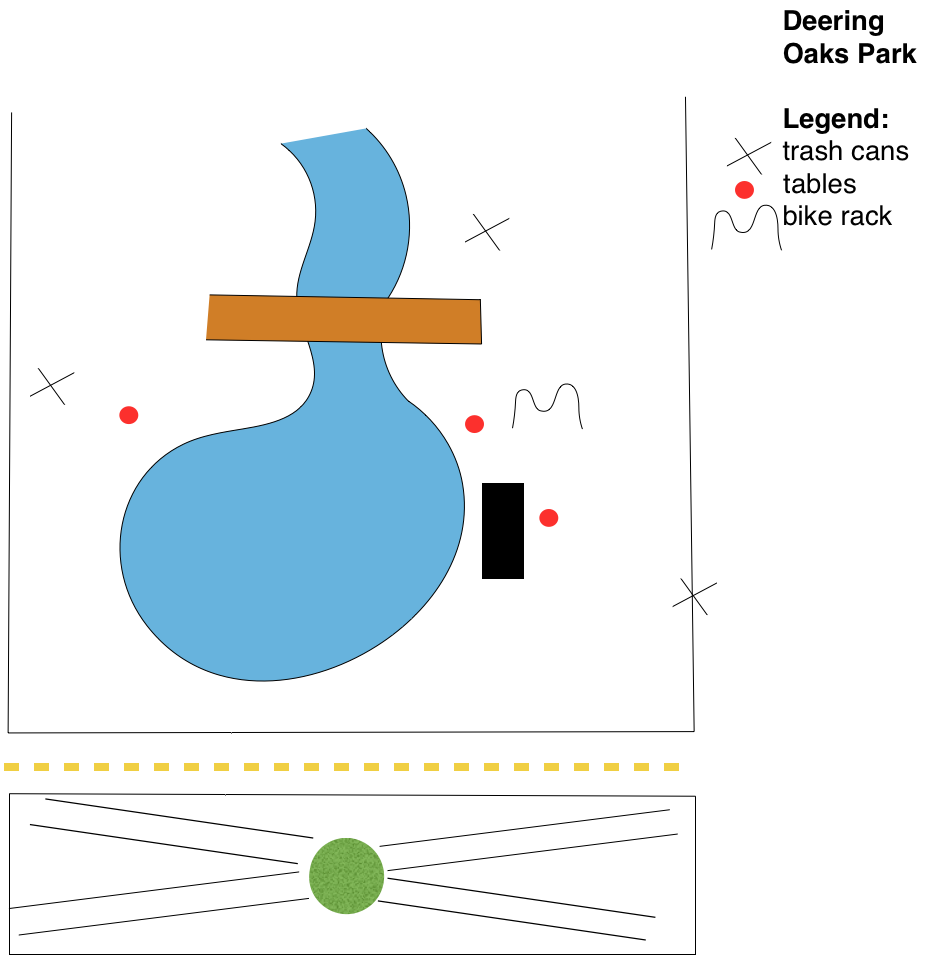
Deering Oaks Park Map (Drawn by Jenny Ibsen) – My extremely rough sketch of the park, including all the trash cans and picnic tables that I saw during my 30 minutes there. The black rectangle is a stage and the green circle is a plot of plants.
The park had several awkwardly spaced benches in an abundance of purposely uncared for grass. There was a sign posted nearby stating, “Sections are purposely left unmowed in order to return to a more natural and healthy woodland.” This was extremely interesting because though naturally maintained gardens are more sustainable, I have never actually seen this in practice. This could be more effective in the park if there were more attractive aspects to the park. There were not enough seating options to attract a large amount of people, and aside from the stage, there were not many other reasons for people to visit the park in general. This, in addition to the uncared for grass, gave the park an overall average feel (though, it did look nicer than other parks in Portland).
Overall, Portland has a few impressive aspects of green technology, but could use some work for the basic framework of the city. There were solar panels a few buildings and there were plans for them on a newly constructed building. I was also surprised by the abundance of Hybrid cars, mopeds, and Partial Zero Emission Vehicles (PZEV). Yet, the city definitely needs to work on its public green spaces and frequency of recycling bins.
Transect Walk
Started: Eastern Promenade (10/19/14)
- Lots of plants at houses
- Garden (corner of E. Promenade and Turner)
- Hybrid car—236 E. Prom, corner of Quebec and E. Prom, 304 E. Prom, corner of Melbourne and E. Prom
- I don’t know why I kept track of this—they just seemed really abundant
- Solar compacting trash – 288 Eastern Promenade
Walked to Walnut, then Willis
- Hybrid—23 Willis
Montreal St
- Corner of Willis and Montreal—first graffiti sign
- Garden: 41 Montreal, 46 Montreal
North St
- Newly developed houses
- Multiple family buildings (condos)
- School located at 129 North St
Walnut, Sheridan
- Green Clean building (local company?) —179 Sheridan
- Organic waste container (curb to garden program)
- Hybrid car
- Area feels empty
- Developing? House under construction across the street
- Solar panels on picture
- Graffiti and overgrown garden
- Fort Sumner Park (hidden view of Portland)
- 107 Sheridan – laundry line in backyard
- 106 Sheridan – recycling bin outside house
- 99 Sheridan – Moped
Cumberland
- 62 Cumberland – solar panels on roof
Sheridan, Congress
- 159 Congress – garden
- 127 Congress – partial 0 emission Subaru
St. Lawrence, Monument
- many front yard gardens
- 53 Monument – garden
Waterville, Sherbrook, St. Lawrence
- garden – 70 Waterville
- recycling bin – 72 St. Lawrence
- Moped – 61, 52 St. Lawrence
Fore St, Eastern Promenade
- Many decks on first and second floors of houses
- Large windows
O’Brien
- 4 O’Brien – organic waste, kWh usage outside house, recycle bin
Eastern Promenade
- 64 E. Promenade –recycle bin
- Fort Allen Rehabilitation Project
- Bollard lighting (instead of over head street lamps)
- Solar compacting trash (no recycling)
- 64, 84 (around corner) E. Promenade
- empty green space
- recycling bin—168 E. Promenade
- roads close to shore, green grass, randomly placed benches facing water
- few trash cans, but no litter??
- Solar compacting trash
- corner of E. Promenade and Congress, Turner and E. Promenade
- First water fountain!! (corner of E. Promenade and Congress)
- Playground (few trash bins where expected (around edges of playground area)
- Many houses have roof windows or natural lighting
- Corner of Congress and E. Promenade
- 222 E. Promenade – garden
Other places (drive back to 295)
- Solar panels — Washington and Cumberland
- School and Solar panels, community garden (North St)
- Pick up to 295 – solar powered signs
Deering Oaks Park (10/21/14)
- No seating near fountain/pond
- Benches along paths and borders
- Only saw 3 trash cans
- Some lampposts located near paths
- Trees near bridges are abundant
- Grass is naturally kept
- What is under the bridge?? Looks like it should be the pond but actually dried up… L
- Stairs leading down to the pond on northern side of bridge
- Park continues across street…no benches, no trash
- Outside park: some houses, commercial, industrial area, near highway
**Added November 3, 2014:

Transect Walk: Above is a map of my transect walk (the red point mark indicates my start and stop location).
I find it frustrating that so many municipalities, including Portland, do not have sidewalk recycling bins. Households have recycling pick up, so obviously the infrastructure for shipping recyclables for processing exists, it is simply a matter of public collection. So, what is holding Portland back from installing public recycling bins? Does the City deem such a system to be too costly?
I am also curious as to the potential for establishing composting sites. I know one family that lives in Portland in an apartment and would like to compost (as they composted at their previous Harpswell home), but the only viable option they have is to pay a composting company to come and pick up their compostable waste every week. Since they do not want to pay this company, all of their compostable waste ends up in landfill. I wonder if there is space to set up a composting site where people could bring their compostable waste and then would be entitled to pick up a certain amount of soil created by the composted waste according to their input contribution. This program would operate as a co-op of sorts.
Jenny,
It seems like a common theme of your research is Portland’s connectivity within the city. Public transport, sustainable municipal waste cleanup, water fountains—all of these things create a network of infrastructure that help the city to function well for the good of all. Not to harp on about signage (I like signage, we get it) but I think that good signage is a hugely important intersection of infrastructure and public space. Your observation and feeling about Deering Oaks Park feeling decrepit was offset by some interest you felt at the “natural mowing” initiative. Without signs, the park just looks unkempt and forgotten. With signs, the public considers things they might have taken totally for granted—that somebody mows the lawn every week, that the grass is part of a larger ecological system, that animals live in the park, too. Also, this kind of education through signage not only makes a difference today, it educates the public for future developments. Someone might even suggest his or her own
innovative alternative to lawn mowing.
Eva
The lack of recycling bins is a very important observation that would make an interesting study. Maine has single sort recycling, why would they not encourage use of it? Especially considering they even have facilities for household compost, it would be assumed that they would be extra conscious of providing amenities that encourage use of the existing infrastructure.
I am excited to see how your map turns out, and whether there is a correlation between the socio-economic climate of a neighborhood and its tendency to support green initiatives like hybrid cars and solar panels. “Green” lifestyles have their own link to conspicuous consumption.
I am glad you noted seating along your walk, and that the East Promenade had good seating. We saw few examples of good seating along our walk in the west.
Observations around recycling and trash bins throughout Portland I find extremely interesting because of the implications it has for the image and health of the city. If there are very few trash bins, there will be a higher chance of littering and dirtying the city than if there were plenty of trash cans. We noticed a severe lack of trash bins on our walk through the West End. I was shocked by the low numbers of trash bins located on the Western Promenade especially. Trash cans are a necessity and not something that you think of until you need one.
Recycling seems to be a trend that is lacking in Portland, which makes little sense to me. With zero-sort recycling it seems to be the easiest type of recycling to implement. I understand the cost of picking up recycling, however it seems silly that households can recycle but the city cannot. This definitely should be a priority throughout Portland, especially due to the wide range of implications recycling has on the health of the environment.
I wonder if the pond in Deering Oaks Park was purposely left without seating. It seems that if they are electing to restore that natural woodland, they might want to reduce traffic closer to the pond to decrease human impact on certain plant species. I mean, I could not imagine maintaining a park and forgetting to put benches by the pond, so there must be a reason. Could it be that they wanted to keep homeless people from sleeping in the park? The current state of the park makes it seem like it was designed as a place to pass through instead of dwell in.